
🏛️ Armenia in one day: Garni, Symphony of stones, Geghard
Armenia is attractive due to its affordable prices, wonderful weather, diverse landscapes, hospitable people, and also an amazing concentration of attractions in a small area. Even without going far from Yerevan, you can collect a unique portfolio of ancient monuments, from fortresses to temples. But not all attractions in this guide will be man-made. Nature also knows how to create beauty. Intrigued? Then we’ll go to the most monument-rich 10 kilometers of Armenian land!
Where are we going and how to get there
Our path lies in the Kotai region – the only region of Armenia that does not have access to the state border. I believe you have already realized that we are going to the very center of the country, which is very close to Yerevan. From the capital to Garni, the first point on our route, it is only 26 kilometers. Then we “rush” to a unique natural place called the Symphony of Stones, and from there to the Geghard Monastery.
Public transport
The Garni complex can be reached by public transport. But in exchange for savings, you have to spend time studying the capital’s logistics. Buses and minibuses to Garni depart from the Gai bus station. But this bus station is very conventional: there is neither a building nor any special sign. It would be a good idea to check with locals exactly where the bus stops. The landmark is the Mercedes Benz car dealership.
Having finished the challenge of finding a stop, we wait for bus No. 284 or minibus No. 266. And then we wait until the transport is filled with people. Not very convenient, would you agree? The fact that commuter buses look like museum exhibits doesn’t add to the comfort either. The ancient yellow buses, which have long disappeared in many countries, still continue to serve regularly here.
Despite their venerable age, these buses are still the main means of transportation for local residents. They connect remote villages and towns with the city, allowing people to get to work, school or other errands. Although traveling on such a bus may not seem very comfortable for tourists accustomed to modern vehicles, for locals it is a familiar part of everyday life.
However, the authorities are gradually working to update the bus fleet. In recent years, newer and more convenient models have begun to appear on routes, providing passengers with greater comfort and safety. It is expected that over time the ancient buses will completely give way to modern ones, but for now they remain a kind of attraction and a reminder of the past.
Despite all the disadvantages, traveling on such a bus can be an interesting experience for the traveler, allowing you to immerse yourself deeper into local life and culture. The main thing is to be patient and be prepared for a leisurely pace of travel.
The cost of a ticket to Garni is 1000 drams ($2.5). Warn the driver in advance to stop the bus at the turn to Garni Temple. From there you will have to walk another five minutes to the entrance to the complex.
Moving from Garni to Geghard is becoming more difficult. There is no direct bus service between them. You need to catch bus number 284 to get to the village of Gokht. From there to the monastery there are another four kilometers. You'll either have to go hiking or call a taxi.
Taxi
As you already understand, the option of public transport in Garni and Geghard is possible, but extremely time-consuming. You will become a hostage to luck and the stuffy interior of a retro bus. I advise you to use a taxi, which is quite modest in cost.
The price depends on the season, time and your charm, which does not apply to calls through services (Yandex Taxi and GG Taxi, popular in Armenia). On average, a taxi to Garni costs 8,000 – 10,000 drams ($20-25). Local taxi drivers will take you from Garni to Geghard and back, waiting in abundance for tourists at the entrance to the ancient temple. This trip rarely exceeds 3000-4000 drams ($7-10).
Organized tours
Advice for traveling in groups. The cheapest and most convenient option is to purchase a tour, which is more like an individual transfer. They will take you, wait, tell you and return you back to Yerevan directly to your place of residence. Pay for the car regardless of the number of passengers. Such a personal taxi costs around 20,000 – 27,000 drams ($50-75) per car. Agree that when traveling with a family or a group of 2-4 people, it comes out very budget-friendly. You can book such a tour, for example, on the Explore Armenia website.
Car rent
Armenians, accustomed to tourists, have also developed a car rental business. If you are not afraid of the crazy Caucasian traffic (and you should be), then you can rent a car and drive around the expanses of the republic. And you won’t have to deny yourself visiting any attractions.
In a search engine you will come across a large number of car rental offers. One of the cheapest operators is Local rent. Transport for a calendar day will cost approximately 17,000 drams ($45).
Before the upcoming busy trip, I advise you to get food and water. There will be practically no shops along the road. And stall traders, greedy for tourists, raise prices exorbitantly.
Palace complex Garni
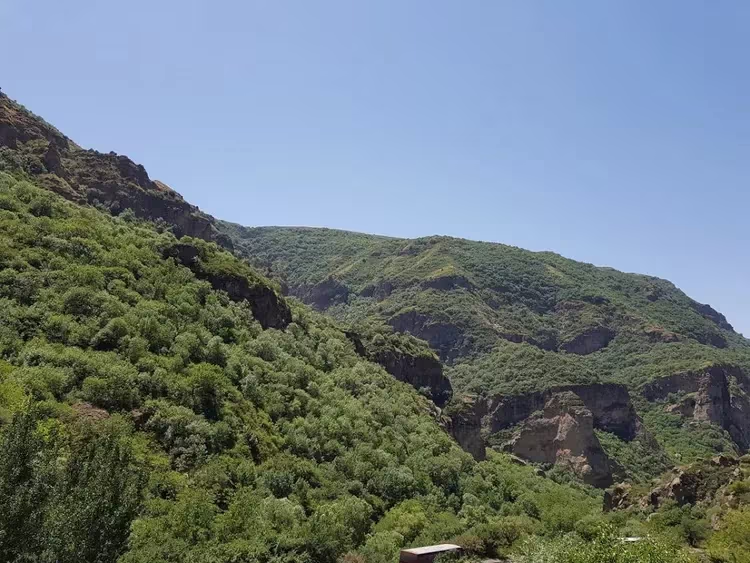
The first point on our route is the Garni palace complex. Despite the fact that only the temple is remembered, Garni includes more than just that.
But first, a life hack. A visit to the complex is paid – 1200 drams ($3). However, if you go around the complex on the left, you can easily sneak into it as a hare – the territory is not completely fenced.
Plan your visit carefully: even in high season , the complex is not open on Mondays (a common feature of Armenian museums). Opening hours on other days are from 09:00 to 22:00 (Sunday until 15:30) from May to November, from 09:00 to 17:30 in other months.
Due to its favorable location, the Garni palace complex was the favorite residence of the Armenian kings. Who felt completely safe here. Over the course of many centuries, the fortress was truly made impregnable. In the 8th century BC, for the first and almost last time in history, it was conquered by the legendary king of Urartu Argishti I, the founder of Yerevan.
The mighty fortress wall of the citadel included 14 towers and 7-meter walls, which are still preserved in some places. But the main obstacle for the besiegers was the terrain. Gorges and hills, try to get close.
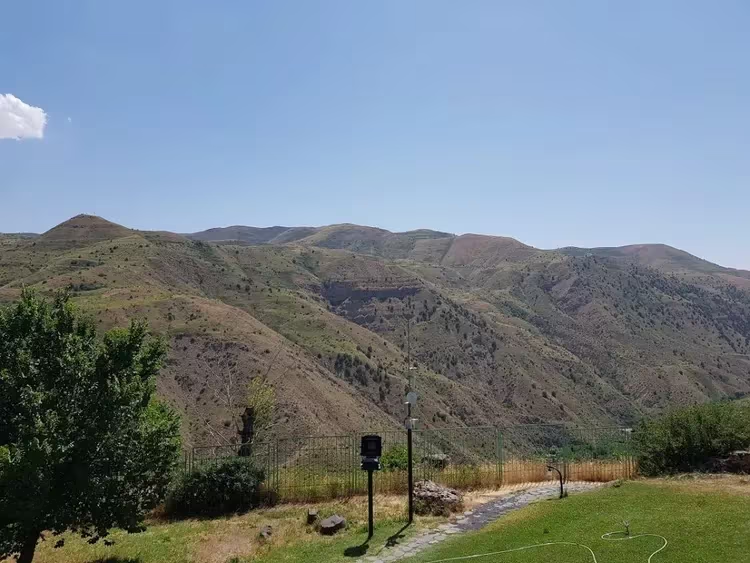
Now these natural barriers delight the eyes of tourists. We have a beautiful panorama of the surrounding hills. Armenia enchants with its unevenness.
- Reach Ararat: going to Khor Virap
- Guide to Turin: what will surprise the first capital of Italy?
- The modest capital of a proud country: a guide to Yerevan
Garni Temple
The Garni Temple is the only surviving pagan complex in the region. In exclusively Christian Armenia, the Garni temple looks like an alien from another planet. And the point is not only in the alien religion, but also in the alien architecture. The building is painfully reminiscent of the Greek Parthenon on a reduced scale.
Antique flashbacks are quite appropriate. The temple was actually built during the Hellenistic period, a period of strong Greek cultural influence on the Mediterranean states. The fashion for Greek was also passed on to the Armenian king Trdat. In 77, on his orders, this majestic temple was built.
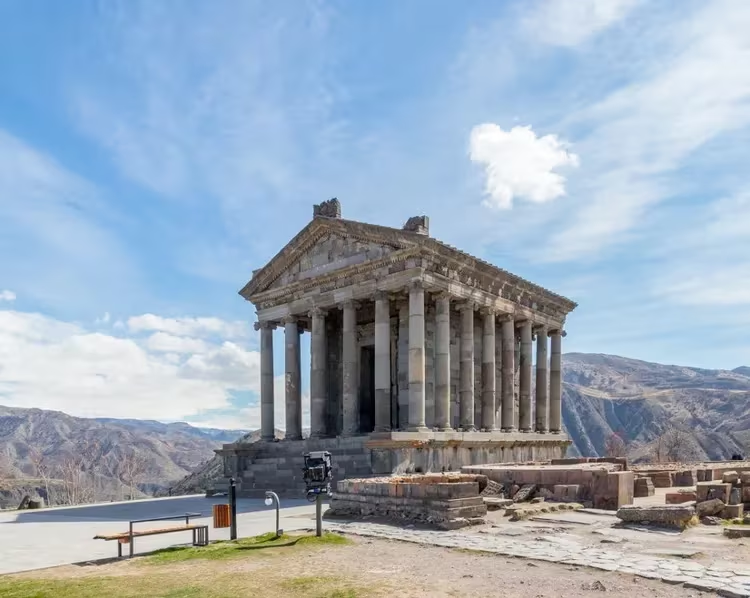
The composition of the temple is full of symbolism. Only an unprepared tourist sees high steps and beautiful columns in it. Nine steps of 30 centimeters in height stretch across the entire width of the temple façade. It's difficult to climb, isn't it?
Not everything is so simple with columns. There are 24 of them – according to the number of hours in a day. The builders decorated all the columns (pylons) with images of Atlanteans. And even these mightiest of people bowed before the deity, holding altars in their hands.
Who is this legendary owner of the temple? Scientists are inclined to believe that the temple is dedicated to the god Mithras. Mithra is the local equivalent of Helios, the sun deity.
We’ll have to interrupt your admiration for the “gray old times” a little. The building facing us, alas, is only 50 years old. The original temple was completely destroyed by the 1679 earthquake and restored during Soviet times.
Symphony of stones
One of the most unusual places I have ever visited. The magic of nature. The finest stone carvings made by the Creator. What epithets come to mind when visiting this place? The people who gave it its name, apparently, just like me, were fascinated by the spectacle that opened up: Symphony of stones, what could be more poetic? Perhaps the Basalt Organ, as this attraction is sometimes called.
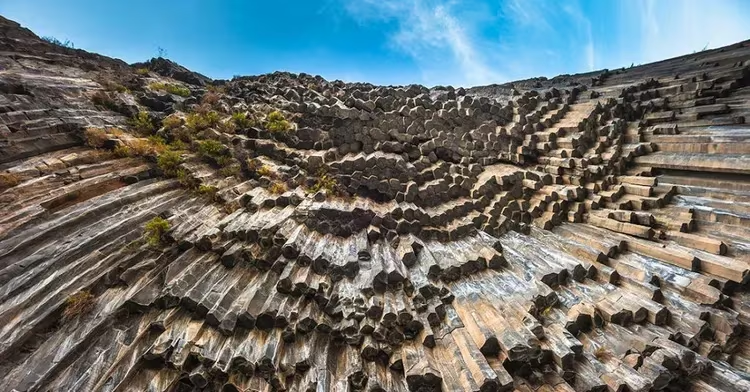
Whatever you call it, there is only one way there. After leaving the Garni complex, turn right onto the path. One kilometer of an easy path – and you are at your goal. By the way, don’t give in to taxi drivers’ persuasion to take you for a ride. The road is really convenient and doesn't cost $5 for a taxi driver.
Another life hack, this time for security. Be careful both on the path and especially near the basalt organ itself. The area is rife with snakes. So try not to walk in grassy areas or watch your step carefully.
As for the Symphony of Stones, the first question is: how did such a miracle become possible? The rocks are composed of basaltic material, a volcanic rock that is the result of Earth's turbulent past. During the youth of our planet, the magma that poured out of the volcano froze, split under external influence into hexagonal columns and formed this semblance of an organ. The regular shapes of the columns make it difficult to believe that this is not a product of human activity, but a natural design, extending 50 meters in height.
Geghard
Last, but only along the route, and not in importance, is the Geghard monastery. You remember how reverently Armenians treat the Christian religion? The title of the very first country in the world to adopt Christianity is obligatory. We talked about the features and legends of baptism in Armenia in the guide to Khor Virap.
And here before us is one of the most revered Christian pearls of the country – the Geghard Monastery. It is a whole church complex, and even located in the middle of wonderful natural views.
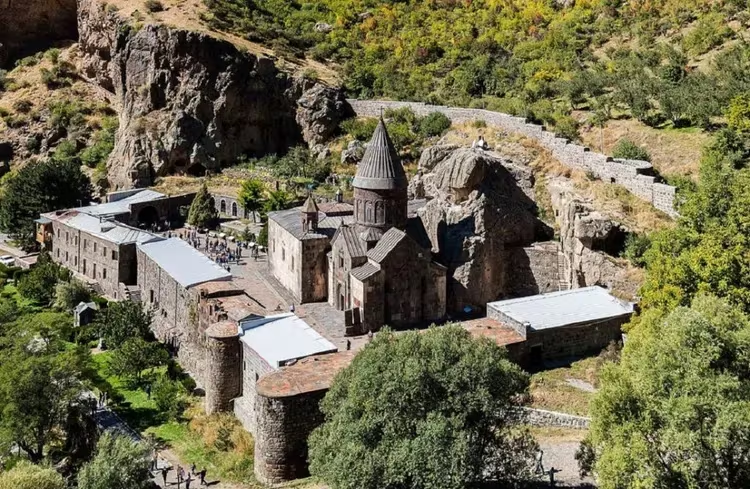
Upon arrival in Geghard, the first thing you will see is not religious buildings, but sellers of souvenirs, sweets and pastries right at the entrance to the monastery. Don't go shopping right away. Prices here are several times higher than in Yerevan at the market and in stores. Postpone purchasing souvenirs and favorite sweets until you return to the capital.
The first buildings on the site of the present Gerard appeared in the 4th century. According to legend, they owe their appearance to the most revered saint among the Armenians – Gregory the Illuminator. The monastery was founded on the site of a sacred spring originating in a cave. Hence the ancient name of Gerard – Ayrivank (“cave monastery”).
Some of the buildings of the complex justify their historical name in their entire appearance. They were actually carved out of rock cliffs. Moreover, on the steep cliffs you can see small monastic cells. Throughout history, monks in search of peace retired there and were distant even from their fellow believers. They were given food and water, but that was the extent of their contacts with the outside world. Half the time I spent in Geghard, I was occupied with the question of how they got into these “swallow’s nests”?
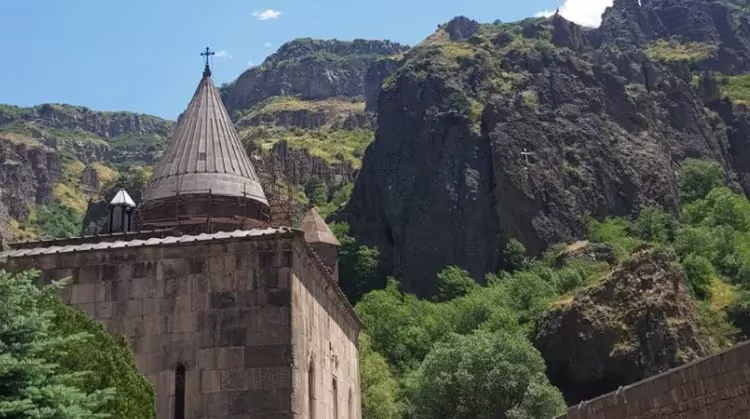
Having no chance of getting a comprehensive answer, I recommend going to study church buildings. Most of them date back to the 13th century.
The buildings of the church complex are so diverse, authentic and exotic to our idea of Christianity that I recommend not skimping on the guide. Only he will be able to explain to you what is special about the katoghike (main church), why the complex has a semi-civil room called gavit, and what the numerous ornaments and paintings on the walls of the monastery mean.
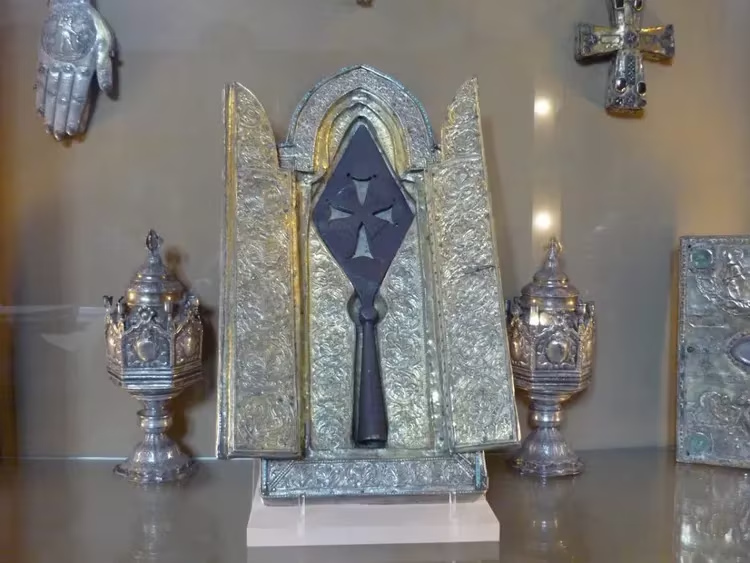
But the main thing that makes Geghard the object of increased attention among tourists and the all-consuming love of locals is the relic that was once kept within the walls of the monastery. We are talking about one of the main Christian artifacts – the spear of fate (spear of Longinus). The Roman legionnaire Longinus used this spear to pierce the crucified Jesus Christ.
Several relics in different parts of the world lay claim to the title of Spear of Destiny. Armenians believe that their artifact is authentic. Now, however, it is kept not in Geghard, but in the Etchmiadzin Monastery.
The Armenian land is rich in secrets. As you can see, just one day in this unique country provided an opportunity to touch the most intimate of them.