
🇦🇲 Yerevan: a complete guide to the capital of Armenia
Remembering the most hospitable and generous people who came across on the path of life, I remember the representatives of Armenia. Armenians have hospitality in their genes. This is part of the mentality and an obligatory component of education. And what tourist wouldn’t be pleased with this?
But you won’t feel like a tourist in Armenia for a long time. You are simply doomed to assume the status of a guest after a few days. And if you’re lucky, then a loved one who has returned to his father’s house after a long absence. This is all Armenians. Difficult living conditions did not harden them, no. They made them even more open. Everything is here for the guest. And what is that all? Read in our guide.
How to get there
For many years, Armenia has been one of the most accessible travel destinations. You don't need a visa to go there. 3 hours in flight – and in front of you are enchanting views of majestic mountains.
Armenia attracts tourists with its rich history, ancient monasteries and temples, and stunning natural landscapes. The capital of the country, Yerevan, is known for its cozy atmosphere, colorful markets and delicious cuisine. Visitors can enjoy walks along picturesque streets, visit museums and galleries, and taste traditional dishes such as khash, dolma and khorovats.
Outside of Yerevan, travelers will find breathtaking mountain scenery, crystal clear lakes and ancient monasteries, many of which are listed as UNESCO World Heritage Sites. Among the most popular attractions are the Geghard monastery complex, Garni Temple and Lake Sevan.
Armenia is also famous for its hospitality and cordiality of local people, who are always ready to help tourists and share their culture and traditions. All this makes Armenia an attractive destination for travelers seeking authentic experiences and unforgettable memories.
Now the journey to Yerevan will take more than 4 hours. And give $500 when purchasing a round-trip ticket from the national air carrier Belavia.
From Georgia
It is quite possible that you have decided to make a Transcaucasian tour and unite Armenia with neighboring Georgia. In this case, your logistics are simplified. There are a large number of routes from Tbilisi to Yerevan and back, approx. They can be booked in advance, for example on the Armenian tourism website. Or you can actually catch it in the capitals of Georgia and Armenia. The main thing is to know where to look (the locals will tell you this).
The minibus takes you from one country to another in 5-6 hours. A ticket will cost $20-30. Contrary to stereotypical perception, what awaits you is not old GAZelles with sheep in the luggage compartment. And quite decent minibuses with air conditioning.
Local transport
The main airport is Zvartnots. It is very compact. From there it will not be difficult to get to the city. You can use bus number 201. But my advice, both in terms of traveling from the airport and in terms of all movements around the city, is to take a taxi. Believe me, you can afford it!
Armenia has the cheapest taxi I have ever seen anywhere. A trip to a neighboring city 80 kilometers from Yerevan cost 6,000 drams ($15). Traveling around the Armenian capital rarely cost more than $2-3. Having paid $250-500 for an air ticket, we can afford such a small thing, right?
If you still decide to experience the flavor of public transport, then you should remember a few rules. Transport stops at stops only if a passenger requests it. While waiting at a bus stop, also let the driver of the approaching bus know that you are his customer. Otherwise you will have to stand until late at night. Payment is made strictly upon exiting the vehicle through the front door.
The city has buses, trolleybuses, and metro. Almost no one uses the only branch of the latter. And that’s why it looks post-apocalyptic. The cost of tickets is pleasantly surprising – 100 drams (a quarter of a dollar).
General information about Armenia
If the common phrase “small but proud” suits anyone, it’s definitely Armenia. Despite a lot of domestic and foreign policy troubles, the Armenians are not discouraged. The present may not be happy, but the past is no different.
Armenians are very proud that they were the first country in the world to adopt Christianity as a state religion. This happened in 301. Even in the Roman Empire, Christianity was outlawed for another 12 years. In Armenia, this page of history is especially revered. They honor spiritually and materially. The churches of the Armenian Gregorian Church are unique places of worship. Something similar can only be found in neighboring Georgia.
A century later, in 405, the Armenians acquired their own alphabet, one of the oldest still existing in the world. It is very archaic, it has passed 1.5 thousand years with almost no changes. There are words here that consist of 35 letters and have the meaning of entire sentences!
Well, who doesn’t know the legendary Armenian bread, lavash. The recipe for flat unleavened flatbread has been around for 6 thousand years. Simple bread does not spoil for years. This saved many generations of Armenians from hunger in the worst times.
What to see in two days?
Yerevan is one of the oldest cities in the post-Soviet space. Under the name Erebuni, it was founded in 782 BC by the legendary king of Urartu Argishti I. This means that Yerevan-Erebuni appeared 29 years earlier than even the eternal city of Rome!
Today, almost nothing remains of the Erebuni fortress. But let's respect the founders and start our journey with her.
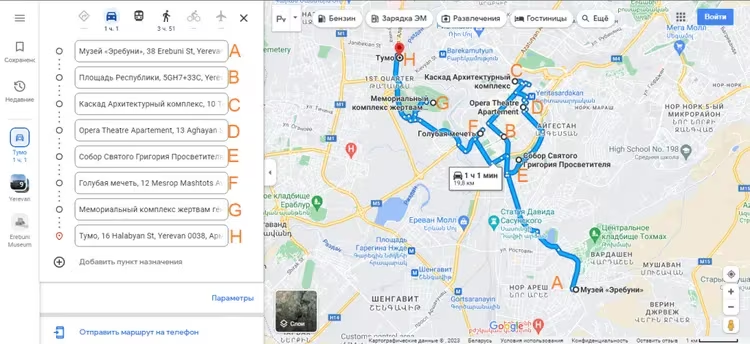
Erebuni Fortress
There is no doubt that antique lovers will appreciate this place. After all, Forbes magazine included Erebuni in the list of the nine most ancient fortresses in the world. Archaeological excavations are still ongoing on the Arin-Berd hill, which shelters the citadel. And there they found a unique cuneiform stele from the times of Argishti I himself.
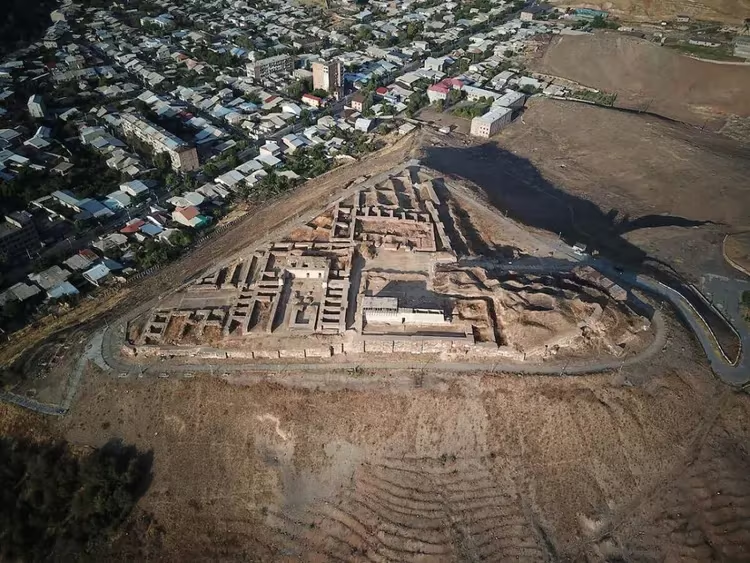
The fortress is only partially preserved today. Ruins 3-4 meters high remained from the 12-meter walls. Only from the words of the guide can you find out where the palace, the Susi temple and the dwellings of the nobility were located on a large area.
The fortress is part of the Erebuni Museum, open from Tuesday to Sunday. An adult ticket costs 1,500 drams ($4). Keep in mind that the fortress is 6 kilometers away from other attractions and the city center, so allow plenty of time for your visit.
Republic Square
Whatever I advise you, your acquaintance with the sights of the capital will most likely begin from this point – Republic Square. Many urban transport routes flock here. Guides also live here, offering trips throughout Armenia. Well, the fact that it is customary to set a meeting place here is needless to say.
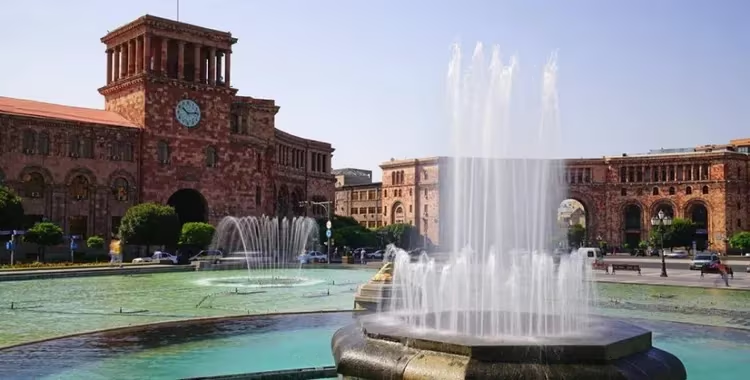
The ensemble of the square is called “the architectural heritage of Yerevan.” Built in 1928, it combines the usual Soviet monumentalism and national flavor (the columns and arches of the buildings are decorated with subtle ancient Armenian ornaments).
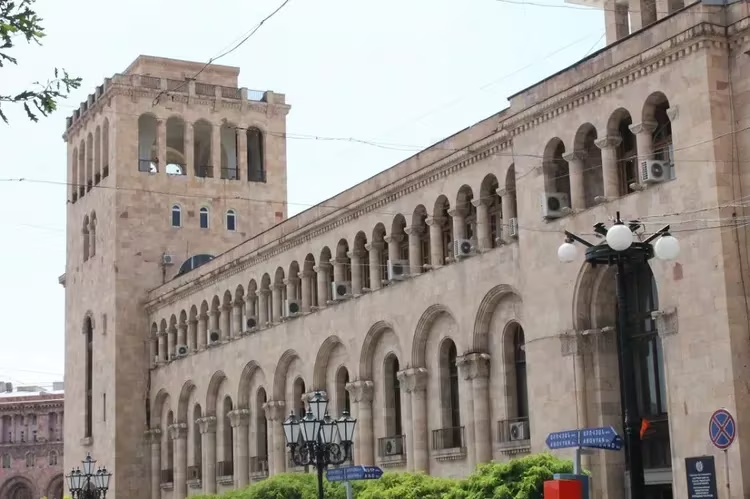
The composition of the square consists of five main buildings, incl. Government House with chimes and House of Ministries. The material used in the construction of the buildings is unusual. They were made of pink and white tuff, and the lower part of the buildings was made of basalt.
As you walk around the square, look at your feet. The laid out pattern, like many things on the square, carries a special meaning. It resembles another national treasure – the Armenian carpet. Now look at the fountains.
Singing Fountains
Have you looked? Recorded? Come back here in the evening!
Armenians know how to create a mood. Nightlife in Yerevan is generally much more active than daytime, which is affected by the hot weather.

And with the help of such locations, nightlife is also “driving”. The music and light show of the fountains will satisfy the most sophisticated people. Classical music gives way to rock hits from the depths of the 20th century. Before the zoomers have time to feel sad, the fountains indulge their tastes, dancing to the shocking Lady Gaga.
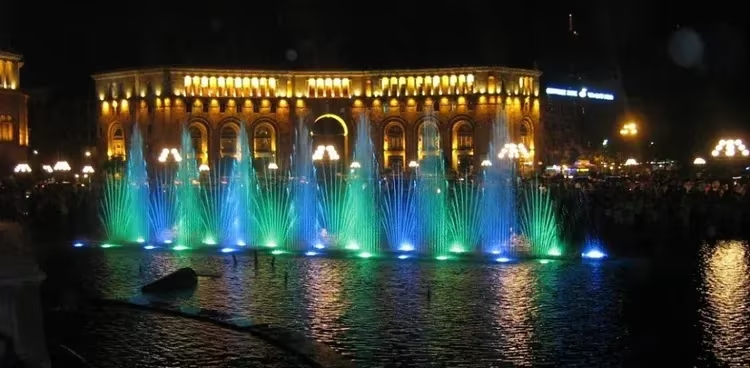
Yerevan Singing Fountains are the very first water-musical structure on the territory of the former USSR. Moreover, even before the advent of electronic innovations, fountains were “singing”. In Soviet times, a live orchestra performed here, accompanying the streams of water. And thanks to French engineers and 1.5 million euros, the fountains sparkled with new colors, in the literal sense of the word.
The fountain season is open from May to September. The mesmerizing show usually lasts 3 hours – from 20:00 to 23:00. Some guidebooks write that the show does not run on Mondays. I haven't been able to verify this, but I hope you have some luck.
- Cognac and more: the best options for unusual gifts from Armenia
- Family vacation: where to go with children?
- Lebanon – an oriental fairy tale against the backdrop of the fires of rebellion
Cascade
If you managed to tear yourself away from the wonderful fountains, welcome to another location that is a must-visit in the evening. And it's not just the hot daytime weather. But also in the views that open from it.
Do you remember from school about one of the wonders of the world, the Hanging Gardens of Babylon? It seems the Armenians decided to restore the lost relic. As you already understood from the name, the Cascade is a composition consisting of several platforms that rushes upward. Its 675 steps will lead to the most amazing view of the city that is possible in the Armenian capital. If such fitness scares you, then there is an escalator, although only up to 2/3 of the height. But it's better to walk this path. Moreover, you will want to stop on each platform to replenish your photo collection.
At the very top of the Cascade, a 50-meter obelisk “Revived Armenia” was installed. The vortex disks on the obelisk's pedestal, reminiscent of the arms of a spiral galaxy, suggest an attempt by the Armenians to establish a connection with space. But everything is a little simpler – this is arevakhach, the ancient Armenian sign of eternity. It represents the transition of life into death and vice versa.
Opera building
В самом центре Еревана, недалеко от площади Республики и Каскада, располагается здание Национального театра оперы и балета. Какой бы национальный колорит местные архитекторы не пытались придать зданию, но советский строительный конвейер штамповал сооружения по единым шаблонам.
И всё же архитектор Александр Таманян (он же спроектировал площадь Республики) предусмотрел изюминку в здании оперы. Таманян почитал многовековые традиции родного края и старался их интегрировать в свои сооружения. Итогом стал удачный симбиоз средневековой крепостной массивности с воздушными орнаментальными традициями.
Собор Святого Григория Просветителя
Как же так, спросите вы: первая страна, принявшая христианство, а в обзоре нет ни одной церкви. Исправляем!
Наш путь лежит ко второму по величине храму Закавказья, собору Святого Григория Просветителя. Неудивительно, что кафедральный храм Еревана назвали в честь самого почитаемого армянами святого. Святому Григорию Армения обязана распространением христианских взглядов на своей территории.
Кстати, запомните: армяне не православные и не католики. Они григорианцы. Официально именуемая “Армянская апостольская церковь” (в миру просто Григорианская) одна из древнейших в мире. Самая интересная её особенность состоит в том, что служения чаще всего проходят ночью.
Что же касается самого собора Святого Григория, то он очень молод. Окончание строительства собора приходится на начало 21 века. Храм выполнили в традиционных для армянской столицы песчаных цветах. Высота главного здания в комплексе достигает 54 метров. Но главное не внешний облик, а то что внутри. В соборе помещаются реликвии, связанные со Святым Григорием, собранные со всего мира.
Однако не архитектура и не внутреннее убранство впечатлили меня более всего в этой достопримечательности. А то, что в значительной степени ее построили за счёт средств меценатов. И, в первую очередь, семьи Алека Манукяна, бизнесмена из США, помнящего свои корни.
Голубая мечеть
Длительное пребывание Армении в составе Турции не могло не сказаться на архитектурном облике страны. Одна из виднейших достопримечательностей Еревана — это Голубая мечеть.
Мечеть совсем не большая по размеру и не чета, тем самым, своей стамбульской тёзке. Но, тем не менее, сооружение славно своим необычным узорчатым голубым куполом.
Построенной в 1766 году мечети несладко пришлось на исконно христианской земле. Из четырех минаретов уцелел только один. В советское время её сначала сделали музеем, а затем планетарием. Вернуть изначальный статус и отремонтировать в 1990-е годы помог Иран.
Цицернакаберд
Одним из самых мрачных, но оттого и обязательных к посещению мест является Цицернакаберд (в переводе “крепость ласточки”). Иностранцам он более известен под именем Мемориал в память о жертвах геноцида армян.
Christian Armenians, forcibly kept within the Ottoman Empire for several centuries, were a persecuted people even on their own land. And with the beginning of World War I, the Turks began to look at them as potential traitors. And they decided to reduce the Armenian population in their provinces. The victims were from 200 thousand to 2 million civilians, expelled and killed.
This atrocity, which still hinders cooperation between neighboring Armenia and Turkey, lies as a deep wound in the collective memory of the Armenian people. Any Armenian lowers his voice when talking about him. And for foreign politicians arriving in Yerevan, visiting the Genocide Memorial is an unspoken rule.
The central part of the complex is a 44-meter stele. From its foot to the top stretches a fault, personifying the divided Armenian people (most of them live not in Armenia, but abroad). The stele itself symbolizes the will to revive.
Next to the stele there is a truncated cone of 12 large stone slabs. According to popular belief, he represents the 12 provinces in which the massacre of Armenians took place.
The memorial, like most museums in Armenia, is closed on Mondays. On other days, guests are expected from 11 to 16:30. The entrance is free.
Tumo center
Armenians are innovators not only in the past. But also in the present. Their gift to the world was not limited to pita bread and the alphabet. Today this nation is demonstrating that it can create and develop the latest social technologies. Their personification is Tumo center.
Officially called the Tumo Center for Creative Technologies, it is a hub for post-secondary innovative education. On an area of 6 thousand m2, teenagers 12-18 years old are trained in animation, game development, web development and digital media. Additionally, they can choose subjects such as filmmaking, writing, graphic design, 3D modeling, robotics, new media, and storytelling. Sound like the school of the future?
In 2016, the French magazine We demain placed Tumo in first place in the ranking of the most innovative schools in the world. The success of the unique educational hub has leapt over the borders of modest Armenia. Similar Tumo centers opened in Berlin, Paris, Beirut and other cities, making Tumo one of the most coveted educational franchises in the world. Stop by to see it in person. And be careful with children – they may not want to leave the center!
It is very symbolic to finish a review of the sights of Yerevan on this educational giant. After all, today Armenia is not only about a rich and harsh past. But also about the future, which local residents are building with their own hands despite difficult circumstances.