
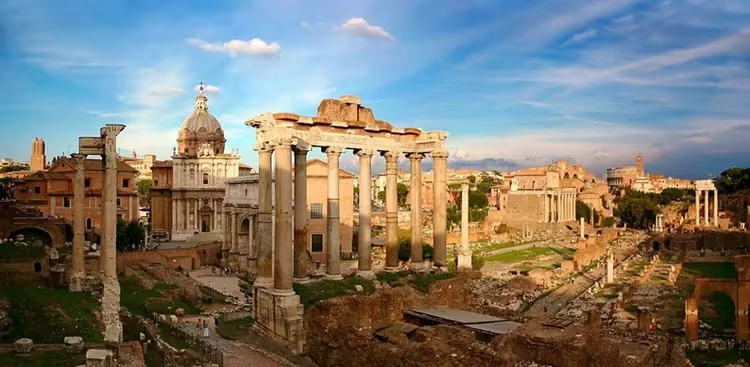
Capitoline Hill in Rome – photo, description, how to get there, map
Rome is located on seven hills. The smallest in size and height, but the most significant in terms of historical and artistic value, is called the Capitol. Every tourist tries to visit this place in order to see with his own eyes the place where the Eternal City arose.
History and ancient temples of the Capitol
There are many beautiful and unique places in Rome: cathedrals, monuments to famous personalities, fountains and palaces. The most impressive is the Capitol Hill, its historical and cultural values do not leave anyone indifferent. According to legend, 2.5 thousand years ago, Romulus (one of the founding brothers of Rome), standing on a hilltop, saw eagles soaring in the sky. Near this place, he decided to found a city. Historians have not come to a consensus on the origin of the name of the hills. There are two versions, according to one it bears the name of Jupiter Capitolinus, whose temple stood long before the appearance of Romulus. Here was the sanctuary of the tribes of the Sabines, they erected a temple to Jupiter and prayed to him, making sacrifices.
The second version is from the word “kaput” (in translation, it means head), since the Senate was located on the hill, where the most eminent and noble dignitaries of that time sat. a lot of people, the Senate gathered here, important issues were decided, courts were held. The building of the Mamertine prison, which also stands on a hill, has survived to this day. It is already over 2700 years old. According to some sources, the date of construction refers to VI, according to others it was built in IY century BC Initially, it was a two-level building, in its dungeon both important dignitaries and the most ordinary citizens languished in anticipation of the execution of the sentence.
According to legend, the apostles Peter and Paul were in this prison before their execution. When the prison ceased to function in XYI, an altar was installed in the dungeon, and pilgrims still come here to worship. Subsequently, the church of Joseph the Carpenter was erected over the dungeon. In ancient times, on the territory of the Capitol there were streets with shops and shops where artisans sold their products. Some have survived to this day, for example, Silver, where, according to the name, silver products were sold.
At the foot of the Temple of Aricheli there are ancient buildings – insulas, in fact, this is a multi-apartment hostel, in the image of which modern hotels and hotels began to be equipped. The first high-rise buildings appeared in the 3rd century BC, and the mass construction of “communal apartments” in Rome began in the 1st century. Insulas were rented out, and the lower the floor, the more expensive the payment for accommodation was, and the more wealthy people settled in it. On the first floors there were even sewerage and water pipes. Houses were located close to each other, so often entire neighborhoods were destroyed by fires. They quickly collapsed, as they were built with violations of the rules, fell into disrepair, but such “apartments” were not cheap.
Michelangelo and the revival of the Capitol
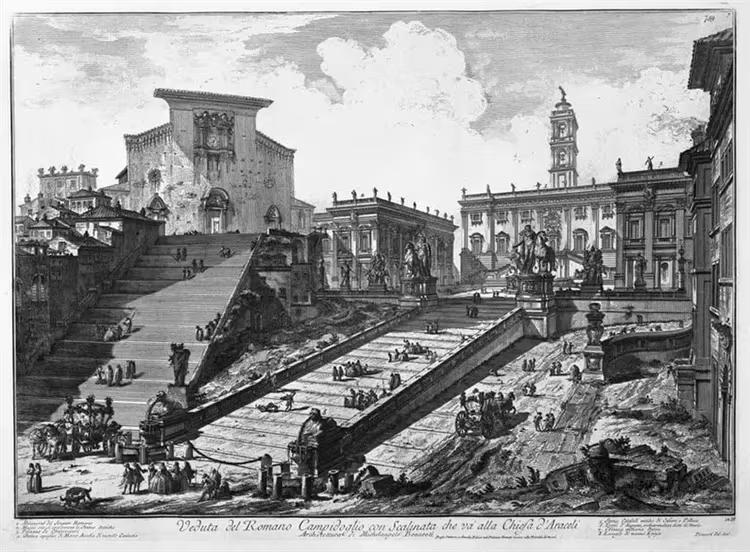
The ancient buildings required restoration; these works were commissioned by the famous sculptor and architect Michelangelo, Pope Paul III. Michelangelo (life: March 6, 1475 – February 18, 1564) designed many buildings, including St. Peter's Cathedral in Rome. From the end of the thirties, he began to re-equip the Capitoline Square. Unfortunately, Michelangelo died before he could complete the construction, this was done by his students and followers.
Capitol Square is considered unique in its beauty and harmony – in its central part of the square is the Palace of Senators. On one side of it, the Palazzo Nuovo Palace was erected, on the other, the Palace of the Conservators, they were built according to the same project, therefore they are exactly the same. They now house museums displaying paintings by old masters, clothing from different eras, crockery, coins and figurines.
In the center of the square there is a sculpture of Emperor Marcus Aurelius, emperor and philosopher. This is a copy of an antique statue. From one side of the square you can go down the ancient staircase, which is decorated with statues of Egyptian lions and sculptures of marble twins – Pollux and Castor. They were discovered in Pompeii and transported to the capital of Italy in the XYI century. Below are the statues of Constantine and Constantine II, sculptures from the ancient fountain and milestones from the Allian road.
Palace of the Senators
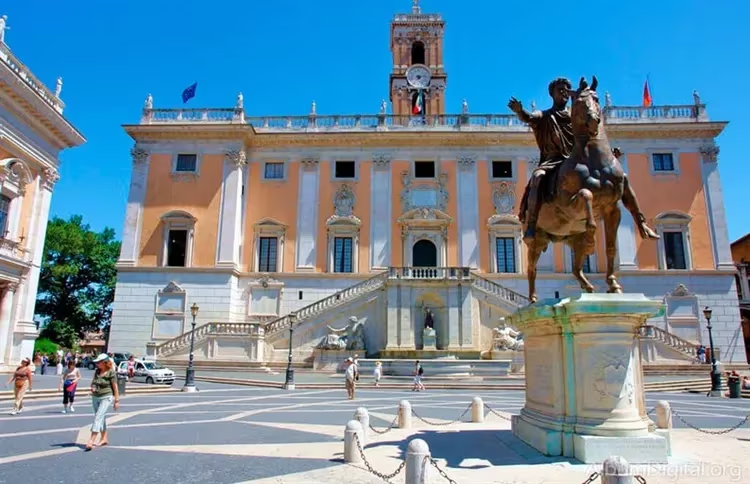
The most notable building is the Palace of the Senators, built in the first century BC. architect Cornelius. Initially, the archive was located in the Palace for a long time, in the Middle Ages it was empty and gradually collapsed. The revival of the palace began in the thirties of the XYI century, when the pontiff Paul III entrusted Michelangelo with the reconstruction of buildings and equipping the square, which was called Piazza del Campidolio. According to the plan of the architect, the central building, the Palace of Senators, was assumed to be the dominant and most majestic. Since 1871, the palace has been the residence of the mayor, so most of the premises are closed to tourists. You can visit the Lapidarium, where antique stone slabs with inscriptions are exhibited. Below, in the old part, you can see the archive – the Tabularium.
Palace of the Conservatives
The first building of the Palace of the Conservatives was erected under the pontiff Nicholas Y in the second quarter of the 10th century. In literal translation, the word means “Palace of the Guardians”. Senators, masters and judges, who were called conservatives, sat in this room, which gave the building its name. All power was concentrated in the hands of these people. But over time, papal power increased and the significance of the city decreased significantly, the treasury was depleted, which led to desolation and dilapidation of the building. In the middle of the XYI century, the palace, like the entire architectural ensemble of the square, was reconstructed by Michelangelo.
Now museums are located in the building, the first exhibits belonged to Pope Sixtus II. In 1471, he donated antique sculptures made of bronze, including the sculpture of the legendary “Capitoline she-wolf”, according to legend, who raised Rem and Romulus. In the central hall, richly painted with frescoes, marble ancient Roman busts are exhibited. On the second floor there is a gallery (Pinacotheca). It presents works by Caravaggio, Van Dyck, Tintoretto and other famous artists. The Castellana hall exhibits ancient Greek and Etruscan items, as well as jewelry.
Nuovo Palace
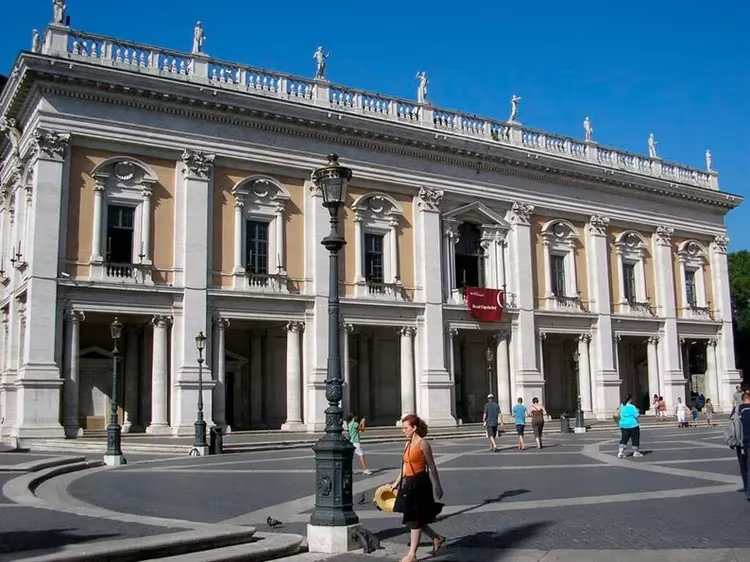
Palazzo Nuevo (New Palace), as the name suggests, is the newest building erected in the 17th century. As intended by Michelangelo Buonarotti, he was a copy of the Palace of the Conservatives. It was originally built as a public museum and was opened to the public in 1734. In our time, part of the Capitoline Museums is located in the palace. Visitors can see sculptures, vases brought from Greece, paintings by artists, ancient mosaics. In the inner courtyard there are parts of buildings and fragments of the statue of Constantine – an arm, a foot, a head.
In the modern part of the building there is an original bronze sculpture of Marcus Aurelius – a unique exhibit of this kind, preserved from ancient times. The beautiful Scalone staircase leads to the second floor of the palazzo; it is richly decorated with relief paintings on antique scenes and inlaid with marble.
Basilica of Santa Maria in Araceli
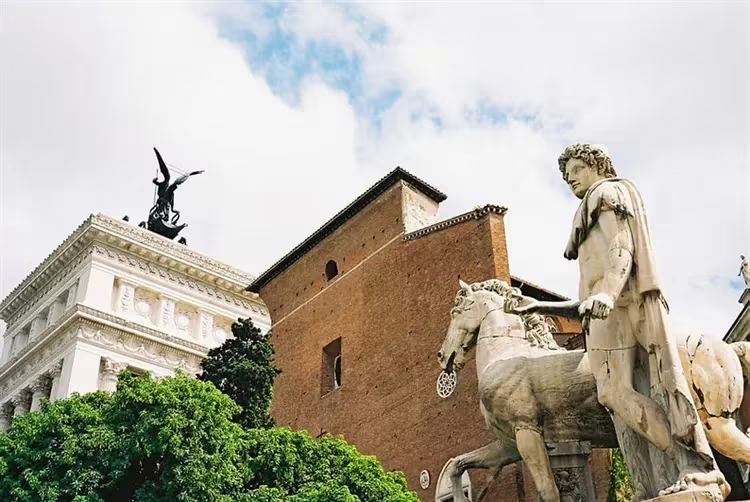
The Church of the Holy Virgin Mary was founded in the XIII century. The Capitol is a hill with two low peaks, on the smaller of which the church is built. According to ancient legends, a temple was erected on this peak to Jupiter, his wife and daughter Minerva, the Goddess of Wisdom. Then she had her own palace – the temple of Juno-Moneta, it was on this place that the Church of the Virgin Mary was subsequently erected.
Historians do not have exact information about the first buildings. They rely on medieval legends that say: when Emperor Augustus ruled, the senators decided to build a church in his honor. The emperor wanted to ask the gods if it was worth doing this and went to the hill, wanting to sacrifice doves to them.
On the way he met a sibyl, a soothsayer. She exclaimed that she saw the birth of God, soon they would only pray to him. The emperor installed the Heavenly Altar where the vision came to the sorceress. Then the church of Santa Maria in Araceli arose here, the first documentary mention of it dates back to the first quarter of the XIY century. In the 6th century a Greek monastery was built, then in the 9th century the Benedictines built a Catholic church. In the XIII century, he passed to the Franciscan order, they carried out a significant restructuring of the building. In the Middle Ages, people not only prayed here, but also held meetings of the people – they proclaimed laws, solved economic issues.
In 1347, Cola di Rienzo, a politician, took power in Rome, he ordered the construction of a grandiose staircase that led from the base of the hill to the entrance of the church. In 1464, the basilica was restored again, in the middle of the 17th century a sacristy and a bell tower were added to it, in 1565 a choir was erected, and in 1575 a beautiful carved ceiling was made in honor of the victory of the Italian fleet over the Turkish one. Nowadays, the cathedral is open to believers and tourists who want to admire the beautiful interior design of the basilica.
Opening hours and ticket prices
The palaces, which are part of the museum, work at the same time and you can visit them by purchasing one ticket:
Opening hours: from Tuesday to Sunday from 9:00 to 20:00. Day off – Monday.
Ticket price: complex – 15 euros, preferential – 13 euros.
Mamertine Prison. The museum in the prison is open from 9:19, the entrance ticket costs 10 euros. It has also become a tradition to leave donations as you see fit.
You can visit the Basilica from 8:00 to 17:30. The entrance is free.
Where is it located and how to get there
Address: Campidoglio Square, (Piazza del Campidolio), Rome, Italy. The Capitol is located near Venetian Square and the Roman Forum. The easiest way to get there is by metro – Colosseo station, line B. Take buses NoNo 30, 51, 81 118, 628 and 810 to the Ara Coeki-Piazza Venezia stop. By tram number 8 to the Venezia stop.
Indelible impressions remain from visiting sunny Italy – its beautiful nature, warm sea and beaches, wonderful cuisine. But the monuments of ancient and medieval antiquity overshadow everything, they amaze and remain in memory forever.