
Greece is a corner of earthly paradise, washed on all sides by gentle seas, heated from the bright blue of the skies by the generous sun, located in a comfortable Mediterranean climate. The famous phrase of Chekhov's hero: “Everything is in Greece” is not far from the truth. In a relatively small country with a thousand-year history, indeed, there is everything: mountains, forests, seas and rivers, an abundance of fish, fruits, grapes… and all sorts of miracles inherited from Ancient Hellas.
How many legends were born here, how many works of ancient literature were left to us by ancient poets and writers, what a huge intellectual potential laid down by Greek thinkers and philosophers, which is still used by their distant descendants all over the world.
If you trace the entire history of the development of this state from the depths of centuries BC, you can once again be convinced that only in such fertile places life was seething, only here there was a worthy place for the Gods, about which legends are composed, supported by “material evidence” in the form of monumental remains grandiose buildings, one of which is the Labyrinth of the Minotaur.
Historical information about Minos
It reflects the era of the Minoan civilization, which originated in the 30th century BC, lasted until the 12th century BC, and was named after King Minos, the ruler of the island of Crete. He created a powerful state with its own army and navy, which successfully developed thanks to the trade in copper, bronze and ceramics.
Beautiful palaces were built on the island – a real miracle of architecture – for the rich nobility. Traces of the Minoan civilization were discovered in 1900 by an archaeologist from England, Evans, who called it Minoan. It was later established that the prosperous Cretan state was badly damaged by a volcanic disaster that occurred on a neighboring island and caused an unprecedented tsunami that reached Crete.
The former power of the Minoans declined, and, having existed even less than 3 centuries, went into oblivion, leaving the memory of the power-hungry and cruel king and his entourage.
What to bring from Greece – an overview of the best souvenirs.
Legend of the Minotaur
The mysterious labyrinth that remained after his reign was overgrown with legends associated with the mythological names of gods and people.
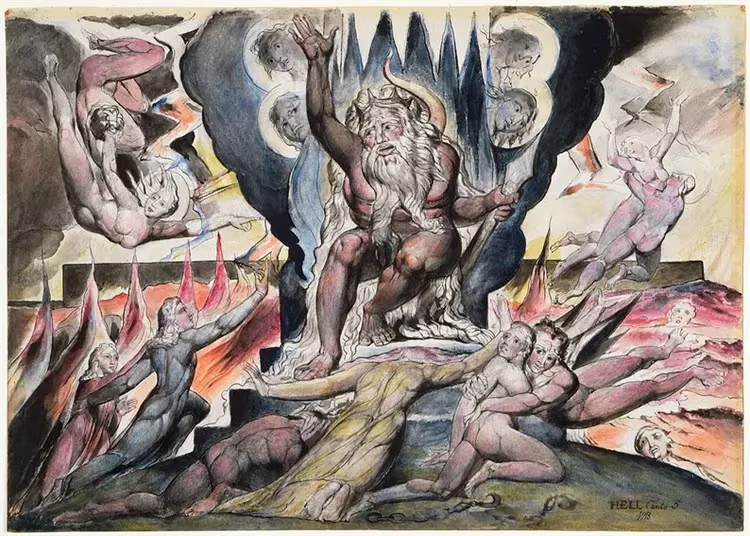
The inhabitants of Crete worshiped the bull, considering it a cult animal, like many ancient European tribes. Minos, like the rest of the Greek kings, had to sacrifice a bull to Poseidon. But one day he violated this duty, leaving the sacred animal with him. The angry God of the sea treacherously punished the obstinate Minos, instilling a vicious passion in his wife Pasiphae, who pervertedly sinned with a bull and gave birth as a result to a humanoid creature with a bull's head, which was a diabolical punishment for all the people of Greece.
By order of the king, the mighty Daedalus built an intricate labyrinth in which the unfortunate fiend of hell was doomed to be – a terrible child of God's punishment – the Minotaur. Possessed with hatred for people because of his monstrous appearance, he demanded from the guilty king the most beautiful young men and women, whom he cruelly tormented, tearing to pieces.
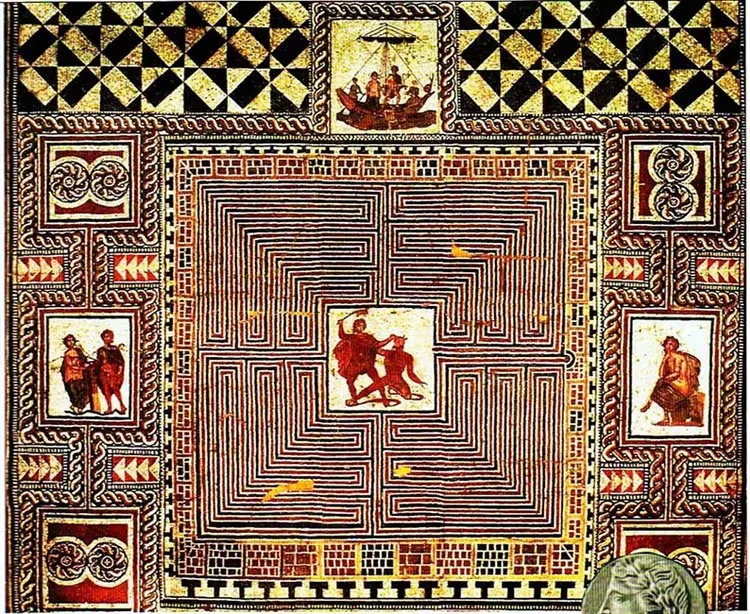
They were brought from Athens conquered by Minos and thrown into the unusual abode of the monster. The grief of the Athenians knew no bounds, but they were powerless against the vassals of Minos, sailing for the next victims. The noble Theseus, the son of King Aegeus, who became a courageous and strong young man, decided to destroy the ridiculous monster himself and went to Crete. He descended into the labyrinth, wandering through it, found the Minotaur and killed him. But before that, the wise Ariadne, the daughter of the Minoan king, saw the handsome hero and fell in love with him at first sight.
Ashamed of such a terrible brother and hating him, she gave a ball – “Ariadne's thread” into the hands of her lover, so that she would serve as a guide and help Theseus get out of the intricate bends of the dungeon. Unwinding the thread, the young man, after the battle with the Minotaur, was able to safely get out of the gloomy shelter of the bull-man.
A modern take on the mythical labyrinth
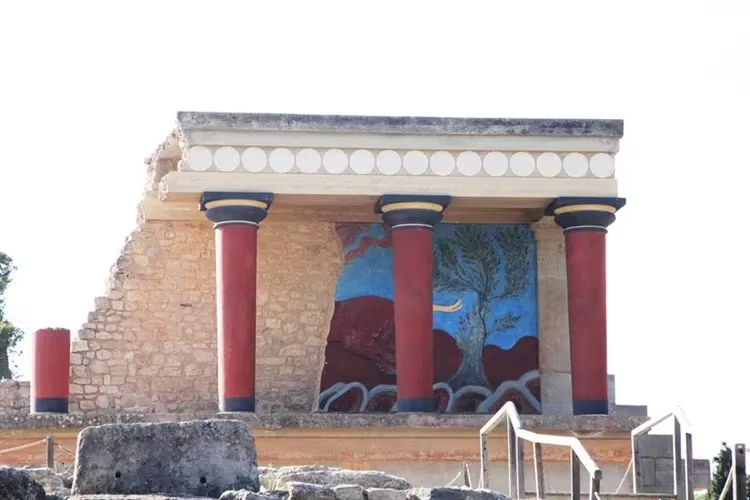
There is a scientific opinion that in reality they are the remains of a huge monumental structure of the Knossos Palace, located in the vicinity of the Cretan capital – Heraklion. It amazes with its size and a heap of countless rooms interconnected by intricately curved passages, which can be conditionally considered the famous labyrinth, if we discard the discrepancy between the difference in the timing of the construction of the palace and the existence of the Minoan civilization.
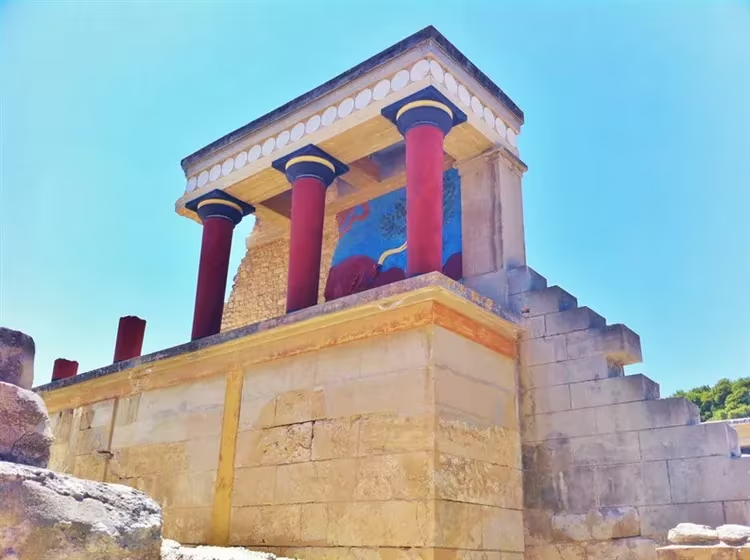
However, people want to believe in miracles and consider the royal ruins of a gigantic ancient structure as a mysterious labyrinth. This unique rarity is not only valuable for this: it is a real museum of architecture and art of the Cretan state, evidence of a high level of development of society BC.
The remains of walls and monumental columns that have stood for millennia illustrate the grandiose possibilities and skill of the builders. And the bright, colorful wall images of graceful Greek women with amphoras in their hands are simply magnificent, as are the dancing beauties dressed in elaborate outfits.
The huge canvas depicts a sacred bull, sleek and powerful, on whose back the artist placed an acrobat in order to compare the strength and power of the deified animal with a small and weak person. But a smart animal is obedient to him, so next to him are those to whom he obeys.
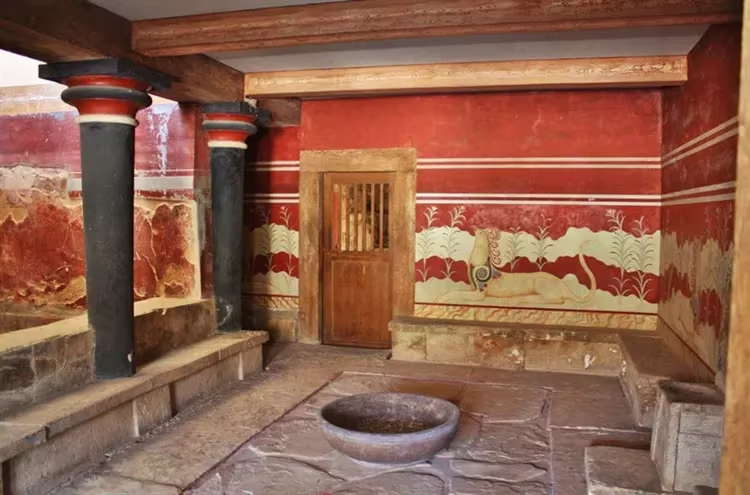
The painting of one of the ceremonial halls of the Palace strikes with its unusual aesthetic design, elegance of lines, cheerfulness of shades of numerous patterns. Images of outlandish totem animals with bird heads are placed everywhere. Even a semblance of a throne has been preserved, cast from an unknown material, over which time has no power.
Beautiful frescoes with frolicking dolphins look unusually expressive, despite a certain sketchiness of the image. How many hands of talented artists worked in these immense palaces, how many craftsmen created such wonderful colors! The classical ornaments decorating the entrances around the perimeter amaze with their modernity. Looking at all this, one begins to think how true it is to say that history moves in circles.
We also recommend that you go to see Meteora in Greece.