
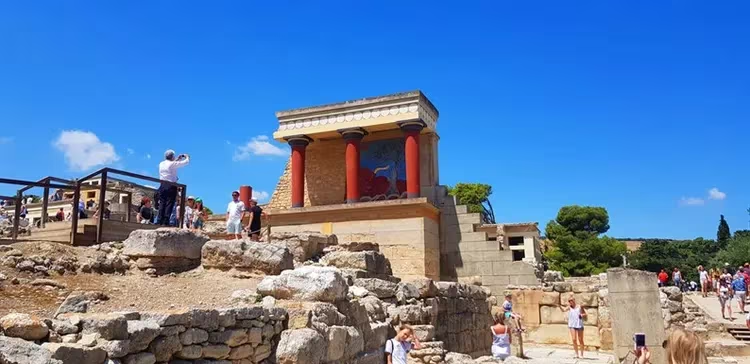
Knossos Palace in Crete – travel tips before visiting
The Palace of Knossos in Crete is a must-visit place for tourists. And there is an explanation for this: the complex is located near the capital of Crete, the city of Heraklion. But not only the convenient position attracts guests. The center is a living evidence of an ancient civilization. Walking along the passages, studying the ancient frescoes, it is easy to imagine the life of the townspeople in 2000 BC. And the legends with which the old building is shrouded add charm to the ruins.
Construction history
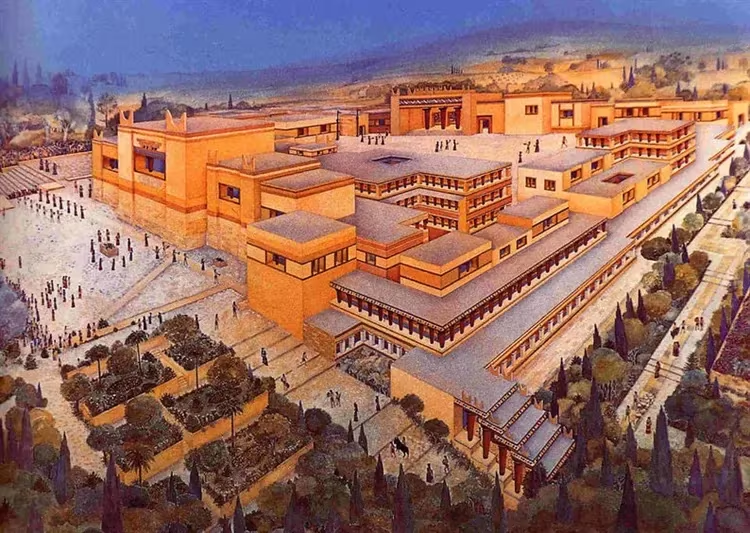
The first palace of Knossos was built by the Minoans in 2000 BC. And already in 1700, the building was almost completely destroyed by an earthquake. Then not only this palace perished: almost all the buildings on the island were destroyed by the elements. But after a while the building was restored. It was the time of the full flowering of the Cretan civilization, so the building surpassed the previous one in beauty, grace and luxury. But she did not stand for long: in 1450 BC. died again. Experts are still arguing about the reason for the disappearance of the building. Scientists consider it a miracle that parts of the palace were excavated and reconstructed.
Discovery by Evans
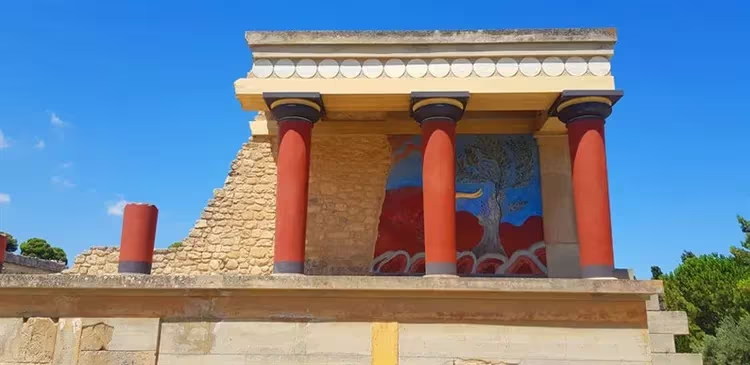
Initially, excavations at the site of the existence of the Knossos Palace were carried out in 1878 by the Greek archaeologist Kalokerinos. He managed to find some artifacts, after the publication of which Europeans showed interest in excavations. The Englishman Arthur Evans is one of them. Evans arrives on the island in 1900 and buys all the land where, in his opinion, the remains of a unique building are located. But until 1905, his work cannot be called successful: the finds are insignificant and of little interest.
And in 1905, Evans unearths artifacts whose significance can hardly be overestimated:
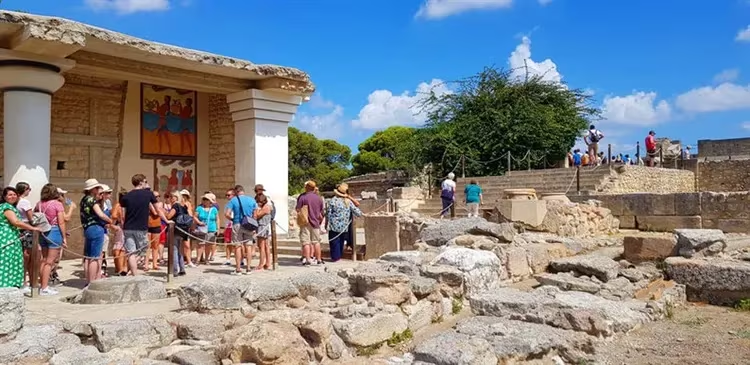
But Evans did not stop there: he carried out a large-scale reconstruction of buildings. At the same time, he himself performed the work of an architect. It is thanks to this colossal work that today's visitors have an idea of what this building was like after the first reconstruction (1700-1450 BC).
Of course, it was not without the introduction of completely new details. All the columns that adorn the building were recreated by Evans: the Minoans used wood to make the columns, which perfectly protected the building from destruction during tremors during an earthquake, but quickly rotted and was damaged by bark beetles. During the reconstruction, the building received columns carved from stone.
Scientists do not have a unanimous opinion about the correctness of the decision made by Evans: some believe that it was enough just to conserve the excavation site and transfer the artifacts to museums. But, nevertheless, thanks to the reconstruction, the monument attracts tourists.
Versions of the death of the palace
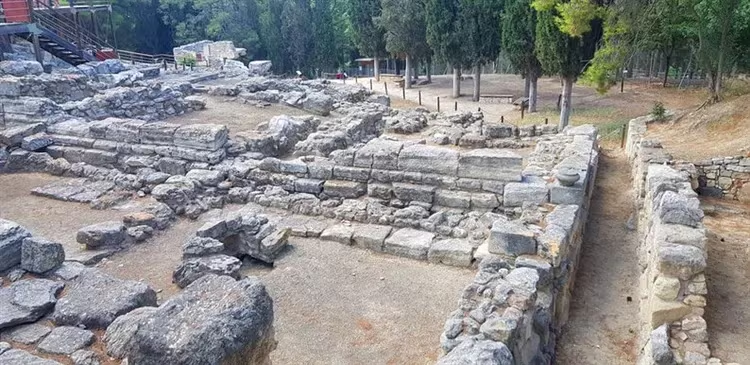
There are several versions of the final death of the building:
- In 1450 B.C. a fire raged on the island, which caused the death of Knossos.
- According to documents, at the same time, Crete was captured by Mycenae: a city-state in mainland Greece. It is known that the invaders were ruthless, they destroyed everything that came under a hot hand. But there are no concrete facts about their rule.
- In 1000 B.C. The Mycenaeans were driven out by the Romans (Roman Greece). They began to build on the island according to their canons. But even less is known about this period.
- In the period from 1450 to 1380 BC. the city and the palace were captured by the Achaeans: this became real due to the fact that the Mycenaean civilization fell into decay. At that time, the palace still existed and was actively used by the new owners. And after 1380 BC. the Achaeans abandoned the building and left the city.
Scientists have yet to draw a final conclusion about the tragedy that befell the unique building.
Minotaur Labyrinth
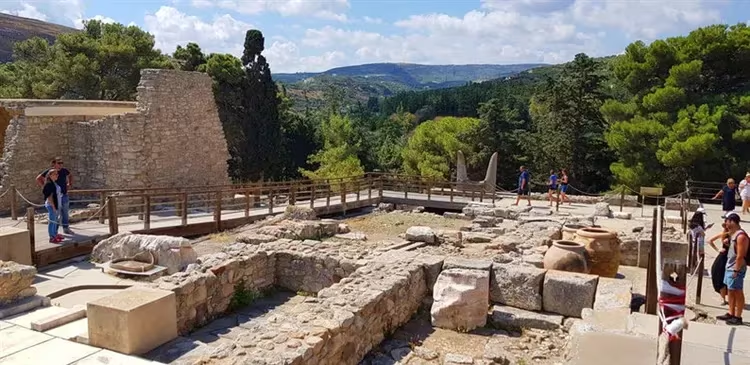
It is generally accepted that the Palace of Knossos is the labyrinth of the minotaur. The following facts support this assertion:
But opponents give a counterargument: the myth of a monster hidden from the eyes of people arose much earlier than the complex was built. All this time, the Minotaur must have been kept somewhere. Presumably, caves were used for this, of which there are a great many in Crete. In the meantime, scientists are arguing, tourists willingly visit the complex, imagining that it was here that the guiding thread of Ariadne saved the hero Theseus from the monster.
Architecture
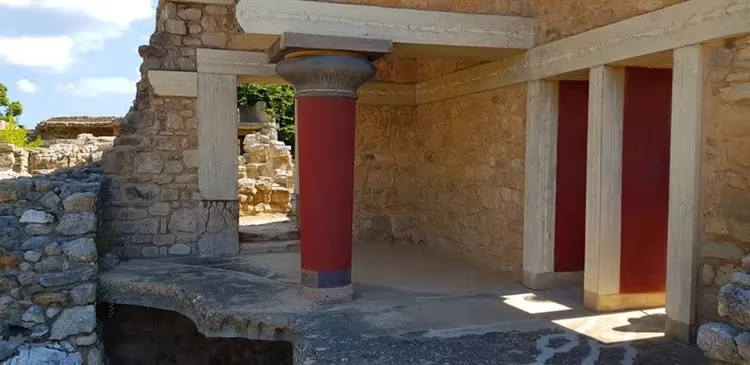
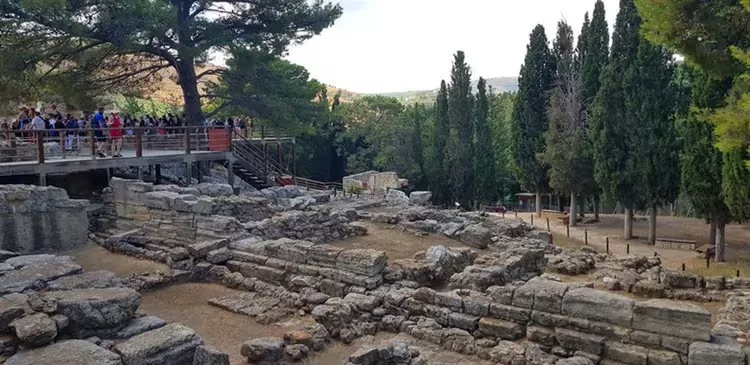
Some modern architects believe that calling the complex a palace is a mistake. Rather, it is a whole closed city that can exist autonomously. At first glance, Knossos is a confusing and unsystematic building. But its logical center is the courtyard, the size of which is 50×50 meters.
Winding corridors and passages intersect here. The complex has water supply, sewerage, ventilation. It is located both above and below ground. It is noteworthy that the complex does not have defensive walls: the Minoans dominated the peoples who lived in the neighborhood, and were not afraid of enemies. The elements were much more dangerous for civilization.
Throne room and other rooms
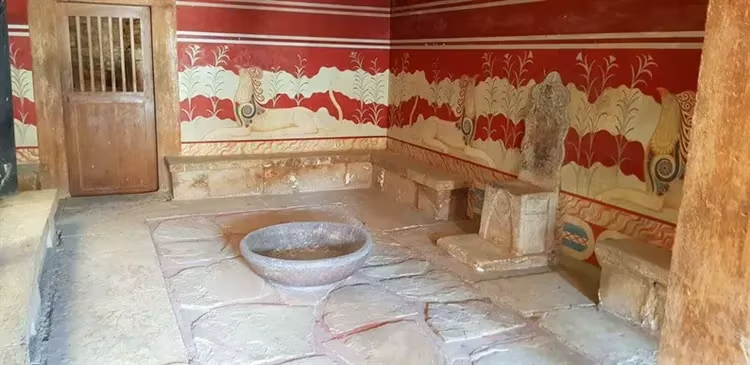
The throne room is a well-preserved room. It got its name because of the massive chair made of stone. There is a bath for ablutions nearby. Presumably, the rulers of Knossos gave audiences in this room. But the complex is also famous for other buildings. These are premises for the owners of the palace, court nobility and priests.
And other rooms, on the contrary, had a service purpose:
The complex had its own customs: all visitors were examined in the hall.
Legends and myths
This wonderful place gives rise to wonderful myths:
- Minos himself is the son of Zeus and Europe abducted by the god. But Zeus ordered the ruler of Crete, Asterius, to marry Europa and become the father of her children. That is why Minos became the legitimate ruler of the island, favored by the gods.
- Poseidon gave Minos a white bull, which had a wonderful stature. But the sea king set a condition: the animal should be sacrificed. However, Minos could not part with the bull, and sacrificed another animal. The deception was revealed: Poseidon made the wife of the earthly king give herself to a white bull. From an unnatural passion, a freak was born: he had a bull's head, and a human body. In addition, the monster was evil and aggressive: immediately after birth, he almost swallowed the nurse. The Minotaur (along with his mother) was imprisoned in a labyrinth from which there was no way out. And Daedalus invented and built an intricate building. Anyone who entered the caves was eaten by the monster.
- But there were no people in Knossos who wanted to become food for the Minotaur. Therefore, after the victory over Athens, Minos ordered 7 Athenian girls and 7 Athenian youths to be sent to the labyrinth every 10 years. The sacrifice was made twice. And for the third time, Theseus fell into the number of young men. He defeated the Minotaur, and was able to get out of the labyrinth along the guiding thread of Ariadne.
How Minos died is not told. But even after death, he continued to control the fate of people in the kingdom of Hades.
Interesting Facts
Arthur Evans led the excavations at his own expense, as a result of which his family almost went bankrupt. In addition, for an archaeologist, he was too impetuous: instead of slowly clearing, he ordered the workers to tear down all, in his opinion, uninteresting layers. Due to this decision, almost nothing is known about the monument after its second destruction.
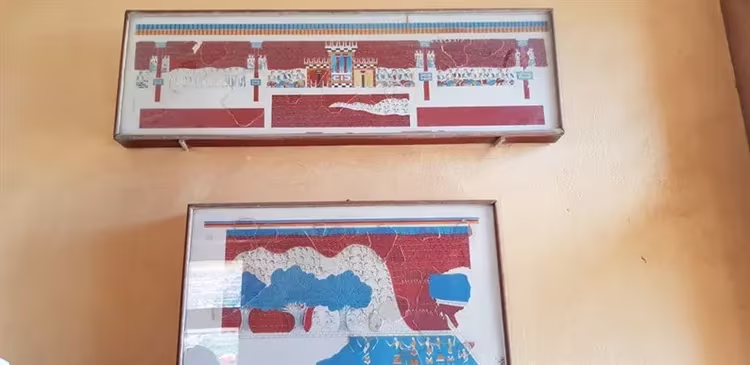
Evans lacked hard data. But this did not sadden him: he simply composed the missing architectural details. Some scientists were outraged by this, others were sympathetic to such actions. In addition, the scientist masterfully restored the unique Minoan frescoes. The Greeks appreciate the work carried out by the Englishman: on the territory of the excavation there is a monument to the selfless architect.
Some modern architects consider Knossos an old skyscraper, and very comfortable: the building had several floors, ventilation, sewerage, plumbing and lighting. The mythical Minotaur, who lived in the labyrinth, was transferred by Dante to the Divine Comedy: the half-beast-half-man became the judge and executioner in the hellish circle. And the popularity of the Minotaur has not diminished since then.
The Minoans created a more advanced civilization than the Greeks: the cities of the latter were colonies of Crete. The main rivals of the island state were Egypt and Mesopotamia. This conclusion was made by scientists after studying the artifacts at the excavation site of Knossos. The complex is a museum and at the same time a center of study: excavations on the territory are periodically renewed: perhaps later finds will answer numerous questions from scientists.
Opening hours and ticket prices
For an adult tourist, an entrance ticket costs 15 euros; for children under 18 years old, a ticket is not required. In order to save money, you should purchase a ticket on the official website.
And you can go for free:
During the holiday season (May-October), the center receives visitors daily from 8 am to 7 pm. In winter (November-April) the complex is open from 9 am to 3 pm. Half an hour before closing, guests are no longer allowed to enter the territory.
Where is it located and how to get there

The attraction is located at: Minoiton, Heraklion 71409. There are several ways to get here:
- By bus from Heraklion. Route number – 2, interval 10 minutes. Get off at the last stop.
- By taxi. Since the destination is located only 6 km from the center of Heraklion, it is inexpensive.
- By rented car. This is a convenient type of travel: there is parking next to the monument. And the trip itself from Heraklion will not take much time. When driving from another city, you should use the navigator.
If the starting point of the route is not Heraklion, but it is planned to travel by public transport, then it is recommended to first get to the city bus station, then take bus number 2 and follow to the final stop.