
















Meteora monasteries: tickets, closed days and the road from Athens
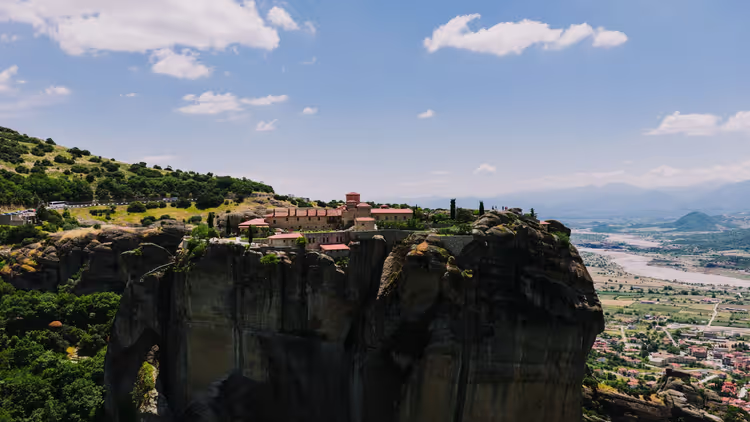
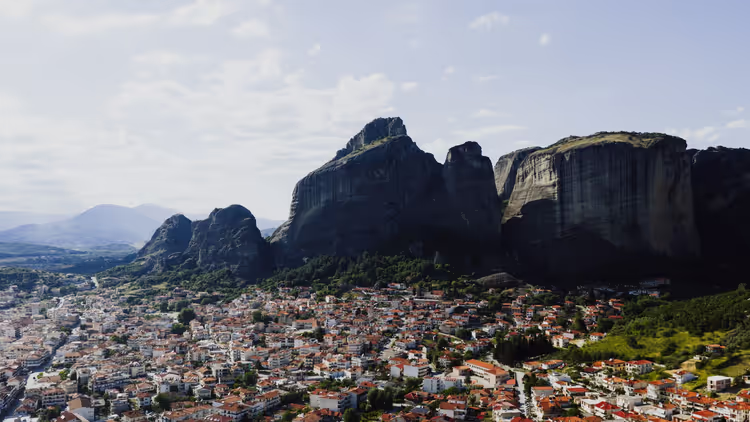
In Greek Thessaly, six active monasteries stand on the tops of cliffs. The climb to each one follows steps cut into the rock, and it is not what you would call an easy stroll.
Entry costs €5 per monastery, payable in cash on site (as of 09/2026, Visit Meteora). On weekdays some of the monasteries are closed, and on Friday two are closed at once. On Saturday and Sunday all six are open.
Ad: this article contains affiliate links, we earn a commission if you book through them, at no extra cost to you.
How Meteora came to be
💡 In short:
- The complex stands above the town of Kalabaka and the village of Kastraki in Thessaly.
- Each monastery is closed one day a week; on weekends all six are open.
- Visitors are allowed inside only in modest clothing: shoulders and knees covered.
- Tickets and opening hours: 09/2026, verified on the official website
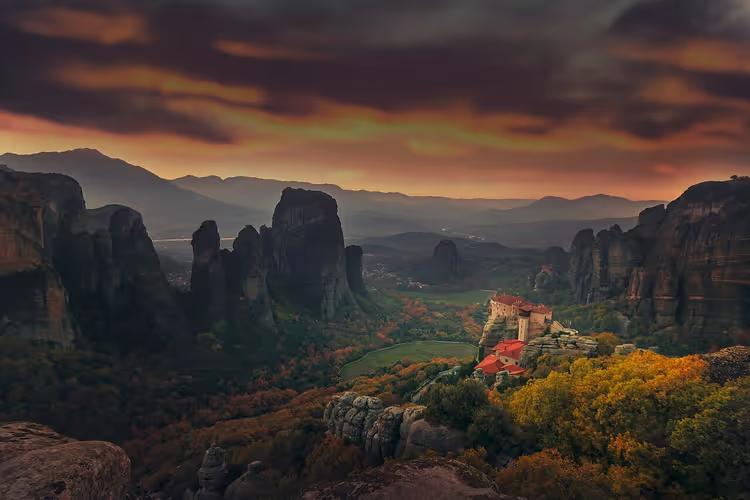
The cliffs of Thessaly were inhabited long before the first monasteries. According to local tradition, hermits settled in the caves as early as before the 5th century and climbed to the ledges to pray. They used the grottoes as shelter, many of which still exist on the cliffs today.
 © Ioannis Ioannidis · CC BY-SAPhoto: Ioannis Ioannidis, CC BY-SA (https://creativecommons.org/licenses/by-sa/4.0), Wikimedia Commons
The official account links the beginning of the complex to the hermit Barnabas. He laid the first stone of the future monastery in the 10th century. Groups of monks gradually gathered around the first sketes, and the settlements grew.
A community formed around the sketes, where each person carried out their own obedience. Over time, cells, chapels, and storage rooms were added, and the buildings began to occupy the entire cliff.
When raids swept through the territory of Greece, the monks began seeking protection on the cliffs. That is how the complex got its "floating" appearance: the monasteries could be reached only by ropes and ladders.
Today Meteora is a UNESCO World Heritage Site. Here you will see active churches, viewpoints over the valley, and old cells that are still being restored.
How the monasteries were built on the cliffs
Materials for the churches were hauled up by hand. They were pulled up rope ladders and cables, and to climb up himself, a monk had to learn rock climbing.
There is almost no water on the cliffs. It was collected in crevices and niches cut directly into the rock, and food was the little that could be gathered around. The work went on for decades and was sustained by faith.
Which monasteries are part of the complex
The complex includes six active monasteries. Each one is closed one day a week, and on Friday two are closed at once. You can see all six in one day on Saturday or Sunday. Below is a table with entry fees and the summer schedule.
Monastery | Entry | Closed day (summer) | Opening hours (summer) |
|---|---|---|---|
Monastery of Great Meteoron | €5 | Tuesday | 9:30-15:00 |
Monastery of Varlaam | €5 | Friday | 9:00-16:00 |
Monastery of Rousanou | €5 | Wednesday | 9:00-16:30 |
Monastery of the Holy Trinity | €5 | Thursday | 10:00-16:00 |
Monastery of St. Stephen | €5 | Monday | 9:00-13:30 and 15:30-17:30 |
Monastery of St. Nicholas Anapausas | €5 | Friday | 9:00-17:00 |
Hours and closed days change, so check them before your trip (as of 09/2026, schedule on Visit Meteora, tickets and closed days).
Monastery of Great Meteoron
 © Janmad · CC BY-SAPhoto: Janmad, CC BY-SA (https://creativecommons.org/licenses/by-sa/2.0), Wikimedia Commons
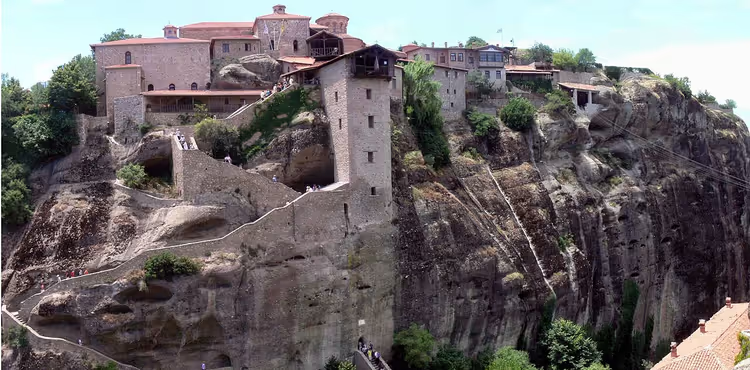
The largest and earliest of the active monasteries. It was founded by Athanasios the Meteorite, a prominent figure of Orthodoxy, and the Cathedral of the Transfiguration was painted by the best masters of the time. It also houses the largest collection of rare icons.
- The catch: in summer the main flow of tourists comes here, so it is best to arrive at the gate by opening time.
Monastery of Varlaam
 © Dido3 · CC BY-SAPhoto: Dido3, CC BY-SA (http://creativecommons.org/licenses/by-sa/3.0/), Wikimedia Commons
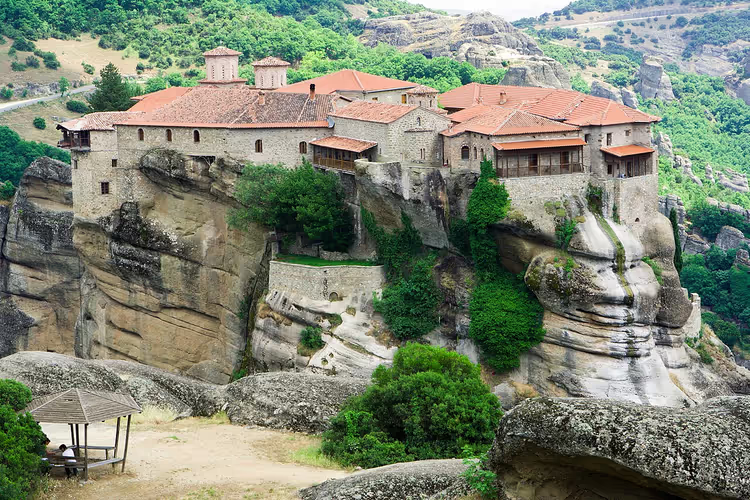
One of the largest monasteries in the complex. It was founded in the 16th century by Theophanes and Nektarios Apsaras. The main gallery is decorated with frescoes by the artist Franco Catellano, and the sacristy holds the oldest manuscripts and gold-embroidered epitaphios.
- The catch: in season a line builds up at the entrance, especially in the afternoon.
Monastery of Rousanou
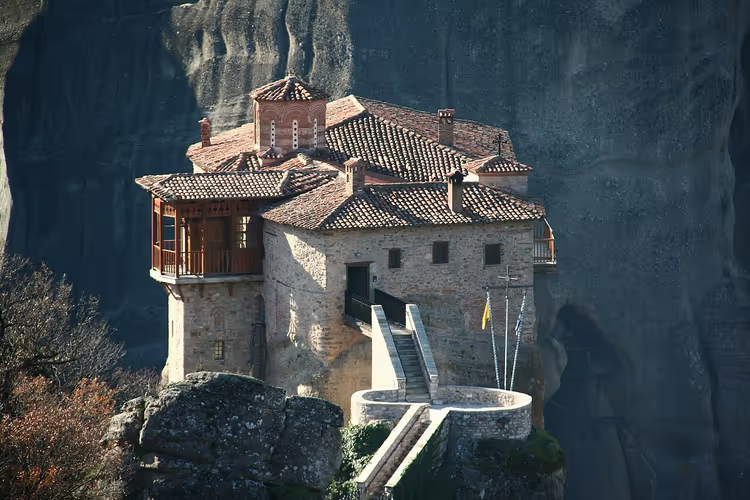 © RoubinakiM · CC BY-SAPhoto: RoubinakiM, CC BY-SA (https://creativecommons.org/licenses/by-sa/4.0), Wikimedia Commons
It stands on a narrow cliff above the gorge. Founded in the 16th century, it is attributed to the brothers Ioasaph and Maximos. The main highlight here is the frescoes and the carved gilded iconostasis, which you can view up close.
Monastery of St. Nicholas Anapausas
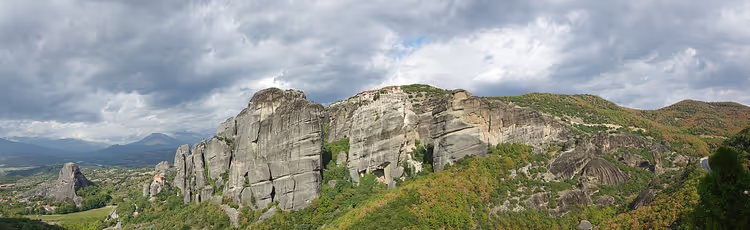 © Berthold Werner · CC BY-SAPhoto: Berthold Werner, CC BY-SA (https://creativecommons.org/licenses/by-sa/3.0), Wikimedia Commons
The first monastery you will see on the road from Kastraki. Founded in the 14th century, and the gallery frescoes were painted by the Cretan master Theophanes Batas-Strelitzas. The church is small, so it is spread across several levels.
- The catch: the climb is steep, and the steps are uneven and worn in places.
Monastery of the Holy Trinity
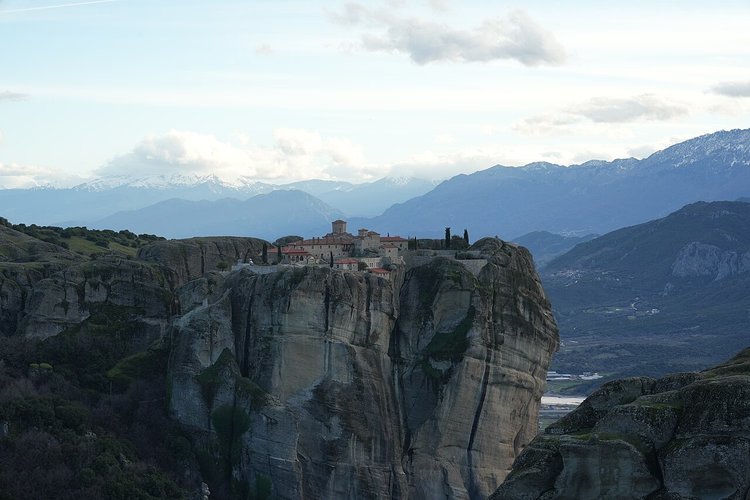 © Sadopaul · CC BY-SAPhoto: Sadopaul, CC BY-SA (https://creativecommons.org/licenses/by-sa/4.0), Wikimedia Commons
It draws visitors with its unusual chapel perched almost at the highest point of the rock. A long staircase cut directly into the stone leads up to it, which is why not everyone makes it here. But the view of the valley from here is completely unobstructed.
- The catch: the climb is long and steep, and it is tough in the heat.
Monastery of St. Stephen
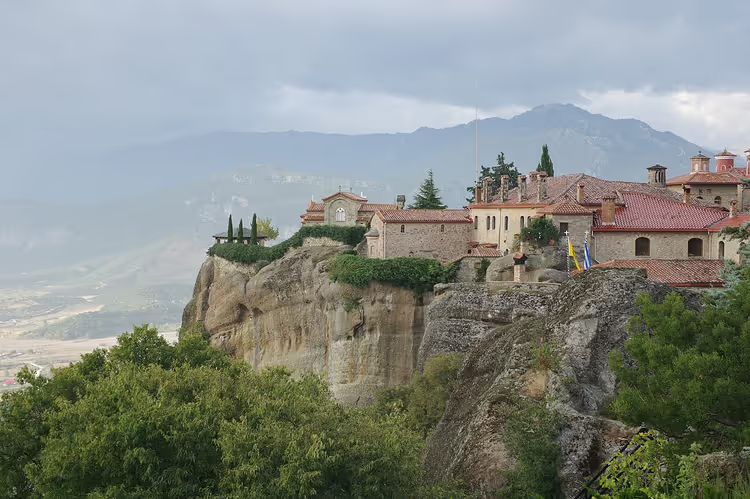 © Berthold Werner · CC BY-SAPhoto: Berthold Werner, CC BY-SA (https://creativecommons.org/licenses/by-sa/3.0), Wikimedia Commons
One of the two women's monasteries in the complex, the other being Rousanou. The climb here is the easiest: a short bridge leads from the parking lot to the gate. Inside you will see an impressive collection of relics and ancient icons.
Want to cover several monasteries at once and not worry about schedules? A ready-made guided tour takes care of both the road and the closed days.
Tours and tickets in Meteora
Guided tours, skip-the-line tickets and activities — most offers can be cancelled free of charge.
See offers on GetYourGuideThe widget loads once you give your consent.
Tickets, opening hours and dress code
Tickets are sold separately at each monastery; there is no single ticket for all six. Admission costs 5 € and is paid in cash: there are no card terminals or ATMs on the rocks, so withdraw money in Kalambaka (as of 09/2026, payment rules).
Children under 12 usually enter free of charge (as of 09/2026, Visit Meteora age rules). The dress code is strict: shoulders and knees must be covered, women need a skirt below the knee, and men cannot wear sleeveless shirts or short shorts.
A skirt and headscarf are usually provided at the gate, but it is better to bring your own. On Orthodox holidays, especially at Easter and on major feast days, the schedule changes, and it is worth knowing this in advance.
If you want to avoid depending on bus schedules, there are ready-made day tours: see options on GetYourGuide.
How to get there from Athens
KTEL buses run from Athens to Kalambaka from Terminal B. There are about six departures a day, the journey takes 4.5 hours, and a ticket costs from 33 € (as of 09/2026, KTEL Trikalon). Buy a return ticket right away, it is cheaper.
The Hellenic Train from Athens takes about five hours (as of 09/2026, Hellenic Train). You need to get off at Kalambaka station, and from there a taxi or local bus will take you to the rocks.
By car, Athens to Meteora is about 400 km (on the map) via Lamia, Domokos, and Trikala. Road signs on this stretch are rare, so download the route in advance.
How to get there from Thessaloniki
From Thessaloniki to Kalambaka, the most convenient option is the train; the trip takes about three hours (as of 09/2026, Hellenic Train, trains from Thessaloniki). The train arrives at the same station as the one from Athens.
After that, you need local transport. From Plateia Dimarhiou square in Kalambaka, a bus goes to the village of Kastraki and to the Great Meteoron Monastery. There are several trips a day, and the schedule changes by season, so check the times locally.
The second option is a taxi or transfer from Kalambaka: from the town to the first monastery is about 5 km (on the map). Staying overnight in Kalambaka or Kastraki gives you extra time and the chance to start sightseeing in the morning.
A ready-made guided tour removes the hassle of transfers and lines: tours and excursions on GetYourGuide.
Meteora monasteries on the map
All six monasteries stand along one road between Kalambaka and Kastraki. The distances are short, but the road winds, so it is convenient to mark the order of visits on the map in advance.
⁉️🤔 Frequently asked questions
Can I buy one ticket for all the monasteries?
No. There is no combined ticket or single ticket office in Meteora, so you pay for entry separately at each monastery (as of 09/2026, Meteora-Monasteries on tickets). For all six monasteries, an adult will pay about 30 €.
How much does it cost to enter the monasteries?
It is currently 5 € per monastery, and you need to pay in cash on site (as of 09/2026, current prices on Visit Meteora).
What days are the monasteries closed?
Each monastery has its own closing day, and on Fridays two monasteries are closed at once (as of 09/2026, closing day schedule on Visit Meteora). On Saturdays and Sundays, all six are open.
How do I get from Athens to Meteora?
KTEL buses run from Athens about six times a day, and the trip takes about 4.5 hours (as of 09/2026, KTEL departures from Athens). The train takes longer, about five hours, and arrives at Kalambaka station.
What is the dress code at the monasteries?
Shoulders and knees must be covered, and women need a skirt below the knee.
Can I visit Meteora in winter?
Yes, but from November to March opening hours are shorter, and some monasteries are closed two or three days a week (as of 09/2026, winter schedule on Visit Meteora). On Saturdays and Sundays in winter, all six are open, and that is the most reliable option.
In short: what to book
If you are going for one day from Athens: buy your KTEL bus or train ticket in advance, and pay for monastery entry in cash on site. If you want to see all six without rushing, stay overnight in Kalambaka or Kastraki.
- If you have one day and no car: take the bus from Athens and visit two or three monasteries.
- If you are traveling with kids: start with St. Stephen's, it has the easiest access.
- If you don't want to figure out the schedules: compare guided day tours.

A small editorial team writing guides for independent travel. We travel ourselves, but we haven’t been everywhere, so we check prices, opening hours and how to get there against official sources.