
25 main sights of Romania – photo, description, map
Romania is a beautiful country with its own amazing and magical world, with beautiful and picturesque places, a number of attractions that are worth seeing and which are very popular among tourists from all over the world. It attracts with its ancient culture and beautiful nature. Any tourist will find a lot of interesting things for himself: beautiful views of the Black Sea, the Carpathian Mountains, clean air, beautiful mountain springs, the famous Danube River of indescribable beauty, historical architectural structures. Sights of Romania can be found in every corner of the country. Each of them has its own history, and even a legend. Many of them are nature reserves.
Peles Castle
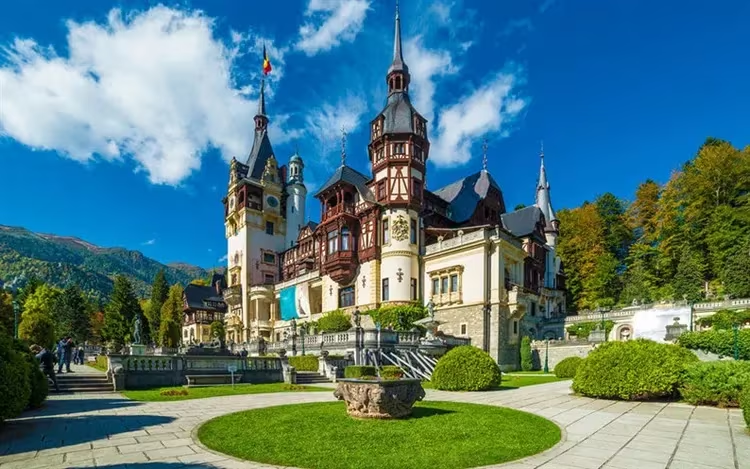
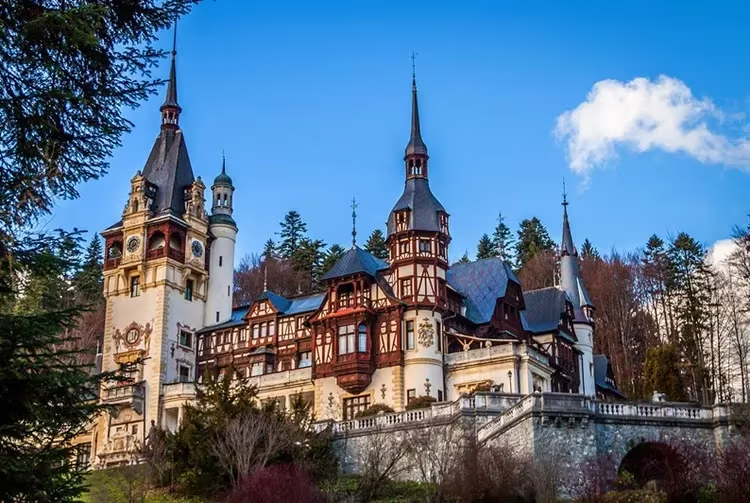
On the way from Transylvania to Wallachia, by order of King Carol I, the Peles Palace was built, which is commonly called the castle. It is 135 km from Bucharest. Its construction began on August 22, 1873 under the direction of the German architect Johann Schulz. It was originally intended as a summer residence of the king and a hunting ground. The central entrance is decorated with a sculpture of King Carol I, who considered his palace “the cradle of the dynasty, the cradle of the nation.”
It was here that two Romanian kings were born: Carol II (in 1893) and Mihai (in 1921). The sculpture of his wife Elizabeth, depicted behind the embroidery, is located in a secluded corner of the garden. The 3200 m² castle was designed in neo-Renaissance style. This building was the first castle in the world to have electricity. For this, a power plant was built on the territory. Stables, houses for protection and hunting are arranged. The tower, 66 meters high, was crowned with a clock.
The interiors are decorated in the Baroque style. In total, the castle is equipped with 160 rooms, 30 bathrooms, a theater for 60 spectators. An elevator and an air conditioning system were built here with the help of sliding ceiling stained-glass windows. Workers from different countries worked on the construction of the castle. According to Queen Elizabeth they spoke 14 languages. In 1947, King Mihai was forced to abdicate and the castle was confiscated. It received tourists, and then in 1958 a museum was created.
During the reign of N. Ceausescu, the castle was under protection, access to it was closed. The reopening of the museum was short-lived. In 2006, it was returned to its rightful owner, the Romanian King Mihai. The government paid him 30 million euros, and the castle again became available for visits. At present, the castle houses the Historical Museum, the collection of which includes paintings and sculptures from Eastern and Central Europe, silver, gold, ivory, Sevres and Meissen porcelain.
The assembled collection of medieval weapons and armor is striking. It has over 4000 exhibits. Carpets for decorating the interiors of the castle were woven in Bucharest, Mosul, Isparta and Smyrna. Leather products are delivered from Spain (Cordoba). Hand-painted stained-glass windows were brought from Switzerland. The park ensemble consists of seven terraces built in the Italian style. They are decorated with a large number of figures made of Carrara marble by the Italian sculptor Raffaello Romanelli, fountains, stairs. Open for tourists from 9 am to 5 pm (Wednesday-Sunday). It doesn't work in November either. It can be visited as part of an excursion group, they gather on the basis of the language principle.
Bran Castle
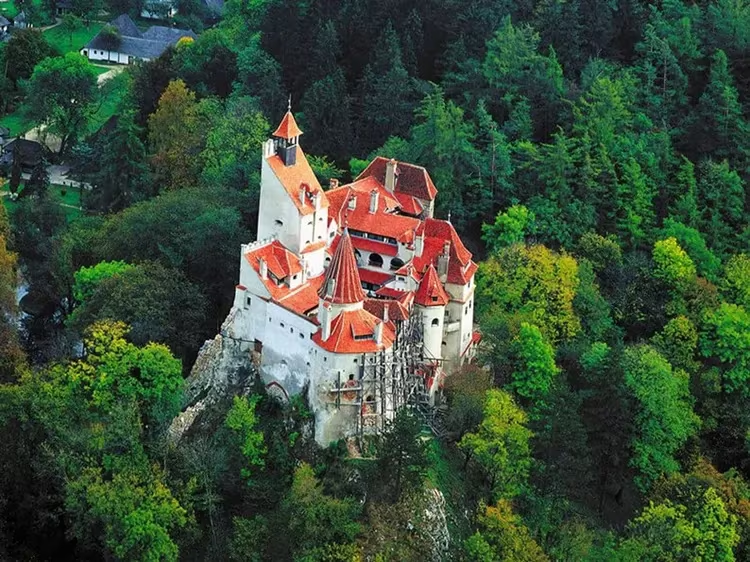
Built at the end of the 14th century, it was intended for defense and was built by the inhabitants themselves. It is located on top of a cliff 30 km from the city of Brasov and covers an area of 8 hectares. Inside, it has a complex system of stairs that allows you to move between four levels. There is a well in the courtyard, which, according to legend, leads to underground rooms. For the construction of this defensive fortress, local residents were exempted from paying taxes to the treasury for several centuries. During its existence, the fortress has repeatedly changed owners. But it got the name of Dracula's castle, since the ruler Vlad Tepes spent the night here during hikes and his favorite hunt.
There is a legend that the Turkish conquerors tortured him in the cellars of the castle. In 1918, the townspeople presented the castle to the Romanian Queen Maria. From that moment on, it began to be used as a royal residence. In 1920-26, a grandiose restoration was carried out, during which a park with fountains, alleys and its own lake was spread on the estate. In 1948, the royal family left the palace, it fell into disrepair. But already in 1956, the Museum of History and Feudal Art was opened on its basis.
In 2006, a law was issued in Romania on the return of property to the previous owners, and the castle was returned to the heirs of the queen. But before that, they took out all the historical furniture. Therefore, it fell to her grandson Dominik to re-create the interiors and buy the appropriate furnishings. Local shops are happy to sell souvenirs related to Count Dracula. In addition, the town of Bran is famous for its local cheeses, the recipes for which are passed down from generation to generation in great secrecy. Bran is a hit with filmmakers around the world. So in 1994, the film “Interview with the Vampire” was released, filmed on the territory of the fortress.
Corvin Castle
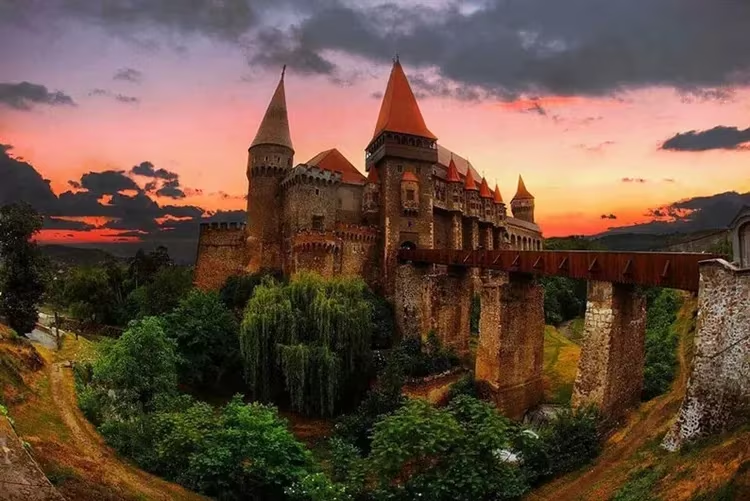
It is located near the city of Hunedoara and was presented for outstanding services by the Hungarian king Sigismund to the Romanian military and political leader Janos Hunyadi. He decided to rebuild it and make it a family estate. The restoration was carried out in two stages. During the years 1441-1446, seven towers were erected, in the years 1446-1453 – a chapel, halls and utility rooms in the south wing. The castle was inherited by the son of Janos, Matthias Korvin, who continued construction work in the chapel and in the northern wing.
The architectural style of the castle includes Gothic elements combined with Quattrocento (early Renaissance) fragments. According to legend, the Transylvanian Count Vlad Tepes was kept in the dungeons of the castle for seven years after the overthrow. Since 1508, the castle has repeatedly changed owners until it was in the hands of Gabor Bethlen, who led the anti-Habsburg movement in the Kingdom of Hungary. He carried out a reconstruction in it in the light of the latest fortification requirements.
But in the 18th century, the Habsburgs still began to own it. Under them, in 1854, a fire broke out in the castle, destroying the interior wooden trim. During the years 1868-74, a reconstruction was carried out here, as a result of which the roof was covered with tiles. During the communist rule, the castle was also reconstructed and opened to visitors.
Points
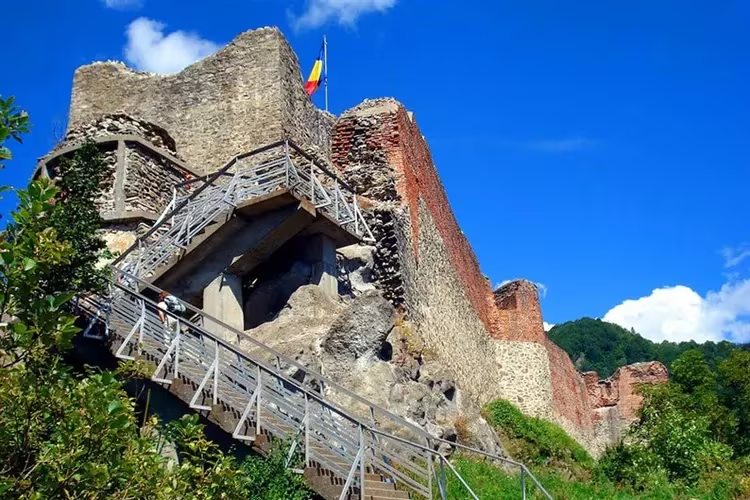
It is located in Arefu (rum. Arefu), which is a few kilometers from Lake Vidraru. Presumably it was built by Radu Negro, nicknamed the Black Governor. This is the semi-legendary founder of the Vlach state. At that time there was only one tower and a small guard garrison. In the 15th century, it belonged to the famous ruler Vlad Tepes, who did a lot to strengthen it.
He built four more towers, expanded the castle buildings. Traditions say that it was in it that Dracula tortured his opponents. After his death, the territory began to fall into disrepair, which was aggravated by the earthquake of 1888. The last restoration work was carried out in 1972. At this time, the masonry of the walls was strengthened and bridges with railings were built for the convenience of tourists.
Archaeological excavations have made it possible to assert that the fortress in the bed of the Argesh River has existed since time immemorial. It allowed to control the territory between Transylvania and Wallachia. To get to the ruins, you will have to overcome 1480 steps of a steep staircase leading to the top of Mount Chetetsuya. There is a platform on it, from which, according to legend, the wife of Count Tepes, Elena, rushed into the gorge.
Romanian Athenaeum
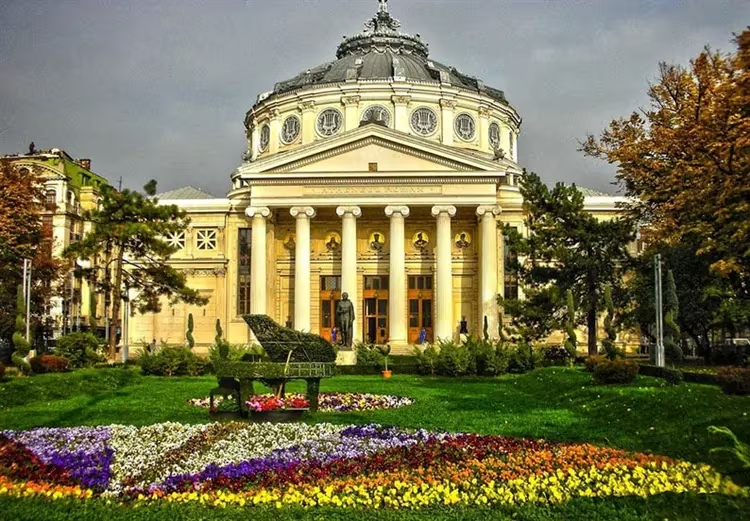
In 1865, the Ateneum Society (Atheneum) was founded in Romania, and in 1888, the construction of the building began at the expense of the Wallachian boyar family of Vacarescu. In addition, for its construction, people's money was also used, collected under the motto “Donate one leu to the Ateneum!”. This is a concert hall located in the capital city of Bucharest. The author of the project was the French architect Albert Galleron. It is built in neoclassical style with romantic elements.
On the first floor there is a meeting room, and on the second floor there is an auditorium with 600 seats (52 additional seats are located in boxes). The interior of the auditorium is decorated with a fresco by the artist Costin Petrescu depicting significant events in Romanian history. Painting work was carried out for 6 years, starting in 1933. On April 22, 1939, a concert was given in honor of the construction of a concert organ.
Organ music was performed by Franz Schütz, director of the Vienna Academy of Music and Performing Arts. In front of the Ateneum building there is a small park with a monument to the classic of Romanian poetry, Mihai Eminescu. Currently, the concert hall is considered a symbol of Romanian culture and is included in the List of European Cultural Heritage.
Rasnov Fortress
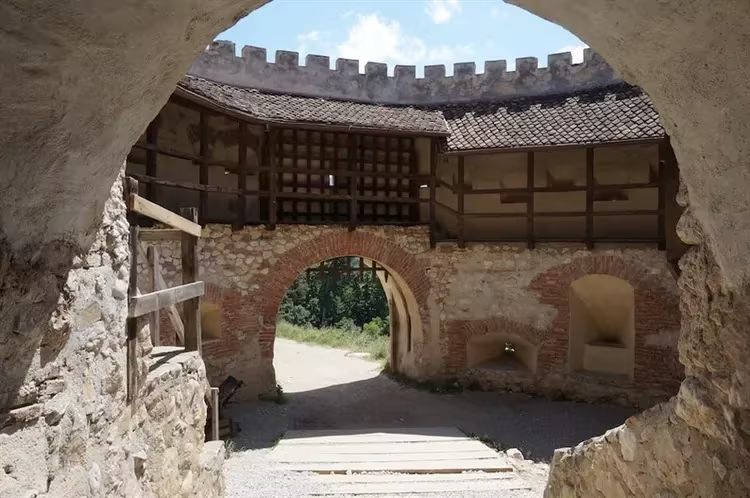
The fortress in the city of Rasnov was founded by the Teutonic Knights in 1215. It served to shelter the local population from numerous conquerors and was so fortified that it was conquered only once in 1612 by the Transylvanian prince Gabriel Bathory. There is a well in the center. A terrible legend is connected with him. During the siege by the Ottomans, the inhabitants did not have enough drinking water. Then they forced the two captured Turks to dig another well 62 meters deep.
They were promised freedom, but at the end of the work, which lasted seventeen years, the captives were killed. During restoration work, two human skeletons were indeed found at the bottom of the well. Currently, the territory is freely visited by tourists. From the fortress there was a fortress wall with towers and the foundation of the church. The observation deck offers a panorama of the two-story city and beautiful surroundings. From here you can see Bran Castle.
Merry Cemetery
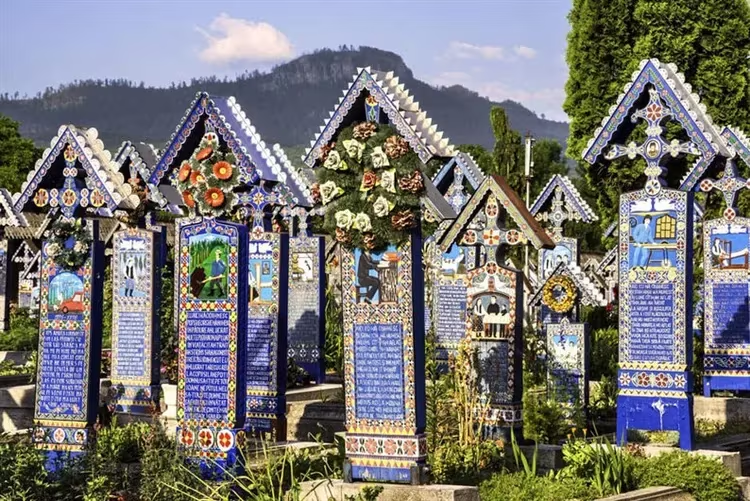
The original cemetery is located in the village of Sapanta in Maramures County. His tombstones are made in bright colors and have original inscriptions in poetic form. They reflect the life path of the buried villagers. This idea of the cemetery belongs to Stan Jon Patras, a local wood carver. He was the first in 1935 to carve and install a cross with a cheerful inscription. Over the years of its existence, more than 800 such crosses have been installed on the churchyard, and it itself has turned into a museum that tourists like to place. There is an inscription on the grave of Stan himself. It reads: “In all my life I have not harmed anyone…”.
mud volcanoes
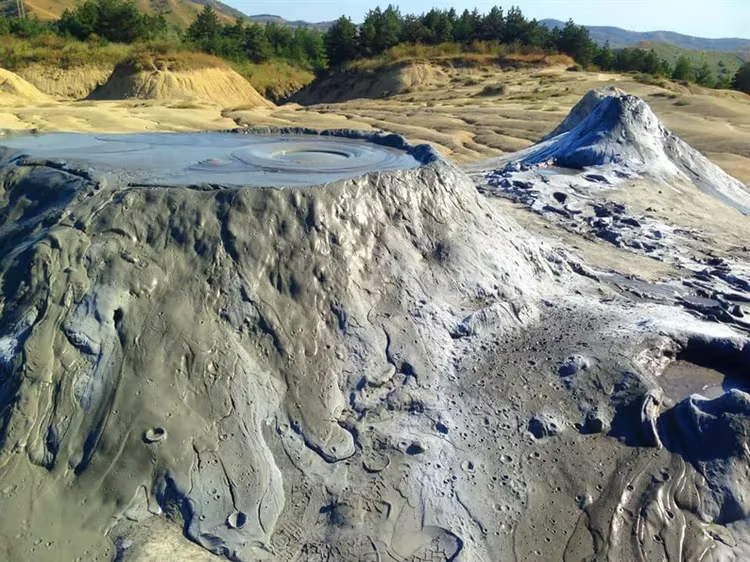
The natural reserve Vulcanii Noroiosi was created in the 20s of the XX century near the city of Buzău, located about 100 km from Bucharest. They originated on the territory of an abandoned mine. In 1977, an earthquake occurred in Romania, and special volcanic activity began to appear. As a result of the escaping gases, dirt and salt water are thrown to the surface. They freeze under the sun and form peaks resembling craters.
Currently, four such volcanoes are constantly active, and twelve – periodically. The originality of the couple is given by the green hills surrounding the reserve. Between the craters are frozen streams. Their cracks on the surface of clay soil reach 5 cm. You can freely enter the territory of the reserve and spend several days in a tent city or as part of an excursion group.
Scarisoara cave
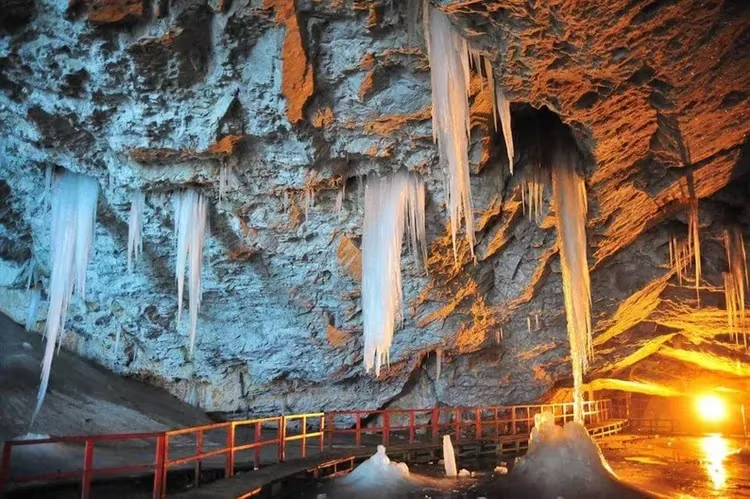
The Bihor Mountains are located 134 kilometers from the city of Cluj-Napoca. They found a cave 1 kilometer long, which was formed approximately 3500 years ago as a result of glaciation. Scarisoara was first mentioned in 1863. Then the Austrian geographer Arnold Schmidl made her map. A glacier was discovered in a grotto located underground in the mountains, which is gradually disappearing as a result of melting. The stalagmites found in the halls resemble church candles.
Therefore, the cave is conditionally divided into halls called the Great Hall, the Church, the Cathedral. Currently, the cave is equipped with metal and wooden stairs, which allows you to freely visit it. Illuminated inside with carbide lamps. Some part of the cave is being studied by scientists. The temperature inside the grotto is approaching zero. Therefore, when visiting the sights, you need to take warm clothes with you.
Pelisor Castle
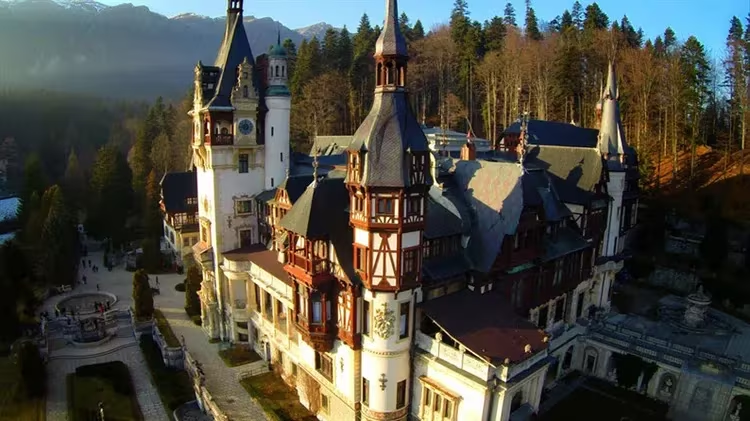
This is a small part of the Pelis complex, built in 1899-1903. It was intended as the summer residence of the heir to the Romanian throne, Ferdinand. The Art Nouveau castle was designed by the Czech architect Karel Liman. In the design of the castle, Ferdinand's wife, Princess Mary, who had a very delicate taste, was directly involved. She successfully combined Art Nouveau elements with Byzantine and Celtic symbols.
The castle has 99 rooms. They are decorated with furniture designed by the Viennese designer Bernhard Ludwig. In addition, the interiors were developed by him together with Queen Mary. Therefore, they have a special sophistication. In order for the castle to have a lot of light, the large windows and the ceiling of the Main Hall, three stories high, are decorated with stained-glass windows. It is finished with oak panels and decorated with portraits of the owners of the castle and their children.
Maria herself developed sketches of furniture for the “Golden Bedroom”. It was made in 1909 in the workshop of the city of Sinai. In the Queen's office there is furniture with the image of lilies and the Celtic cross – the symbols of the princess from Scotland. The office of King Ferdinand, on the contrary, is designed in a strict German neo-Renaissance. The castle contains a unique collection of works by modern masters of modernity, including the designers Halle, the Daum brothers, Hoffman, Tiffany, Gurshner.
Monastery Sucevitsa
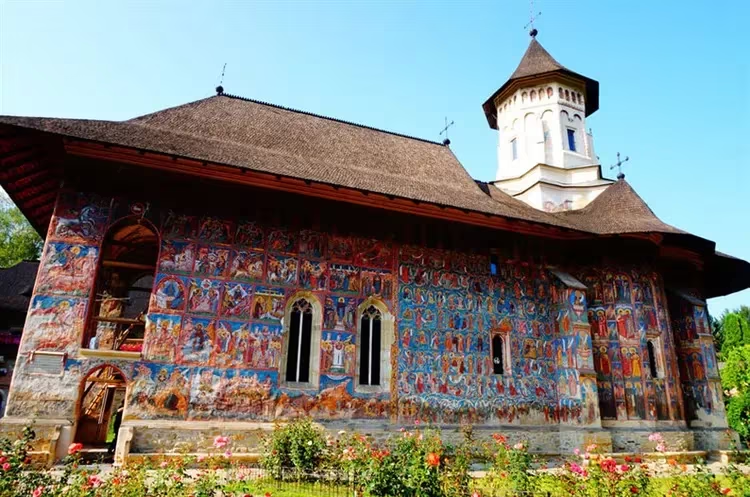
It is located in Bukovina, in the northeastern part of the country. The nearest town of Radauti is 18 kilometers away. In 1585, it was built by brothers from the Wallachian family Mohyla Jeremiah and Simon. The square-shaped monastery is surrounded by six-meter walls. Towers were built in the corners for fortification. Its architecture contains both Byzantine and Gothic elements. The building inside and outside is completely covered with unique paintings based on the Old and New Testaments.
They were made by Moldavian masters brothers Ion and Sofroniy with the help of a huge number of unknown masters. The unique interior painting serves the idea of spiritual renewal of a person with the help of faith and pious deeds. In 2010, the monastery was included in the World Heritage List. Currently, one of the walls is used for the museum, which houses a large exhibition of historical items.
Mogoshoai Palace
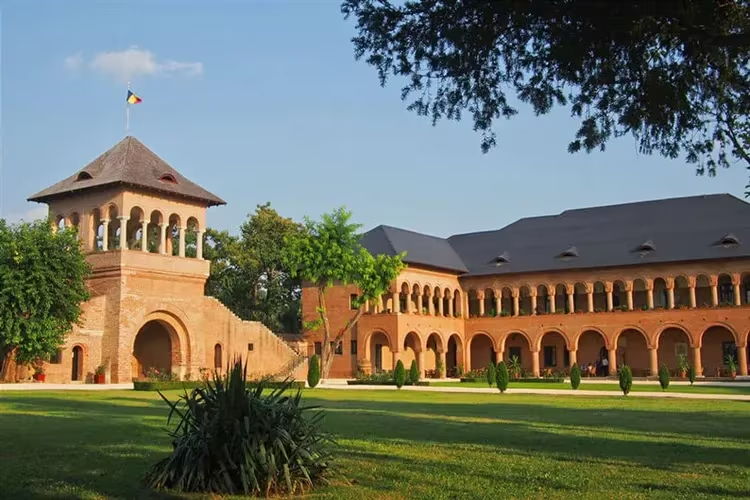
In 1698-1702, the Wallachian ruler Konstantin Brankoveanu built a palace and park complex 16 km from Bucharest as the summer residence of his family. Constantine was the founder of a national architectural style that combined Venetian, Dalmatian and Ottoman elements. It contains numerous carved decorations and decorative paintings. In 1714, the Ottomans executed Brynkovyan, and a hotel was set up in his palace.
Having recaptured it during the Russian-Turkish war, in 1853 the Russians set up warehouses for weapons in it. The princes of Bibescu, who became the new owners of the palace complex, began its restoration in 1860-1880. They managed to recreate and decorate the palace, which they owned until the Second World War. In the 1920s, it belonged to the widow Marta Bibescu, who put a lot of effort into its restoration and opened a salon in it.
Many famous people of the first half of the 20th century, including Antoine Saint-Exupery, became its visitors. It was her name that the palace and park ensemble began to bear. Representatives of the princely family of Bibescu found peace in the church of the park. Despite significant restructuring of the 20th century, the main elements of the national style are inherent in the palace. In 1957, the Brynkowiec Art Museum was opened here, including antique furniture and household items of the 17th-19th centuries, historical documents, icons and works of art.
throne fortress
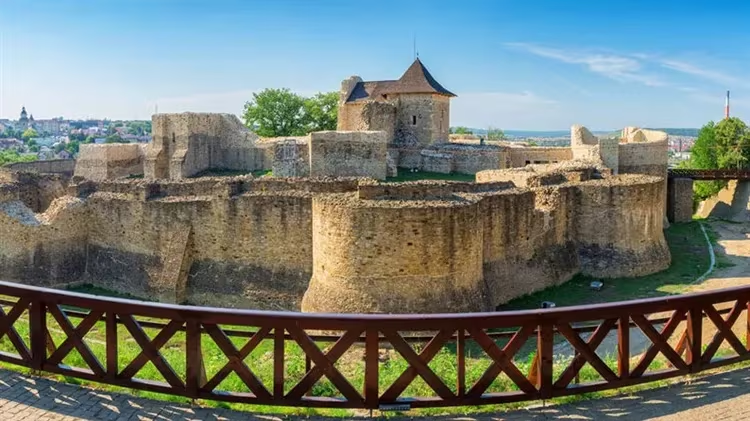
The fortress of the XIV century served as the place of coronation of Moldavian rulers. Located in the city of Suceava, it is currently a ruin. Restoration of the remains of the once powerful fortress began in 1961 and is still ongoing. The almost square fortress of 40×36 meters had square towers. A moat was dug around it. Its depth reached 10 meters. The fortress was founded by Peter I Mushat, but it was of the greatest importance under Stephen III the Great (Stefan cel Mare).
He reinforced two-meter walls of solid stone, built an additional defense system of walls 10 meters high, which was carried out 20-25 meters forward. Inside, additional halls were built for members of his family. Its siege by the Ottoman troops was unsuccessful, until in 1563 the self-proclaimed ruler Stefan VII Tomsha took refuge in it. The mercenaries betrayed him and surrendered the citadel to the Turks. After that, she was burned, passed from hand to hand of proteges of the Turkish Sultan.
In 1675, by order of Dumitrash Kantakouzin, it was blown up. The remains were destroyed by an earthquake. The revival of the fortress began after archaeological research by the Austrian architect Karl Romstorfer at the beginning of the 20th century. But reconstruction began only in the 60s. Nowadays, the remains of the fortress can be visited for a fee.
Neamt fortress
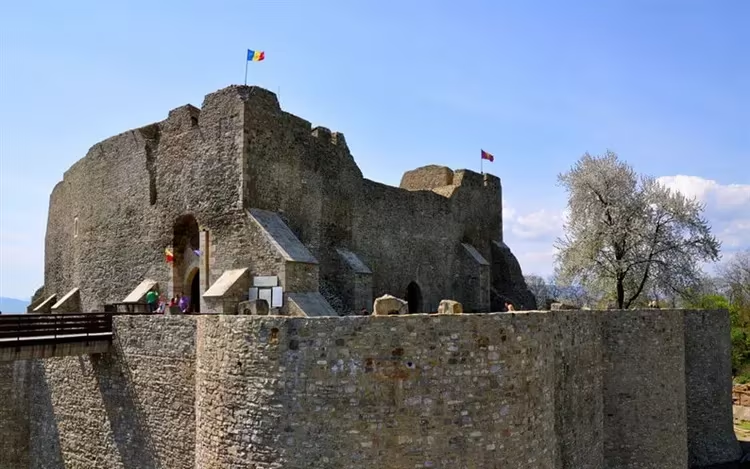
During the reign of Peter I Mushat, the Neamt fortress was also built. It is located near the town of Targu Neamts. Legends say that the Teutonic Knights were the first to fortify this place. They appropriated large territories in Transylvania and colonized Semigradje. The name Targu Neamts is translated as “German Bargaining”. Stefan the Great, in preparation for the fight against the Turks, was engaged in strengthening the ring of fortresses, including Neamtskaya.
By his order, its walls were increased by 20 meters in height and an outer courtyard was built, where artillery pieces were installed. A huge bridge was thrown across the moat, reminiscent of a Roman aqueduct and bridges of the 20th century at the same time. A well was dug in the courtyard to supply drinking water in case of a siege. But neither the Ottomans nor the Polish commander Jan Sobessky could take it.
The Turks got into the fortress only thanks to the conquest of Moldova, but they did not destroy it. Left as an observation post. Currently, there is a small museum exposition in the fortress. It presents household items of the defenders of the citadel. Reconstruction began in 2007-09. Thanks to her, a reliable road has appeared for tourists who place this place, the infrastructure has been improved, and the architecture has been updated.
Gorge Bicaz
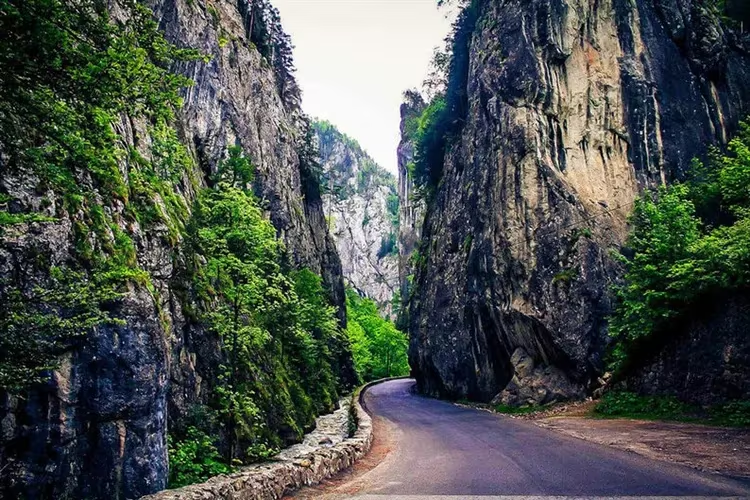
In the Eastern Carpathians there are rocks of the Bikaz gorge. It stretched between Moldova and Transylvania, and served as the only natural road. Bicaz is the deepest and longest gorge in Romania, its banks are separated by the river of the same name. Currently, this is a protected area with almost sheer cliffs over an 8-kilometer highway.
Photography is allowed in certain areas. Passing along the highway in awe of the surrounding beauty of nature is breathtaking. In 1961, a hydroelectric dam with a reservoir was built at the exit from the gorge. It is recognized as the largest Romanian lake. River trout is found in the waters of the Bikaz River, and red-winged wall-climbers, considered rare birds, live on the rocks.
Chahleu
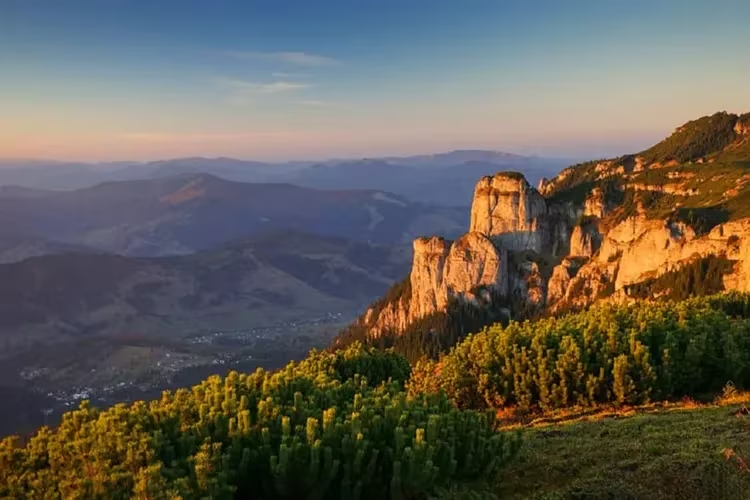
One of the most famous mountain ranges is also located in the Eastern Carpathians. It is located near the town of Spring Lake Mountain in Neamt County. The highest points are Toaka (1904 m) and Okolashul-Mare (1907 m). The massif is surrounded by the Bistritsa and Bikaz rivers, in the east – Lake Bikaz. In the national park there is a monastery “Transfiguration”, and Mount Chakhlau is recognized as the second Christian mountain after Athos. Many pilgrims flock here to visit the monks who have taken refuge on the top.
A beautiful legend is connected with the formation of mountains. According to her, the ruler of the Dacians, Decebalus, had a beautiful daughter, Dokia. After the capture of Dacia by the Roman emperor Trajan, she went to the mountains of Chahlau, so as not to get to him. Here she herded goats and froze. According to one version, the Virgin Mary turned it into a stream, and the sheep into beautiful flowers around. According to another, the girl turned into rocks. According to another legend, the emperor Trajan ordered the mountain to be poured in order to block the way for the barbarians who attacked from the East.
Laku— Roshu
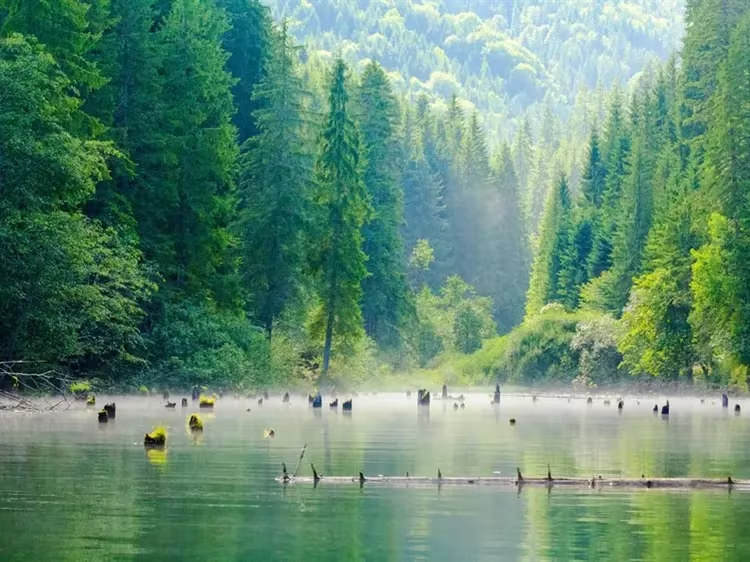
Near the Bikaz gorge there is a lake, formed in 1837 at an altitude of 978 meters. One of the rocks was washed away by heavy rain showers. The fallen stones formed a dam in the shape of the letter “G” on the site of the former pastures. The coastline of the lake is 2830 meters, and the depth reaches 10.5 meters. A beautiful fairy tale is associated with it. Nearby lived a girl, Esther, whose lover was drafted into the army.
She was very sad, and often cried alone near a mountain stream. Here a robber met her and stole her away. The girl begged the mountains to save her, and nature took pity. The mountains shook, the earthquake killed everyone, including the innocent shepherds. The collapsed rocks formed a lake with tree trunks sticking out of the water and hid the unfortunate Esther in their waters.
Canyon 7 stairs
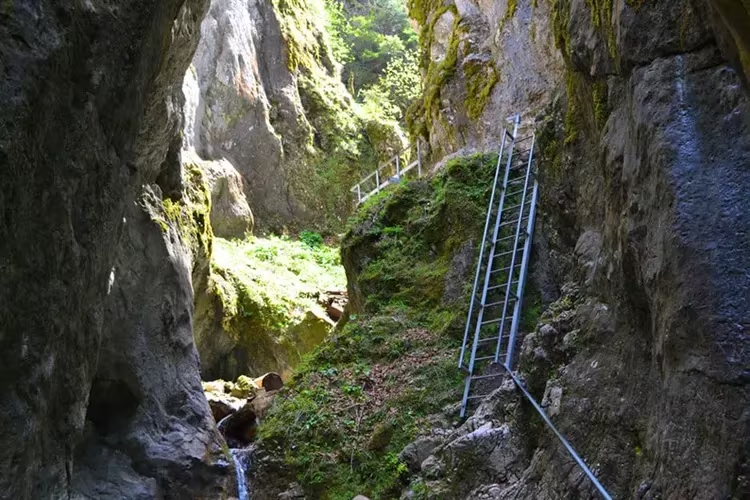
The gorge got its name in the 20s of the XX century, when crossings for the local population were stretched here. They stretched for 230 meters with a height difference of 55-60 meters. It is held in groups without special equipment. From time to time on the route there are small waterfalls, additionally spraying tourists with water.
Scientists attribute the formation of the canyon to the Jurassic period. It is assumed that its bottom is the base of the ancient sea, along the shores of which dinosaurs lived. In addition to the marvelous nature, legends attribute miracles to the canyon. Young people, in order to test their future wives, invited girls for a walk along the bottom of the canyon. Thus, they figured out her endurance. Then the girls were invited to spend the night above him, climbing up the seven stairs.
If in the process of testing young couples did not quarrel, but helped each other, a long happy life awaited them. And in our time there are daredevils who repeat the instructions of ancient legend. The atmosphere of the gorge is filled with very ozonized air, which kills all conceivable infections, thereby contributing to a strong healing effect.
Retezat National Park
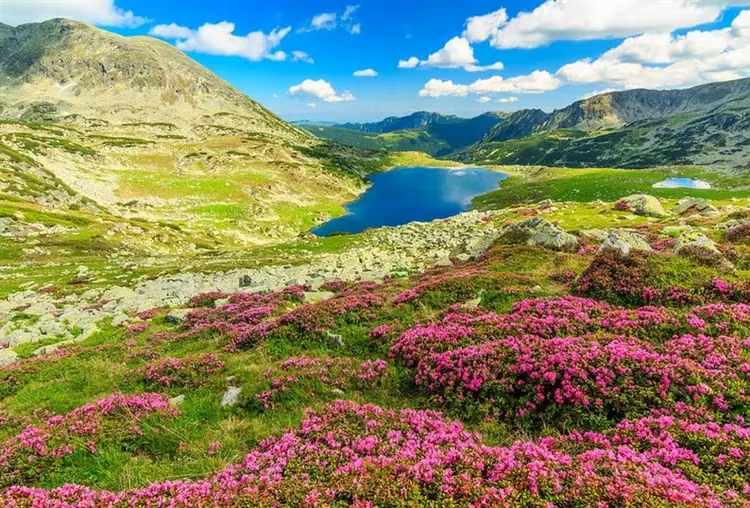
This is the first national park in Romania, founded in 1935. The main reason for the formation of the protected area was the desire to preserve the unique alpine vegetation. On an area of 381 km², located at an altitude of 2000 meters above sea level, traces of glacial lakes have been preserved. It is here that the deepest Romanian lake, Lake Zenoaga, is located. At an altitude of 2509 meters is the peak of Mount Peleaga.
1190 plant species have been found in the park, of which 90 are endemic. Alder, rhododendron, krupka, bluegrass, hawkweed grow here. The reserve is home to many wild animals. Among them are brown bear, forest cat, lynx, wolves. It is home to a large number of birds: horned lark, brown vulture, rare golden eagle, white-throated thrush and many others. Because of them, the national reserve has been declared a specially protected area.
Piatra Craiului National Park
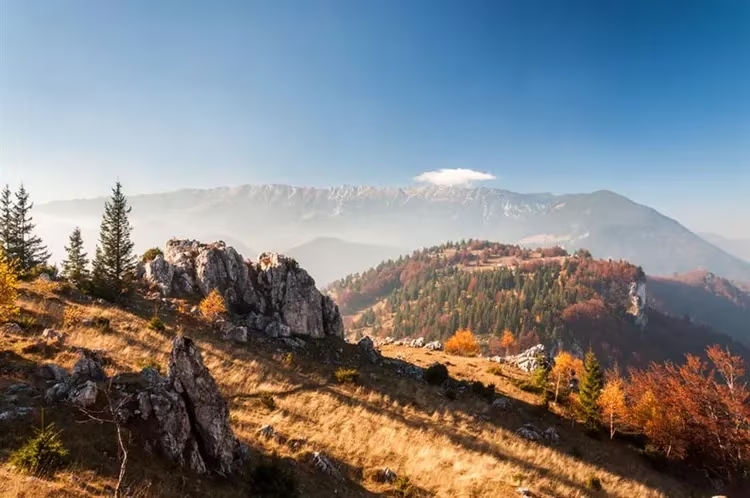
Another interesting corner of Romania is located 200 kilometers north of Bucharest in the Southern Carpathians. The date of formation of the protected area is considered to be 1938, which became a national park in 1990. The total area of the reserve is 14,781 hectares. Its karst landscape with limestone outcrops is distinguished by a variety of flora and fauna. Among 1170 species of vegetation there are pines and willows, alder, hornbeam, oaks.
48 species of representatives of the orchid family grow. Among the representatives of the living world of some birds, there are 11 species. These are thrush, cuckoo, oriole, kayuki, golden eagle and many others. But there are only 3 types of fish: barbel, stream lamprey and sculpin. Walking routes are organized for any physical condition. They allow you to admire the beauties of Romanian nature: mountain gorges, valleys and glacial lakes.
Rodna mountain range
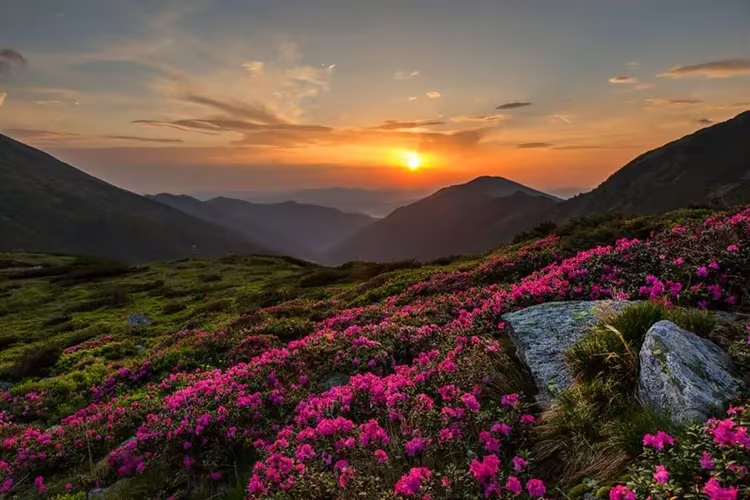
Another Romanian mountain range near the Ukrainian border. It is formed by granites and crystalline rocks. Pyrite deposits have been discovered here. On the territory of the massif there is the Rodna National Park with an area of 46,599 hectares. It was created in 2000 and is a unique territory of glacial cracks and caves, valleys, forests and mountain pastures. Some of the inhabitants of the park are protected by law. Common mammals include brown bear, wolves, lynxes, capercaillie and eagle.
Sarmizegetuza
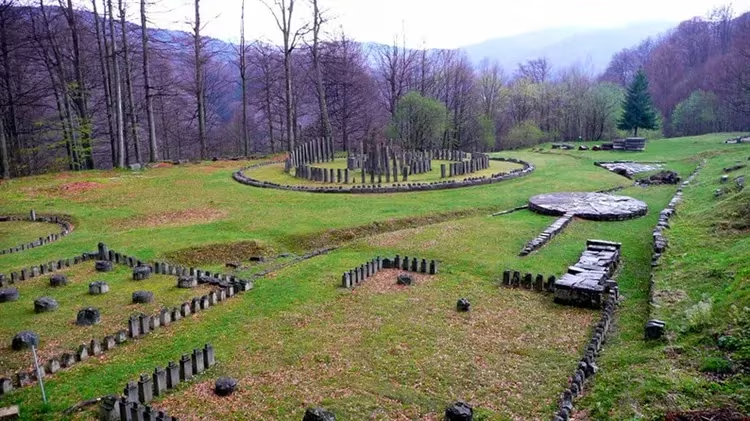
In the southwest of Transylvania, the territory of Dacia was located. Its residence and main military and political center was Sarmizegetusa, located on the Gradishtea-Muncheluluy hill. It received such an interesting name in honor of the conclusion of a truce between the tribes of the Sarms and Getae. The last Dacian ruler Decebalus included it in his defensive system. It was destroyed by Roman troops during the conquests. In 1999, the remains of Sarmizegetusa were inscribed on the UNESCO World Heritage List.
The fortress was located at an altitude of 1200 meters above sea level, had a quadrangular shape and occupied 30,000 m². In addition to its defensive significance, it was also a religious center, since it contained important sanctuaries for the Dacians. It is assumed that the cave on Mount Kogaionon, located here, served as a shelter for the god Zalmoxis. Several sacral sanctuaries were found on the top, the road to which is paved with tightly fitted parallelepiped stones. In the houses located on the terraces of the mountains, ceramic pipes were laid, through which water flowed. This made it possible to draw a conclusion about the high culture of life of the Dacian tribes.
Vidraru Dam
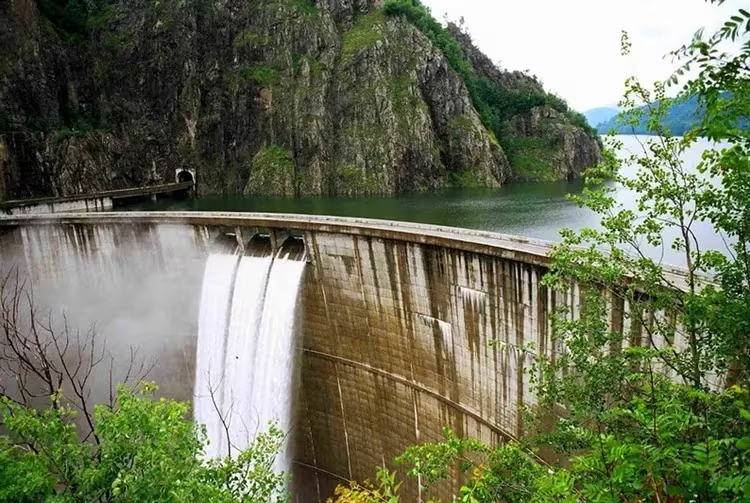
A dam was built on the Arges River in 1961-66, which flooded the village of Arges Arefu. The area of the artificial lake is 870 hectares. This is the highest dam in Romania. It has a shape resembling a bow, up to 167 meters high and 305 meters long. At the time of commissioning in the 60s of the XX century, the dam was considered the ninth largest in the world and the fifth in Europe. Currently, the dam is undergoing extensive repair and restoration work to modernize and strengthen existing capacities. An observation deck with an iron figure of Prometheus was built next to the dam, which was previously allowed to climb a stone staircase.
Currently, security is working around the dam, since a large amount of explosives are located on the slopes of the mountains in case of a water breakthrough. In this case, in order to prevent an accident as soon as possible, it will be easier to create an artificial barrier. Boat rides and a bungee jumping attraction resembling a bungee are organized along the reservoir.
Bucegi Sphinx
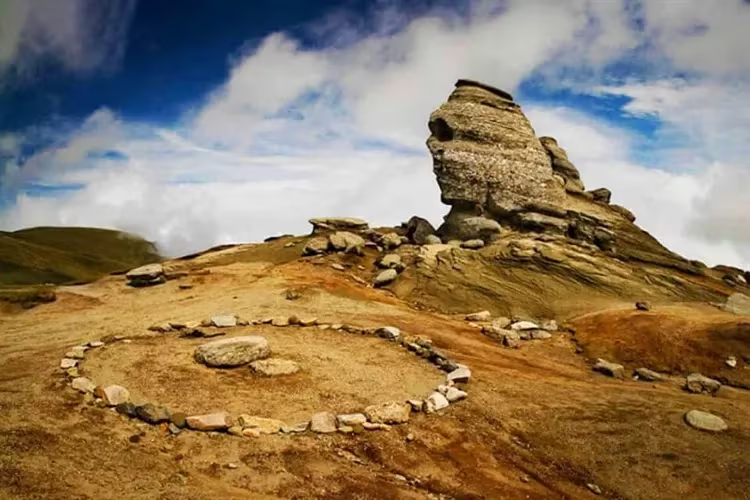
In the mountains of Bucegi, located in the center of the country, at an altitude of 2216 meters, there is an interesting natural formation. It is very similar to the Egyptian Sphinx. As a result of wind weathering of sandstone and calcareous rocks, such a miracle was formed in the Southern Carpathians. It is assumed that in this area there was one of the centers of Atlantis, where the landing sites of an alien civilization were located. A clairvoyant lives in the city of Iasi, who claims that under the Sphinx there is a labyrinth that hides treasures with the knowledge of an ancient civilization that will be revealed to humanity when it is ready for this. Bucegi Sphinx is included in the List of seven natural wonders of the country.
Kurtya-Veche
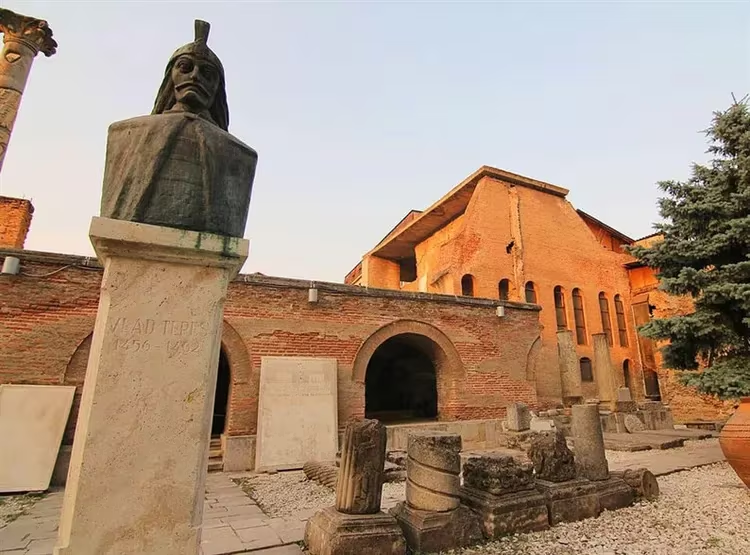
The Old Courtyard (Rom. Curtea Veche – Old Court), or the Prince's Court (Rom. Curtea Domnească din Bucureşti) is a complex of buildings designed to serve the Wallachian rulers. It was built in the second half of the 14th century by the ruler Mircea Sarym. After his death it was not used. In the 15th century, Vlad Tepes decided to build the Dymbovitsa fortress on its ruins.
The stone fortress founded on September 20, 1459 is considered the foundation of Budapest. After him, special attention to the fortress began to be paid after 1545 under Mircea Chobanul, who founded the church of St. Anton (hramul Sf Anton) and the Annunciation (de Buna Vestire). Later, coronations of Romanian rulers were held in it. It is currently the oldest building in Bucharest.
Occurring fires and natural disasters led to the desolation of the palace and the transfer of the government residence to another place, and this fortress was given the name of the Old Court. Currently, it is an open-air museum that tells about the past of the Romanian capital. Here you can see the remains of a water pipe, murals and decorations of the building, fragments of defensive fortifications and galleries of the Courtyard, as well as a Turkish bath built on its territory.