
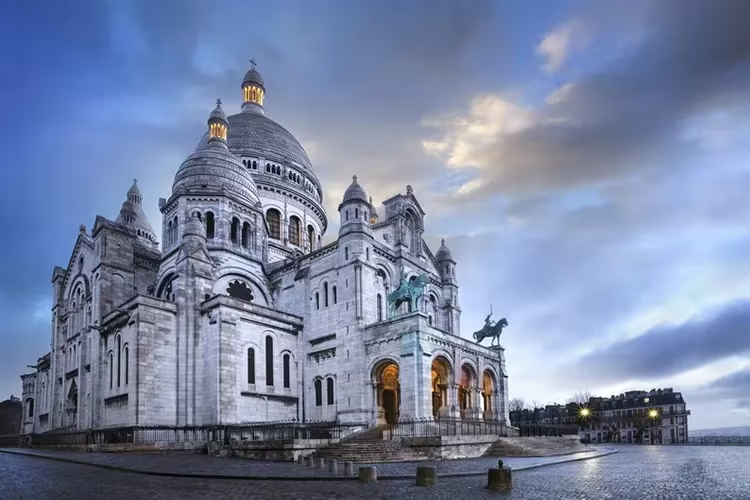
The Sacré-Coeur Basilica is the most beautiful cathedral on top of Montmartre, which can be seen from anywhere in Paris on a clear day.
Construction history
The decision to build the Sacré-Coeur Basilica was born on September 4, 1870, the day the Third Republic was proclaimed. On that day, Bishop Fournier broke into a pathetic speech about the defeat of the French troops in the Franco-Prussian War as divine punishment for “moral decline” after the French Revolution.
A society split into devout Catholics and legitimate royalists on the one hand, and democrats, socialists and radicals on the other, was punished. Although some sources state that the basilica was erected in honor of the fifty thousand who fell during the war, according to the order of the National Assembly in 1873 (in response to the wishes of the archbishop), the basilica was built in order to atone for the sins of the Paris Commune.
It was in Montmartre that the first uprising of the Paris Commune took place, and Archbishop Darois was executed there, who became a kind of martyr for the resurgent Catholic Church. His successor claimed that in October 1872 he had a vision, and in the clouds that dissipated over Montmartre, he saw the truth: “It is here, here, where the souls of the martyrs are, here the Sacred Heart must reign, becoming a beacon for the suffering.”
With the resignation of the government of Adolphe Thiers in May 1873, Bishop François Pied expressed the national desire for spiritual renewal: “The hour of God has come,” of which the Sacré-Coeur is the main, material monument. All French parishes were involved in financing the future basilica, and the construction itself took several decades (1875-1914).
The architect of the project was the talented creator Paul Abadi, who bypassed more than seventy-seven rivals. In 1880, there was an attempt to stop construction when the basilica was called “an incessant provocation to civil war.” The matter even came to a discussion in the House of Parliament, where the project was defended by the archbishop, despite the assertions of Georges Clemenceau (the future prime minister) that the basilica was a material stigmatization of the revolution. Another attempt to stop work was prevented in 1897, although by that time almost the entire interior had been completed, and the Sacré-Coeur had been working for almost six years.
Abadi passed into the other world in 1884, catching only the erection of the foundation, and construction continued under the direction of five architects: Honore Dume (1884-1886), Jean-Charles Lianat (1886-1891), Henri-Pierre-Marie Raoulet (1891-1904), Lucien Magnier (1904-1916) and Jean-Louis Houlot (1916-1924). All major work was completed by 1914, but the war intervened, and the temple was consecrated only in 1919.
The money for the basilica, estimated at seven million French francs and entirely from donations, ran out even before the visible above-ground part appeared. The temporary chapel was consecrated in March 1876, and the donations of the pilgrims became the basis of the budget for the future basilica. Anyone who left a donation could lay, for example, a commemorative brick.
The English geographer and historian David Harvey noted that the echoes of the “martyrs” can still be heard within the walls of the basilica. This idea is confirmed by the fact that in 1971, demonstrators, pursued by the police, took refuge in the Sacré-Coeur, in a church “built on the corpses of Communards.” This provocative statement was very eloquently illustrated in the leaflets distributed by them.
Architecture
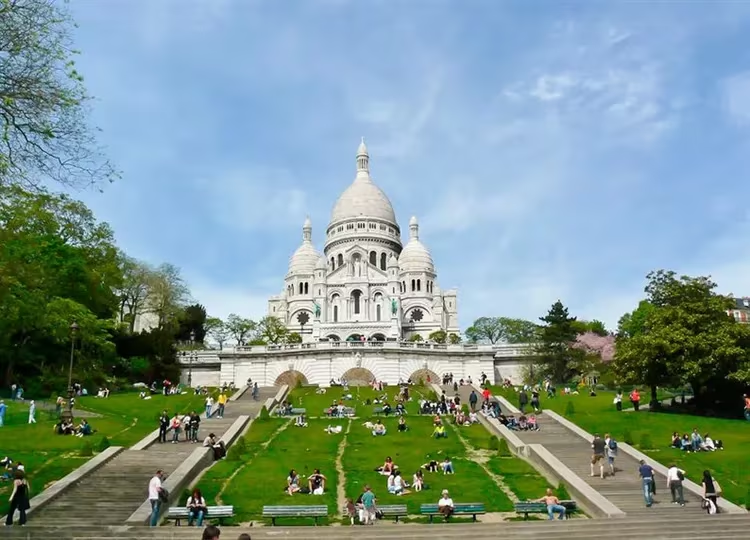
The Basilica of Sacré Creux is an extraordinary architectural structure. This is a massive assignment that has managed to retain its bright white color even in a city as noisy and dirty in places like Paris. The trick is that the building was built from travertine mined in the mines of Chateau Landon. Its main feature is that upon contact with rainwater, the stone acquires a white tint.
Thus, the temple illuminates the capital with its snow-white walls. The general stylistic solution is very unusual – the holy temple is permeated with Roman-Byzantine features, which is clearly opposed to the excess of the French Baroque in the decoration of the Granier Palace.
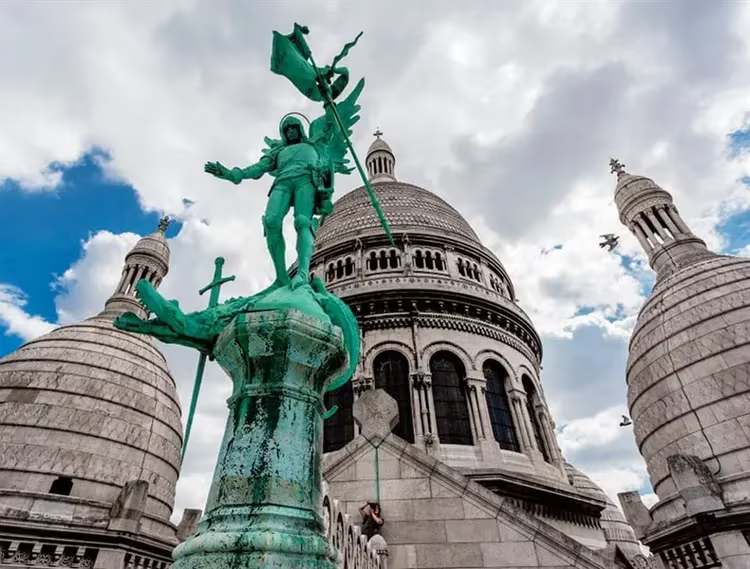
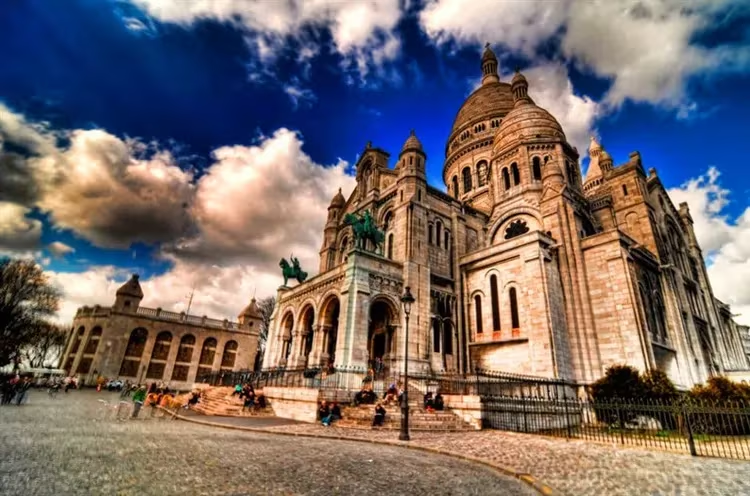
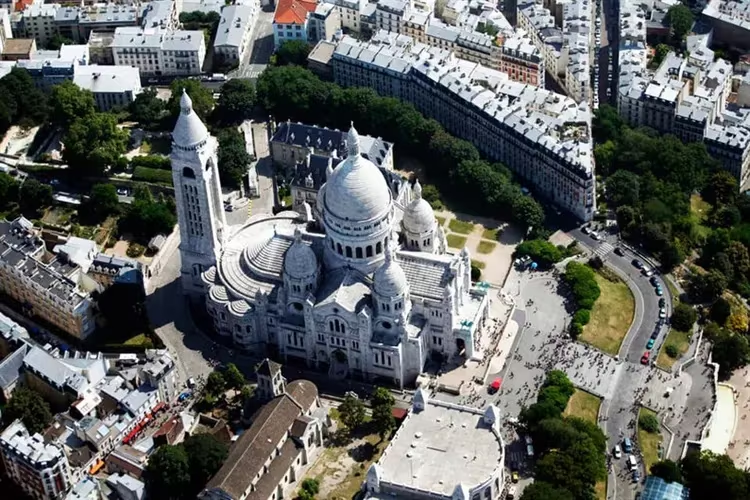
Many design elements of the basilica symbolize nationalistic motifs: in the gallery, which has three arches, there are bronze statues of Saint Joan of Arc and King Saint Louis IX, cast by the sculptor Lefebvre, there is also a nineteen-ton bell called “Savoyarde”, cast in Annecy and erected in honor of the entry of Savoy into France in 1860. The basilica complex includes a meditation garden with a fountain. The top of the dome is open to tourists, it offers an unforgettable view of Paris (the entrance to the top is paid).
Interior decoration
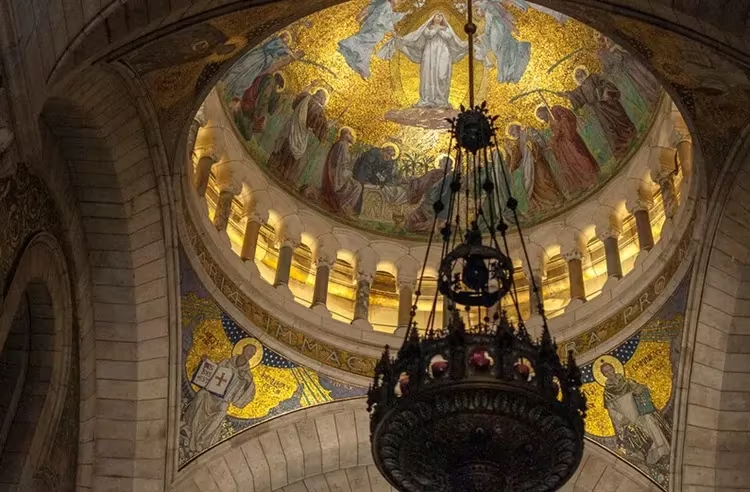
Similar to the exterior, the interior of the basilica is decorated in the Roman-Byzantine style, which gives the “House of the Lord” an atmosphere of harmony and peace. Light and some design details focus attention in such a way as to focus on the semicircular apse. Amazingly beautiful stained glass windows were destroyed by the bombing of 1944 and replaced in 1946. Also in the interior there are two important elements that complete the delightful ensemble: a mosaic and a great organ.
The 475 square meter mosaic depicting Jesus Christ is one of the largest in the world. Jesus is depicted resurrected, dressed in white clothes and with outstretched arms, as if opening his heart to people. He is surrounded by admirers, including the saints who defended France: the Virgin Mary, St. Michael, St. Joan of Arc, as the personification of France, offering the crown, and Pope Leo XIII.
The large pipe organ of the Basilica is unanimously considered one of the most stunning not only in Paris, but throughout Europe. This instrument is the last work of the renowned master Aristide Cavaillé-Col. Due to its impressive size and unique sound quality, the French government recognized the organ as a national monument in 1981.
Opening hours and visiting rules
The Basilica is open to the public daily from 6 am to 11 pm. After 11 a.m., only persons registered for the night service can remain on the territory of the Basilica.
Since the Basilica of Sacré Creux is a Catholic church, there are several basic rules for visiting:
Where is it located and how to get there
Address: 35 Rue du Chevalier de la Barre, 75018 Paris, France
Metro:
By bus:
Buses numbered 30, 31, 80 and 85 (stop Anvers Sacr-Coeur).