
Tower of London – history, photos, descriptions, prices 2021, opening hours, map
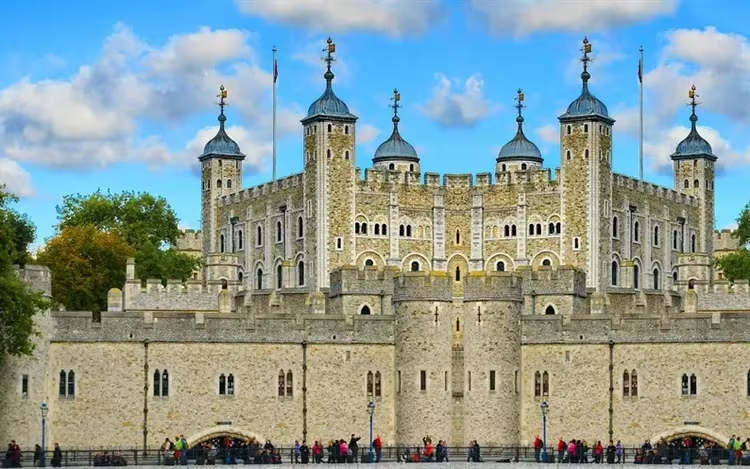
The Tower of London is the hallmark of the city. It is located in its historical part and is the largest architectural and museum center of this type. Every year it is visited by thousands of tourists who are eager to take a hundred or two photos and remember the unique atmosphere of this place forever.
Story
The foundation of the Tower of London is associated with the name of William the Conqueror, who, after the Battle of Hastings in 1066, began to actively strengthen his power. It was decided to establish a number of fortified points, one of which was to be located on the ruins of the old city walls, laid down by the Romans. So on the banks of the Thames appeared the first fragment of the White Tower, a stunning fortification, inferior in size only to the donjon of Hedingham Castle.
Soon the tower began to serve as a prison. An amazing story is connected with its first prisoner – Ranulf of Flambard. The first prisoner became the first fugitive: good friends gave the clergyman a bottle of wine, in which there was a rope. Ranulf's act was so daring that he was immediately accused of conspiring with evil spirits.
Expansion under King Richard I the Lionheart
It is not at all necessary to be a historian to know about this English king, who spent most of his life on the mainland in the Crusades, and then in captivity. It is not surprising that the expansion of the Tower did not take place on his direct initiative, but on the orders of William Longchamp, who served as Vice-Chancellor.
The increase in the territory of the White Tower, and then the appearance of a moat along its perimeter, became extremely timely, since very soon the Tower had to survive its first siege, which, however, did not last long. The vice-chancellor considered it expedient to surrender the fortress three days after the start of the siege.
Expansion under Henry III
The 13th century passed very calmly for the Tower. Henry III turned out to be a capable king, and it was with him that the significant expansion of the castle territory was associated. Under him, nine towers were erected, which were then surrounded by stone walls. Each tower was not only an independent defensive point, but also served as a concentration point for important craft and administrative premises.
Each of the towers performed its function. For example, a watch bell was housed in the Bell Tower. Lantron Tower was a lighthouse for ships passing along the Thames (from the old English “lanthorn” – “lantern”).
Expansion under King Edward I
Edward I completed the formation of the Tower's Outer Court. He actively put into practice the knowledge of fortification, which saved him more than once during numerous military campaigns. It was under him that a new line of walls appeared, two bastions (near the northern part of the fortress walls) and another ditch, whose width reached 50 meters.
New buildings were added: the Lion Tower, in which, in fact, they kept lions; Gate of traitors, through which boats passed with future prisoners of the castle; Mint and others. The construction of two giant water mills was completed, which made this place completely independent from the outside world.
Late Middle Ages
This period in the history of the Tower was marked by a series of high-profile imprisonments and bloody murders. So, for the first time, a woman was imprisoned in the cellars of the Tower, who not only did not want to accept Queen Isabella in her castle, but also ordered to kill part of her retinue. At different times, there were some noble prisoners from the mainland, but their content here was not as comfortable as in other castles. Almost the entire 15th century passed under the banner of war with Scarlet and White Roses. Representatives of both dynastic lines repeatedly besieged, captured and even partially destroyed the Tower.
This made the new owners of the castle think about the modernization needed to make it able to withstand artillery attacks. With the period of the late Middle Ages, another extremely sad event is associated, more than once reflected in books and paintings. This is especially evident in the works of William Shakespeare and Thomas More. We are talking about the murder of princes Richard and Edward, who were declared bastards and imprisoned in the castle. Power was usurped by Richard of Gloucester, their uncle. The princes did not come out from under the vaults of the old castle.
From castle to prison
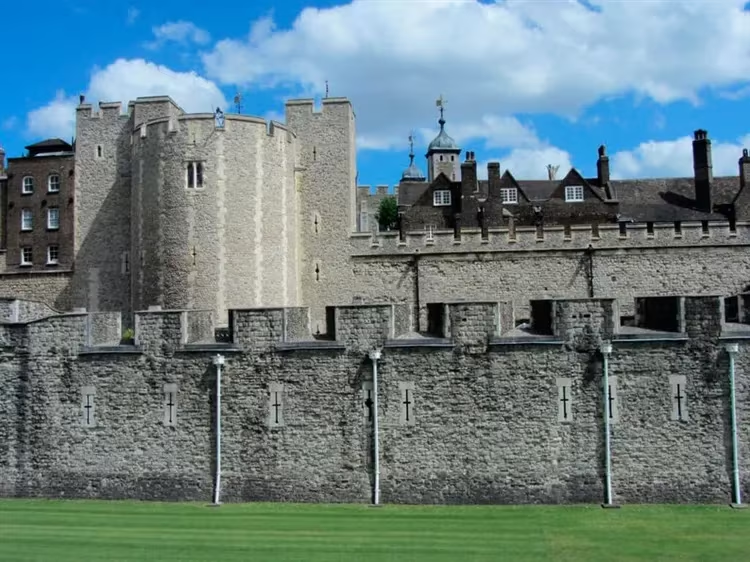
By 1585, the Tudor dynasty had established itself on the throne, which soon moved its residence from the old fortress to Westminster. The Tower fell into disrepair and turned out to be hopelessly outdated in terms of fortification. Its restoration and refurbishment would require huge funds, and therefore it was simply practically ceased to be used, except for special ceremonial occasions. However, the atmosphere of the torture and dungeon did not correspond to reality.
In fact, such associations became stable only thanks to the rather bold pamphlets of the 17th century and the writings of English novelists who were inclined to dramatize. Nevertheless, noble prisoners were still kept here, although not in shackles and not under torture instruments. Executions rarely took place on the territory of the Tower itself, as a rule, they were public and carried out on a hill behind the palace.
Inside the thick walls, according to official statistics, only three people were executed: Catherine Howard and Anne Boleyn – the infamous spouses of Henry VIII, as well as Jane Gray, who sat on the throne for only nine days. The murder of these women could cause too wide a resonance in society. In the future, the monarchs from the Hanoverian dynasty tried to return the castle to its status, carried out work to clean the moat, added new fortifications, but ultimately decided to build the Waterloo barracks. The Tower was last used as a prison during World War II. High-ranking members of the Nazi Party and some spies were kept there.
Recovery and tourism
Today this historic site is one of the main symbols of Great Britain. The interest of tourists in it is undeniable, but it did not appear recently, but even during the time of Elizabeth I, under whom a menagerie was opened here. A new twist in the Tower's tourist history is associated with 19th-century England, when William Ainsworth wrote his sensational novel.
At the same time, the glory of the main torture chamber in the country was entrenched in the Tower, and the entrance here became paid and more orderly. Of particular interest were the premises of the Beauchamp Tower, on the walls of which the names and dates scratched by the prisoners were preserved. By the 21st century, the tourist function of this place has finally taken shape.
Treasures and crown jewels
Royal regalia in the Middle Ages were not only an important part of the coronation ceremony, but also gave the kings some financial independence, since, if necessary, the monarchs could pawn them and receive the required amount of money.
Royal treasures have always been a subject of special value and carefully guarded until the 17th century, when Oliver Cromwell usurped power and ordered everything to be melted down. In the end, only three swords and one spoon survived. The collection had to be rebuilt. Now the treasures are stored in the western wing of the Waterloo barracks.
Exhibition “Row of Kings”
The “Row of Kings” is the oldest permanent exhibition in the world. The first version of the collection was presented to the public in 1688. Ten equestrian statues of kings were made in full growth with amazing detail. The best masters of their time worked on them: carvers, artists, sculptors. The most famous of them is Grinling Gibbons.
The statues were created to raise the popularity of the Stuart kings. Since the exposition was a kind of marketing ploy, it did not include statues of “bad” kings, unpopular among the people. The modern exposition is located in the oldest part of the fortress – in the White Tower, being a real decoration of the Royal Armory.
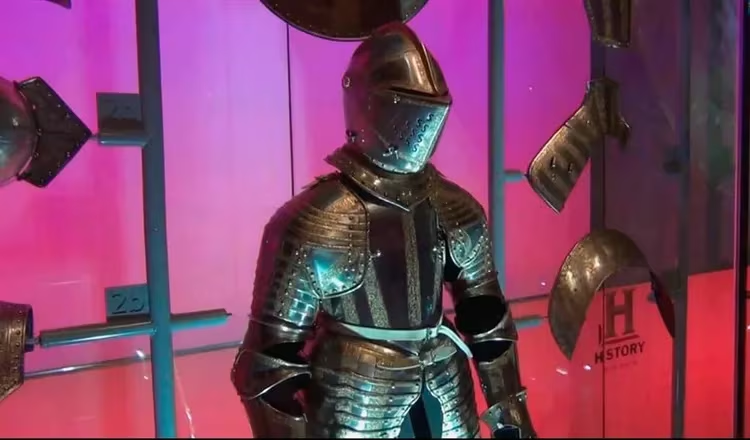
This exposition is a companion exhibition, which is located in the same room as the “Row of Kings”. It includes numerous armor from the Middle Ages, as well as the armor of some kings. Among them, the armor of Henry VIII for different years of his life is especially distinguished. They differ in skill and complexity of design. The children‘s armor of Henry Stuart, as well as the armor of James I, presented to him by Japan in the traditional Japanese style, are also of particular interest.
Weapon display
The collection of weapons is also part of the “Row of Kings” exhibition. Samples of swords, rapiers, sabers, bows and even firearms are collected here. Each exhibit represents a different era.
royal menagerie
The exhibition “Royal Animals” is part of the expositions that tell about the historical past of this place. It is located in the Brick Tower and is dedicated to the menagerie, which has been a special passion of the English monarchs since the 13th century. Some of the local animals were so popular that today life-size sculptures of them are part of the collection.
Among such exhibits is a polar bear, once presented to the crown by the Norwegian king. For the sake of his maintenance, each official paid 4 pence to the treasury daily, and the bear himself was periodically allowed to swim in the Thames. At different times, the menagerie was replenished with three lions (a gift from Frederick III), an elephant from Louis XI and other equally exotic animals. By the 18th century, anyone could visit the royal menagerie by purchasing a ticket or by giving a cat or dog instead of a fee to feed predators.
castle ravens
Eight ravens currently live in the Tower. These large, important birds are the property of England. If the legends are to be believed, when the crows leave the fortress, the kingdom will fall. In practice, this prediction has not yet been tested, but birds still clip their wings. A beefeater takes care of them. The caretaker goes to the market every morning and personally selects the meat for the birds. It is forbidden to touch the crows or feed them.
Yeomen (beefeaters)
Initially, the yeomen were created as a guard, which was supposed to protect the monarch during his stay in the fortress. But gradually they became the guardians of the royal regalia and overseers. Today, beefeaters serve as guides. As under the Stuarts, the guard consists of 37 people. Their shape has changed little. Most tourists instantly recognize the traditional blue and red suits, which are replaced with purple and gold when the Queen visits the Tower.
Coca-Cola London Eye ticket £24.30
Tower of London and Royal Treasures
ticket £26.80 Tower Bridge ticket £9.80
Westminster Abbey entrance ticket and audio guide £20
Madame Tussauds ticket – £29
St. Paul's Cathedral: Fast Track Ticket – £16
Shard Skyscraper – Entrance Ticket & Champagne – £24.95
Key Ceremony
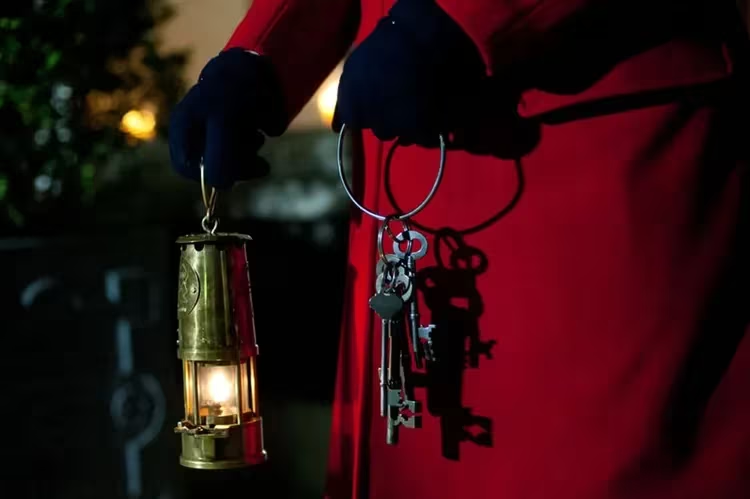
Traditionalism has always been considered a trademark of the British, which is quite clearly seen in the key ceremony, which takes place daily at 21:30 for the past 700 years. In itself, this action is not very impressive: the main beefeater simply hands over the keys to the Tower to the head of another unit guarding the fortress at night.
Chapel of St. Peter in Chains
This building was erected in the XII century, but could not preserve its authentic appearance. Four centuries later, it underwent a large-scale reconstruction. The chapel went down in history as a place of funeral and burial of numerous prisoners of the castle. Here, right opposite the chapel, demonstrative executions were carried out.
Among the most famous personalities buried on its territory, three privately executed queens stand out, as well as two fighters for the rights of the Catholic Church: John Fisher and Thomas More. The magnificent organ of the 17th century still amazes with its purity of sound. It is also worth noting that Grinling Gibbons, who created some of the sculptures that are part of the Row of Kings, worked on the design of the chapel at one time.
Fusiliers Museum
The fortress was always defended not only by the Beefeaters, but also by the Fusiliers, a special branch of the English troops, the main weapon unit of which was the fusei – flintlock guns. The first regiment of Fusiliers was formed in the 17th century. Over the past years, he managed to take part in all the significant military conflicts that England has ever entered. The current museum stores orders, medals, uniforms and honorary military trophies.
Medieval palace premises
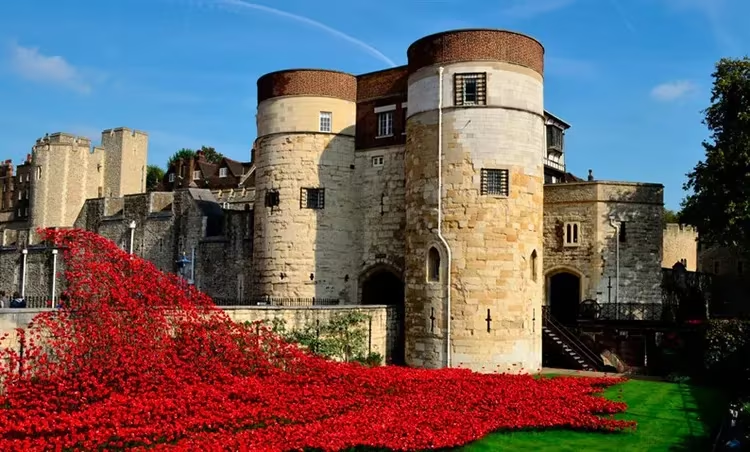
The Tower was once a royal residence. Echoes of this time, fortunately, are perfectly preserved in stone. We are talking about such buildings as the Royal Palace, which was built mainly in the XIII century, the living quarters of the monarch in the White Tower, as well as the Queen's House. The latter could not be saved, but fragments of the rooms and their furnishings were recreated in other rooms of the fortress.
Guests will be able to get a little closer to the life of the English monarchs, see a real throne, a fireplace, a meeting room, a throne room and other premises. There is also a collection of rare items that complemented the life of a medieval person, for example, a unique lead figurine of a knight, which was once a toy of a small aristocrat.
Opening hours and ticket prices
During the summer period (from March 1 to October 31), the Tower can be visited from 9:00 to 17:30 from Tuesday to Saturday, on Mondays and Sundays the territory opens for visiting an hour later. In winter (from November 1 to February 28), the working day is slightly reduced. From Tuesday to Saturday, visits are possible from 9:00 to 16:30, on Mondays and Sundays from 10:00 to 17:00.
The price of the entrance ticket varies depending on the age of the tourist and the way the ticket was purchased. A full ticket purchased at the entrance will cost 25.0 GBP, a child ticket – 12.0 GBP. Buying your ticket online will save you up to 2 GBP. It is also worth considering that the ticket price includes a charitable contribution of 10% of its total cost, but this contribution is voluntary. You can also use the audio guide if you wish. This option will cost 4 GBP.
Where is it located and how to get there
There are many ways to get to the Tower. The easiest is the subway. The nearest station is called Tower Hill. Next, you need to carefully look at the pointers. The entrance will be through the Tower Moat. You can also use public transport services. Buses RV1, 100, 78, 42 and 15 are ideal. Fans of river walks can get to the Tower Pier on river buses that depart from Greenwich, Charing Cross and Westminster every twenty minutes.