
Wenceslas Square in Prague – history, photos, attractions, how to get there, map
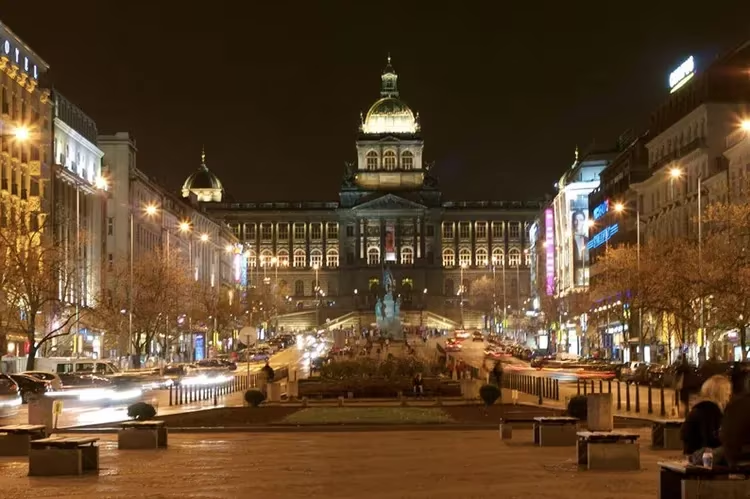
Wenceslas Square is one of the most popular and lively places in the Czech capital. This is the entertainment, commercial and cultural district of Prague. It is home to luxury hotels, stylish shops, trendy restaurants, bars, casinos, nightclubs, international and local banks, and administrative offices. The square is considered the center of the capital of the Czech Republic, where various demonstrations, festivities and other public events are traditionally held. Today it is a favorite pastime place for Prague youth and numerous tourists.
Story
In 1348, the King of the Holy Roman Empire, which included the Czech Principality, Charles IV ordered to build a new district in Prague. The ruler made this decision because of astrological forecasts, which predicted that the city would be destroyed due to floods and fire. Between the new and the old quarter was an uninhabited vast territory.
Initially, it was intended for trade in horses, agricultural products, spices, clothing and weapons. Around the square were gallows for public executions. Over time, trade and crafts houses began to be erected around the perimeter of the district. In the 17th century, a sculpture of St. Wenceslas, who is the patron saint of the Czech Republic, was installed on the square.
In the middle of the 19th century, the market, surrounded by unsightly buildings, turned into a true cesspool of the city. It was decided to demolish the market buildings. Large beautiful buildings were erected in their place. They housed commercial enterprises, banks and hotels. The appearance of the quarter has completely changed.
The area was paved with paving stones, and gas lamps for street lighting were installed around the perimeter. Later, the first tram line in the Czech Republic, Konka, was launched in the district. A wagon on rails, which was carried by a trio of horses, was the only type of public urban transport of that time. With the advent of electricity, the horse tram was replaced.
The square has become a convenient place for rallies. The main street of the city becomes a witness to many turning points in the history of the country. In 1848, the Czech uprising took place here against the dominance of Austrian rule. The revolution contributed to the formation and acquisition of the national identity of the Czech nation. At the same time, the square was officially named after Prince Vaclav, whose monumental sculpture personified the birth of a new independent state.
In 1918, the independence of Czechoslovakia was proclaimed on the square. During the Second World War, anti-Nazi demonstrations took place here, and decades later, protest marches were carried out against the ruling Communist Party, which headed the state apparatus of Czechoslovakia. In 1989, Wenceslas Square filled with 250,000 protesters who proclaimed the Velvet Revolution, which led to the dismantling of the country's socialist system of government.
Description
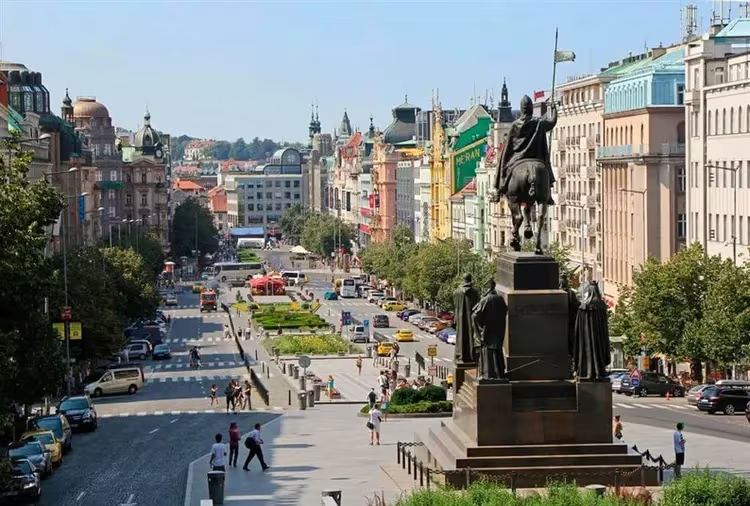
The square is a spacious boulevard in the form of an elongated rectangle, framed by lime trees and decorated with flower beds. The main square of the city is over 700 meters long and 60 meters wide. The center of the boulevard is a pedestrian area with benches. Roads filled with vehicles stretch around the quarter.
Wenceslas Square is bordered by an architectural ensemble that took shape at the turn of the 19th-20th centuries. Most of the buildings were built in the Art Nouveau and Neo-Renaissance styles. The facades of the buildings are colorful and unusually beautiful. Here you can see buildings decorated with golden relief stucco, floral ornaments, stone pilasters, sculptural compositions, mosaic drawings, balconies with bars and lancet windows.
In addition to historical and cultural buildings, shops and shopping centers are located on the square. Here you can buy anything: from small souvenirs and groceries to branded clothes and jewelry. After dark, the area turns into the nightlife center of Prague. A wide variety of clubs, bars, restaurants, open until early morning, allows everyone to find a place to their liking for a pleasant stay, dancing and fun.
sights
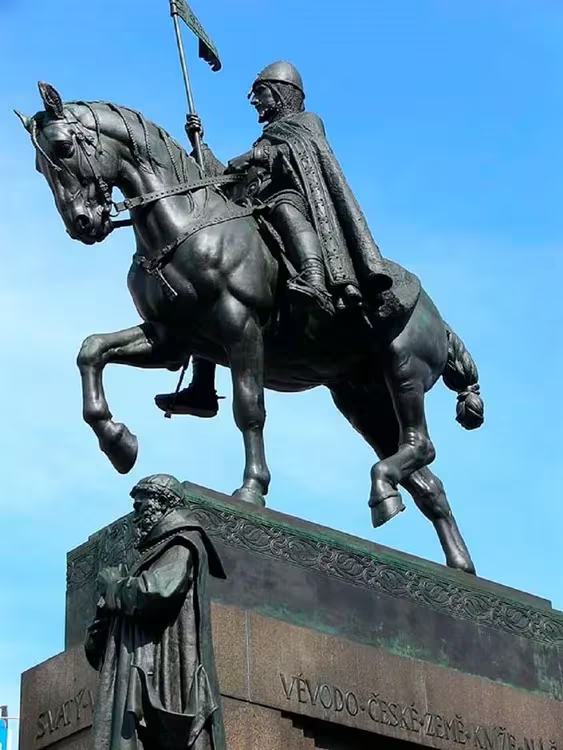
The main attraction of the square is the statue of St. Wenceslas. The monument was erected in 1912, replacing the old one from 1680. In the 10th century, Wenceslas was the duke of the Czech Principality and, having abandoned paganism, became an active preacher of Christianity. The legend says that during the service, Wenceslas was martyred by mercenaries sent by his own younger brother.
A few years after this incident, the locals of Prague declared the prince a patron saint and a symbol of the Czech land. The bronze statue of Wenceslas in armor on horseback holds the reins in his left hand, and clutches a spear in his right hand. At the foot of the pedestal there are statues of Saints Agnes, Procopius, Adalbert and Ludmila.
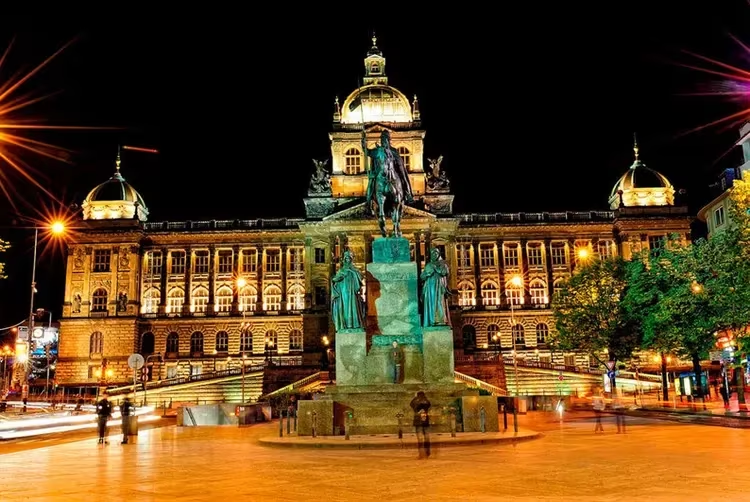
In the eastern part of the square rises the majestic building of the National Museum. It was built in 1891 on the site of an ancient defensive wall gate. The building is 100 meters long and 70 meters high. The facade is decorated with lancet and rectangular window openings, graceful pilasters, and is also crowned with four domes on the sides and one large dome in the center. The museum is filled with sculptural exhibits, a collection of books, manuscripts, as well as a variety of valuable items from such sciences as archeology, history, zoology and botany.
The tragic event is dedicated to a relief cross, installed on a granite pavement near the building of the National Museum. In this way, the place of death of student Jan Palach, who set himself on fire in protest against the entry of Soviet troops in 1969, was marked. The most striking representative of the Art Nouveau architectural style is the Europa Hotel, built in 1903.
The flat facade of the building is framed with gilding and relief ornamentation. The roof is crowned with sculptures of three naked girls. At the beginning of the 20th century, the hotel was a favorite meeting place for the Prague aristocracy. Major trade deals were made here, romances were struck up and high-profile scandals took place.
Lucerne Palace, built in 1921, certainly attracts visitors to the square with its versatility. This is the first reinforced concrete building in Prague, inside which there are glazed passages. There is also a cinema, a concert hall, music bars and restaurants.
Where is it located and how to get there
Wenceslas Square is the center of Prague. You can get to it by metro. On one side of the boulevard is the Muzeum station, on the other side is the Mustek station. You can also take the tram, which stops in the center of the square. The following routes run here: No. 3, 9, 14, 24, 91. The square is open to the public 24 hours a day without any restrictions. In addition, the entrance to the boulevard is absolutely free. It is enough just to come and see the beauty of Wenceslas Square.