
Basilica of Santa Croce in Florence – history, photo, description, opening hours, map
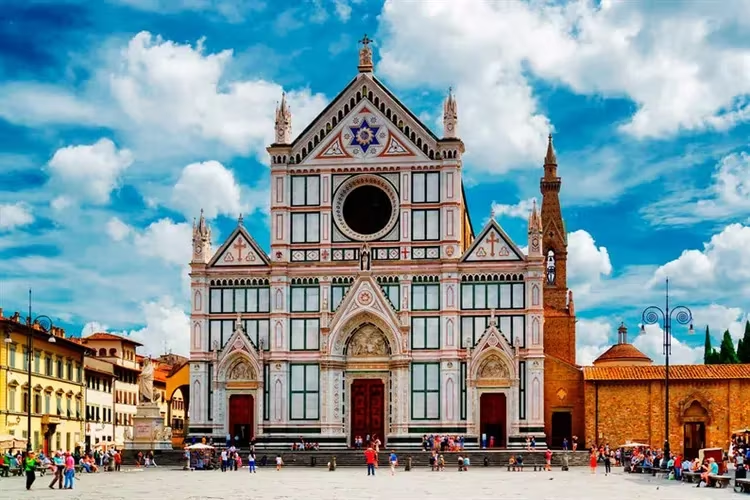
Almost every major tourist city has its own architectural symbol: the Eiffel Tower in Paris, Big Ben in London, the Hermitage in St. Petersburg, the Colosseum in Rome, the Basilica of Santa Croce in Florence… Basilica of Santa Croce (in other words, the Basilica of the Holy Cross) – one of the most beautiful and famous buildings in Florence. This is the first and largest Franciscan church in the world, in addition, it is known for the frescoes of the legendary Italian painter Giotto and the tombs of iconic figures of Italian art and science: Leonardo Bruni, Galileo Galilia, Nicolo Machiavelli, Michelangelo Buonarotti are buried here, and there are also several commemorative plaques and cenotaphs.
Construction history
There is a beautiful legend that the first stone of the Basilica of Santa Croce was laid by Francis of Assisi himself, a canonized Catholic Italian saint who founded the world-famous Order of the Franciscans, or the Mendicant Order. Unfortunately, this legend is broken by the real state of affairs: Francis could not lay the first stone of the church, because he died in 1226, and the basilica began to be built only in 1294. However, it is possible that Francis laid the first stone of the small church that stood on the site of the basilica earlier, as early as the beginning of the 13th century. But this is only an assumption, since no documents confirming this fact have been preserved.
But it is known for certain: the church was built by the followers of Francis, the Franciscan monks. By that time, their Order had already grown quite strongly, and the monks did not fit in a small church. The honor of becoming the architect of the new temple fell to Arnolfo di Cambio – later it became his greatest and most important architectural work.
A lot of money was spent on the construction of the temple: firstly, at that moment the Ghibellines, representatives of a kind of political opposition of those times, were expelled from Florence, and their fortunes remained within the city, and the authorities reasonably distributed these wealth, including detaching some part money to build new temples and churches. In addition, the inhabitants of Florence themselves donated considerable sums: both representatives of the middle class – artisans, merchants, merchants, wealthy peasants – and all the nobility and the aristocracy. The latter gave huge sums to the Franciscans in exchange for the right to have personal, family chapels in the temple under construction: Bardi, Peruzzi, Castellani, Baroncelli, Medici – all these noble families invested heavily in order to remain immortalized in the walls of the temple.
The place for the construction of the basilica – the area of Santa Croce – was not chosen by chance: in those days, the poor lived here – an ideal flock for the Mendicant Order. Later, craftsmen and builders who participated in the construction of the church began to settle here. Historians say that later the Franciscans waged a real war for the parishioners with the Dominicans and won. The reason for this is the numerous frescoes that adorn the vaults of the Basilica of Santa Croce. For the illiterate poor, the drawings on the ceilings and walls were like holy Scripture: a visual history of the main religious events in pictures, which is why they chose the Franciscan cathedral.
The interiors of the basilica were painted by Giotto, Giovanni da Milano, Maso di Banco and other famous Italian artists. The construction itself lasted a long time, almost a century, presumably until 1385. The consecration of the Basilica of Santa Croce took place only in 1443.
The temple has its own black page of history: in 1966, a severe flood occurred in Florence, in some areas of the city the water rose five meters above the usual level, flooding houses, public buildings and temples. The Basilica of Santa Croce also had a hard time: individual masterpieces of artistic creativity were hopelessly damaged. Fortunately, most of them still managed to be restored, but something died in the water.
It should also be noted that initially the temple had its own monastery, but at the end of the 18th century it almost outlived its usefulness, and at the end of the 19th century the city authorities even decided to equip a museum there. Now the museum complex has grown so much that an attentive tourist will need almost a whole day to carefully examine it. Over the past two centuries, the Basilica of Santa Croce has become a real center of tourist pilgrimage and has even appeared several times in popular culture, for example, in the cult computer game Assassin's Creed II.
Architecture
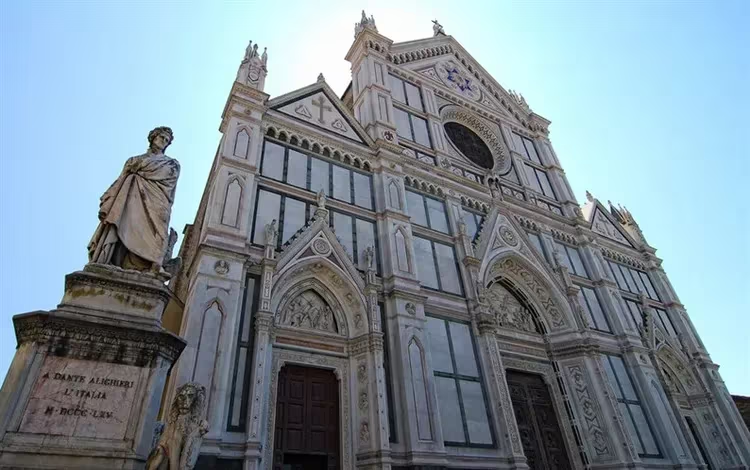
The original architectural style of the building is Gothic, but certain parts of the temple were rebuilt or completed over several centuries, so that the current appearance of the basilica retains the skill of architects and artists from several historical and cultural eras at once.
Built in the 13th and 14th centuries, the temple is still the largest and most imposing Franciscan building. All its components – the snow-white facade and the inner vaults ennobled with frescoes, the southern and northern naves, sixteen named chapels, the main altar, tombs, cenotaphs, memorial plaques – keep the pride and grandeur of bygone days. It is impossible not to admire the beauty and richness of the Basilica of Santa Croce.
Timed entrance ticket for Michelangelo's David – €16
Uffizi Gallery entrance ticket – €20
Uffizi Gallery: Priority entrance – €40
Florence Cathedral: Dome entrance ticket – €29
Palazzo Vecchio entrance ticket and audio guide – €19
Tour Hop- on Hop-off. Ticket for 24, 48 or 72 hours – from 23 €
Leonardo da Vinci Museum: entrance ticket – 7 €
Tour to the Duomo with a guide and climb to the top of the dome – 40 €
Entrance ticket to the Basilica of San Lorenzo – 8.50 €
Air flight balloon over Tuscany: Florence – 250 €
Facade
The original facade of the basilica was quite simple and uncomplicated, one might even say that it was absent: no one specially designed the outer, front side of the temple. Only in the 19th century, when the temple underwent another restructuring, Nicolo Mattas took up its appearance. Prior to that, he had already designed the facades of several Gothic churches, it is not surprising that the honor of putting the Basilica of Santa Croce in order fell to him.
However, Mattas decided not to make the design too fanciful and pretentious: laconic marble whiteness, three arched spans, life-giving crosses, the Star of David (a kind of tribute to the Jewish origin of the architect), graceful reliefs and sculptural modeling – nothing superfluous. Probably, this is exactly how, modestly and nobly, the facade of a truly great temple should look like.
Mattas, by the way, hoped that he would be buried somewhere near Machiavelli and Buonarotti for his services to the basilica, but the Franciscans were not ready to place a sarcophagus with a deceased Jew under the arches of their Catholic church. As a result, Mattas was buried on the territory of the basilica, but not in the church itself, but in a small courtyard.
Interior decoration
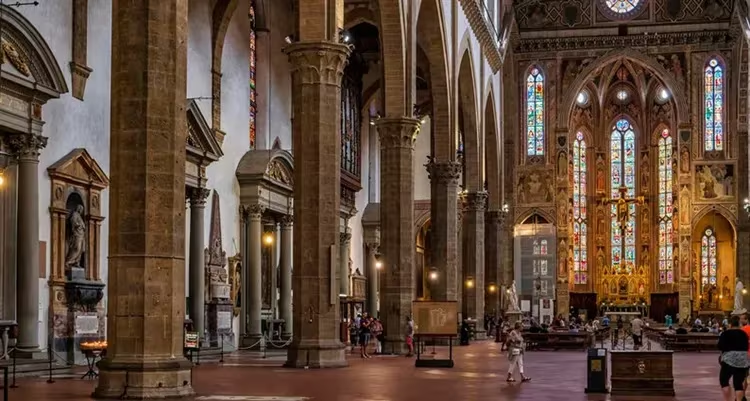
But inside the Basilica of Santa Croce – this is a real loud, majestic, magnificent ode to the Italian Renaissance and the Proto-Renaissance and not only. There are so many frescoes, paintings, stucco, stained-glass windows and other artistic and decorative elements that were once created by the hands of the greatest masters: a novice tourist's eyes will certainly run in different directions. The Basilica of Santa Croce has three naves, separated by graceful arches and rows of massive columns. The main, central nave is slightly higher than the side ones, but the South and North amaze with their rich decoration.
What is located in the southern part of the temple:
What is located in the northern part of the temple:
Chapels
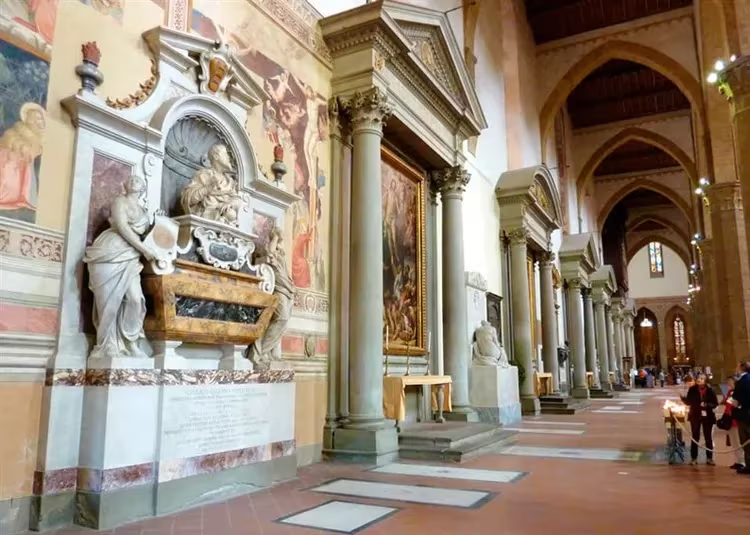
There are sixteen chapels (sixteen chapels) in the basilica. Most of them are nominal, belonging to one or another rich and influential family of medieval Florence. In fact, a chapel is, as it were, a separate, independent small church, while being part of a large temple or temple complex.
The chapels of the Basilica of Santa Croce are individual works of art. Unfortunately, some of the frescoes by Giotto have not been preserved, because in the Middle Ages the bubonic plague raged in Florence several times, the temple was used as a hospital, and the luxurious frescoes were simply covered with whitewash. The plague, by the way, was so cruel to Florence that many Europeans called it that – Florentine, and Giovanni Boccaccio and Francesca Petrarch mentioned it in their famous works.
The crucifixion of Donatello
The famous wooden “Crucifixion” by Donato di Niccolò di Betto Bardi is one of the main attractions of the temple. This work is remarkable in that it is early in the work of the Italian sculptor and somewhat copies a similar work by Donatello's teacher, Lorenzo Ghiberti. Jesus Christ depicted crucified on the cross is muscular, desperate, languishing, but at the same time, as if not expressive enough. What is the reason for this inexpressiveness – culturologists are still arguing. Most likely, the point is that Donatello was just beginning his creative search.
main altar
The main altar of the Basilica of Santa Croce is a truly grandiose sight. Decorated with frescoes by Agnolo Gaddi, it is a living book of biblical stories: here is the Archangel Michael, giving Seth a branch of the Tree of Knowledge, and Seth himself, planting this branch on the grave of the late Adam, and the Queen of Sheba, and the formidable moment of making the Cross for the crucifixion of the Lord, and St. Helena, and the capture of Jerusalem… All the frescoes are detailed, detailed, carefully drawn. You can look at them for hours.
Agnolo Gaddi is also the author of the stained glass windows of the High Altar. Bright, motley, colorful, they are specially located so as to let in sunlight and in a bizarre, bewitching and magical way to illuminate the main nave and all the interior of the temple. The altar polyptych depicts the Madonna and saints. Even higher is the “Crucifixion” by an unknown author, presumably Figline.
Castellani and Baroncelli Chapels
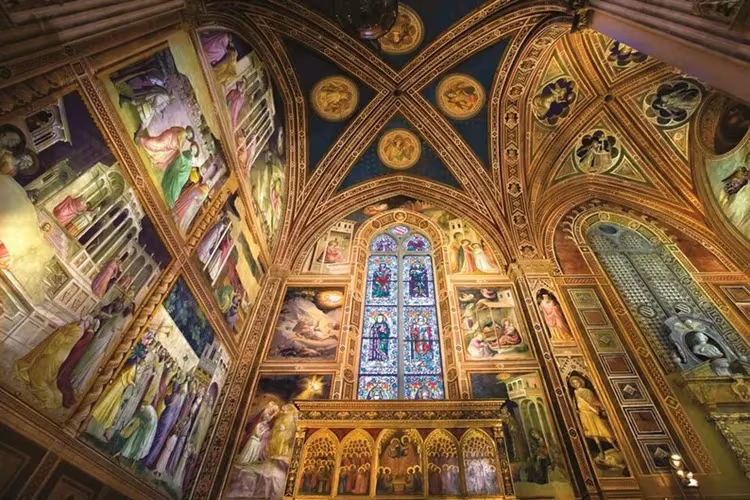
These two chapels were painted by Gaddi's son and father: Agnolo and Taddeo. The family chapel of the Castellani family is a whole series of eerie and frightening stories: here is a dragon devouring a baby, and Apollonia, whose teeth are brutally knocked out by tormentors, and a commoner crushed by a cart. Why so much violence is not clear, culturologists find it difficult to answer this question. In the second chapel, the frescoes are more peaceful: most of the paintings depict the life of Mary.
Bardi and Peruzzi Chapels
The Bardi Chapel is one of the first family chapels in the Basilica of Santa Croce. It was built at the beginning of the 14th century. It was painted by Mazo di Banco, the story depicted in the drawings is the life of St. Sylvester, the former Pope, and some other saints.
The Peruzzi Chapel is perhaps the most famous in the temple, because its walls were painted by Giotto himself (the lives of St. John the Theologian and St. John the Baptist), in addition, Michelangelo and Galilio are buried here. Initially, there were four similar chapels in that side of the temple, but, unfortunately, only two of them have survived.
Medici Chapel
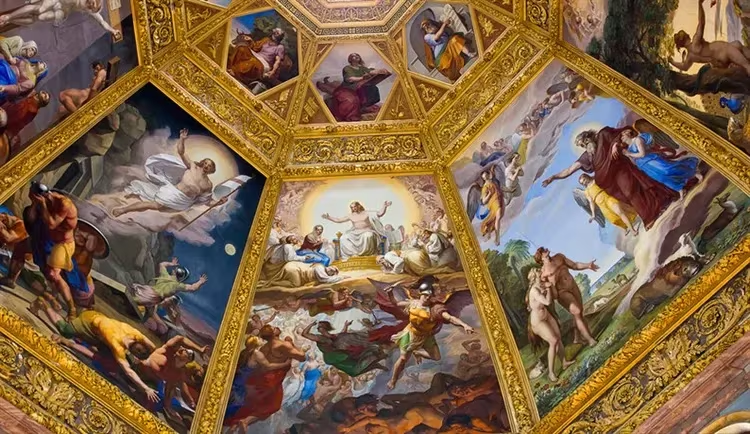
The Medici are by far the most famous Florentine dynasty. As many as four Popes of Rome came out of this family, as well as two queens of France – Catherine and Mary. It is not surprising that the Medici Chapel is perhaps the most luxurious and richest in the basilica. It was decorated by Michelangelo Buonarotti himself, and this is considered one of his best works.
Tombs of great men of Italy
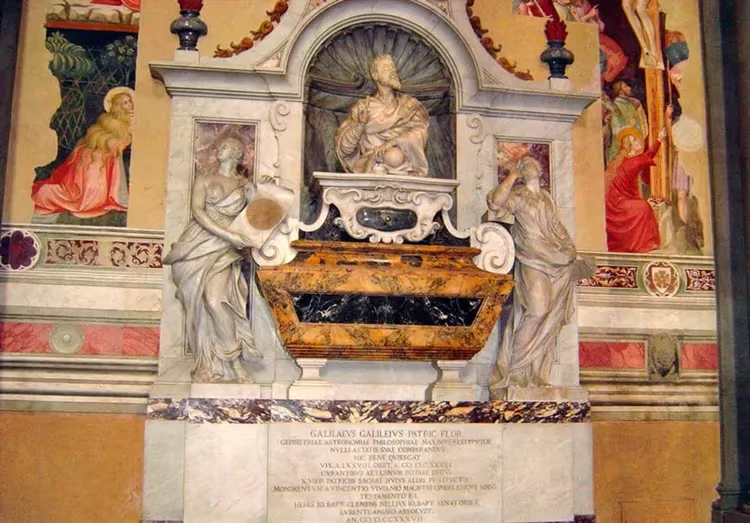
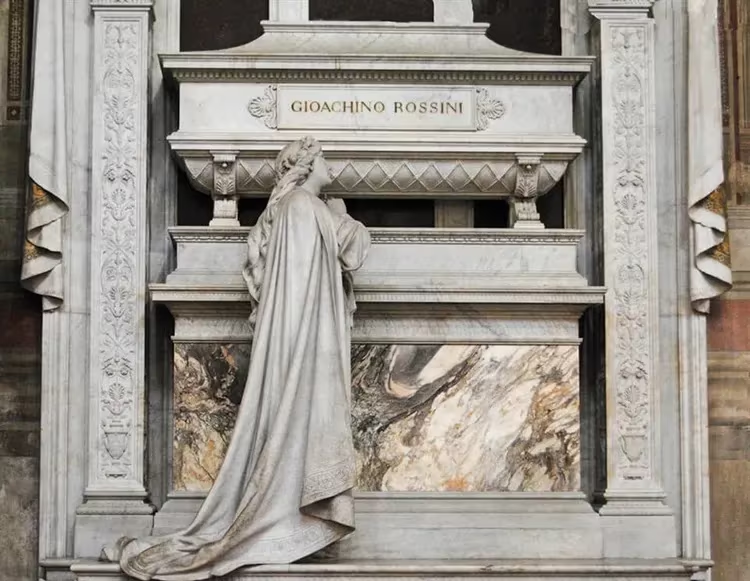
In total, there are more than three hundred burials in the Basilica of Santa Croce. All the people buried here are famous Florentine and Italian politicians, public figures, philosophers, artists, sculptors, architects, musicians, writers, poets and scientists.
The most famous of them:
The name of Dante Alighieri, the famous native of Florence and the author of the Divine Comedy, stands apart. At one time, the writer was expelled in disgrace from his native city and wandered for a long time: Verona, Bologna, Paris, Venice, Ravenna. In Ravenna, he eventually settled, lived the last years of his life and died of malaria.
Only after the death of the writer did Florence realize what a genius she had lost. The Florentine authorities tried to demand that Alighieri's ashes be returned from Ravenna, but Ravenna refused. The dispute over who has more rights to the remains of the poet is still going on, and in the Basilica of Santa Croce there is an empty sarcophagus prepared for Alighieri, if his ashes suddenly return to their homeland one day.
Opening hours and ticket prices
Opening hours of the Basilica of Santa Croce:
Ticket prices:
You can also rent an audio guide at the Basilica (the audio guide is available in several languages). This will cost an inquisitive tourist another 1.5 euros.
Where is it located and how to get there
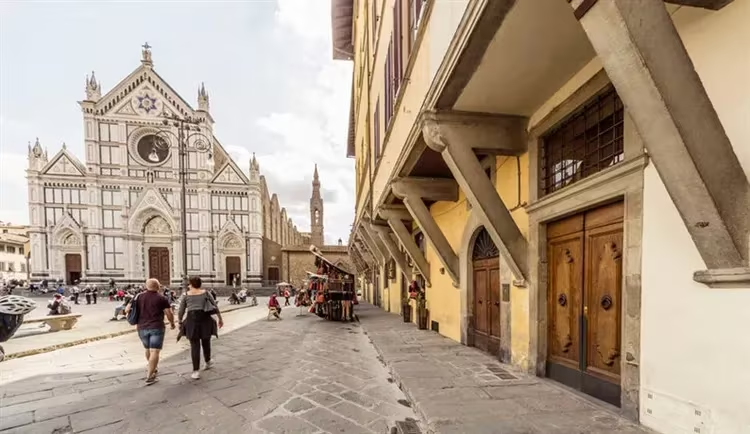
Piazza Santa Croce, 16 – any Florentine will tell you how to get to this address: for foreign visitors, the Basilica of Santa Croce is one of the main places of tourist and religious pilgrimage. Public transport runs here (for example, bus routes C1, C2, C3, 23) and taxi drivers are happy to drive, in addition, you can get to the basilica on foot: only 20 minutes from Florence train station. It is almost impossible to miss the attraction: not only is it located in the historical and cultural center of the city on a huge square of the same name, it also attracts attention with its impressive size.
In addition, various events are often held on the square in front of the Basilica of Santa Croce, which are also impossible to pass by: theater and music festivals, concerts, matches of the famous medieval Florentine football, more like a spectacular costume show than a sports game.
Every tourist should visit the Basilica of Santa Croce in Florence, because it is the absolute quintessence of the centuries-old historical and cultural layer of Italy, and simply an incredibly beautiful, rich, majestic, peaceful place.