

🏰 Buda: a journey along the right bank of Budapest
A rare tourist who has visited Budapest will not want to return here again. A city that for a long time was located on the very border of Christian civilization in Europe. Every self-respecting tourist must visit here at least once in his life. For what? Read our guide for a two-day stay in the Hungarian capital: a day in Buda and a day in Pest, two beautiful areas of the city separated by the Danube.
How to get there
Buda Pest traditionally hosts many organized tours. But even for independent travelers, getting to the capital of Hungary is not difficult. The simplest options are a low-cost plane or a bus from Warsaw.
Airplane
For those who love fast travel, we recommend starting your search for air tickets from the Wizzair website. This major Hungarian airline has direct and low-cost flights between Central European countries. The route runs between the main, and not secondary, air ports: Chopin Airport in Warsaw and Liszt Airport in Budapest.
Bus
Every day, several flights of the budget bus carrier Flixbus depart from Warsaw. There are also night ones. Not to say comfortable, but cheap and economical. We spend the night on the road, and in the morning we are ready to start exploring the capital of Hungary. Buses arrive at Nepliget or Kelenföld bus stations.
Train
Trains also travel to Budapest and arrive at one of the country's two main railway stations, Keleti (“East Station”) and Nyugati (“West Station”). In Hungary, railway communication is developed both within the country and with neighboring countries. But keep in mind that even regional trains are 30-40 minutes late – the absolute norm by local standards. Add to this the abundance of train stations in Budapest, between which it is not so easy to move, allow plenty of time for transfers.
Visa issue
Hungary is part of the Schengen area, which allows you to freely enter the country with a multiple visa. In 2023, the country is one of the most hospitable for tourists wishing to obtain a Schengen visa. The consulate readily issues visas to both organized groups of travelers and individual tourists who provide evidence of their plans. To confirm the purpose of the trip, you must provide a hotel reservation (preferably with paid accommodation) and tickets to/from Hungary.
But there are no guarantees that the visa will be multiple-entry. Consulate employees can paste both an annual Schengen visa and a single-entry visa into your blank passport.
Local logistics
Budapest is a large and densely populated city. It takes energy to move around it with two people. The capital's transport network includes a huge number of buses, trolleybuses, trams, metro and, for gourmets, river boats. The Ikarus buses and trolleybuses (!) renovated by the Hungarian authorities have a special charm for me, as a person from the 90s. The “Ikarus” produced in Hungary were the pride of the local automobile industry and will certainly hit the nerves of those who found them in the vastness of our country.

For maximum convenience, I advise you to purchase a day ticket for all types of transport. It will more than pay for itself, since there will be a lot of moving around. This will save time and money. Tickets can be purchased from vending machines at public transport stops and the metro. A 24-hour ticket will cost 2,500 forints or 6.5 euros. Further, for convenience, I will indicate prices only in euros. Over the course of 2 days, I never noticed any inspectors in Hungarian transport, but I had no desire to take risks and “harness.”
For those who like to sightsee not only externally, but also visit museums internally, purchasing a Budapest card is an excellent option. For 48 hours it will cost 49 euros. It gives free access to most museums, free travel on public transport and even free entry to the Lukács Baths.
- Lebanon – an oriental fairy tale against the backdrop of the fires of rebellion
- Traveling only with a group, visa for a select few: top most closed countries in the world
- Trakai Castle – history covered in red brick
What you need to know about the history of Budapest in 2 words
Now about the main thing: what you need to know about the “almost imperial” Budapest. And why, in fact, “almost imperial”? The fact is that Hungary for a significant part of its history was part of the Habsburg Empire, the heart of which was located in neighboring Austria. One of the most famous royal houses in Europe, the Habsburgs, lived in Vienna, building it up with mansions.
The second most important city in the empire was Budapest. Despite this, the Magyars, as the Hungarians are also sometimes called, were a people alien to the Habsburg Germans. With a completely different and incomprehensible language, culture and traditions, including something Asian. And a high degree of love of freedom. Therefore, royalty visited Budapest only on short visits and did not stay in the city for a long time. Although, in terms of the blinding splendor of its architecture, Budapest could outshine most European cities at any time in its history.
And why “almost the capital” – will be your question addressed to another name I mentioned in the preview. The descendants of the violent Huns, the Hungarians, who periodically rebelled against German rule, finally broke free as a result of the agreement of 1867. And almost again. The so-called “dualistic monarchy”, Austria-Hungary, was established in the empire. Both of its most important parts formally received equal status. And Budapest on paper became like Vienna. But it never became the second capital on equal terms. The emperors looked askance at the alternative capital. They did not have much trust in the Hungarians. The luxurious palaces were deprived of the presence of royalty.
Buda. Top objects to see
The palaces of Budapest did not become worse from the sluggish attention of the monarchs. And for the most aristocratic buildings, first of all we go to the “royal half of Budapest”, the Buda district.
The Buda district is located on the right bank of the Danube. We can say that Buda is the most metropolitan part of the Hungarian capital. It was the center of Hungarian statehood until its fall to Turkish invaders in 1541. Only in 1873 did Buda and Pest unite into a single city, giving the world the largest concentration of historical monuments.
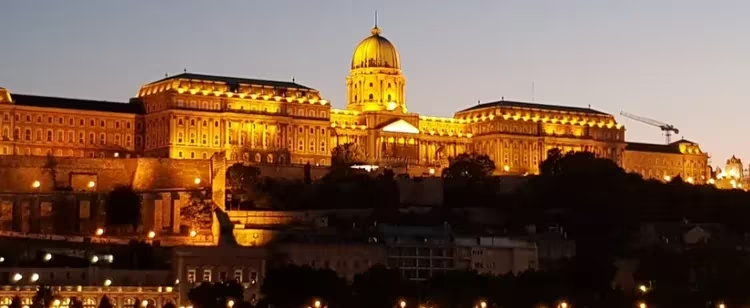
Buda Castle (Royal Palace)
The first thing you will see on the right bank of the Danube and what will undoubtedly attract attention will be the Royal Palace, formerly called the Buda Fortress. The history of this grandiose metropolitan landmark is a history of destruction and restoration, oblivion and brilliant grandeur.
Built in the 13th century to protect against the Mongol-Tatars, the fortress quickly lost its defensive status, turning into a palace. Its golden age came during the time of King Matthias I Corvinus (“The Crow”), considered the first Renaissance ruler of Europe. The features of the Renaissance were also reflected in the updated appearance of the royal residence – it was probably rebuilt in the image of the Palazzo Vecchio in Florence.
In the future, the palace underwent global reconstruction three more times due to military operations and fires. The long-suffering landmark of the capital suffered greatly during World War II. In the Battle of Budapest, the Buda fortress and the palace became the last center of resistance of fascist troops in the city.
The outer fortifications of Buda Castle and the courtyard can be visited free of charge. But you have to pay to view the interior. Today the palace houses the National Library, the Hungarian National Gallery and the Budapest Historical Museum. Tickets for each location must be purchased separately. For example, tickets to the National Art Gallery cost about 10 euros. Additionally, you can purchase a ticket to the palace cellars. For Budapest card holders, access to most locations of the Buda Castle, as well as tours of them, is free.
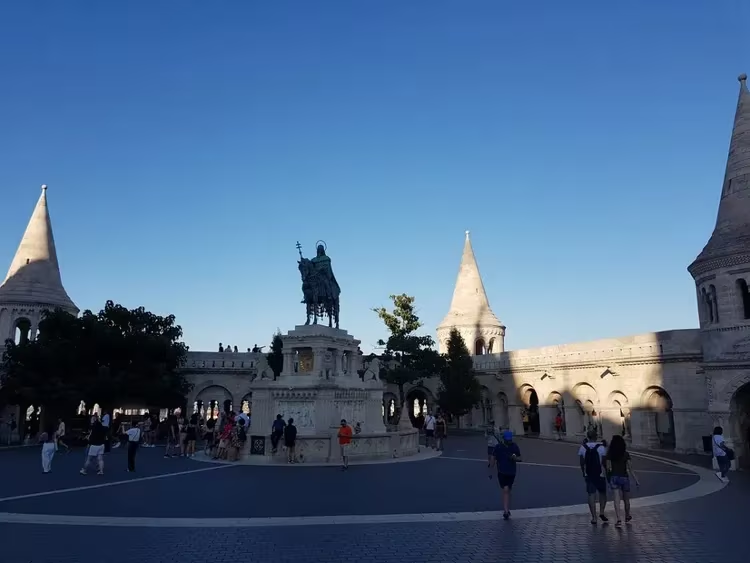
Fisherman's Bastion
If the beautiful views of neighboring Pest from the Buda Fortress weren’t enough, then be sure to head to the neighboring location – Fisherman’s Bastion. It is located on the right hand of the fortress-palace, when viewed from the Danube. Just like the Buda Fortress, the Fisherman's Bastion is included in the UNESCO World Heritage List. And it is absolutely impossible to imagine the modern appearance of the Hungarian capital without it.
The strange name of this attraction has medieval roots. In the hoary days of the Hungarian capital, fish markets were located here. In times of danger, Buda fishermen came to the defense of this section of the fortress wall.
However, the bastion itself is not that old. And it was not conceived for defensive purposes at all. It was erected, like most of the capital’s attractions, at the turn of the 19th and 20th centuries, when the Hungarians celebrated the 1000th anniversary of the acquisition of their land. The stone gallery and 7 hipped towers are of exclusively aesthetic importance. By the way, here’s a riddle for you: why are there 7 towers? Find the answer in our next guide, about the Pest region.
In the courtyard of the bastion there is an equestrian statue of the most revered Hungarian king, Stephen I. We will also tell you about the reasons for such a reverent attitude towards this monarch in the guide to Pest. Meanwhile, deep in the architectural ensemble of the Fisherman’s Bastion, there is the next attraction – Matthias Church.
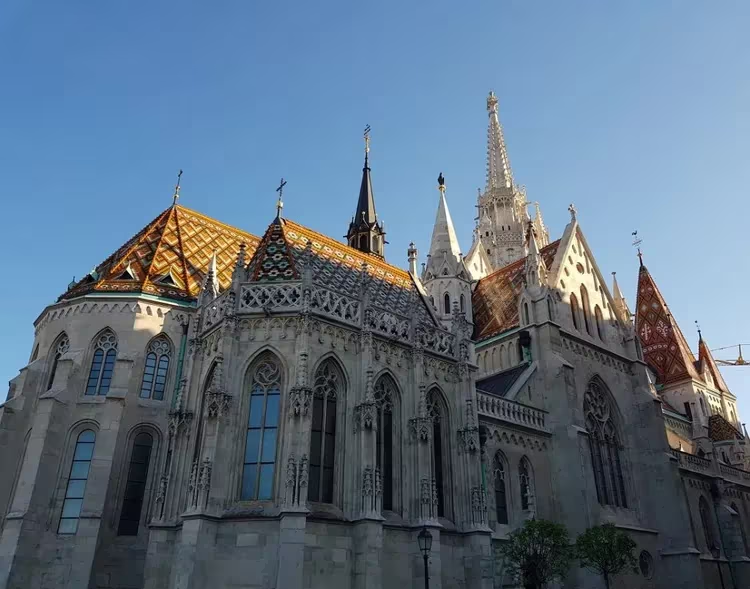
Matthias Church (Church of the Blessed Virgin Mary)
The Church of the Blessed Virgin Mary represents the quintessence of the metamorphoses so familiar to Budapest history and architecture. This is one of the oldest churches in the city, built in the 14th century in the Gothic style. It was founded on the site of an even older church of the same name, built by Stephen I.
The temple underwent large-scale reconstruction during the time of Matthias I Corvinus. The church began to be named in honor of this king.
But the most significant transformations of the temple were yet to come. After the capture of Buda by the Turks in the 16th century, the temple was turned into a cathedral mosque. The building played this role for a century and a half. According to legend, the patroness of the church, the Blessed Virgin Mary, punished the Turks for Islamizing the shrine. In 1686, when Buda was besieged by Christians, one of the walls of the former church collapsed due to artillery shelling. At the site of the collapse, a statue of the Blessed Virgin Mary was discovered hidden behind it in a secret place. The appearance of a statue of the Virgin Mary right in front of the praying Turks so undermined their spirit that the city was surrendered on the same day.
We go inside in search of the patroness of the church. True, there is an entrance fee. Its cost is about 5 euros.

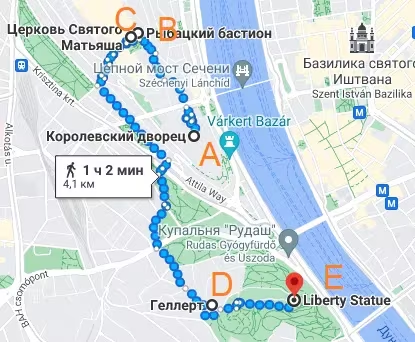
Gellert Hill and Citadel
For stunning panoramic shots of the neighboring Pest district, head to Gellért Hill in Buda. It is located on the left hand of the Buda Castle, when viewed from the Danube. Challenge your limits and climb a 235-meter hill on foot. A pleasant bonus will be the silence and unity with nature on the way to the top.
And at the end point of your “Alpine hike” awaits the Citadel, one of the darkest and most massive monuments of the Hungarian capital. The citadel was built by the Austrians in the mid-19th century after the suppression of the Hungarian Revolution of 1848-1849. It served as the location of a military garrison loyal to the Habsburgs. Hungarians perceive it as a symbol of absolutism and tyranny. The walls, up to 16 meters high and up to 4 meters thick, really make an oppressive impression. In order to smooth it over, in 1947, the Statue of Liberty was installed in the middle of the Citadel: “In memory of all those who sacrificed their lives for the independence, freedom and prosperity of Hungary.”
At the time of my visit to the Citadel in 2022, it was under reconstruction. Which was not very pleasant to find out after many hundreds of steps in 30-degree heat. Nevertheless, even without viewing the interior of the fortress, the mountain hike left a lot of wonderful panoramic photographs of the city. Even in the worst case scenario of the ongoing reconstruction, it will be possible to look at the Citadel through the fence.
Do you still have energy for Pest? We believe in your answer “YES!” and look forward to the next part of the guide!