
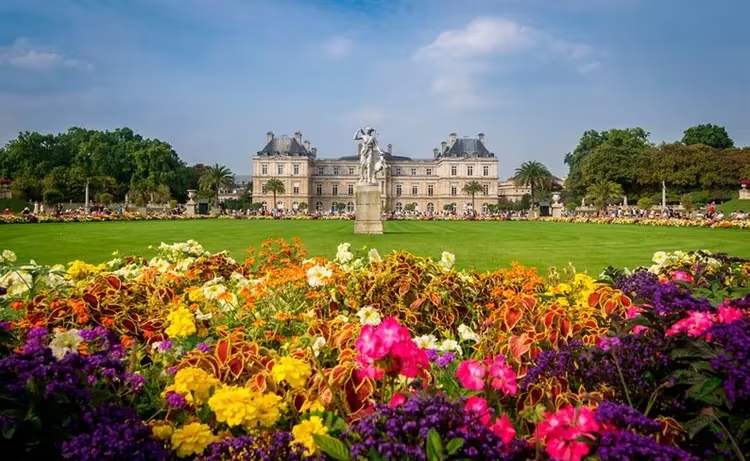
A rare person who comes to the city of lovers will deprive the attention of the Luxembourg Gardens, a landmark of Paris.
Favorite vacation spot for Parisians
The Luxembourg Gardens is an amazing palace and park ensemble, where rich history is cleverly intertwined with modern and vintage entertainment. No wonder this is the favorite place of both the Parisians themselves and the ubiquitous tourists. Here you can not only see the luxurious palace, stunning fountains and flower beds, but also play tennis, relax on the lawn, listen to music or watch a touching puppet show.
Despite political troubles and wars, original buildings of the past have been preserved here, such as the magnificent Medici fountain or the Petit Luxembourg Palace. This is an ideal place for both a solo walk and a family vacation.
Green dream of Marie de Medici
An Italian by birth and the wife of King Henry IV, Maria Medici, although she lived idly in France, suffered from the closeness and crampedness of the Louvre. Grieving for a long-gone childhood and the sunny fields of Italy, she decided to build a new palace, more modern and comfortable. In order to make her dream come true, the Queen started looking in earnest for a suitable land, reminiscent of the place where she grew up (the Florentine Palazzo Pitti, surrounded by green gardens and clear waters).
The choice fell on a piece of land on the left bank of the Seine, where a small mansion was built, which belonged to the local duke, which is now called the small Luxembourg palace. And the land itself in our time was called the Latin Quarter. At the dawn of the seventeenth century, Marie de' Medici commissioned Salomon de Brosse to start building a new palace on eight hectares of land, while Tomasso Franchini was to arrange a beautiful garden around the building.
In 1630, additional space was acquired, and the landscaping of the Luxembourg Gardens passed into the hands of Jean Boisot, who had previously taken care of the Tuileries Garden and early plantings in Versailles itself. Boiso had a particular eye for design, planting plants in straight lines, sticking to squares and rectangles. Even the fountain in the center is an octagonal pool.
It is sad to admit, but not all the future rulers of France were able to appreciate the quiet harbor of Marie de Medici. Louis XVIII was even forced to sell part of the garden in order to find money to restore the palace. But later the land was confiscated in order to re-deploy a magnificent garden here. The eminent Jean Chalgrin took up the cause, who treated the past with all respect, keeping some places intact, for example, vineyards and the Carthusian monastery.
The famous statues in the garden began to appear after 1848, when it was decided to decorate the area with the incarnations of rulers, artists, writers, saints and even animals. During the reign of Napoleon III, a number of changes were made to the garden, including the addition of new walkways and the relocation of the Medici Fountain. It was at this time that Gabriel Daviu, who played a significant role in the design of the monuments of Paris, designed the decorative gates and the fence. Over time, more and more new entertainment appeared in the garden, such as a carousel, puppet show, playgrounds, etc.
Luxembourg Palace
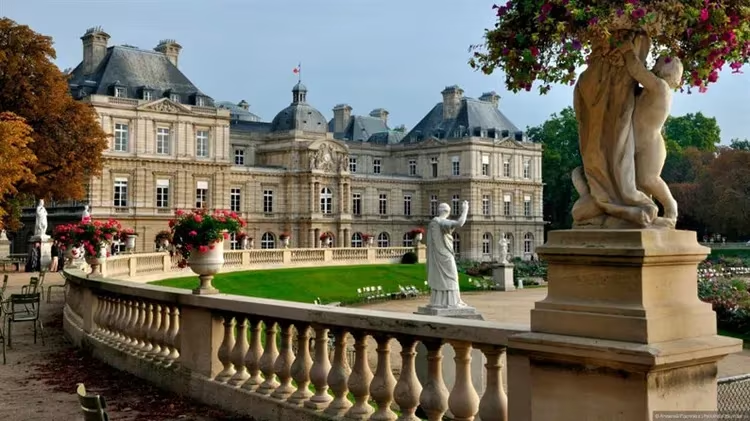
This majestic building was built at the beginning of the seventeenth century. In 1791, the palace was declared a national treasure, and after the French Revolution, it became the home of the French Senate and continues to be so to this day. An amazing fact, but the patrimony of Maria Medici for some time served as a prison, and then the members of the Directory settled here.
Construction began in 1615. Maria Medici embodied her own dreams in the design, which is why Tuscan motifs of sunny Italy are clearly felt in it. The central staircase, the western wing, where the queen's chambers were located, and the apartments on the eastern side, intended for her son, the future king Louis XIII, look especially majestic. Unfortunately, the years have been cruel to the original building. A significant part of the original decor was lost, which was especially facilitated by Napoleon Bonaparte, who made a number of changes to the palace image.
Some elements and paintings have been preserved, for example, in the “Room of the Golden Book” the ceiling painting is alive, although it is not known for certain whose brushes the work is. the palace has a “gallery of busts” where you can find statues of past senators and politicians, including Jean-Baptiste Colbert – the first man under the government of Louis XIV. In addition, the palace has an impressive library that helps the senators in their hard work – it has more than 400,000 different volumes, and that's not counting the archive, which contains another 170,000 copies.
sculptures
The stunning beauty and exceptional work of the statue is what the Luxembourg Gardens can rightfully be proud of. In total, there are more than a hundred statues on the territory, among which twenty figures stand out especially, surrounding the very center of the garden – they were commissioned by Louis Philippe and dedicated to the outstanding French women. So here you can see Margaret of Provence, Valentina Visconti, Maria Medici herself, Bertha of Burgundy and many others.
In addition to great women, statues of prominent creators and politicians have been erected throughout the park, for example, Jean-Antoine Watteau, Ludwig van Beethoven, Charles Baudelaire. But the most original statue, of course, is a copy of the Manhattan Statue of Liberty, donated in 1906 by Frederick Bartholdi.
Fountains
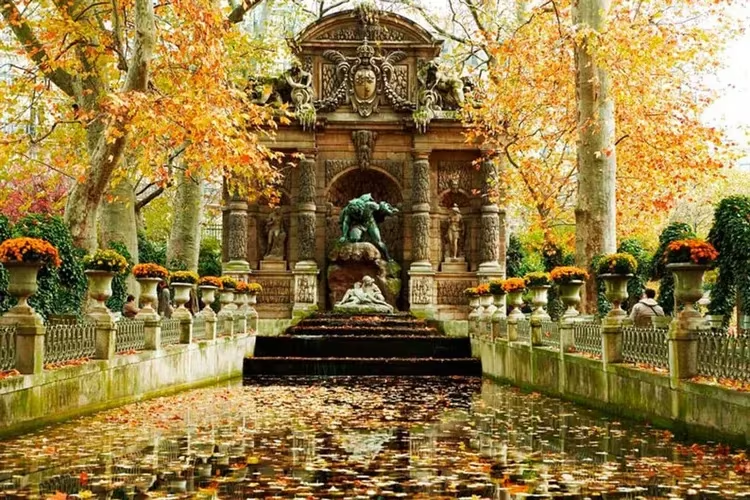
The Luxembourg Gardens are famous for their magnificent fountains. The most famous of these is the Medici Fountain, a romantic baroque creation designed in the early seventeenth century. It is located at the end of a small oblong body of water on the northeast side of the park. The fountain is decorated with an amazing group sculpture depicting the plot of the Greek myth – Polyphemus is watching the lovers Akis and Galatea.
The hero is surrounded by metaphorical images of the rivers Seine and Rhone. The fountain was designed by Tomaso Francini, a Florentine craftsman and hydraulic engineer who was brought to France by order of King Henry IV. In the eighteenth century, the famous fountain was almost completely destroyed and restored only a century later thanks to Napoleon Bonaparte. The process was commanded by the architect of the Arc de Triomphe – Jean Chalgrin. The Medici Fountain found its present place between 1864 and 1866.
Another fountain is secluded behind the Medici fountain and is called the Fountain of Leda. It was built in 1806. Like the “elder brother”, the bas-relief is decorated with a plot of Greek mythology depicting Leda and Zeus, the latter in the form of a swan. The picture refers us to the myth when the god of thunder descended into the mortal world, was struck by the beauty of the girl and appeared before her in the form of a beautiful bird.
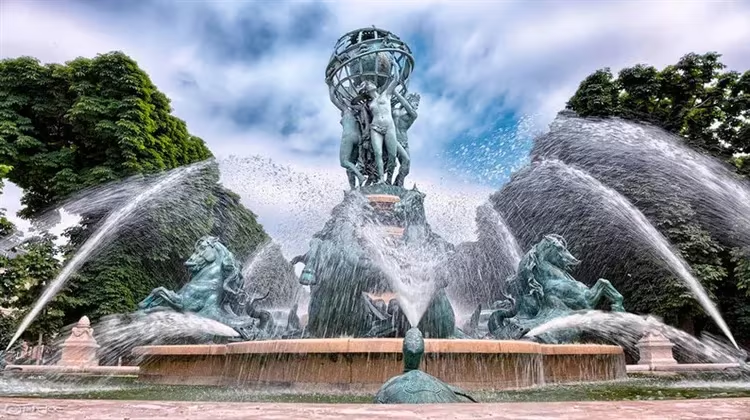
The third fountain is located to the west of the palace. It is based on a rectangular pool, in the center of which there is a pedestal with a bust of the great French creator – Eugene Delacroix (in the Louvre, a whole room is allocated for his paintings). Also, the fountain is decorated with several metaphorical statues, symbolizing time, glory and genius. The fourth fountain is located in the southern part of the garden and is called the fountain of the Observatory. It was created in 1873 by Jean-Baptiste Carpeau, Emmanuel Frémiet and Gabriel Daviu. In the center of their work is a globe held by four women – symbols of the continents.
The museum that Hemingway fell in love with
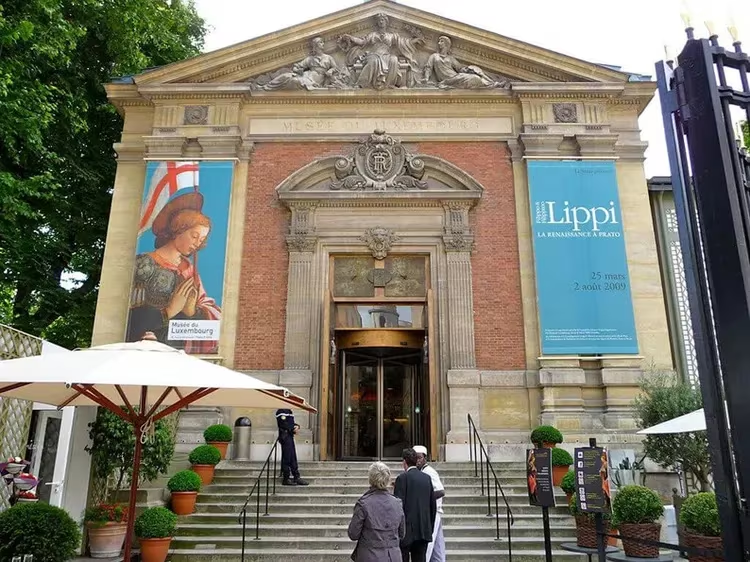
The Luxembourg Garden Museum occupied a special place in the heart of the eminent American writer Ernest Hemingway. It is housed in a building dating back to the 1800s but now closed for renovation and redesign by the architect Shigeru Ban. The original collections are no longer in the hands of the museum and have been moved to other locations such as the Louvre.
However, the Luxembourg Museum can still surprise with temporary exhibitions, so you want to come back here again and again. For example, in 2015 a unique collection dedicated to the Tudors was exhibited here. What else attracts tourists back? The unique teahouse, which is famous for its hot chocolate and cakes, is the perfect place for a short break.
Entertainment
It is no secret that over the years the infrastructure of the Luxembourg Gardens has grown, and now seasoned travelers and locals can find a lot of interesting entertainment here. Here are some of them as an example:
- Puppet theater “Guignol”
Founded back in 1933, the theater still preserves the traditions of the past by staging performances for children, but now in a much more comfortable and pleasant room. This is the largest theater of its kind, not only in the capital, but throughout France (275 seats). The show is designed for children from 2 to 6 years old, but we can safely say that adults will also like the program. Along with classical performances such as “Little Red Riding Hood” and “Puss in Boots”, modern plays are staged here.
- Music pavilion
Located near the main entrance. This is an open-air stage, where live music is constantly played by talented amateurs and seasoned professionals.
- vintage carousel
The vintage carousel is not at all rich in decoration, but it boasts an interesting history. It was designed by Charles Garnier himself in 1879. This is one of those carousels that we often see in films – with horses, elephants and deer, on which every child can ride with pleasure.
- Orangery
For several centuries there were greenhouses in the Luxembourg Gardens, but the one that pleases us to this day was built in 1830 and is a historical monument. Like two centuries ago, orange and palm trees are still grown here. Incredibly, some of them are 250-300 years old, although the building around was rebuilt.
Where is it located and how to get there
Address: 75006 Paris, France
The easiest way to get there is by metro (Odeon and Notre-Dame-des-Champs stations).
You can also take the Rer high-speed train and get off at the Luxembourg station.