
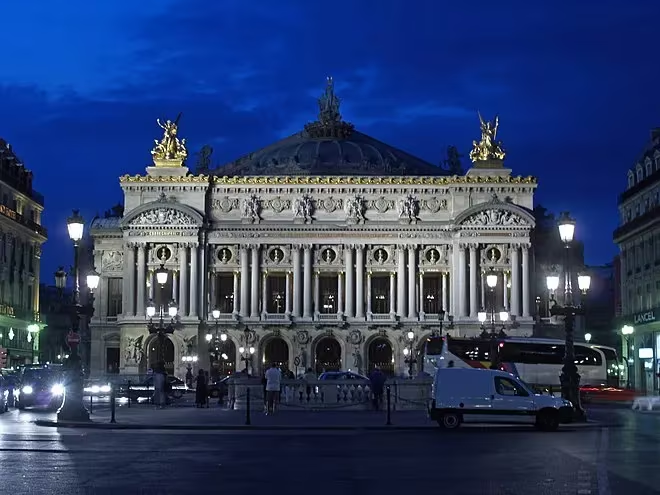
The Opera Garnier was built in Paris in 1875 by architect Charles Garnier. Other names of the opera house, known all over the world: Grand Opera (Grand Opéra), Garnier Palace (Palais Garnier), Paris Opéra (Paris Opéra).
Construction history
It owes its origin to Emperor Napoleon III. There was an attempt on his life in 1858. It happened at the Theater of Music on the Rue Le Peletier. The emperor demanded the construction of a new building that complies with all safety rules: with a separate entrance ramp and a secret entrance, from which he would immediately get into his box.
The announced competition was won by the young architect Charles Garnier. The first stone was laid in 1861. Difficulties arose during the construction of the foundation. It turned out that in the place approved for construction, the soil is too loose, swampy, due to the accumulation of groundwater. In addition, during the work, a large underground lake was discovered that impedes construction.
It took 8 months to drain and strengthen the soil. All this left its mark on the engineering features of the foundation: below the building there are real catacombs with thick double walls, consisting of labyrinths and compartments.
The Franco-Prussian War (1870-1871) and the revolutionary events (1871) made adjustments to the construction plan. The budget was cut so much that it became impossible to continue work. When the political situation stabilized, construction resumed. The opening took place in 1875.
Terrible secrets
The building is surrounded by a halo of fatal coincidences and secrets. One of them served as the basis for the novel by G. Leroux “The Phantom of the Opera”, about the inhabitant of the dungeon – Eric.
This is a real character that existed during the construction of the building. His tragedy was that outwardly repulsive and ugly, he was an unusually talented, sensitive person. Eric traveled for a long time with a traveling circus to different countries, while studying architecture and architecture.
When Garnier heard his ideas, he was delighted and decided to illegally keep this tramp with him as an assistant. So Eric turned out to be a resident of the basements of the Grand Opera. One day he fell in love with a choir girl. With his mind, it cost nothing to mystify her, though he hid the ugliness under a mask and cloak. The girl even agreed to live with him, but happiness did not last long. When she left him, Eric decided to leave this world by immuring himself in one of the basement rooms.
Mystically inclined people claim that his spirit, not knowing rest, wanders through the halls. But not only this excites rumors. Allegedly, the underground lake is nothing more than an entrance to the kingdom of the dead, and during the years of the revolution, people were tortured and executed in the building, and their souls appear to the caretakers in the form of ghosts.
Mysteriousness was added by an incident that occurred in May 1896. It was said that during the opera “Gella” the building shook, thunder was heard, clouds of smoke and bright light appeared, a chandelier fell, killing one woman and maiming several others, and panic began. In fact: a cable broke, holding a 700-kilogram counterweight to the chandelier. A large piece of metal flew into the chimney, shorted the electrical wiring, part of the masonry fell off, which caused noise, lighting effects and the tragedy of several people.
theater building
Opera Garnier is a luxurious and exquisite palace that combines different styles and elements of baroque, gothic, renaissance architecture. 24 types of marble, bronze, onyx, gold leaf were used for the construction.
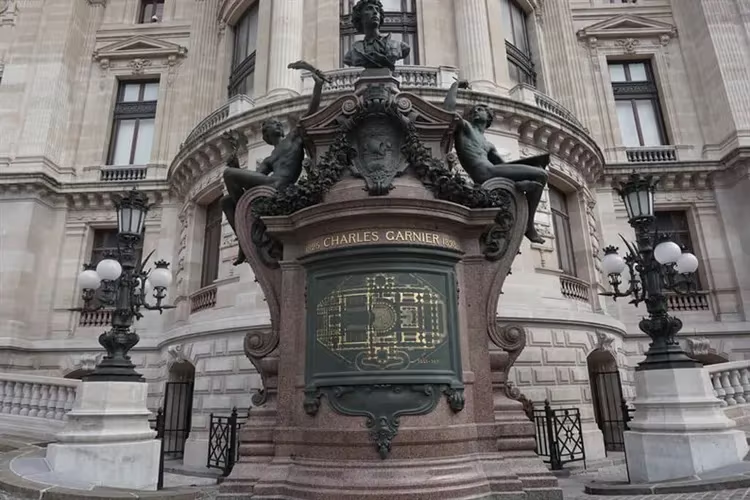
The facade is decorated with several sculptural compositions: Drama, Music, Dance, Poetry. On the dome is a sculpture of Apollo holding a golden lyre. Bronze statues of Greek gods look impressive. Between the marble columns are busts of famous musicians.
Main staircase
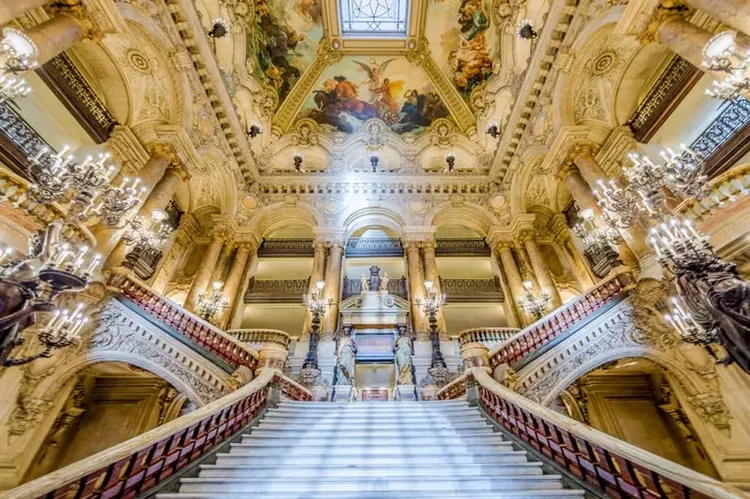
The staircase, consisting of two spans, is the connecting link between the theater lobbies, the foyer, and the auditorium. This amazingly beautiful building is located in the central part of the building. The steps are made of polished snow-white marble. The balusters are decorated with red and green stone.
The onyx balustrade has a complex oriental ornament. Below are high floor lamps in the form of sculptural compositions with female figures holding bouquets of light beams that illuminate the stairs. The plafond is painted with patterns in antique style.
Library Museum
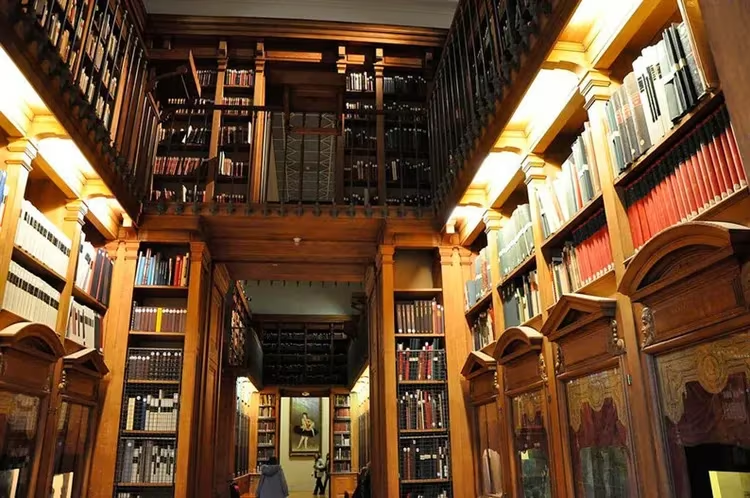
The date of foundation is considered to be 1866. It is the oldest museum of its kind in the world. It started with an archive collected for the needs of the theater, which gradually developed into a library-museum. It occupies the round hall of the former Imperial Rotunda, located in the western part of the building and has 5 exhibition halls. There is a permanent exhibition of unique photographs. In addition, there are numerous thematic temporary exhibitions.
The library-museum contains materials that tell not only about the Opera Garnier, but also about the history of opera and ballet in France, which began its existence in 1671. In total, the museum has more than 600,000 documents and 8,500 exhibits. This is a collection of costumes of famous artists, scenery, books, sketches, programs, posters and much more.
Theater foyers
The interior design allowed Garnier to dispense with heavy internal structures. Therefore, inside the building looks spacious, bright. Of the many lobbies and foyers, the Grand or Main Foyer occupies a special place. It is intended for walks, communication of the public during intermissions.
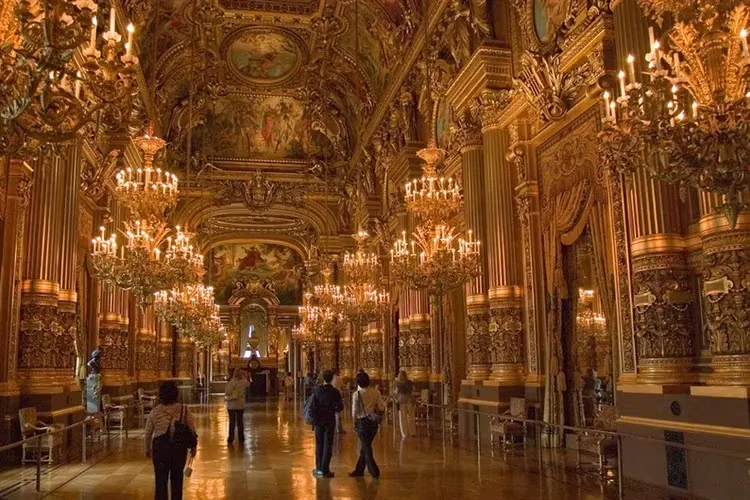
The Foyer got its name not only due to its huge size (56 m * 13 m and 18 m in height), but also for the richness and luxury of decoration. Large windows, the play of light from numerous mirrors and crystal chandeliers add airiness, further increasing the feeling of space.
The domed ceiling is painted on musical themes by the artist Paul Baudry with allegorical figures of Comedy and Tragedy, lined with mosaics, decorated with frescoes depicting children playing musical instruments, dancers and musicians. The lyre was chosen as the unifying element. It is often found in artistic compositions and the interior of the room, even the door handles are made in the shape of a lyre. In the center is a bust of Charles Garnier.
The small Lunar Foyer is interesting in its decision. The theme taken for the design was the night: at the top of the black sky is a yellow spot of the moon, spilling rays of light. Around him are bright sparkling blotches of stars, bats, owls. Behind the stage is the Dance Foyer, separated from it by a curtain. It serves for the rehearsals of the actors and, if necessary, for deepening the stage. The walls are decorated with portraits of famous dancers of the 17th-19th centuries in stage costumes.
Theater Hall
The theater hall is the main attraction of the theatre. It is located in a semicircle, has five tiers, and can accommodate 2156 spectators. The chairs are upholstered in red velvet. The curtain on the stage was made of the same material, decorated with gold inserts, tassels, and a lambrequin. Gold leaf, marble, stucco are present in the design of the columns, balconies, mezzanine boxes and the upper gallery. External splendor is accompanied by excellent acoustics and high-tech equipment of the stage space.
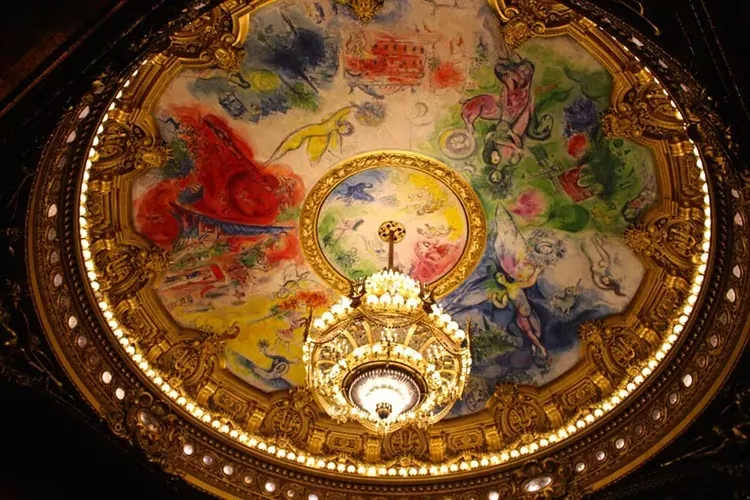
A crystal chandelier with 340 lights is installed above the hall. The plafond, attached at a height of 20 meters, originally looked like a Renaissance fresco, but eventually required replacement. In 1964, the famous artist Marc Chagall received an order for painting.
His work consists of 5 color segments: white, yellow, red, green and blue. Each segment has its own topic. As subjects, Chagall chose fragments of operas, ballets, architectural masterpieces of Paris (Eiffel Tower, Arc de Triomphe). The artist, the great colorist of the era, chose the colors in such a way that they effectively emphasize the splendor of the hall and blend harmoniously with it.
Grand Opera in numbers
Monument to Diaghilev
Before entering the building in 2009, it was decided to erect a monument to the talented Russian impresario S. Diaghilev. He deserved this honor by right. The famous ballet seasons organized by him at the beginning of the 20th century, in which the Russian Ballet troupe performed, conquered not only Paris, but all of France, Great Britain, and Monaco for almost 20 years.
The troupe included outstanding choreographers and dancers: V. Nezhinsky, A. Pavlova, M. Kshesinskaya, T. Karsavina, J. Balanchine, S. Lifar, M. Fokin. Music for them was created by I. Stravinsky, M. Ravel, R. Strauss, S. Prokofiev, K. Debussy. The authors of scenery and costumes were L. Bakst, A. Benois, P. Picasso, A. Matisse and K. Chanel.
The performances so shocked the sophisticated French public that even a fashion was established for everything Russian, including costumes and names. Almost a century later, the Parisians decided to pay tribute to the great theatrical figure. The international competition for the best layout of the monument was won by the sculptor V. Mitroshin: Diaghilev is standing on a pedestal, a top hat is on his head, and a cane is in his hands. Now the monument is under construction.
Where is it located and how to get there
The Opéra Garnier is located at the end of the Avenue de l'Opéra, in the IX Parisian arrondissement near the Opera metro station of the same name.
You can get to it: