
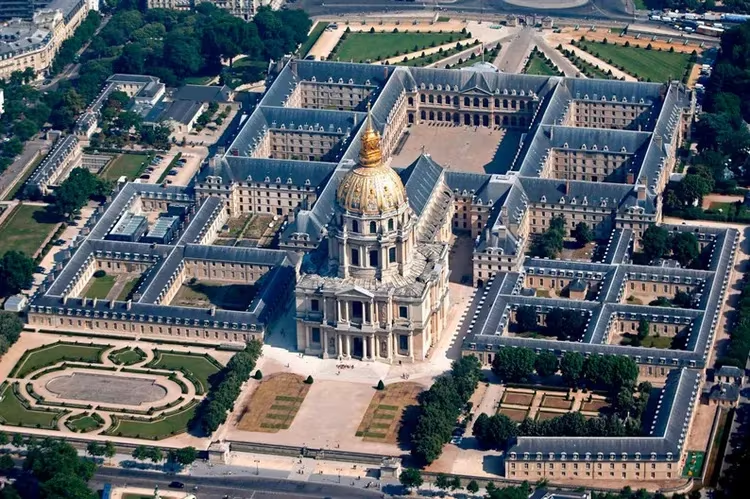
Les Invalides in Paris, not without reason, is one of the most popular and valuable sights of the French capital. The complex of grandiose buildings, located on the banks of the Seine, is a mirror reflecting the great architecture of the city of love and the history of the country that gave the world one of the greatest commanders – Napoleon Bonaparte. The scale of the colossal development is impressive: its area is 13 hectares; the graceful spire of the dome, dazzling with golden radiance, rises to 107 meters. More than 1.5 million tourists visit L'hôtel national des Invalides every year.
Story
The Les Invalides owes its origin to the Sun King – Louis XIV, who decided to raise the prestige of the French army and provide a decent old age for the aged and crippled in battles. In 1671, on the left bank of the Seine, where at that time there was a huge wasteland, the construction of a charitable institution began, the architect of which was Liberal Bruant.
The first veterans moved in after only three years; the work was completed in 1677. It was originally planned that the social institution would receive six thousand people, but upon completion of construction it turned out that the building could not accommodate more than four thousand guests. By the end of the 18th century, the complex, which was created as a shelter, turned into a miniature city, which housed barracks, an infirmary, refectories and a place for parades. In 1706, in the central courtyard, by order of the king, a basilica was built, the prototype of which was the Roman Cathedral of St. Peter.
The residents of the House observed almost military disciplinary requirements: there was a ban on smoking and alcohol in the premises, obligatory condition of residence was the observance of fasting and the constant wearing of a uniform. Veterans, united in detachments, worked to the best of their ability in craft workshops and participated in guard duty. For non-compliance with the rules, the guilty were punished: from food restrictions to exclusion.
Over time, the monumental complex of buildings began to acquire “civilian” features: in 1777, the building received part of the collection of relief plans transported from the Louvre, and 95 years later the Museum of Artillery was opened. At the beginning of the 18th century, Peter I visited here. During his stay in the capital of France, the Russian tsar received an apartment on the second floor for undivided use.
Architecture
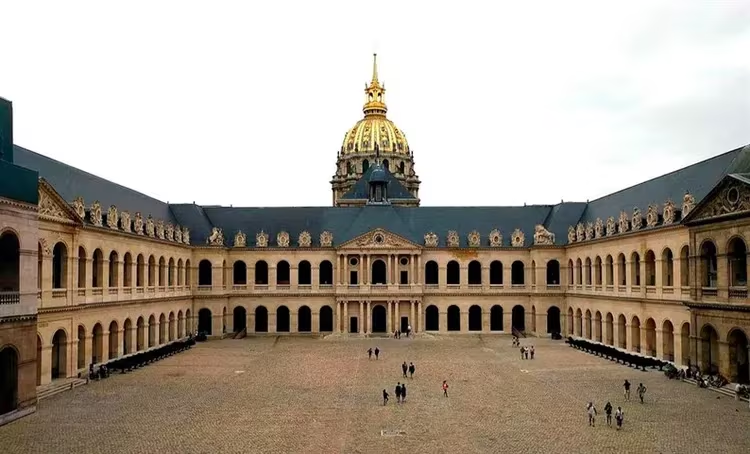
The complex of buildings is perfectly visible from the Seine embankment and the bridge built in honor of the Emperor of All Russia Alexander III. From here, an esplanade leads to the House, the creator of which was Robert de Côte. Lawns, a number of artillery trophies and French cannons were spread out on the square.
The courtyard of the House of Charity, intersecting with the esplanade, creates the largest open space in the city, where the buildings of the embassies and the Ministry of Foreign Affairs of France are also located. The Grand and Petit Palaces, located on the opposite bank of the Seine, complete the harmonious urban ensemble. The decoration of the 196-meter front facade of L'hôtel des Invalides, which is an example of classicism architecture, was an arched portal with an engraved figure of the Sun King on horseback.
The whole complex consists of four-storey buildings, forming fifteen courtyards, in the main of which there is an architectural center – a baroque cathedral. Its round dome, decorated with a stylized image of military trophies and crowned with a lantern with a spire, dominates the entire system of buildings. For the restoration of the dome with a diameter of 27 m in 1989, 12 kg of gold was spent.
Cathedral of Saint Louis
In 1676, Louis XIV, who was not satisfied with the initial appearance of the chapel being built in the central part of the Les Invalides complex, entrusted the construction of the church to Jules Hardouin-Marsart. The young architect managed to please the king. The façade of the basilica he created impresses with its symmetrical lines and graceful design, combining a circle and a square.
Its protruding central part is decorated with a monumental pediment, as well as Doric and Corinthian columns, which give the building symmetry and grace. The dome of the temple is visible from all city hills. Near the parish there is a small park, where multi-colored flower beds are in harmony with perfectly trimmed cones of shrubs.
Inside the cathedral is a Greek cross inscribed in a square. Behind the altar one can guess the features of a soldier's church overlooking the front yard. For better illumination, Hardouin-Marsart used a triple dome system. A hole was cut in the inner part, through which the painting of the middle dome is visible. Daylight entered the room through the third outer covering.
The central hall has four exits-corridors ending in chapels where the great people of France sleep in eternal sleep. Here the brothers of Napoleon, the son of the emperor, generals Bertrand, Duroc, marshals Vauban, Turenne, Leonte, Foch and the author of the Marseillaise Rouget de Lisle found their last refuge. The heart of the necropolis and the main attraction is the crypt designed by the architect Louis Visconti, in which the ashes of Napoleon are buried.
Tomb of Napoleon Bonaparte
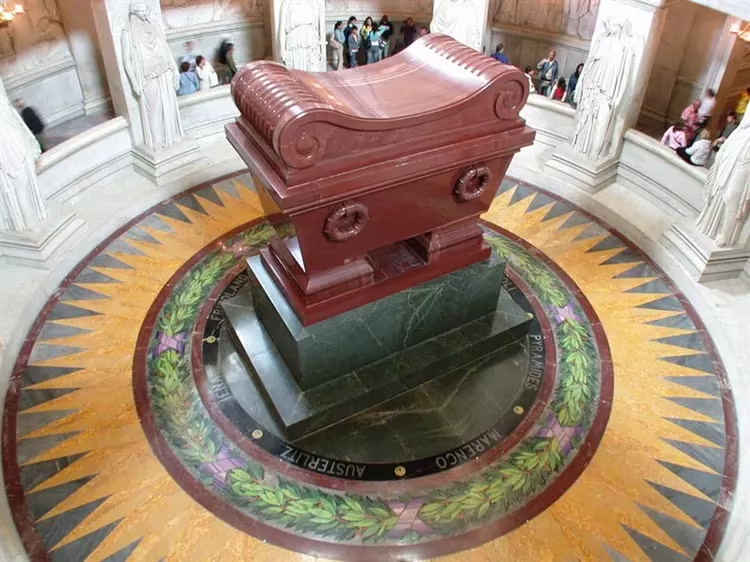
In 1840, to the mournful sounds of Mozart's Requiem in the chapel of St. Jerome solemnly brought in the coffin with the body of Napoleon, delivered from the island of St. Helena. After 21 years, the ashes of the emperor were transferred to the Cathedral of St. Louis and placed in a crimson sarcophagus made of Karelian porphyry. An integral block weighing 200 tons was presented to France by Nicholas I, while declaring that there would always be a stone for Bonaparte in Russia.
Inside the tomb rests the body of the great Corsican, dressed in the uniform of the guards; at the feet of the deceased lies his famous cocked hat. As conceived by the architect, the tomb is set on a granite plinth and is located below the floor level, therefore, in order to examine it and read the engraved inscriptions, visitors to the crypt are forced to bow their heads, saluting the emperor.
The eternal dream of the commander is guarded by twelve marble statues of the goddess Nike. Next to the sarcophagus, two bronze atlases, representing civil and military power, carry out honorary service. In their hands is a power, a crown and a scepter. The walls of the crypt are decorated with medals, certificates and weapons. Here is the leader's sword, which accompanies him during the battle of Austerlitz.
Museums
At the beginning of the 20th century, the Place of Charity for Retired Soldiers acquired the status of a museum object. Its collections include more than five hundred thousand exhibits related to important eras in the history of France, as well as the political, social and military life of the state.
Army Museum
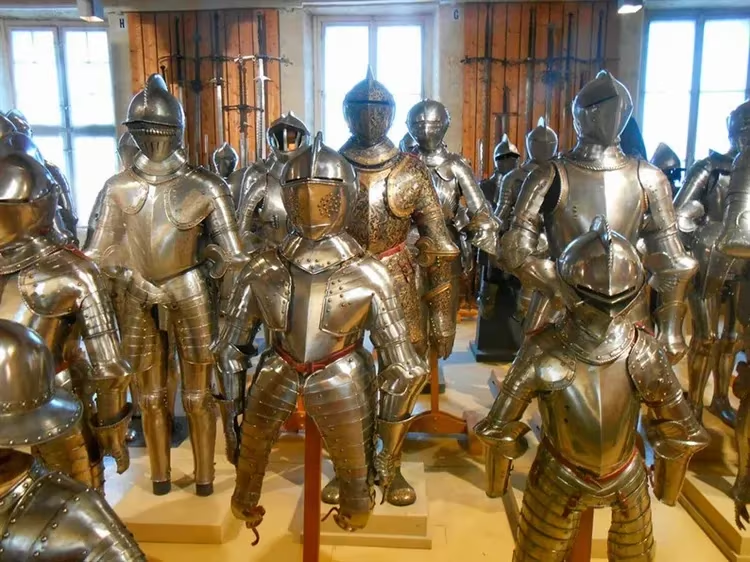
This museum, founded in 1905, gained world fame by the fact that today it is the owner of the third largest collection of armor and weapons in the world in terms of the number of exhibits. The expositions are divided into weapons and historical parts, the halls are also divided into categories.
The galleries of the Armory are an exhibition of knightly uniforms. Many armors look as if their owners just returned from battle yesterday. Items from the enemy arsenal, including samples of Russian weapons, are on display in the lobby. Banners and flags are also exhibited here, the most ancient of which are reproduced from surviving paintings. A special place is given to the armaments of the countries of the East: Persia, Japan, China and India.
The historical hall is admired for its interior – the ceiling is draped with a tent, which until 1900 belonged to the Chinese empress. The showcases contain personal belongings of Napoleon: his uniforms, furniture, a travel box, stuffed animals of his beloved horse and dog. One of the most valuable exhibits is exhibited here – a posthumous cast of the face of the great commander.
Museum of the Order of Liberation
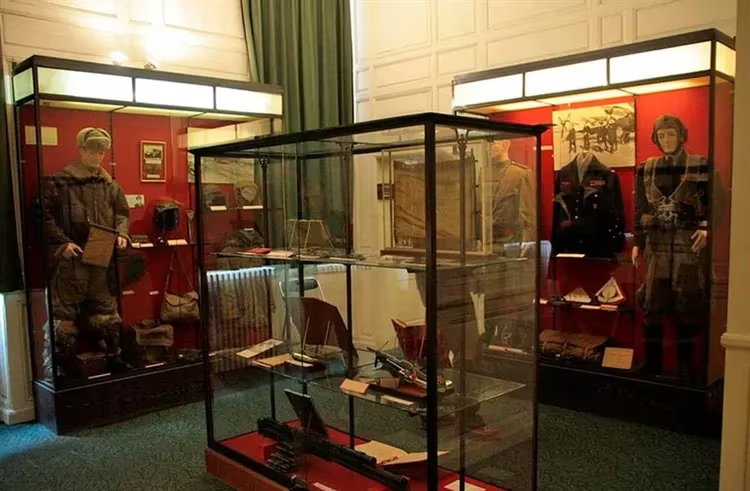
The Order of Liberation is one of the most important state medals. In November 1940, General Charles de Gaulle awarded supporters of the French independence movement who voluntarily defended the country with a distinctive sign – a rectangular bronze shield (30×33 mm) with an engraved Lorraine cross. The highest award was given to 1061 people, including six women.
The history of the order and its knights became the basis for the creation of the Museum, located on an area of 1,000 m2. The expositions acquaint visitors with weapons, banners, documents, radios and uniforms of the members of the brotherhood. Six halls and three galleries contain 4,000 original items.
Charles de Gaulle Museum
The Charles de Gaulle Museum is the youngest in the House – its opening dates back to 2008. The collection of exhibits, located on an area of 2,500 m2, is fully interactive. Tourists are greeted by a hall, the walls of which are decorated with 80 portraits of the first president of the Fifth Republic, then, in a spherical room, guests are invited to watch a film about this outstanding political figure. The film is shown in eight languages.
De Gaulle's personal belongings, manuscripts and awards, animated archives and historical documents, split screens, video materials, the total duration of which exceeds 20 hours – all this captivates tourists from the first minutes of acquaintance. The premises are arranged here in a circle, visitors themselves choose the route that interests them the most.
Les Invalides today
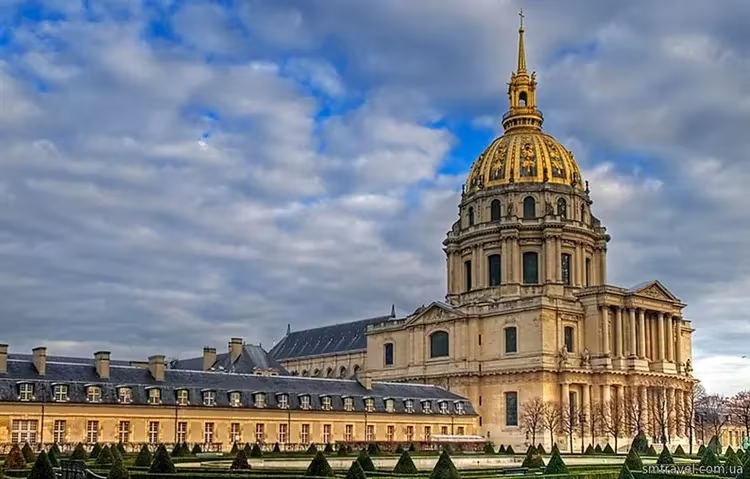
Modern L'hôtel national des Invalides is one of the hallmarks of the French capital. In addition to visiting the cathedral, the necropolis, historical monuments and priceless relics of museums, visitors do not ignore the souvenir shop, where you can buy a mug with Napoleon's initials or a figure of the famous Corsican with a glass bell. At the entrance, all children receive a chic hat of the great commander.
However, the architectural ensemble continues to perform the functions that Louis XIV laid the foundation for. The House for the Invalids has not lost its main purpose, and this is worthy of respect. Pensioners and veterans who have devoted themselves to serving the motherland still live here to this day. For the convenience of former soldiers and officers, who are under the care of the State Institute for the Disabled, a hospital, a pharmacy and church services operate on the territory of the complex. In addition, the administration of the Parisian military commandant's office is located within the walls of the palace.
Where is it located and how to get there
L'hôtel national des Invalides is located in the seventh district of Paris, one kilometer from the Seine embankment. There are two entrances: the southern one from Place Vauban and the northern one from the Esplanade des Invalides.
The complex is very easy to reach by public transport:
Opening hours and ticket prices
The State House for the Invalids receives guests daily from 7:30 to 19:00 (on Tuesday from 7:30 to 21:00). The doors of the museums are open for visits every day:
Days off: 01.01, 01.05 and 25.12. On the first Monday of each month, tourists are only allowed inside the cathedral. In July and August, the visit to the tomb of Napoleon is extended until 19:00. A little trick: if you come to the ticket office not in the morning, but in the afternoon, then the waiting time in line will be reduced to 10-15 minutes. Tickets can be purchased 30 minutes before closing.
Full fare – 12 euros, preferential – 10 euros. The right of free entry is granted to children under 18 years of age, unemployed citizens of the European Union and journalists (upon presentation of an appropriate certificate), the disabled and their escorts, military personnel in uniform.