
Sagrada Familia in Barcelona – history, photo, description, ticket prices 2021, opening hours, map
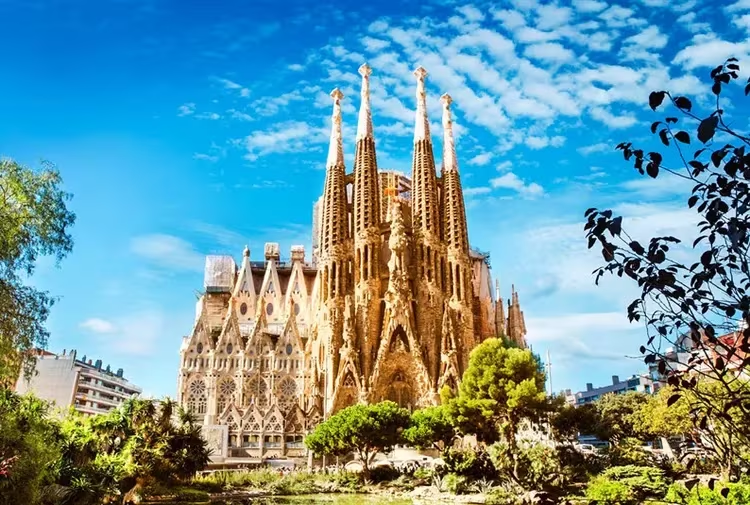
Beautiful Barcelona, the capital of Catalonia, is truly a unique city with many attractions. But let's be honest, most inquisitive tourists go there solely to admire the work of the brilliant architect of the past – Antonio Gaudi. In particular, his unfinished creation called the Sagrada Familia is famous – an architectural object of amazing fate and stunning beauty.
Temple or Cathedral
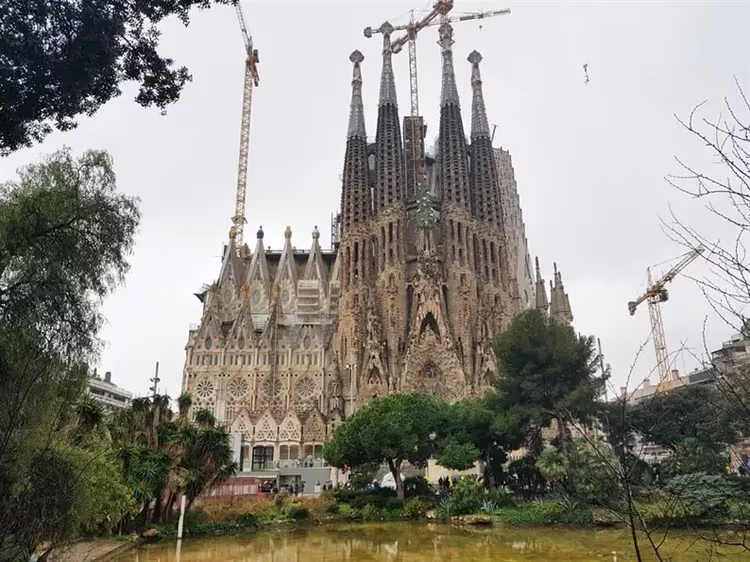
In a free Russian translation, the Expiatory Church of the Holy Family is often called a cathedral. Is it correct? The answer lies in the terminology. The fact is that the main temple of the city is called the cathedral, where the bishop directly conducts worship. Sagrada Familia is certainly an important cultural, religious and historical site, but, alas, the ruling episcopate in Spain is located in the Cathedral of St. Eulalia. That is why the creation of Gaudi should be called a temple or a church, and nothing else.
Construction history
The amazing story of Barcelona‘s most popular landmark began way back in 1866, when Josep Maria Bocabella, a prosperous bookseller, founded the Spiritual Society of the Devotees of Saint Joseph. It was this organization that in 1874 initiated the construction of the Expiatory Church dedicated to the Holy Family. In 1881, with money from donations, the society managed to acquire a land plot of 12,800 square meters, located between the streets of Provence, Sardania, Marina and Mallorca. It was here that the construction of the temple began.
The first stone was laid on Saint Joseph's Day, March 19, 1882, in a solemn ceremony presided over by the Bishop of Barcelona. The architect of the temple was Francisco de Palua del Villari y Lozano. Some time later, due to disagreements with members of the Spiritual Society, de Palois left the post, and Antonio Gaudi was appointed in his place.
1882-1926
Finally standing at the head of the project by 1883, Gaudi continued the work begun by de Palua on the crypt, which he completed in 1889. Fortunately, donations for the construction came with enviable constancy, and after the crypt, Gaudí was able to start work on the apse. And a significant anonymous donation completely stirred up the ambitions of the architect, who dared to propose a new, more grandiose design.
Gaudí decided to abandon the old neo-Gothic plan in favor of a more innovative and monumental structure, both in form and structure. Gaudi's design involved the construction of a large church with a floor plan based on the Latin cross and “soaring” towers. According to the creator's plan, the temple was supposed to become extremely symbolic and, by its very appearance, convey the teachings of the Gospel and the Christian church.
In 1892, the foundation stone for the Nativity façade was laid. It was the first to be built, because, according to Gaudí, it would be difficult for people to accept the heavy plot and modest facade of the Passion. It was necessary to start with something more grandiose and ornate. In 1894 the apse façade was completed and the Portal of the Holy Rosary, one of the entrances on the side of the Nativity façade, was completed by 1899.
In 1909, Gaudi built temporary school buildings for the children of builders and locals living on the southwest side of the construction site. A year later, at the Grand Palais in France, a model of the Nativity façade was presented at an exhibition. The Passion Facade was designed in 1911. In 1914, Gaudí decided to devote all his efforts to the construction of the temple itself, and this explains why he did not undertake any other major work in the last years of his life. His passion for the Expiatory Temple was so strong that hardly anyone saw the creator outside the workshop, which was located next to the apse.
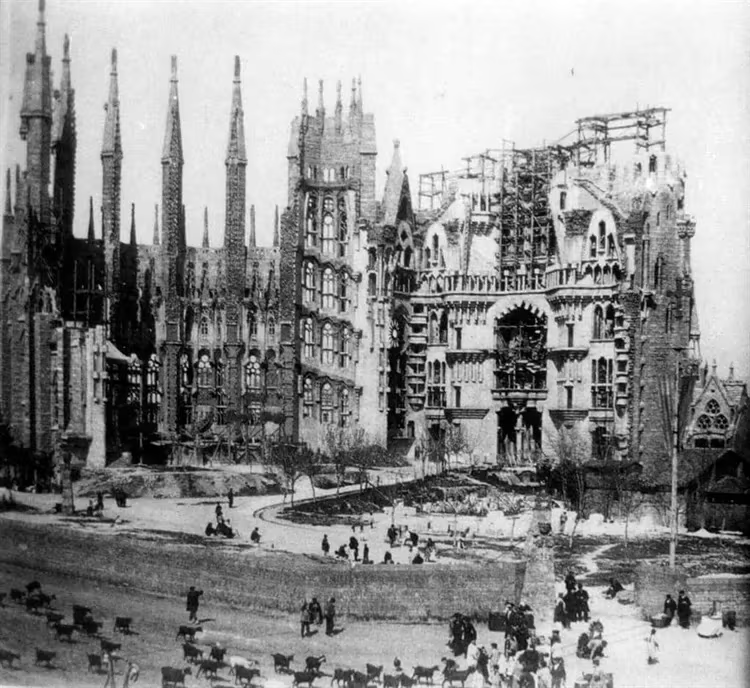
Long days of painstaking work led to the fact that in 1923 the design of the naves and roofs was completed. However, the construction work itself progressed agonizingly slowly. The first bell tower of the Nativity facade, 100 meters high and dedicated to Saint Barnabas, was completed on November 30, 1925. This is the only tower completed during Gaudí's lifetime. On June 10, 1926, the most talented architect died due to severe injuries received after a collision with a tram.
After 1926
Even during the life of Gaudi, a large group of architects, artists, sculptors and sculptors worked with him. After the death of the architect, his close friend Dominic Sugranes took over the construction. He led the project until 1938. In 1930, the remaining bell towers of the Nativity facade were completed, in 1933, the Vera portal and the central cypress. In July 1936, a terrible tragedy occurred: during the military uprising and the start of the civil war, the Spanish revolutionaries set fire to the crypt, a temporary school and workshops.
The original plans, drawings, and photographs are gone forever, as are the large-scale plaster models. This was the first “bump” on the construction path, but it should be noted that despite hundreds of such problems, the construction of the temple never stopped and only went forward, without departing from the original concept of Gaudi.
Between 1939 and 1940, the architect Francesc de Paula Quintana y Vidal, who had collaborated with Gaudí since 1919, restored the fire-damaged crypt and some of the destroyed models, which were then used for further construction. Later, the leaders of the construction were people who knew and worked with Gaudí. The last of the main architects was Jordi Fauli, who has been working on the temple since 2012.
In 1952, a staircase leading to the Nativity façade was built, and at the same time it was consecrated for the first time. Since 1964, the consecration of the facade has become a tradition. In the meantime, work continued, and in 1954 construction began on the Passion façade. In 1961, a museum was opened in the crypt providing information about the history and various aspects of the temple.
1955 was a landmark year for the Atonement Temple. This year, for the first time, there will be a fundraiser for its construction. The event was so successful that it has become an annual event. Thus, the management of Barcelona allows everyone to participate in the construction of the temple.
At the beginning of the 2000s, arches were built in the central nave and the foundations of the Glory facade were laid. In the same year, to mark the new millennium, a special mass was held in the temple. In 2001, the central window of the Passion façade was installed. This is a stained glass window depicting the Resurrection. In 2006, a kliros (place for the choir) was built inside the Glory façade, based on Gaudí's models.
Architecture
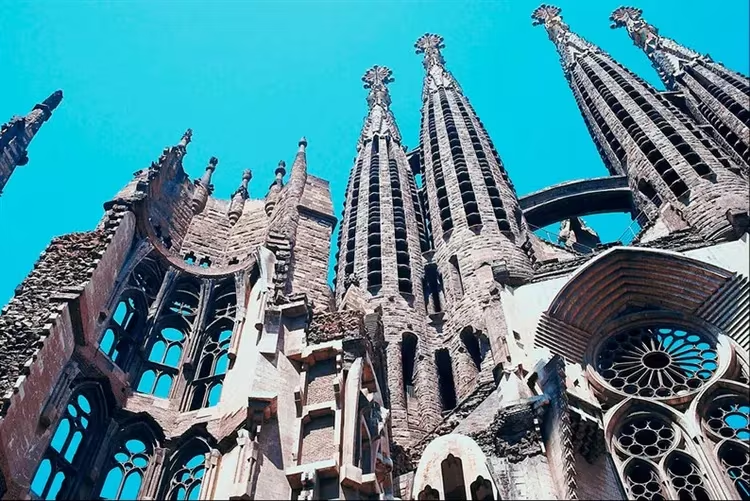
In the concept of “Sagrada Familia” as conceived by Gaudí, the tradition of Gothic and Byzantine cathedrals is clearly traced. The main idea of the creator was to reflect the Christian faith through the architecture and splendor of the building, to convey a certain message. He managed to achieve a symbiosis between form and Christian iconography, expressing his own vision through new, but completely logical structures, shapes and geometries inspired by nature.
A significant role in this is played by his vision of light and color. Various architectural elements of the temple are imbued with hierarchically organized Christian symbols. Thus, each of the 18 towers has a special meaning. In the middle is a tower dedicated to Jesus Christ, around it are four more, symbolizing the Gospel. The tower above the apse is dedicated to the Virgin Mary, and the other twelve are dedicated to the apostles. Without a doubt, when all 18 towers are completed, they will become the greatest architectural creation.
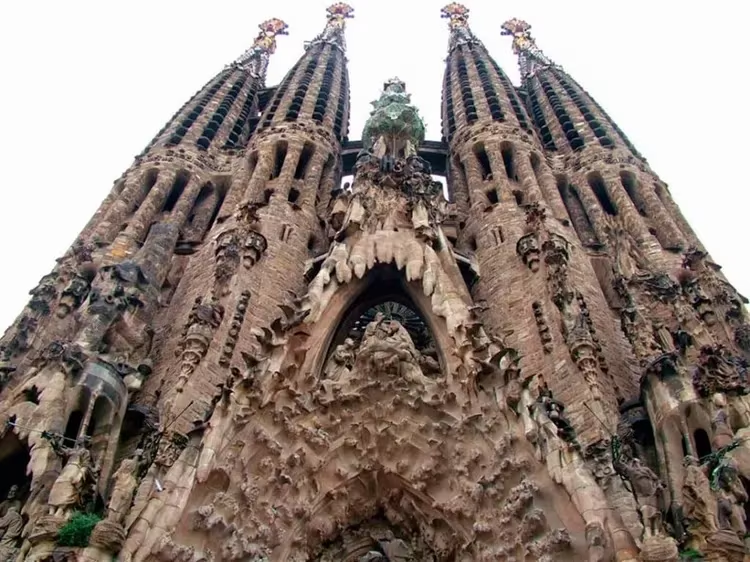
In fact, one of the main features of the building – its verticality, symbolizes the elevation to God. Sometimes it seems that its naves and tops of the towers merge with the sky. The life and teachings of Jesus Christ are presented on the portals of the three facades. Each of them depicts one of the three most important moments of his existence: Passion, Death and Resurrection. When the sun moves across the sky, each image plays with very special, mysterious undertones, slightly revealing the secrets of the temple.
According to Gaudí's plan, the light inside the Atonement Temple was supposed to be harmonious and emphasize the curves of the nave, but at the same time humble, making the incoming thinker. To bring this most enchanting light into the building, the architect designed special lucarnes between the columns, built using gold and green glass.
Despite the fact that many contemporaries were unable to understand Gaudi, he is the creator of a special architectural language, which brought him worldwide fame. Now, a century later, his design methods are rightfully recognized as revolutionary.
Facade of the Nativity
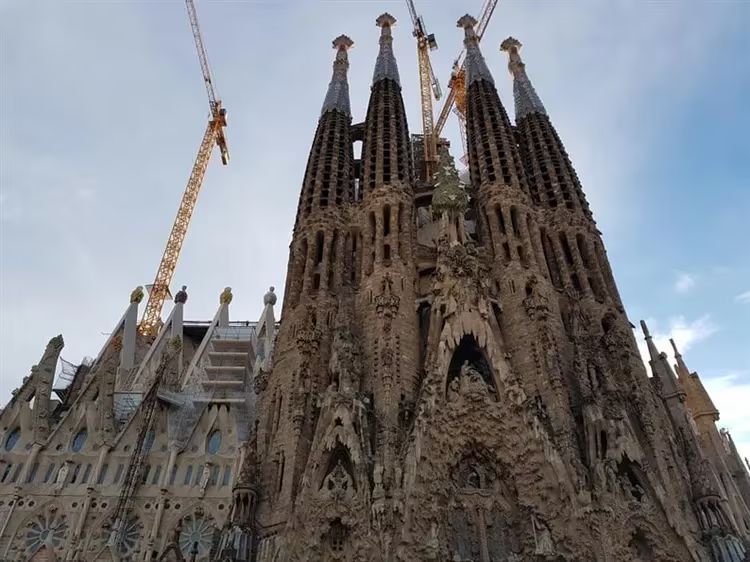
The Nativity façade, among others, is especially noteworthy because Antoni Gaudí was directly involved in its construction. It seems that Gaudí embodied all his most daring ideas in this façade. The design incorporates many natural forms, from rounded rocks reminiscent of Montserrat to human figures and plants. The facade has four towers and three doors.
One of the features is the exquisite decor with Christian symbols. The sculptures extend from the very base of the façade to the tops of the towers. The images that can be seen are the Holy Trinity, the Virgin Mary, Christmas, the Star of Bethlehem, the Three Wise Men and the Tree of Life. These sculptures were created by various artists, and then assembled into a single Gothic composition of the facade.
Portico of Mercy
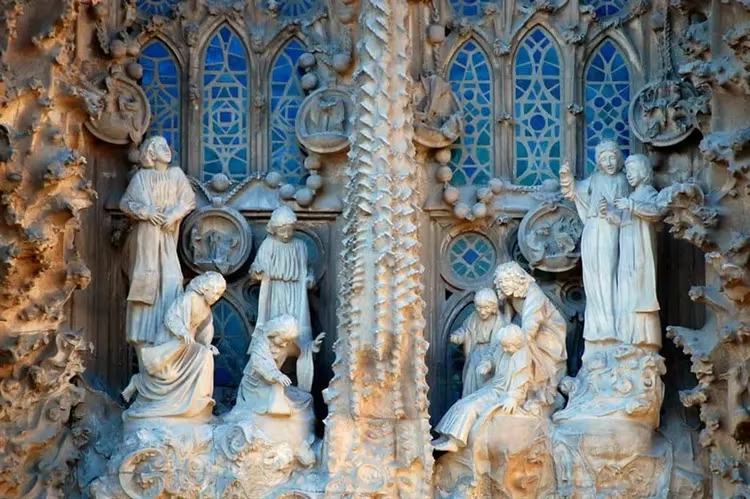
The central and largest portico of the Nativity façade. It is divided in two by a column, which is wrapped around a serpent with an apple of sin in its mouth. The main scene of the Portal of Mercy is the birth of Jesus Christ. At a higher level, the scene of the wedding of Mary is depicted.
Portico of Faith
Located to the right of the portico of Mercy, the portico of Faith is decorated with some scenes from the Gospel. Above the gate – a terrible picture – the heart of Jesus, pierced by thorns.
Portico of Hope
The last of the porticos of the Nativity façade, which is on the left. Surprisingly, the scenes depicted next to this entrance are by no means imbued with hope. So, for example, there are images of the murder of children by Herod, the flight of Joseph into Egypt, a child with a dead dove in his hand. Above the entrance is the scene of the betrothal of Mary and Joseph.
Facade of Glory
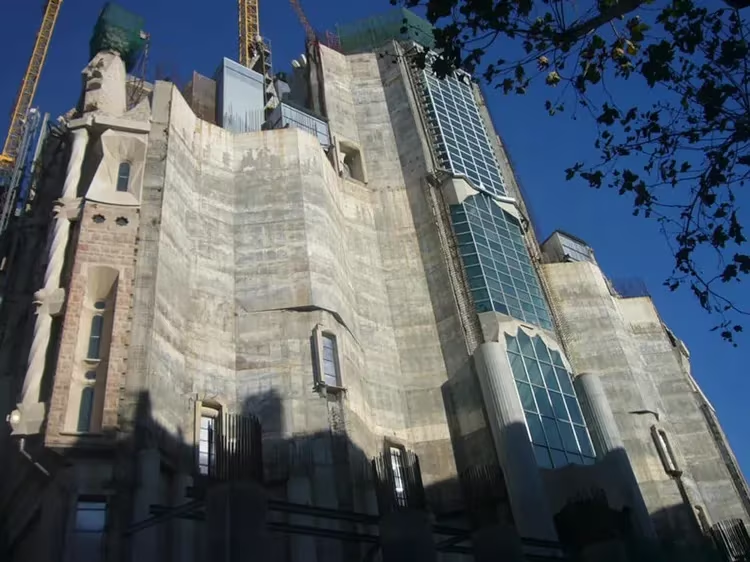
The facade of Glory promises to be the largest and most prominent, the construction of which started in 2002. As planned, it will become the main one, with access to the central nave. Its theme is the path to God through 3 stages: death, final judgment and, finally, glory. Accordingly, hell awaits those who renounce faith. Realizing that he could not live forever, Gaudí created a complete model of the façade, which was destroyed in 1936. Now construction is underway on a replica.
Completion of the Glory façade will require the demolition of an entire block of buildings on Carrière de Mallorca Street. As planned, an underground passage will lead to the facade, painted with images of vice, hell, demons, false gods and other heresy. At the bottom of the seven columns, the seven deadly sins will be depicted, and at the top, the seven virtues.
Facade of the Passion of Christ
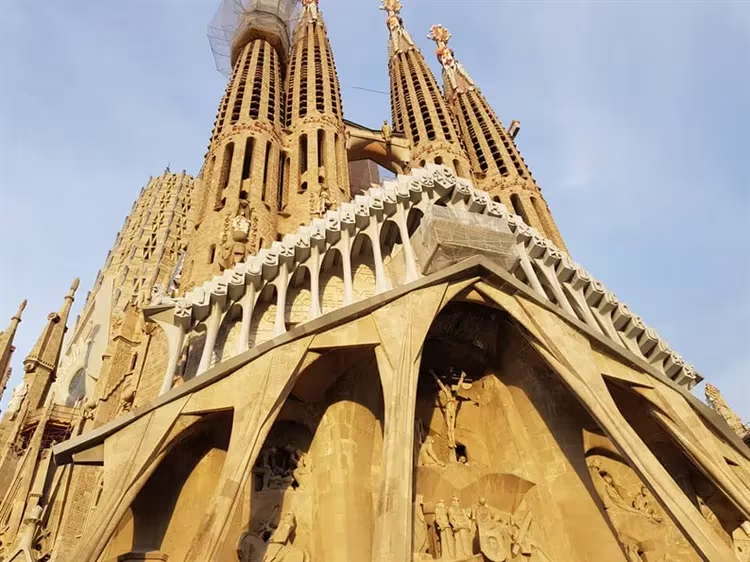
Compared to the ornate and opulent façade of the Nativity, the façade of the Passion is characterized by austerity, restraint and simplicity. And this is not surprising, given the main theme of the decor – the suffering of Jesus Christ during his crucifixion. Construction began in 1954 based on sketches and drawings left over from Gaudí's death. The dramatic effect in the design is exacerbated by harsh straight lines and angular sculptures. Gaudi believed that this facade should cause awe and fear in people.
The scenes viewed from the façade can be divided into three levels, which rise to the sky in an arc of the Latin letter “S”. At the lowest level, the night before the crucifixion is depicted, at the middle level – Golgotha, the last – the death of Christ, burial and Resurrection. Like the façade of the Nativity, there are three porticos representing the theological virtues, but in a completely different light.
Passion Façade Gate
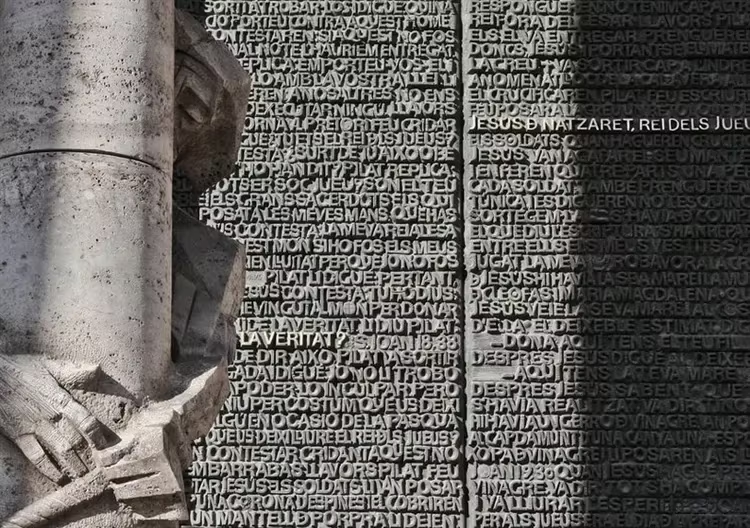
The terrible theme of the Passion facade is fully revealed even at the gate. The first thing a visitor sees is a five-meter statue of the scourging of Christ at the pillory. An excerpt from the Holy Scriptures is engraved on the bronze doors, telling about the last earthly days of the Savior. To the left and to the right of the gate are Greek symbols – alpha and omega, the beginning and the end, respectively.
Apse
The apse is located between two facades – the Nativity and the Passion. It consists of seven chapels and two side staircases, in the design of which one can clearly see the connection with the spiral staircases of the crypt (images of snails). The interior of the apse is decorated with weeping angels to commemorate the suffering of Christ. On the outside, frogs, lizards, snakes and salamanders are depicted, which cannot go inside. In addition to the symbolic meaning, the latter perform an important function – they do not allow rainwater to accumulate and get inside.
Interior decoration
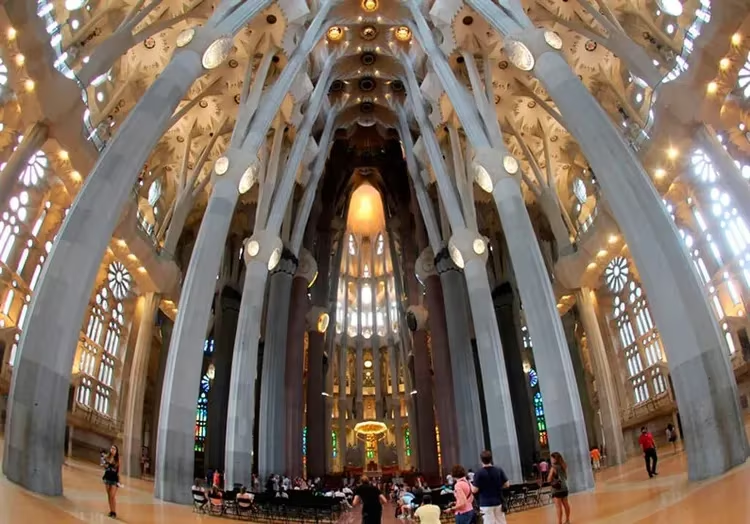
At the heart of the church building of the Holy Family is a classic five-level basilica. The central level rises above the rest, but from each of the five you can go to the unfinished facade of Glory. There are also two side portals that lead to the chapel of repentance and the baptistery. The altar is located behind the nave, inside the apse. The interior decoration, like the facades, is full of symbolic decor.
Every door, every pillar, yes, and what can I say, almost every wall is fraught with a special, sacred meaning. These allusions and parables apply to individual Catalan and Spanish dioceses, to every church in Latin America and all five continents. In addition, the apostles are mentioned again and again, especially revered saints, theological virtues, sacraments, and much more.
Museum
In the summer of 1926, a month after the death of Antonio Gaudí, the general director of the art museums of Barcelona, Joaquim Folch y Torres, proposed turning the artist's workshop into a museum. Despite the fact that the fire of 1936 destroyed a lot of sketches, drawings and models, some of the lost ones were restored and a new museum was opened. The grand opening took place in 1961 on the lower level of the Passion Façade.
Today, this room is only part of the modern museum. Notable exhibits include original Gaudí models, replicas of burnt models, and the current workshop, which is constantly working to restore original models. This is a kind of guarantee that the construction is entirely focused on the original concept of Gaudí. Also in the museum you can watch entertaining videos about the history and current state of the temple.
Opening hours and ticket prices
December 25 and 26, and January 1 and 6: 9:00 – 14:00.
The ticket price is 15 euros, you can buy it on the official website www.sagradafamilia.org.
Ticket sales stop half an hour before closing.
Where is it located and how to get there
Address: Carrer de Mallorca, 401, 08013 Barcelona, Spain.
You can get there by metro (lines 2 and 5, Sagrada Familia station) or by bus number 19, 34, 43, 44, 51, B20 and B24.
The main entrance is from the side of the Nativity facade.