
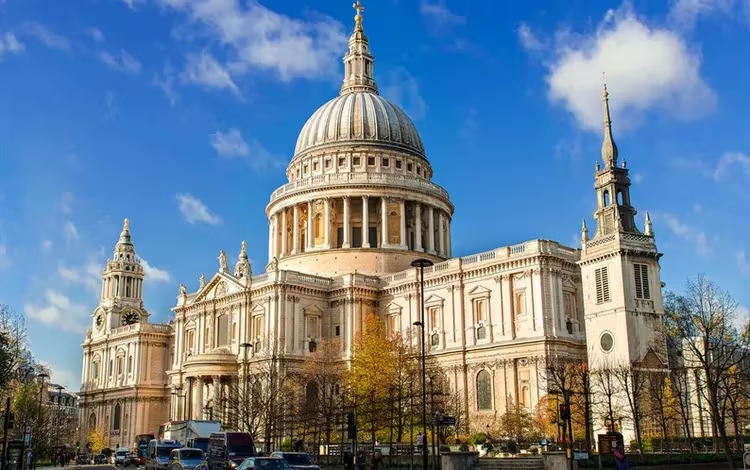
St. Paul’s Cathedral in London – history, photo, description, how to get there, map
Londinium (the Latin name for London) needed a dominant that magnifies the city and gives Christianity the status of the main religion. The bishop crowned kings. The cathedral was planned as a place of coronation, and at the end of the journey – as a luxurious tomb. St. Paul's Cathedral in London was destined to become a religious and national symbol, the starting point of the reign of monarchs.
Story
Baptized in 604, the Anglo-Saxon king Sabert ordered the construction of a church in honor of the Apostle Paul. After the departure of the king to another world, his sons refused to accept Christianity. Britain has become pagan again. The stave church, built on the banks of the Thames, burned down in 675. However, at the end of the 7th century, the new religion of Rome returned to the island. The Church of Sabert was restored twice, exactly the same number of buildings disappeared in the flames of fires (962 and 1087).
The Normans, who owned London in 1087, undertook to restore the temple, continuing the history of the so-called Old Cathedral of St. Paul. Fire again interfered with the plans: the unfinished building was damaged by a fire in 1136. Almost a hundred years later, in 1240, the construction of the temple was completed. A curiosity of extended construction: the Romanesque style was replaced by the Gothic. The cathedral, which began to function, needed immediate reconstruction in order to meet the requirements of the Universal Church.
From 1314 to 1561, London was adorned with a cathedral of incredible length – 178 m. Medieval engravers testified to the greatness of the second tallest building in Albion (149 m). Until the 19th century the exact location of the cathedral was not known. Only after the archaeological excavations of 1878 did it become finally clear that the New Cathedral of St. Paul was erected on the foundations of the old one, but with some displacement.
Construction of the modern St. Paul's Cathedral
During the Reformation period (second quarter of the 16th century), services ceased in the Old Cathedral. The property of the abbey is confiscated in favor of the royal treasury. The interior decoration was destroyed, church utensils were looted. The lightning hit the spire (occurred in 1561) was perceived by the inhabitants of London as a sign from above. Therefore, the decline of the Old Catholic Cathedral was inevitable, it was accelerated by dismantling the brickwork for the construction of the palace of Lord Cromwell.
1630s.
The New Anglican Church requires a creed. A western façade in the classical style is being added to the dilapidated nave. In July 1668, the mathematician Christopher Wren, attracted by the episcopate, submits the first project, designed to “exalt the glory of the city and the nation,” but the proposal was rejected. Only the third version of 1675 received approval.
By introducing a royal tax on coal, the authorities are calling for the free-rent to develop the quarries of Fr. Portland (North English Channel).
The narrow isthmus between the island and Britain was quickly turned into a bulk pier. The man-made isthmus became the way to supply the most durable limestone on the islands. Capitals, column bodies, window openings, niches, massive beams of architraves, foundation blocks were made from Portland stone. The same stone is used for facing. It also came in handy for carving most of the sculptures of the New Cathedral. holy apostle Paul.
Services began 19 years after the consecration. The last fragment was laid in October 1708. After another 3 years – the official announcement of the complete completion of construction. The installation of parapet sculptures (1720s) is considered the last stage of finishing work on the exterior. The interior decoration of the cathedral continued for another two centuries.
The names of the masters have been preserved: Francis Byrd (carved the bas-relief of the pediment, font, sculptures of saints and angels), Grinling Gibbons worked on the wooden sculptures of the choirs, the dome was painted by James Thornhill, Jean Tichou was engaged in forging, the mosaics of the “sails” between the arches were designed by Sir William Richmond, the altar, the chandeliers are the work of Stephen Bauer and Gottfred Allen.
Design features and style
111 meters of the dome (the highest dome is the Roman Cathedral of St. Peter and Paul with an unsurpassed height of 136 m so far) is a challenge from the Anglican Church to the Catholic. But to build like the great Michelangelo, in England they still did not know how. However, the Cathedral of St. Paul is striking in its scale (it remained the tallest building in London until the 50s of the 20th century).
Architect Christopher Wren used for his brainchild all the achievements of construction known at that time:
The flying buttresses were taken from Gothic construction but cleverly hidden behind sheer walls. The three-layer dome was built on the model of Brunelleschi from Florence. But the Florentine has 2 shells, so there is a certain ribbing of the sphere. Christopher Wren's lead dome is like a glove thrown on a cactus: many steel beams extend from the intermediate masonry of the dome and support the molded lead of the finish.
The supermassive crypt (tomb) of the lowest, underground tier is made with a special margin of safety and along the entire perimeter – in case of unforeseen behavior of groundwater in the shifting sands of the London embankment. Frequent flutes (grooves and their returns), not reaching down to the drum of the dome – they are sometimes called Wagner – allow us to attribute the structure to the Baroque style.
Signs of “Baroque” are the round windows of the belfry towers, balustrades along the contour of the roofs, arched niches, and also “rake-outs” (i.e., protrusions of the cornices of window openings), 12-corner plans of the towers, and rich ornaments without rigid geometry. Ren used completely non-canonical pea pods, sunflowers, corn cobs in jewelry – he boldly took risks and for the sake of the rebel king, teasing both Rome and the Pope.
The cathedral with its porticos, acanthus on the columns could be considered as a model of classical architecture, if it were not for the play of forms inherent in the Baroque style. The interior decoration also testifies to the author's commitment to Romanesque and Byzantine styles. The creator of the English neo-baroque rests in the crypt, the first to be buried in it. Ren is one of the few great architects who lived to see the completion of state-scale construction. Bequeathed on the stove “Look around – everywhere I am” is now being read by visitors to the Cathedral of St. Paul.
Dome (exterior)
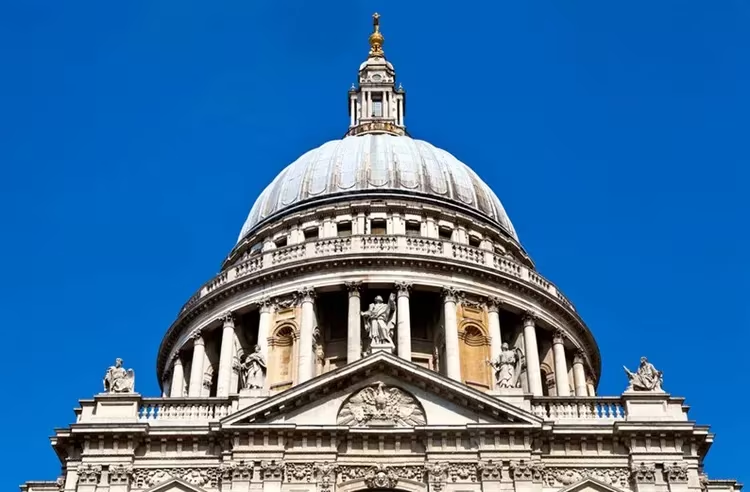
The gigantic mass of the dome rests on the peristyle, which is perceived by the audience as a light, graceful structure. The effect is achieved thanks to paired pilasters and pseudo-windows. The drum of the dome rests on the so-called “stone gallery”, which is nothing more than a ring of flying buttresses disguised as a rotunda, but not passable through. The drum with the visible part of the dome overlaps a strict cone made of brickwork, on which the internal interior dome is “suspended”. In order for the cone to fit between the two shells, the shape of the dome was not made strictly spherical – it was elongated.
The many windows above the balustrade are functional: it is thanks to them that the built-in brick cone is illuminated. Further, light from special round holes enters the eight inner windows. Slots at the pole of the sphere are also involved. They are glazed horizontal hatches. The top of the dome is completed – laterna – consisting of a tier of the so-called. Golden Gallery (530 steps lead to the observation deck of the gallery). The second tier is made in the form of a tiny tempietto temple. Above the dome of the laterna is the Golden Cross of the Savior.
Coca-Cola London Eye ticket £24.30
Tower of London and Royal Treasures
ticket £26.80 Tower Bridge ticket £9.80
Westminster Abbey entrance ticket and audio guide £20
Madame Tussauds ticket – £29
St. Paul's Cathedral: Fast Track Ticket – £16
Shard Skyscraper – Entrance Ticket & Champagne – £24.95
Dome (interior)
Eight ceiling windows form a beam of light directed towards the floor. It symbolizes the Holy Spirit. The painting of the dome is divided into eight parts using the “grisaille” technique (without color).
Plot: between the paired columns of the rotunda, milestones in the life and deeds of St. Paul the Apostle are depicted. The Pharisee Paul was blinded for unbelief. Hearing the reproaches of Christ, Paul, who was baptized, was healed after a pilgrimage to Damascus. Paul's preaching about Christ in the synagogue, his trip to Cyprus and enlightenment with the help of proconsul Sergius are illustrated. The last picture shows the death of Paul at the hands of the Romans on the cross.
The golden painting is played with gilded ornaments of the dome ring, so it seems to be a continuation of the decoration of the main nave. The blue dominant color of the mosaics forms a single background with the azure of the sky in the windows. The dome appears to be floating. The presence of eight bas-reliefs of saints made of stone seems absolutely incredible here. They are carved on the faces of the flying buttresses, and therefore are slightly inclined towards the middle cross.
Western facade
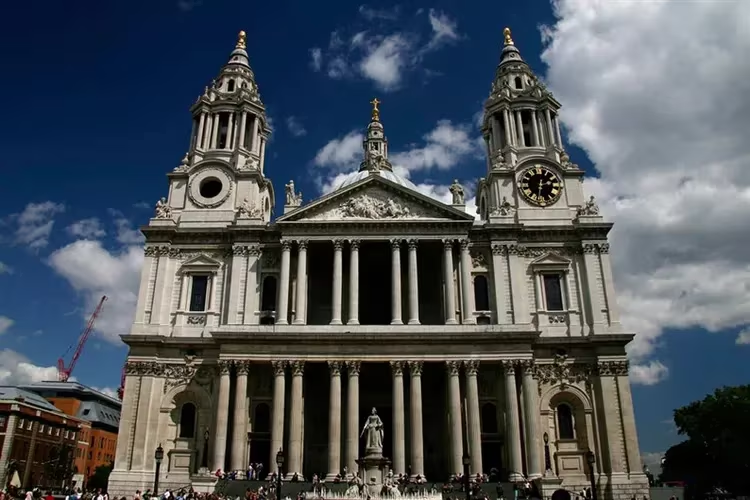
The project did not envisage towers on the western façade. The idea arose already during construction. One of the towers is decorated with a clock. Until 1969, the watch mechanism was manually started. There is also a staircase to the library, named geometric by the architect Wren (it is not twisted). This staircase leads to the Chapel of All Souls.
The classical portico of the Western façade is unusual for its two-tier structure. The second, no less original solution for the facade is paired columns. Thinning plus multiplicity is a technique that, while maintaining the necessary masses, made it possible to make the facade visually light, filled with light and with a rich play of shadows.
Lush garlands above the window openings are echoed by figurative images of the pediment (the end triangle of the roof), as well as niches with bas-reliefs. Statues of the apostles, bowls at the turrets, cornices with a clear rhythm of triglyphs create an expressive light and shade pattern and a memorable silhouette of the facade.
Interior
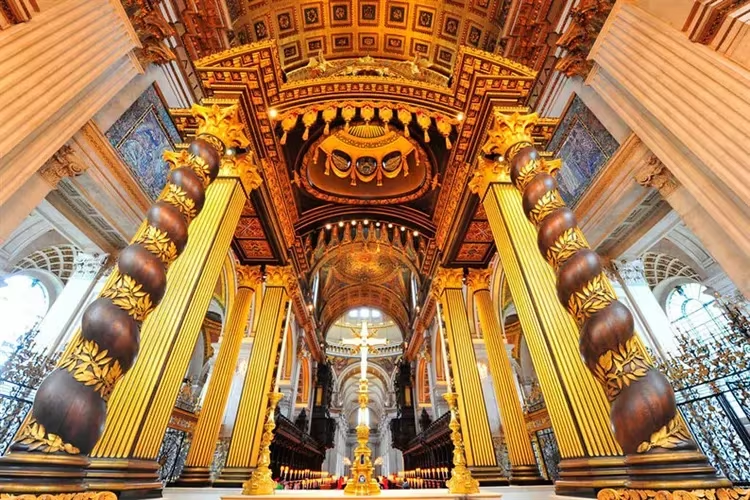
The gallery of the nave is 68 meters long, 28 meters high and 37 meters wide. The transverse gallery (transept) is 51 meters long. A huge granite font by the sculptor F. Byrd (XVIII century), standing in the first travey, is a materialized call to be baptized with water. The obstacle at the door is not accidental: only the Lord Mayor of the city can enter through the main entrance. On both sides of the bowl are two chapels. The left one (St. Dunstan) is intended for private worship. The right one bears the name of Saints Michael and George.
Mosaics made of Venetian glass are monumental. They are interesting not only for the traditional interpretation of biblical characters, but also for the picturesque details in the “naive” style: birds, animals, fish, shellfish coexist with the heroes of the New and Old Testaments. The reformism of the Anglican Church is built on the All-Unity, and therefore any expressive means are allowed.
Those who enter the cathedral hear the powerful sounds of the choir, the overflowing of organ music, but do not see the organ pipes at the end of the hall: the pipes are placed on both sides. Instead of an organ, there is a stream of light from the stained-glass window of the apse. Light plays the role of a participant in the service. At the middle of the cross rises the pulpit. Opposite it is the place of the organist. 4 traves (square divisions of the nave) lead to the middle cross, that is, under the very dome. The same number of them – up to the closing gallery of the apse. Wide stained-glass windows illuminate the hall, and gilded arches repeat rhythmically on the vault.
The visitor will not see the usual iconostasis in Orthodox churches. Only openwork gates block the way to the altar. Right in the cathedral there is a picturesque canvas “The Light of Peace” by Holman Hunt (in the northern part of the transept). But this work is not an icon, but a well-known work of art.
Apse
In the apse, the face of Jesus is depicted three times: on a mosaic panel among the archangels, on the stained-glass window and on the canopy of the altar. The Messiah does not stand, but goes towards the parishioners, moves along the silver dome of the altar. The sculptural image is original: Jesus – with the Cross of the crucifixion – in one hand, and with the other he overshadows with the Sign of the Cross.
On the fresco, the Almighty is shown as God the Son and God the Father rolled into one. There is no sculpture of Jesus depicting martyrdom on the cross. The crucifix can only be seen on one of the mosaics. The American Memorial Chapel is just behind the altar. It is dedicated to the heroes of the United States who died for England during the Second World War.
Monuments
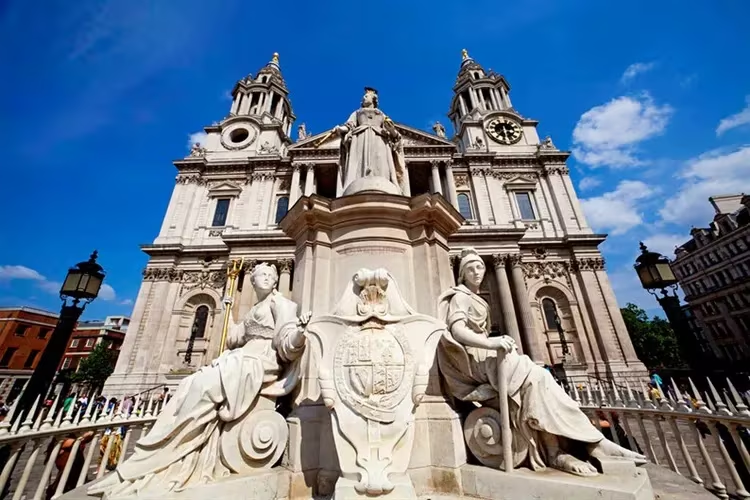
Monuments to prominent figures of Great Britain stand on both sides of the main nave – in the small naves. On the left is an equestrian statue of the Duke of Wellington, Lord Arthur Wesley (honored for the victory at Waterloo), in the north transept is the chapel of the Middleland Regiment of the British Army. Behind him, in the depths, at the altar is the statue of “Mother and Child” by the abstract artist Henry Moore (made in memory of King George IV).
The statue of Viscount Nelson begins the commemorative row on the right. At the entrance to the south wing of the transept stands the Turner Memorial, next to it is a monument to one of the first rectors of the Cathedral of St. Paul to the poet John Donne; in one of the apses lie the ashes of General C. J. Gordon. In total – 200 burials, the visible part of which is marked with granite slabs with inscriptions. You are allowed to walk on the tiles. Monuments along the walls – 67.
Crypt and burial
In addition to the mentioned Duke of Wellington, Nelson, the painter Turner and the architect Wren, the following are buried in the crypt:
The crypt hosts meetings of the Order of the Knights of the British Empire, founded by King George in 1917. Such meetings (even receptions) can be ordered in a specially designated hall. In most cases, the feasts are memorial.
Clocks and bells
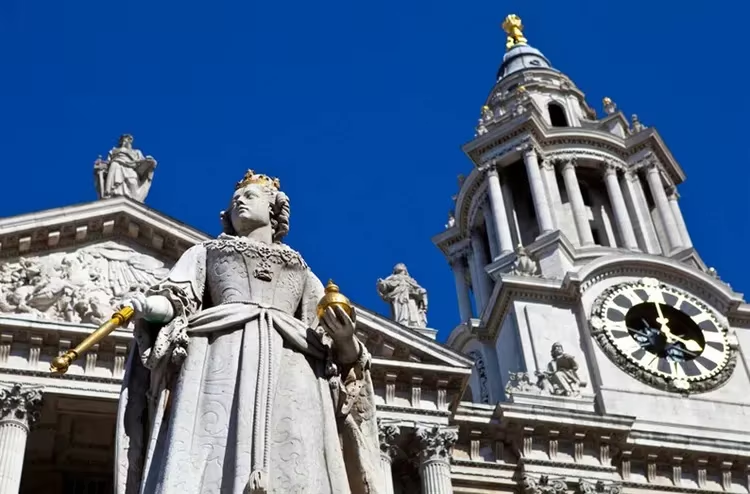
Clock designed and installed by Smith of Derby (1893). The dial diameter is 5.3 m.
The clock tower is used as a bell tower. The first bells were cast in 1717, the weight of the most massive ones is 600 kg and 1500 kg. They strike a quarter of an hour. The opposite twin tower holds 12 smaller bells. Small bells are used to chime.
But the largest bell (cast in 1881) weighs 16.5 tons, its name is Big Pavel (it is the largest in the British Isles). The task of the giant is to strike the first hour at noon.
“Paul's Companion” Big Tom – a little smaller, they beat him every hour. It also sounds in funeral prayers for members of the royal family or for a bishop who has passed away. Big Tom was beaten on the day of the death of US President James Garfield. In 2002, he mourned the Queen Mother Elizabeth. The last monument-colossus was erected at the Western facade.
Where is it located and how to get there
The cathedral is located half a kilometer from the Blackfriars Bridge. You need to get off at the City-Tameslink electric train stop on the City and County Main Line and go along Fleet Street to the east. From St. Paul's tube station, it's only 100 meters towards the Thames. Address: St Paul's Churchyard, EC4.
Buses No. 4, 11, 15, 23, 25, 26, 100 and 242 are taken to the cathedral. Excursions in the Cathedral of St. Paul's prayers are held in the intervals between services with a frequency of one hour – from 11:00 to 14:00. With a Russian-speaking guide, such an excursion costs 18 pounds.