
Villa Borghese in Rome – history, photos, opening hours, prices 2021, map
A trip to the most visited city in the world, Rome, does not need inviting advertising. Mankind is rushing here to touch the Eternal City of the planet at least for a moment, to see elements of its ancient past. It is possible to capture the view of the modern metropolis from special sites, optimally located in specific places of the city. One of them is located on the natural hill of Pincho, which went down in history as a resting place for the ancient families of the country. The view of the Field of Mars, the famous Spanish Steps, the first garden of the city founded by order of Nero, the burial places of the ancient period and many more attractions attract many tourists to this area of Rome.
History of the Borghese family and family villa
Many noble families of Rome, holding high positions, having power, money, sought to create dwellings that emphasize wealth and social status. The ancient genus Borghese from Siena belonged to this genus. The beginning of the clan comes from the nephew of the merchant Tiezzo da Monticiano (XII century) Borghesi Agostino, who served Pius II. Sons, nephews, grandchildren, great-grandchildren of the family Niccolò, Pietro, Francesco, Mark Antonio, Scipione Caffarelli, Giovanni Battista continued the affairs of the family, increasing its wealth. Starting from the 15th century, all the most important positions of Rome belonged to the representatives of the family. Even the throne of the Pope under the name Paul V in 1605 was taken by Camillo Borghese.
He worked closely with his nephew Scipione Borghese, making him a great cardinal, who is considered the founder of the famous Villa Borghese and the creator of the richest collection of art works in Italy. Now it is called the Berghese Gallery, striking with unique statues, such as Apollo Savrokton, Ares Borghese.
A significant piece of land on the popular hill was purchased by Marcantonio I Borghese in (1504–1574) for planting vines. Only Scipio (Scipio) Borghese in 1606 begins the construction of the villa. The selected project consisted of the beautiful Casino Nobile mansion, the surrounding park area, called the Garden of Delights. The construction of the mansion was led by the architect F. Pontius, D. Vasanzio.
The decoration of the sculptures took place under the direction of Pietro, Lorenzo Bernini. For the implementation of landscape design, the designer of parks and gardens, Domenico Savini, was invited. The original water system was built on the ideas of Giovanni Fontana. In 1633, the villa was completely built, surrounded by a beautiful park. On the area of the villa, there were three closed, secret gardens used by family members and close associates. Exotic plants and rare flowers grew on their territories. Now here you can see an old fountain, a fence. The figures of an eagle, a dragon froze on them. These are the eternal symbols of the family that adorned its coat of arms.
The constant expansion of the park area, the reconstruction of the mansion in which the famous gallery is located, was carried out several times. Since 1901, the complex has been taken over by the state and has become available to the general public. In the garden with centuries-old trees, statues, fountains, comfortable seating areas are equipped. Numerous cafes and restaurants are open. The famous Water Clock is located here. The complex includes the following buildings:
The villa is equipped with interesting playgrounds, bicycle rental is available.
sights
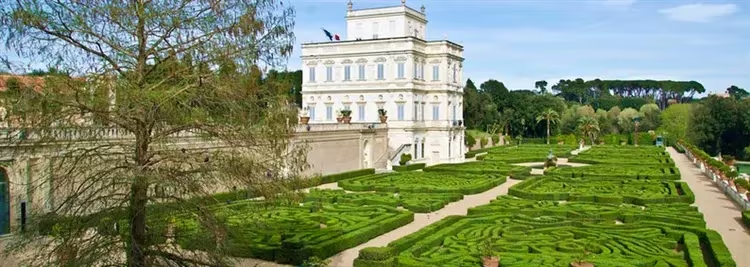
The first impression of the grandeur of the ancient complex is created by the unique horticultural technique of the garden. It was formed under the influence of Greece, Egypt, Persia. Private parks in ancient Rome consisted of three parts. The first (xystus) looked like an open terrace leading to the house through a connecting portico. The second part (ambulation) was decorated with flowers and trees. It served as a place for walking.
The third part (gestation) was decorated with majestic alleys of pines, cypresses, oaks, plane trees, elms, chestnuts, shady willow trees. In all gardens, complex hydraulic structures were built in the form of numerous fountains and lakes. Their design solutions merged with the ideas of nature itself. Rock waterfalls, ringing streams, calm expanse of lake water seem to have been here forever, and were not born as a result of human labor.
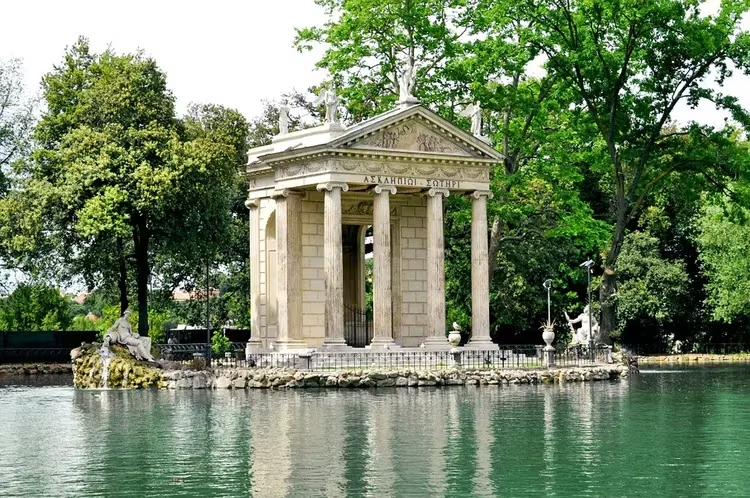
Many of the principles of building a Roman garden were later used in the parks of England, Africa, and Europe during the neoclassical, Renaissance, and Baroque eras. The gardens at the villas were used for household, entertainment, and religious purposes. For example, sacred groves were created, where a temple and chapels were built. So, in the center of the park in the 18th century, a temple of Healing was erected on a small island of an artificial lake. On the hill of Pincho, such a grove is located at its foot. By the way, during the reign of Emperor Augustus in Rome, there were 700 pools, 500 fountains, 130 artificial reservoirs.
Among the endless sea of flowers growing in the gardens of the villa, there are always thickets of roses and violets, the favorite flowers of the Romans. From ivy, laurel, boxwood, rosemary, complex figures were formed in the form of columns, pyramids, figures of animals, birds. This was done by specialists in garden art, called topiarus. Here was born a whole trend of curly trimming of shrubs and trees, which took root in the design of parks and gardens in other countries.
Sculptural forms were considered an important indicator of the wealth of the owners of the villa. In the park surrounding the Villa Borghese, 300 marble sculptures were originally installed. Many are treasures of ancient art. The park is considered the third largest among the famous landscape works of Rome.
Gallery Borghese
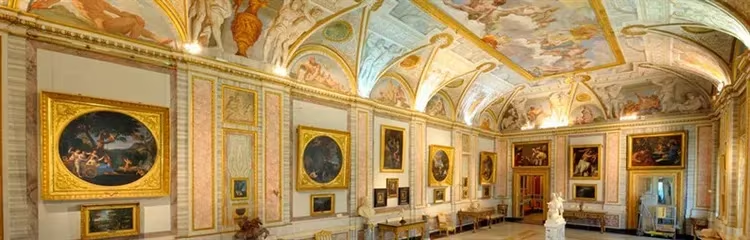
The National Gallery was formed on the basis of the famous collection of works by ancient architects and artists, collected by the owner of the villa, Scopion Borghese. A wealthy cardinal, a subtle connoisseur of art, an admirer of ancient works, collected them in different ways. By the end of his life, his collection contained more than 800 art paintings, and the collection of ancient sculpture was the largest in Rome. Unfortunately, after the marriage of one of the family members with Napoleon's sister, many works were taken to Paris. For example, the famous statue “Borghesian fighter”, created by Agasius in II-I in BC. is now in the Louvre. The sculptural portrait of Antonio Canova of Napoleon's sister in the form of a triumphant Venus can be admired in the Gallery hall.
A unique collection of masterpieces from different eras, schools of great masters is located on two floors of the restored halls of the villa. It contains about 560 paintings, several hundred sculptures from different eras. After the restoration, frescoed panels, stucco, marble floors, and painted ceilings appeared on the walls of the villa. The design changes fit well with the elements of the gallery's displays.
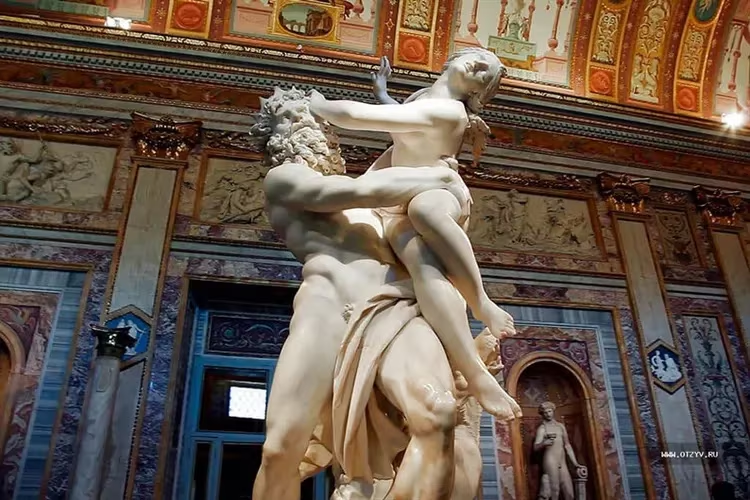
The art halls of the gallery contain paintings by Titian, Botticelli, Raphael. Six works of Caravaggio cannot be found in any museum in the world. The gallery presents all the artistic movements of the 19th and 20th centuries. The treasures of the sculpture collection are the works of Giovanni Lorenzo Bernini. The one whose father, Pietro Bernini, created the park that surrounded the villa. Four masterpieces, created by the sculptor for the villa, earned him worldwide fame. These are “Apollo and Daphne”, “The Abduction of Proserpina”, “Amalthea”, “Aeneas, Ankhikh and Ascanius”. For the first time applying a special polishing of marble, he breathed life into his creations. It seems that the bodies of his sculptures are flexible, mobile, as if alive, filled with beauty, warmth of the human body.
The Gallery has many interesting themed rooms. For example, the ancient sculptures of the country are presented in the Egyptian Hall. Its design is made in the fashion trends of those times. A visit to the entire Gallery makes a vivid impression, fills visitors with a unique aesthetic pleasure. The National Museum, which consists of 75 rooms, exhibits over 5,000 interesting exhibits. The museum building at Villa Giulia houses a collection of Etruscan art.
Opening hours and ticket prices
Getting started, the price of the entrance ticket for each historical site of Villa Borghese is different. For example, the gallery is open from 8:30 to 19:00 with a day off on Monday. The ticket price is 4 EUR. The National Museum invites tourists every day, except Monday from 10 00 to 12 00, then from 14 30 to 16 30. You will have to pay 6 EUR for entry. The general opening hours of the villa are from 10:00 to 19:00. The total cost of the entrance ticket is 8.50 EUR. There are preferential, children's tickets.
Where is it located and how to get there
You can get to Villa Borghese by climbing the steps of the Spanish Steps, by bus or taxi. The main thing you need to know is that this is the most inaccessible museum in Rome because of the huge number of people who want to get into it. At the same time, 200 people can pass at any time of the year for two hours. It is difficult to imagine how much time it takes to even catch a glimpse of the sights of the eternal city of Rome. But climb the famous Pincho hill, walk through the luxurious park, stand next to the living antique statues. Plunging into a philosophical mood when looking at the paintings of famous masters is a must.