
Capitoline Museums in Rome – history, photos, descriptions, prices 2021, map
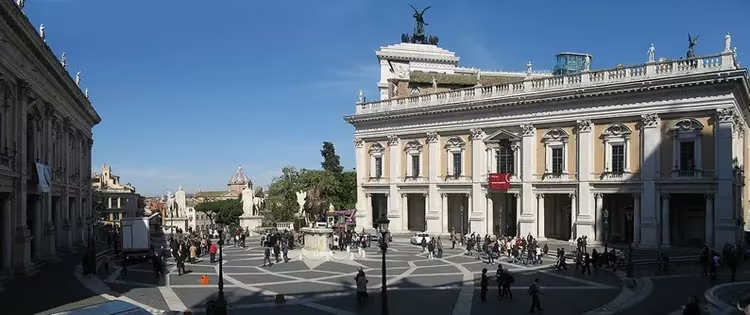
The famous hills on which the city of Rome was built have kept and will keep their interesting history forever. Often she was born in the excavations of archaeologists, ruins, preserved sights. The Capitol Hill, where the meetings of the ancient Senate were held, the temple of the gods of the ancient Romans towered, conceals amazing evidence of the past of the city, the country. The Capitoline Square of Rome, located at the highest point of the hill, is now considered its main square. The eternal Capitoline she-wolf, named the symbol of the city, attracts tourists with its ancient legend to hear a fascinating story. Waking up to see the wealth in the museum.
Story
The architectural masterpieces of the museums are palaces designed along the perimeter of the famous square, with works of art and ancient artifacts stored in their halls. The old buildings, towering on the hill, were destroyed, looted, burned. Only in 1536, by decrees of King Charles V, did the revival of the life of the Capitol begin. The work on the creation of a new ensemble was entrusted to the great Michelangelo Buanarotti. At that time he was the chief court architect and artist. He was commissioned to create palaces to house the collection donated by Pope Sixtus IV around 1471.
They were famous works of art, jewelry, coins of the Middle Ages, the Renaissance. Many, for example, unique bronze statues, were brought from the collection of the palace of the famous Lateran family.
The basis of the complex was made up of architectural heritage designed by Michelangelo. These are the two palaces of the Palazzo Conservatori, Nuovo. As well as the Capitoline Square itself. The ingenious idea of the master helped to create a small space in the form of a trapezoid open for viewing. The paved area, lined with elliptical beams, has a strong optical effect that expands its boundaries. The followers of Michelangelo completed the building in 1654.
The main building of the square is the Palace of Senators. The building is surrounded on both sides by the Capitoline Museum, an architectural marble representation of the Nile, the Tiber. Water arteries that gave life to many inhabitants of the planet, the Palace of the Conservatives. The works of Michelangelo, according to art historians, hide encrypted messages, secrets. The solution to many is yet to come. In the central part of the square stands a statue of Emperor Marcus Aurelius. A rare treasure reborn from ancient times.
Museum buildings and exhibits
To get here, you do not need to book a ticket in advance, stand in a long queue. You can just come for a walk, admire the grandeur of the buildings, the unique design of the square. The three buildings of the museum complex, connected by an underground gallery, are filled with various collections of paintings, sculptures, exhibits from the eras of the Roman Empire, the Etruscans, etc. During the tour you can see the wealth of the palaces. But to learn the history, to carefully consider the treasures stored, will not work.
The Palace of the Senators, built in the XII century, the Palazzo Conservatori, Nuovo, which appeared in the XVI, XVII centuries, contain a huge number of valuable exhibits. Among them are unique art galleries with works by Caravaggio, Titian, Tintoretto, etc. Ancient statues, mosaics, works of art from baroque, renaissance styles. The complex was supplemented by a small palace Caffarelli-Clementino in the XX century. Among the unique collection of sculptures kept in the Capitoline Museum are the following world masterpieces.
Capitoline she-wolf
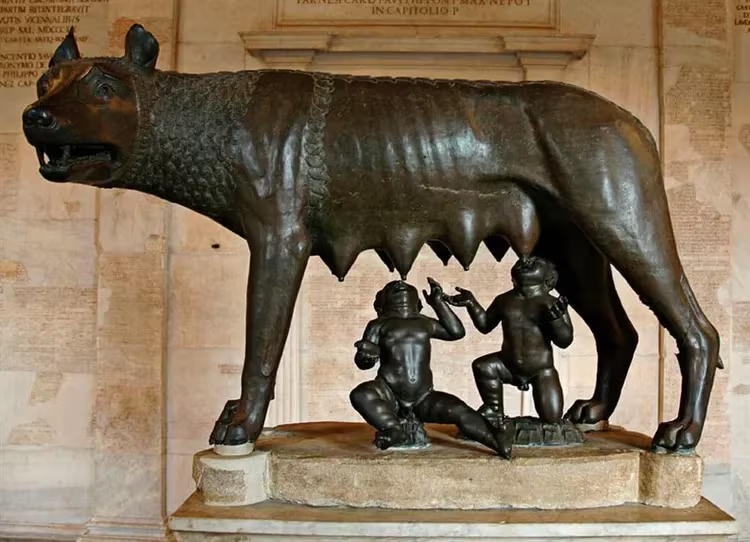
This is a worthy symbol of Rome, reflecting the myths of the country. The most confirmed date of manufacture of the monument is considered to be the period of 1021-1153. The statue is made of bronze. For many years it was believed that the Etruscans made it in the 5th century BC. e. Information from the monk's notes says that at first the she-wolf without newborn brothers was in the palace of the Laterans next to the court, the so-called place of execution at the “wolf”. It was a deity or “mother of the Romans”.
By order of Sixtus IV, she was transferred to the Palazzo Conservatori in 1473. The figures of babies appeared on the she-wolf at the end of the 15th century. They are made in a different way. A copy of the She-Wolf is mounted high on a column to the left of the central museum. There are similar copies in different countries. For example, Romania, where they are considered a symbol of world heritage. Near the Olympic Stadium in Tokyo. Pisa, New York, Paris.
Dying Gaul
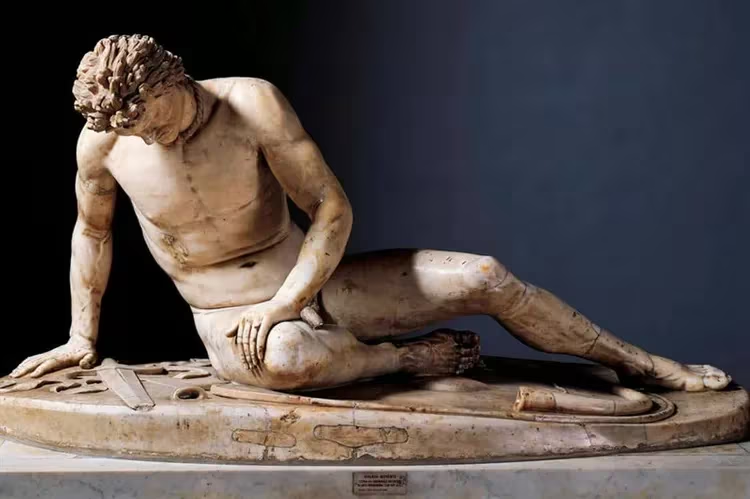
Made a marble copy of the original bronze, commissioned by Emperor Attalus I around 230 BC. e. as a sign of victory over the army of the Gauls. The author of the statue is considered to be Epigonus, a sculptor from the Attalid dynasty. There is a version that confirms that the creation was discovered during the construction of a villa in Rome, and then bought by Pope Clement XII and kept in the Ludovisi Palace.
During the war with Napoleon, the statue was taken to France. There, the work was exhibited as an exhibit of the Louvre. The dramatic, naturalistic nature of the sculpture refers it to the heights of the art of ancient times. The naked figure of a Celtic warrior, lying on a shield, surprisingly fully conveys the pain, annoyance of a mortal defeat.
Capitoline Brutus
The bronze sculpture of a portrait of a man is considered the creation of the Etruscans, born at the beginning of the 3rd century BC. It was found among the excavations of Rome around 1500. The similarity of the portrait with Brutus, depicted on the coins of Rome, gave reason to consider him the founder of the Roman Republic. The sculpture was found in its original form without damage. Hair, forehead, cheeks, inlaid eyes are completely preserved. Some of the clothes were made anew under the style of the Roman emperors.
Boy pulling a splinter
In the hall of celebrations of the Capitoline Museum there is a bronze sculpture of a boy sitting on a stone, pulling a spike from his left foot. The statue never disappeared in the historical storms of the Middle Ages, remaining available for viewing. There are legends explaining the appearance of the statue. According to one it is believed that the boy was a shepherd sent to the Romans to warn them of the attack of the enemy.
Overcoming the pain in his leg from a splinter, the boy climbed the hill, adequately fulfilled his duty, pulled out the splinter, and died. The sculpture from the Renaissance was one of the first to be copied by order of rich people. Marble versions of the original are kept in the Medici collection, the British Museum, the gallery in Pavlovsk, and the composition of the Nikitsky Botanical Garden.
Colossus of Constantine
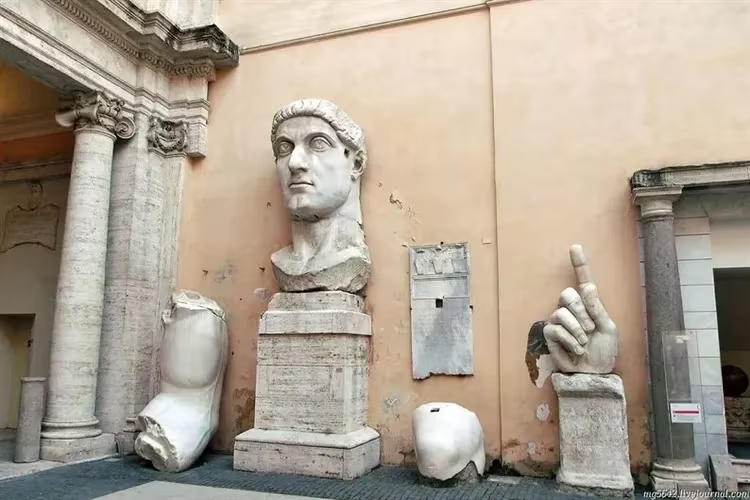
The surviving parts of a gigantic portrait statue depicting the seated Emperor Constantine the Great are kept in the Capitoline Museum. The estimated time of creation of the statue is attributed to the reign of Constantine. The height of the head of the statue is almost 2.5 m. The dimensions of the feet and hands give reason to believe that the total height of the sculpture reached 12 m. The body of the statue was made of marble. The clothes were made of wood, covered with gilding, bronze (acrolite technique).
Initially, the statue was located next to a public place near the Basilica of Maxentius, Constantine, symbolizing the divine power of the state. The statue is believed to have been damaged by vandals. The ancient masterpiece acquired a new life by 1486.
Now the fragments of the statue, located in the palace courtyard, are arranged in order: right hand, knee, head, passage to the museum, column. Then the left leg. There are two different fragments of the right hand. This is due to the alteration of the statue at the end of the reign of Constantine. The hand holding the scepter has been replaced.
Palace of the Conservatives
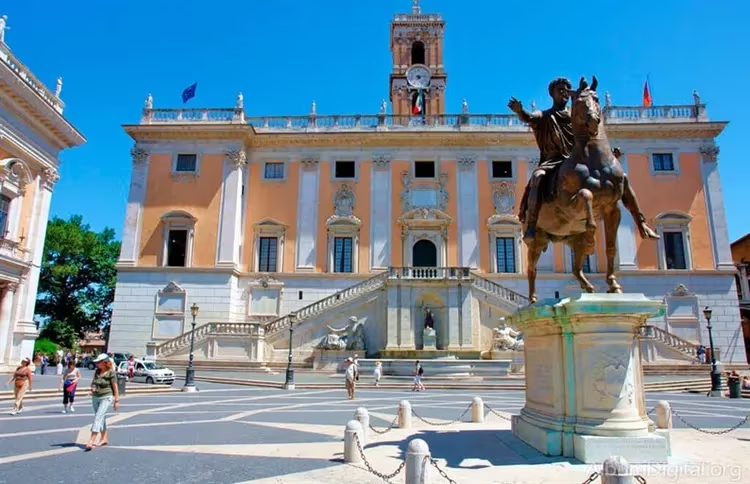
Palazzo dei Conservatori is named similarly to the meeting room of judges, senators or the conservatory. Important decisions of the ruling forces of the country have been made here since the 15th century. Now the palace houses a collection of sculptures of their marble, preserved from the period of Ancient Rome. The well-equipped halls house the famous frescoes, the Pinacoteca with paintings by Caravaggio, Rubens, Velazquez, the legendary Capitoline she-wolf. Artifacts of the Greeks, Etruscans are in the Castellani room, along with a wonderful collection of red-figure black-figure Greek vases.
The well-known fresco depicting the combat between the Curiatii and the Horaces, the statues of Urban, Innocent X are in a special room. Halls of the Conservatives, the New Museum, and the Art Gallery are open in the Palace. The exterior design of the Palazzo dei Conservatori is famous for its original architectural techniques in the form of pilasters located on different floors.
In the future, they were used in buildings of different times by many countries (for example, one of the Moscow railway stations). The first building of the palace was erected in the middle of the 15th century. The façade was decorated with arches framing six windows on the ground floor. Several of them are now preserved. The final design of the harmonious facade was completed much later.
Palazzo Nuovo
The palace belongs to the new architectural buildings of the ensemble of the 17th century. The construction of the palace began in 1571 and ended around 1654. Giacomo Della Porta, Girolamo Rainaldi, Carlo Rainaldi were engaged in the implementation of Michelangelo's ideas. This is a copy of the Conservative Palace, intended to serve as a public museum since 1734. The palace is called the first public museum in Rome. Sarcophagi, statues, busts, masterpieces of ancient art, such as Cupid and Psyche, statues of Capitoline Venus, the Dying Gaul, ancient mosaics can be viewed in the spacious halls of two floors of the palace.
More than a hundred ancient sculptures of gods and heroes are placed in the Palace Gallery. The halls of the Palazzo have original names, for example, the hall of the Pigeons, the Faun, philosophers, gladiators, emperors, the office of Venus. In the courtyard there is a marble “Talking Statue” Marforius Fountain, created in 1588. Residents of the ancient city gathered nearby to express dissatisfaction on everyday issues.
Palace of the Senators
The appearance of the ancient palace, conceived by the Great Michelangelo, has been preserved in its original form since 1605. The place, surrounded by the Capitoline Square and the Roman Forum, has always been at the center of the political life of the city. Back in 78 BC, the Tabularium, the archive of the state, was located here. Dilapidated in the Middle Ages, the structure was restored, changed. A beautiful staircase with a fountain and a sculpture “Joying Rome”, statues personifying the Nile, the Tiber gave a different look to the palace. The facade of the building was decorated with baroque elements. The lower part of the Tabularium and two side towers have been preserved. In 1582, the Belfry appeared, replacing the medieval building.
Now here you can see the halls of the city council (the hall of flags), the Councils (it contains a sculpture of Julius Caesar, made in the 1st century BC). Capitoline proto-library, collection of busts. City hall meetings are held in the palace. Many premises are not allowed for inspection. You can freely visit the Lapidarium, which stores ancient stone slabs with ancient inscriptions.
Equestrian statue of Marcus Aurelius
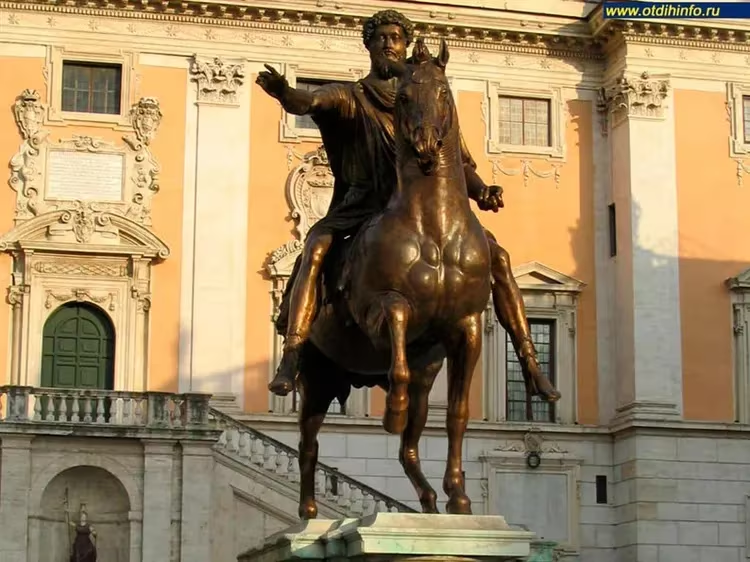
The fate of many ancient statues was not as happy as this one. Often this is associated with a random assumption that the ancient sculptural work belonged to Emperor Constantine. He made Christianity the official religion of Rome, stopping the destruction of ancient artifacts by order of the church in the Middle Ages. The original statue of the emperor is in the Capitoline Museum, and its majestic copy adorns the center of the old square.
It is believed that the statue was made in the 180s by an unknown author. The pedestal of the statue is made from the columns of the temple of Castor, Pollux. The reign of Marcus Aurelius (Mark Annius Catilius Severus) was called the golden period of ancient history. Initially, the statue, in the form of an emperor sitting on a bronze horse, addressing the army with a gesture in honor of another victory, stood on the slope of the Capitoline Hill. From 1538 she received a seat on the Capitol.
Cafarelli-Clementino Palace
The building is located next to the three main palaces of the Capitoline Museum complex. It is an example of 16th century civil engineering architecture. Four interesting expositions are organized on the squares of the building:
Dungeon
Three museum buildings were interconnected by a huge underground tunnel, laid in the bowels of the square in 1930. Gallery Lapidaria (Conjuncione) with interesting artifacts is a popular place for tourists. Here are the ruins of the ancient dwelling of the Romans, a collection of ancient inscriptions on stones. The entrance is at the famous Roman Forum.
Opening hours and ticket prices
There are always many people wishing to visit the palaces of the Capitoline Museum. Therefore, it is better to book tickets in advance. There is a single complex ticket that gives the right to visit all places of interest. The price of a full ticket is 15 €, a reduced ticket is about 12 €. The museum is open every day except Monday and Sunday from 9 am to 8 pm.
Where are they located and how to get there
A half-hour walk from the Colosseum, next to the Roman Forum, on the Capitoline Hill at Piazza del Campidoglio are museum buildings. You can use metro line B, get off at Colosseo station. By bus service on routes 30, 170, 810, 85 you need to get to the stop Ara Coeli-Piazza Venezia. Or take tram 8 to the last stop Piazza Venezia.