
Catacombs of the Capuchins in Palermo – history, photo, description, opening hours, prices 2021, map
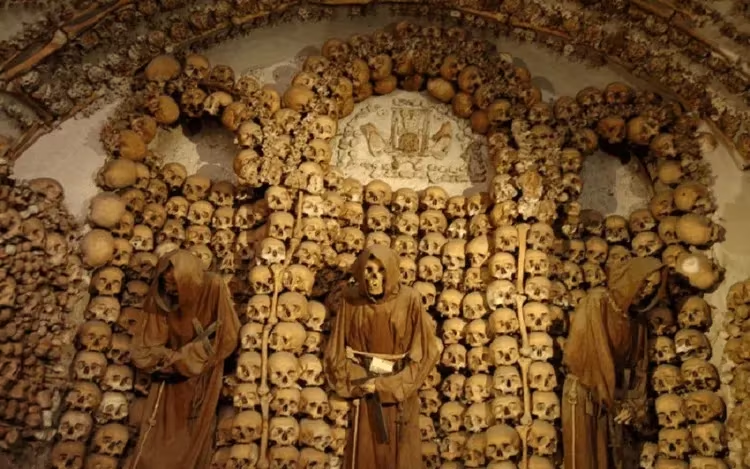
On the famous refuge of the Italian mafia, the island of Sicily, there is a unique underground burial – the Catacombs of the Capuchins in the capital of the island of Palermo. This peculiar Museum of the Dead is located under the Capuchin Monastery (Convento dei Cappuccini) and contains about 8 thousand mummified remains of monks, representatives of the local aristocratic elite, the clergy of past eras, being a spectacular and partly scientific object of research.
History of the catacombs
The historical roots of the Sicilian “Kingdom of Hades” stretch from the 16th century. At that time, the Order of the Capuchins, based on the Apennine Peninsula, moved to Fr. Sicily, where he became quite in demand. Its representatives were against burial away from the native monastery, so it was decided to organize a cemetery directly on its territory. The first grave in the catacombs appeared at the end of the 17th century, and later other remains of the formerly deceased monks were moved here. Over time, there was not enough space in the crypt, and little by little the Capuchins dug out a rather long corridor. Over time, patrons of the monastery began to be buried here. Additional corridors and cubicles were also excavated for their burial.
Until 1739, burials in the crypt were authorized either by local archbishops or leaders of the order. Later this right passed to the abbots of the monastery. From the 18th to the 19th century, the Capuchin dungeon took on the role of a prestigious cemetery, where the clergy and high-ranking residents of Palermo were buried. In 1837, the burial of the dead in a visible form was banned. Despite this, the ban was often bypassed, leaving a “window” or removing the wall of the coffin in order to see the deceased.
Burial in the catacombs ceased only at the end of the 19th century (1882). After 1880, exceptions were made for some petitioners, and several more embalmed bodies were placed here, among which was Rosalia Lombardo. It was this child who became the final person buried in the catacombs of the Capuchins.
The originality of the museum
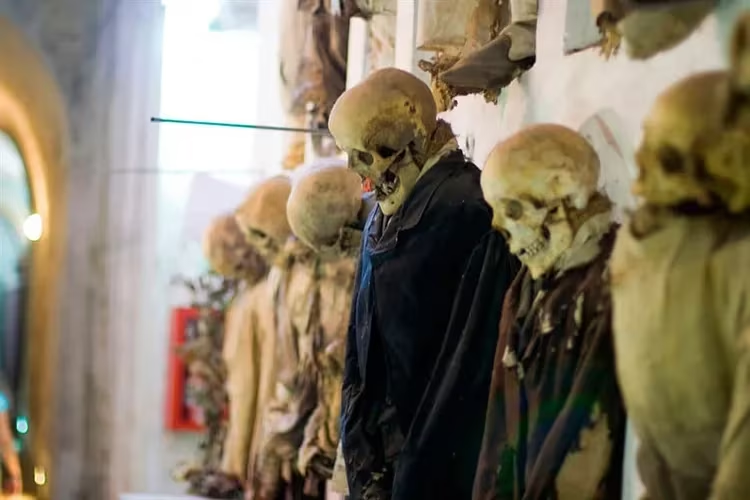
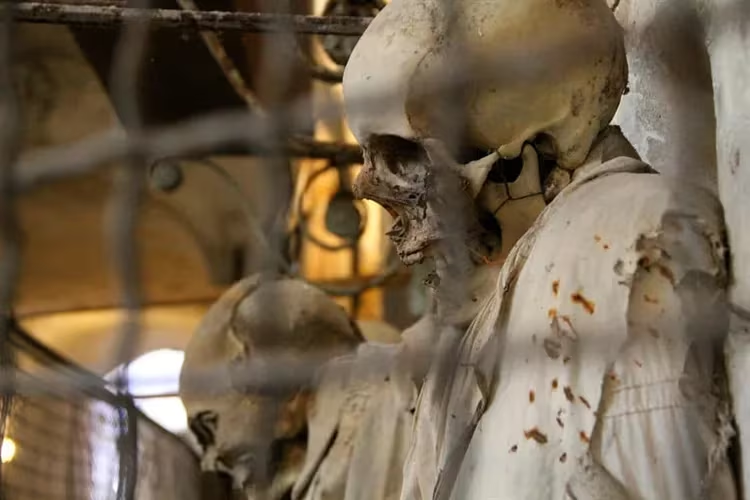
This museum is unusual in that it is nothing more than burial galleries located underground. They enclose within their walls a mass grave – more than 8 thousand noble people of Sicily of the 16th-19th centuries. The crypt is still in great demand among tourists today. At the Palermo exposition of mummies, the bodies of the dead lie, sit, stand, and even hung on hooks, forming compositions. The remains of the deceased are buried in an open, accessible form. From the things they wear, one can easily guess the fashion of those eras in which they were buried.
The catacombs themselves are more like a labyrinth – a network of corridors and compartments, in which every centimeter is filled with mummified dead. The spectacle is not for the faint of heart, sometimes there is a feeling that the mummies are about to start moving. All the “exhibits” located in the Capuchin monastery catacombs are divided: according to the status occupied during life, professional, gender and other characteristics. Here you will find corridors: for monks, priests, craftsmen, men and women, virgin girls and immaculate babies. In addition, there are: a “new” corridor, in which they were buried since 1837, after a decision was made to ban the exposure of the bodies of the deceased in the open, and a chapel.
Description of the catacombs
Such a huge crypt was formed under the Capuchin monastery in the 16th century, when it became necessary to bury the Capuchin monks. The number of inhabitants of the monastery increased every year, and, accordingly, the number of dying, so the dungeon continued to lengthen, turning into grandiose catacombs divided into corridors.
At first, monks were buried in them, whose bodies were previously dissected, embalmed with vinegar and dried. When it was found that the composition of the soil in the catacombs contributed to the preservation of the remains, many relatives of the deceased nobility of Palermo also began to wish that the bodies of their relatives would take place in the niches of the catacombs. This is how special corridors were formed, where people with different social status are buried. A visit to the Capuchin catacombs is not a sight for the faint of heart, but at the same time it is exciting and interesting. Now access is forbidden to the corridor with the remains of especially revered monks, mummies of the most terrible kind are not put on display.
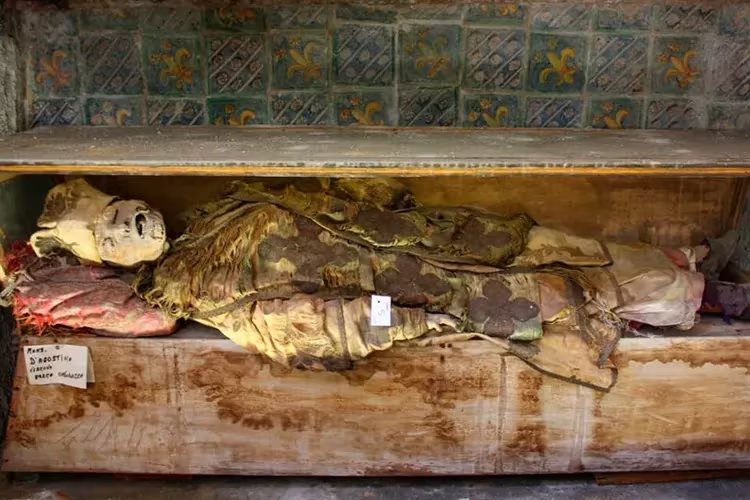
monks corridor
The first to be buried in the corridor of the monks, formed from the crypt, was the capuchin Silvestro, after which the remains of the previously deceased monks were moved here. In the most ancient corridor, especially respected monks found their shelter, who made a significant contribution to the development of the Cappuccini order and the monastery. The mummies are dressed in traditional Capuchin robes with a canvas hood and a rope around their necks. Today, access to the site is closed for religious and scientific reasons.
corridor of men
In a fairly large room with lime-washed stone walls, there are mummies of ordinary male citizens who donated a lot of money for the upkeep of the monastery. Many of them have well-preserved burial clothes, contrasting with the terrible appearance of the empty eye sockets on the turtles. By the type of clothing, one can draw a conclusion about the socio-financial situation of the deceased people. Some of the men are dressed in simple canvas pajamas, others in luxurious tailcoats and tuxedos, thin shirts with frills or ties. Some of the remains are set in groups, some are located in separate niches, showing visitors the ugly manifestations of death.
children‘s cubicle
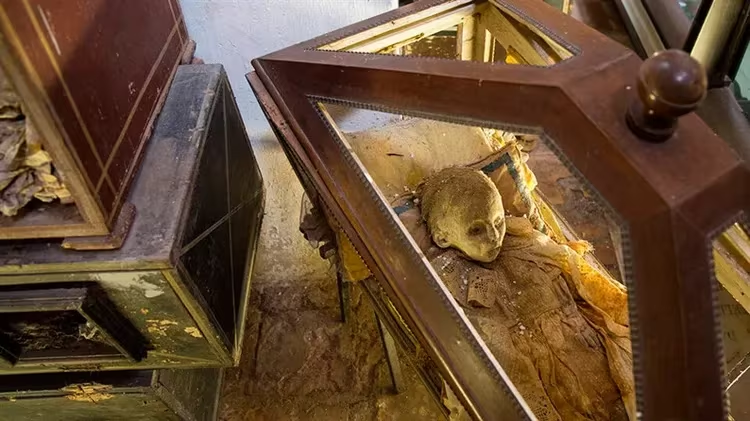
In a small corner room with walls lined with painted panels, the remains of small children are buried as the personification of the most terrible grief of parents. Their bodies are located in coffins mounted on pedestals and in niches. On the plates placed at individual coffins, the names and surnames of the deceased children are indicated. By the children's clothes, one can judge with what martyrdom the parents buried their crumbs here in order to come here, hoping to overcome the terrible grief.
A huge impression is made by the central niche, in which a boy “sits” on a rocking chair, holding his little sister in his arms. Frost runs through the skin not only from the sight of dead children, but also from the scale of parental grief, who have lost their “treasures”.
corridor of women
The air attacks of 1943 over Sicily were so powerful that they also touched the catacombs, partially destroying the Corridor of Women, damaging some of the mummies. But even from the surviving remains, one can get an idea of the burial traditions associated with women. Pre-prepared bodies were dressed in bright beautiful dresses, lace caps. Elegant sandals or shoes were worn on the feet, flirty gloves on the hands, that is, the entire ladies' entourage. Of course, when visiting, it's creepy to see a black grin of the mouth and eye sockets gaping with emptiness against the background of the snow-white lace of the bonnet of one or another mummy, but we must pay tribute to the relatives who cared about the respectable appearance of the deceased.
Most of the female bodies rest in open wooden niches-shelves or coffins, a smaller part is in a standing position. It should be noted the well-preserved robes of the inhabitants of the women's corridor. This once again confirms the special atmosphere of the catacombs, which prevents decomposition. The feeling of sadness, mixed with disgust at the unpleasant sight, is consoled by a faint hope that, indeed, the human soul regains beautiful flesh.
Cubicle of virgins
The same small corner room as for children – the cube contains the mummified bodies of virgins. Probably, as a symbol of immaculate virginity, they are surrounded by a metal grill that blocks free access to them. On the heads of virgins, wreaths of metallic flowers are worn, embodying innocent purity.
With sadness, one can look at the beautiful bright outfits of those who did not fully experience the bliss of sensual love, did not know the happiness of motherhood. Fanciful bonnets, framing the once captivating faces, exacerbate the already gloomy contemplation. If these former beauties could imagine that someday they would become objects of such an impartial spectacle, they would probably not agree to be buried in the open!
New corridor
Despite the ban on burying the dead in the catacombs (1837), there were many who wanted to place the bodies of their relatives there, so they had to form a New Corridor that accepted the dead until 1882.
There are no niches in the walls here – the entire area of the corridor along the walls is lined with coffins. They are installed in several rows, regardless of the sex and social status of the mummies. A notable feature of the New Corridor are several family burials, where the bodies of both parents lie with the bodies of their teenage children. There are also married couples who have not separated even after death.
Corridor of professionals
The eloquent name of the corridor testifies to the burial in it of outstanding citizens of various professions who made a significant contribution to the development of society during their lifetime. The bodies of the sculptors F. Pennino and L. Marabitti, who decorated the cathedrals of Montreal and Palermo with their works, are buried here. The surgeon Salvator Manzella, Colonel F. Enea, found shelter here, lying in a luxurious military uniform (perfectly preserved). The researchers are haunted by the legend about the famous Spanish artist Diego Velasquez buried here. But it is simply impossible to establish this precisely now.
Priests Corridor
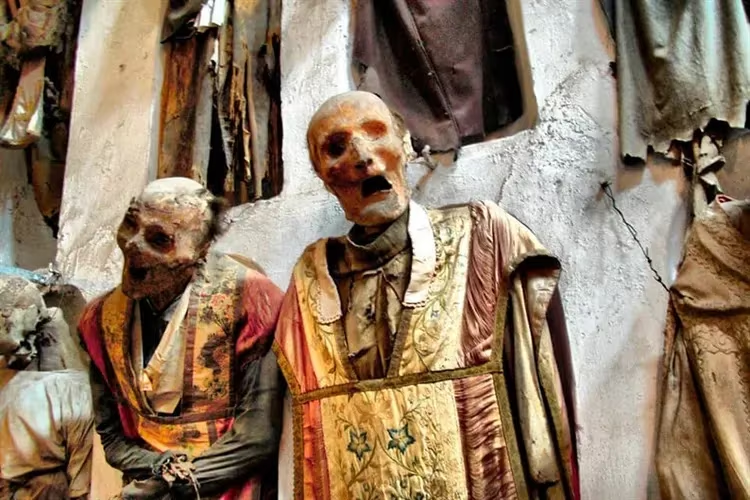
The preachers of God's word – the priests – are also dedicated to a separate Corridor, which runs parallel to the Corridor of monks. Mostly representatives of the Palermo diocese are buried here. Their bodies, dressed in magnificent church robes of different colors, are placed along the walls in 2 rows. The brightness of the robes, the strictly vertical arrangement of the mummies, as it were, emphasizes the former greatness and influence of the leaders of the church. But the contemplation of faces mutilated by traces of corruption framed by robes evokes conflicting feelings. The mummy of the Bishop of the Italo-Albanian Church, Franco de Agostino, occupies an honorable and unique niche here.
Chapel of Saint Rosalia
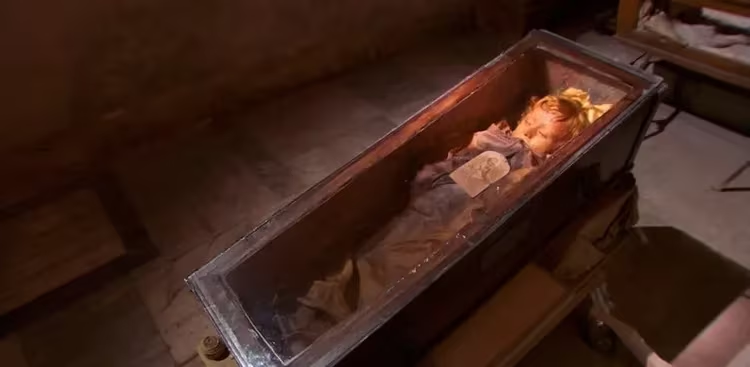
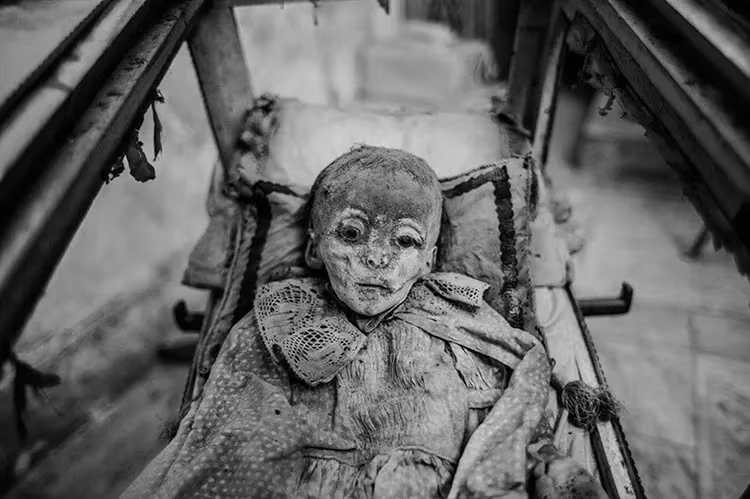
This corner of the catacombs – the Chapel of St. Rosalia – is the most amazing and mystical place that evokes, perhaps, the brightest feelings. In the center of the room in a glass coffin lies the imperishable body of a 2-year-old girl, Rosalia Lombardo (December 13, 1918 – December 6, 1920), one of the most famous mummies of the museum, once she did not live up to her second birthday just a week, having died of pneumonia). She was buried here in 1920 at the request of her heartbroken father, who begged her to embalm her daughter's body so that it would be preserved as long as possible.
Dr. Salafi, who embalmed the body, did it so skillfully that even after a century, all the internal and external organs of the child did not succumb to decay. There is a version about the solution of the doctor's method, according to which a mixture of alcohol, formalin, glycerin, zinc and other substances was pumped into the blood vessels. Rosalia lies as if alive: her cheeks, eye sockets, curls, eyelashes, eyebrows are perfectly preserved, which proves the effectiveness of embalming according to Salafia. Experiments conducted in the USA using this method have confirmed its effectiveness. But a certain veil of mystical mystery continues to hover over the chapel of Rosalia.
The well-preserved body of the baby raised doubts among many experts that this mummy was once a living child. However, the study of her body with the help of an X-ray machine proved that a girl, not a doll, rests in the coffin. In addition, the study revealed that all the organs of the baby after almost a century are intact.
Previously, the remains of the child were exhibited in a glass coffin, standing on a marble pedestal in the center of the chapel of the same name. However, in the 2000s, signs of decay still appeared on the mummy. In order to prevent subsequent tissue destruction, the baby's body was moved to a drier place and enclosed in a glass container filled with nitrogen.
Burial techniques
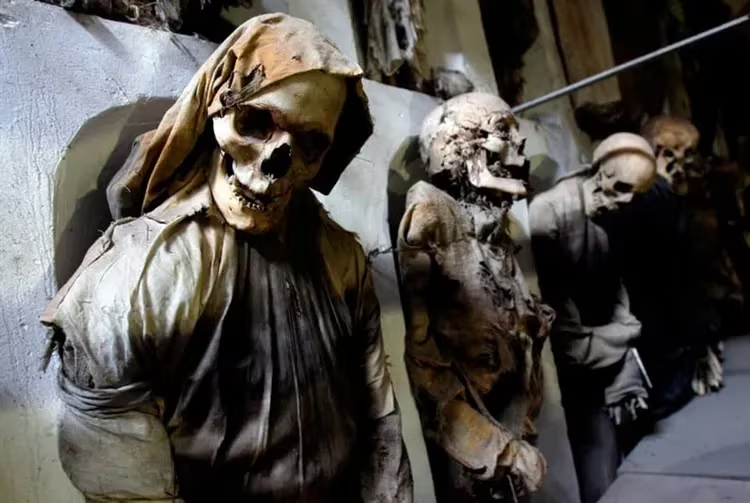
In the 17th century, it was discovered that the chemical composition of the soil and air of the Capuchin catacombs does not allow the bodies of the deceased to decompose. The principle of preparing the remains for placement in the crypt was their drying in specialized chambers. Drying took 8 months, after which the bodies were wiped with vinegar and dressed in the best clothes. After all the manipulations, the mummies were moved to the corridors and cubes of the underground crypt. During epidemics, the method of preserving the remains was modified: the bodies of the deceased were dipped in solutions of lime or arsenic. Then, as usual, they were placed openly in the corridors.
Opening hours and ticket prices
The catacombs are open to the public every day from 9 am to 6 pm. Break – from 13.00 to 15.00. The underground museum is closed on Sundays (end of October – end of March).
Entrance fee – 3€ (price 2017) Photographing and filming is not allowed.
Where are the catacombs and how to get to them
The Museum of the Dead (catacombs) is located at: Capuchin Square. Although the square is located outside the historical center of the city, it can be easily reached on foot. To get to Piazza Cappuccini, you need to go from the central square of Independenza, where the Norman and Orleans palaces are located, along the street. Corso Calatafimia walk 2 blocks, turn onto Via Pindemonte and walk along it to Pl. Capuchins and a monastery with catacombs.