
🕌 Jordan: a complete guide for travelers
In the raging ocean of passions in the Middle East, an island of peace and tranquility lurks under the name of Jordan. It has everything a traveler needs: beaches and sea, breathtaking sights, delicious cuisine and an incomparable atmosphere. And few people know about this.
The country, nicknamed the Switzerland of the Middle East, is becoming more accessible and attractive to tourists every year. I share with you my experience and life hacks that will help turn your stay in Jordan into the most memorable days of your life.
Visa
Jordan is a conditionally visa-free country. There are several ways to avoid a visa. The first requires the simultaneous fulfillment of four conditions:
- traveling in a group of five people;
- everyone has a return ticket;
- your trip is organized by a Jordan-accredited travel agency;
- the group will stay in the country for at least two nights.
The second method is much simpler. If you plan to stay in Jordan for at least four days and visit the legendary Petra, then it would be optimal to purchase a Jordan Pass on the official website. It replaces a visa and gives you the opportunity to visit 40 popular tourist locations for free. The cost of the Jordan Pass is 70-80 Jordanian dinars ($99-113) depending on the number of days in Petra. In most cases, this option is the most profitable and not troublesome.
The third method is suitable for those who are considering Jordan exclusively for a resort holiday on the beaches of Aqaba. When entering the country through the air or sea harbor of Aqaba, a visa is not required. But there is a nuance: if while visiting the country you ignore the visit to Petra, then upon departure you will be charged a 20 dinar ($28) fee.
If you don’t want to restrain your tourist fantasies with bureaucratic conventions, then obtaining a visa will not be difficult. This can be done upon arrival at Amman airport or at the land crossing with Israel – Sheikh Hussein. The cost of a visa is 40 dinars ($56). When applying for a visa, you may be asked for a hotel reservation and a return ticket.
How to get there
Jordan is a fairly open country for travel. In 2021, a flight to the resort of Aqaba was launched. The carrier currently offers flights to Amman with a connection in Sharjah. Tickets cost about $1,000 for a round trip flight.
It’s cheaper to go after a sultry dream from Moscow. Flights to Jordan make connections in various countries of the Arab world. The average cost of tickets is $600 round trip.
It will be much cheaper to fly from European countries on low-cost airlines. For example, Ryanair flies to Amman from Warsaw, Poznan, Prague and many other cities. In the velvet autumn season, it is possible to find tickets from Warsaw to the capital of Jordan for $200 round-trip. I flew to Jordan from Paphos, Cyprus , and the ticket cost only $25.
Another way to get to Jordan is by land. Jordan has fairly good relations with Israel. Therefore, while you are in the Promised Land, you can sign up for an excursion to a neighboring country. Tours to Petra from Tartu from $200. You can find such a tour, for example, here.
How to get around the country
Getting around Jordan is the main challenge for a foreign tourist. All inscriptions on the buses are made in Arabic script, including the route numbers. Locals (with the exception of traders) do not know English well and are unlikely to act as transport consultants.
The first difficulties await the traveler when leaving the completely modern Amman airport. Innovation ends at its doorstep: in order to get a transfer into the city, you need to find an inconspicuous ticket kiosk, buy a ticket and then make your way into a museum -like dolmusha minibus. On it you will reach something like a bus station, very far from the city center.
Fate itself pushes greedy taxi drivers into the hands. All you have to do is choose: give up right at the airport or only after the transfer, when you feel the flavor of local buses. But you will definitely give up, so I recommend keeping the Uber and Bolt taxi apps on your phone, and a reserve in your pocket for expenses.
According to Eastern tradition, you should never agree to the driver’s first price if you catch a taxi on the street. It is not at all typical for Jordan to treat tourists as a guest, rather as a money bag that needs to be shaken out. Do everything possible with your bargaining to prevent this.
Things are a little better with trips between cities. JETT is distinguished by its relative consistency and accessible English-language service. It offers regular bus services to Wadi Rum, Petra, Aqaba and other cities.
- Lebanon – an oriental fairy tale against the backdrop of the fires of rebellion
- Where history lives: top most ancient cities in the world
- Gulf cruise: what to see in the UAE and Qatar
Their morals
If I were asked to describe the three main values in the life of a Jordanian, I would say without hesitation: mosque, king, bazaar. And they determine not only the lives of locals, but also the behavior of tourists.
Jordanians are less orthodox than residents of the United Arab Emirates or Qatar. But they are more religious and strict in behavior than Lebanon, Egypt and, especially, Turkey. This is due to the fact that tourism has only recently begun to develop in the country. The visiting Europeans with their free views did not have time to pervert the pure Jordanian souls.
What does this mean in practice? In Jordan, you should pay attention to your appearance. Especially women. Open shoulders and shorts will be inappropriate. No one will hit you with stones, but get ready for the predatory looks of the locals who will eat you like Turkish delight on a platter.
If you didn’t know that Jordan is a kingdom, and the king is the foundation of the state, you will understand this truth from the first steps in the country. Portraits of the monarch are present in all buildings. The Hashemites are a very ancient dynasty. The country owes much of its peace and relative prosperity to her. Therefore, you should either remain silent about members of the royal family or say good things.
And finally, the third thing is the bazaar. On the streets they try to sell everything: from fake Rolexes to excursions. The Jordanian's eyes immediately identify visitors, and they are immediately identified as customers. Therefore, be prepared for intrusive offers to enter into trade relations. There is nothing wrong with this if you know how to bargain. Prices in Jordan are already expensive (except for food), but for tourists they are even more expensive.
What to see in Amman
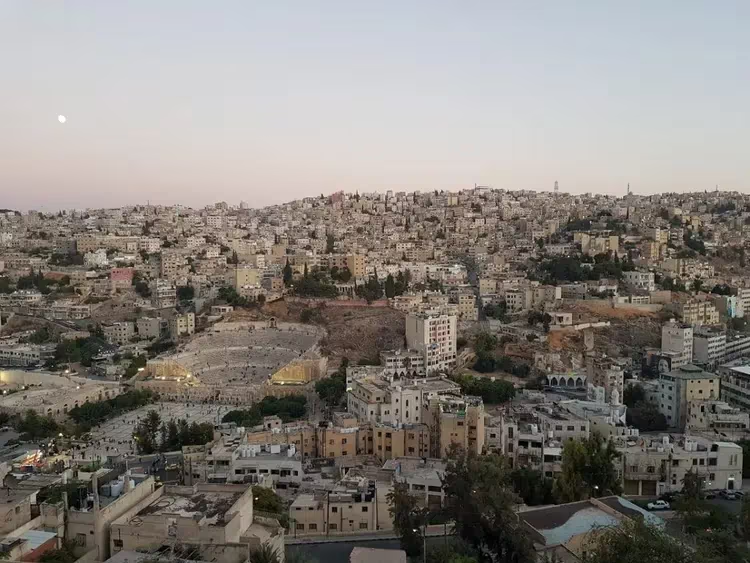
Amman is one of the oldest cities on the planet. He is even mentioned in the Old Testament under the name Rabbath Ammon. Under the rule of the Egyptians, Amman acquired a name that related it to America – Philadelphia. And under the rule of the Romans it flourished as one of the centers of the Middle East. But no matter what owners Amman had, each of them left behind you a “stone autograph”, or even several.
Citadel
The entire chronicle of the history of Amman can be read in one place – the ancient Citadel. For seven thousand years people have been continuously living here, rebuilding it in their own way.
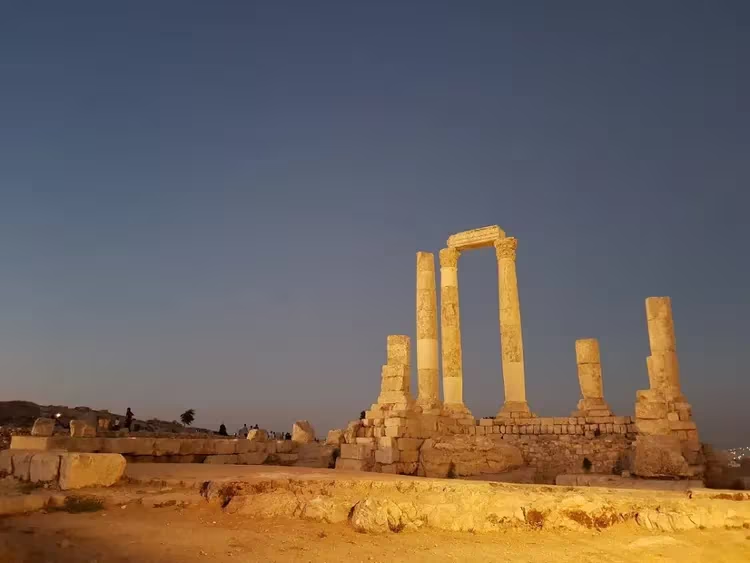
From the Roman era, the Citadel remains the ruins of the once majestic Temple of Hercules from the 2nd century AD. Unfortunately, of the 33 columns surrounding the temple, only three were well preserved. From the huge statue of Hercules, three fingers and a piece of a knee have reached us. But this does not prevent the Temple of Hercules from being the main place for wedding photo sessions of Amman residents.
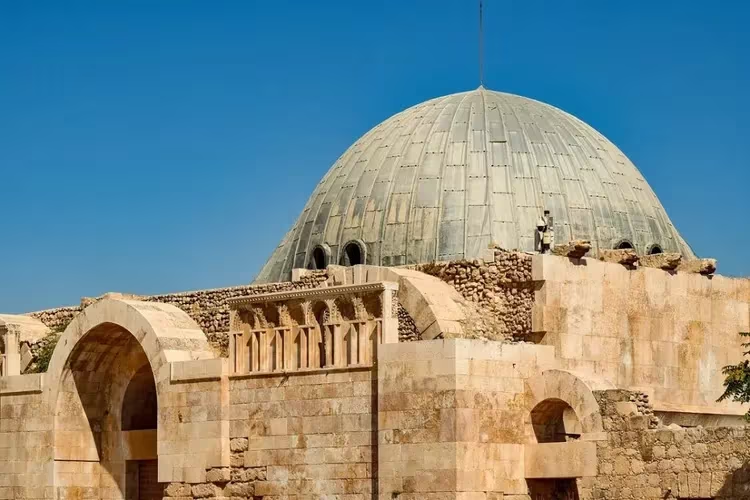
From the Byzantine era, the Citadel inherited a basilica, dilapidated, but not broken. The Arab Caliphate recalls the times of its rule by the Umayyad palace. The palace, however, lies in ruins, just like the dynasty that built it. Their fates are very similar: the palace, which had seen magnificent receptions and audiences, was destroyed by an earthquake in just the 30th year of its existence, and the Umayyad dynasty was overthrown a year later.
Next to the Citadel is an archaeological museum where the legendary Qumran scrolls are kept. They are the oldest carriers of information from the Old Testament.
Entrance to the Citadel costs 2 dinars ($2.8), to the museum – 3 dinars ($4.2). Free with Jordan pass.
Roman amphitheater
For breathtaking views, literally and figuratively, come here. With this building, the Romans once again proved to the whole world that they knew a lot about entertainment. This provincial theater, well preserved despite two thousand years behind it, can accommodate six thousand pairs of eyes. And the acoustics are capable of transmitting what is happening on stage to six thousand pairs of ears, regardless of their seats in the hall.
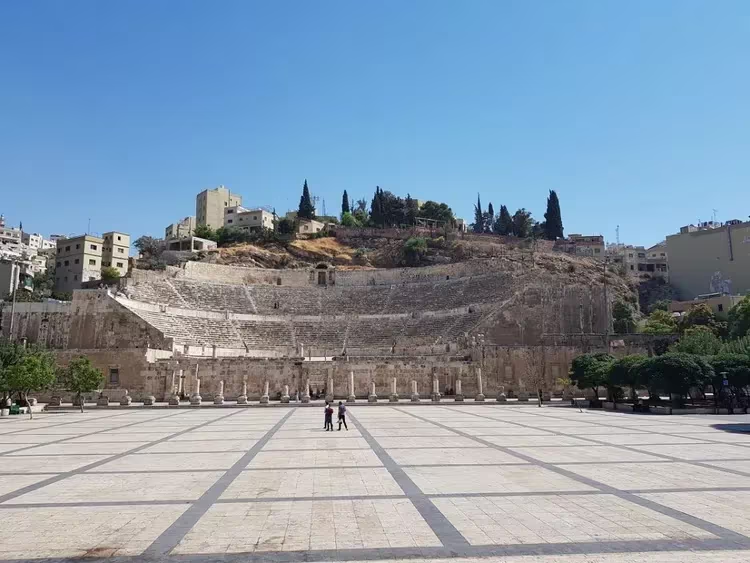
The amphitheater is also striking because it was carved right into the rock. As they say, art sees no obstacles. To fully experience the grandeur of the building, climb to the very top.
Next to the amphitheater there is its museum – the Nymphaun fountain, as well as the odeon (a small theater with 500 seats). Entrance 2 dinars ($2.8). You can try to cheat: they take money for entry either at the odeon or at the amphitheater. At the same time, they don’t give you a ticket and take your word for it when you say that you’ve already paid at another entrance.
King Abdullah I Mosque
Mosques in Arab countries are the heart and soul of the people. That’s why I always go there first. This did not work out in Jordan; visiting mosques is only available to the faithful. With the exception of the King Abdullah I Mosque, designed to show the whole world the greatness of Jordan.
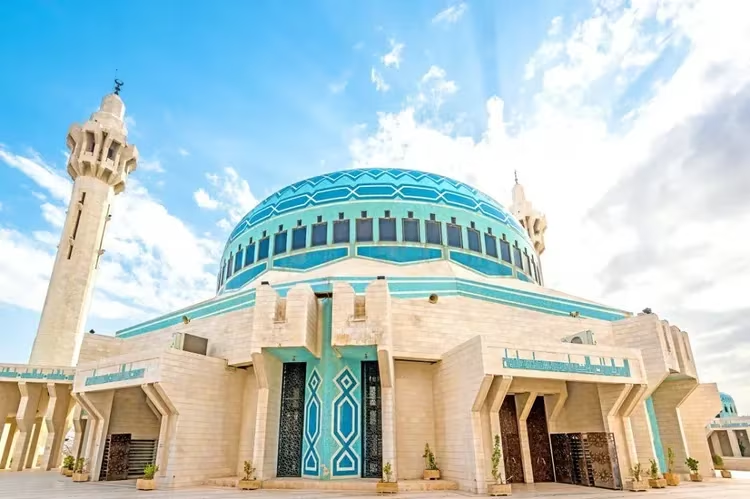
You will recognize the mosque you are looking for by its huge blue dome. 10,000 worshipers can fit under it. It costs 2 dinars ($2.8) to see this with your own eyes.
Other attractions in Amman
The Al-Hussein Mosque in the city center is available for external inspection. But in order to see the “Chess Mosque” you will have to walk or drive uphill five kilometers from the center. Or you can simply be content with its distant view from the Citadel.
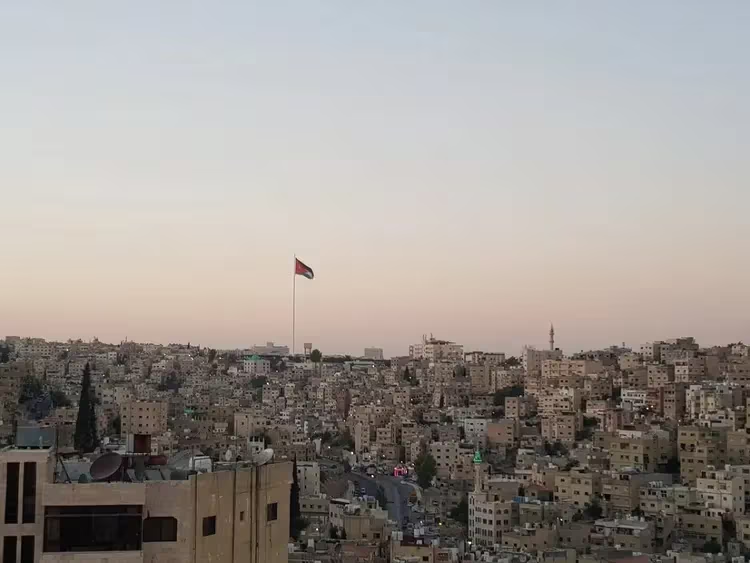
A huge Jordanian flag flutters outside the Royal Raghadan Palace. You won’t be surprised to learn that it’s called “The Pride of Amman. ” At the time of installation in 2003, it was the largest flag in the world with a height of 130, a length of 60 and a width of 30 meters.
Car lovers should visit the Royal Motor Museum, which contains more than 70 expensive exhibits with purring engines.
What to try
Prepare yourself for typical Arabic food in Jordan. The most common question on the streets of Amman is: “Do you want to eat mansaf?” Mansaf is a typical local dish. Lamb cooked in sour cream is placed on rice laid out in an even layer. All this is sprinkled with roasted nuts and flavored with bread flatbread.

A common dish is adas. It consists of yellow lentils with chicken and onions in lemon juice. What Jordanians can definitely be praised for is their portion sizes. One serving can easily satisfy two adults.
Vegetarians will not be bored either. Jordanians are one of the creators of hummus and falafel, which have now spread throughout the world.
It's not just what you eat, but also where. Choose from Amman's most authentic restaurants. According to my Jordanian friends (and I agree with them from personal experience), the traditional establishments AlQuds and Hashem, located in the very center, are a must-visit.
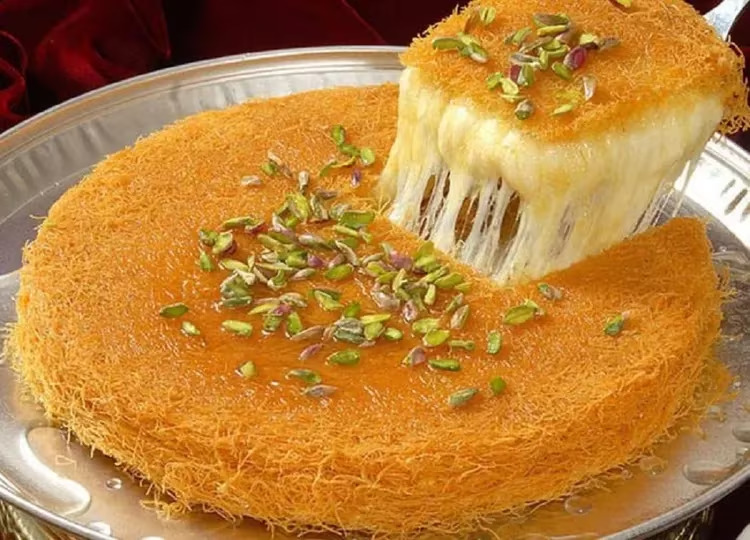
Well, be sure to treat yourself to dessert. It was on these lands that knafeh was born – a dish of sweet vermicelli (sometimes replaced with biscuit) and goat cheese, topped with caramel. Judging by the endless queues, the best knafe in the city is prepared at Habiba Sweets.
Jordan and alcohol
But there will be problems with washing down everything you eat with fun drinks. Jordan produces both wine and beer. But alcohol is sold on the outskirts. Want to enjoy a bottle of beer at the end of a languid day? You'll have to go to Amman sleeping bags and visit a special store. As the locals explained, there are many mosques in the city center and the proximity of religious shrines to drinking establishments outrages God.
Once you get to the store, you will be unpleasantly surprised by the prices. A bottle of beer 0.33 starts at $2.5, the stronger the alcohol, the more expensive it is. I would like to say that “the prices are like in a cafe,” but the trouble is that there is no alcohol in Jordanian cafes.
What else do you need to know
Jordan is the fourth most water-poor country in the world. It’s not surprising, because 90% of its area is desert. Therefore, water in the country is very expensive. Always having a few bottles of drink in stock could help with days under the scorching sun, but it is better if our article does this.
The capital is practically devoid of pedestrian crossings. Crossing a wide highway in front of a moving car soon feels like a local attraction. In fact, there is an unspoken agreement between drivers and pedestrians: you have the right to cross the road wherever you want, and they will let you through. And the driver has the right to shout whenever he pleases.
Don't be afraid of military equipment on the streets. The country is quite calm, but surrounded by restless neighbors. Soldiers on the streets are a precaution. But I don’t recommend taking pictures of them – it will be perceived negatively.
Locals assured me that there was practically no crime. And I haven’t encountered any hints of it even in poor areas. But girls should refrain from walking alone at night in an unfamiliar area.