
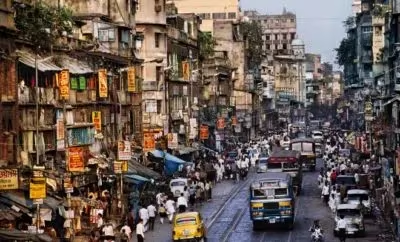
Kolkata – eastern India
Kolkata is located in India, 154 km north of the coast of the Bay of Bengal, on the banks of one of the branches of the Ganges – r. Hoogly (Hoogly, Hugli). It is one of the largest economic and cultural centers in the country, the capital of the state of West Bengal and the former capital of British India.
City landmarks
Calcutta stretches from north to south along the eastern bank of the river. Hoogley. For tourists, the most interesting is the central historical part of the city on the eastern coast, which can be conditionally divided into three parts: North, Central and South.
How to get there
Airplane: international airport. Subhash Chandra Bose International Airport / Dumdum (Netaji Subhash Chandra Bose International Airport / Dumdum) is located 17 km northeast of the city center. Serves daily flights from New Delhi, Mumbai, Chennai, Bengaluru, Bhubaneswar, Goa, Guwahati, Hyderabad, Jaipur, Kochi, Lucknow, Patna, Pune, Varanasi and Ahmedabad.
Railway: Kolkata has two railway stations – Howrah Station accepts trains from other Indian states, Sealdah Station provides intra-state railway connections.
Urban transport
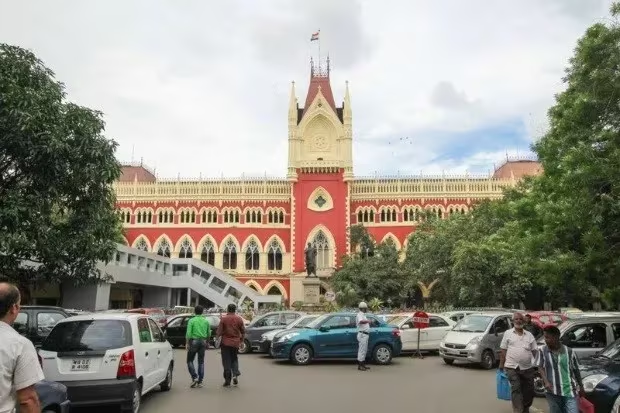
High court
Metro
The Kolkata underground metro was built in 1972-1995. with technical assistance from foreign, including Soviet, specialists. The total length is 16.45 km. The most popular tourist routes are in the southern sector from Chandni Chowk station to Tollygunge, and in the northern sector west of BBD Bagh. Try to avoid travel during rush hour (9.00-11.00 and 17.00-19.00), when crowds are crowded in the metro.
The cost of the ticket depends on the distance of the trip; there are multiple tickets.
Tram
The first horse-drawn tram was launched in Calcutta on February 24, 1873. Since 1882, steam-powered trams were running, and in 1900-1905. the tram lines were fully electrified. The total length of the lines is about 66 km.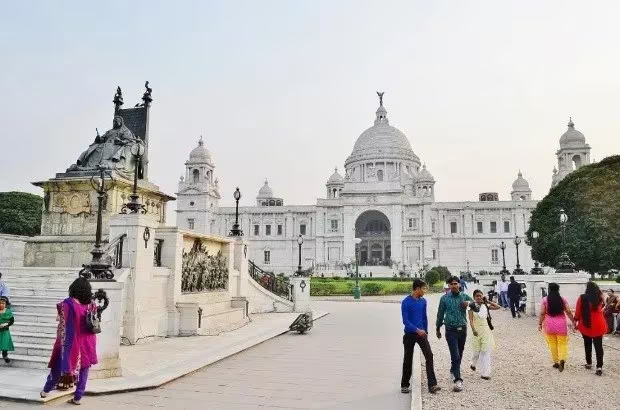
Postmpt
From the history
From the 2nd half of the 16th century. Bengal was ruled by the viceroy (nawab) of the Mughal emperor. The developing trade in silk and saltpeter attracted British merchants, who in 1650-1651. settled in the trade center of the Mughal Empire on the Bengal coast – Hugli. At that time, the main trading post of the British East India Company was located on the west coast in Surat (Gujarat), in addition, the British were actively developing trade and export production in Madras, on the east Coromandel coast of India. These were still weak trading posts, the existence of which was of little concern to Indian rulers, including the Great Mughals. Nevertheless, the British, despite the lack of any interest in Indian acquisitions in London, hoped to gain a foothold here for a long time and create a strong dominion.
The prospects for the development of trade with Bengal caused a dispute between British merchants and the Bengali Nawab Shaista Khan. The overconfidence of the British almost provoked a military conflict with the Mughal Empire. In 1685, the governor of the East India Company, Joshia Child, persuaded King James II to send 10-12 warships to India to capture Chittagong, a city on the coast of the Bay of Bengal (present-day Bangladesh). The expedition was planned in a hurry and was unsuccessful. As a result, in 1688 the British merchants were forced to leave Bengal. The British factory in Surat was captured by the troops of the Mughal emperor Aurangzeb. He ordered the expulsion of the British from India. However, in the end the parties agreed.
In 1690, the new Nawab, Ibrahim Khan, invited Job Charnock to return to Bengal. The invitation was accepted, and on August 24, 1690, on the banks of the river. Hooghly, the British flag flew over the marshy land of the village of Sutanati. This village, along with neighboring Govindapr and Kolikata, from which the name of Kolkata is probably derived, was destined to grow into the largest city on the east coast.
The original settlement of the British was located on the site of Fort William, founded in 1696 to protect the inhabitants of the trading post, named after the British king William III. The construction of the fort was carried out gradually, until 1716. It was located in the area between the BBDBagh and the river, north of present-day Fort William. New Fort William was built in 1758-1770. after the troops of the Nawab of Bengal, who captured the city in 1756, left Calcutta, the area around the fort was cleared to create a place for targeted fire in case of a repeat siege. Over time, this open space became the main city park.
From 1773 to 1911, Calcutta was the center of British possessions in India. During this time, it developed into a thriving commercial city with Victorian Gothic buildings, churches, parks and boulevards. This is the legacy of the 18th-19th centuries. survived to this day.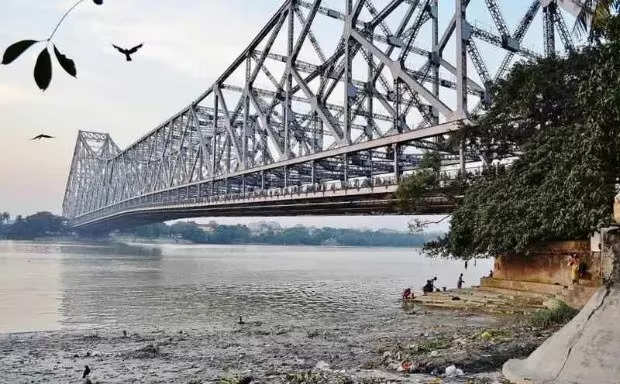
Bridge over the river. Hoogley
The favorable geographical position of Kolkata contributed to the all-round economic development of the city. Calcutta was the main port through which the British colonial trade with India was conducted. In the middle of the XIX century. the construction of large factories (mainly jute) and factories began. After the transfer of the capital to New Delhi in December 1911, the influence of Calcutta weakened slightly, but its importance for India remained unchanged.
During the Second World War, the Japanese bombed the city twice. During the terrible famine of 1943, thousands of people died in Calcutta. The partition of India and Pakistan in 1947 triggered a wave of violence and a significant demographic crisis in Calcutta. Hundreds of thousands of Muslims left the city. In their place, a large number of Indian refugees arrived from East Bengal.
Calcutta is an important center for the workers' and left-wing democratic movement. In the 1960-1970s. the left-wing extremist movement of the Maoists became more active. And today, their units pose a significant threat.
The significant influx of refugees from East Pakistan (Bangladesh) during the 1971 Indo-Pakistani war proved to be an overwhelming burden on Calcutta.
Economic reforms in India in the 1990s. opened up new opportunities for the revival of Calcutta, associated with the development of the service sector and industrial production in satellite cities.
In 2000, the Indian government approved the change of the name of the city from Calcutta to Kolkata, but in Russian the city continues to be called Calcutta.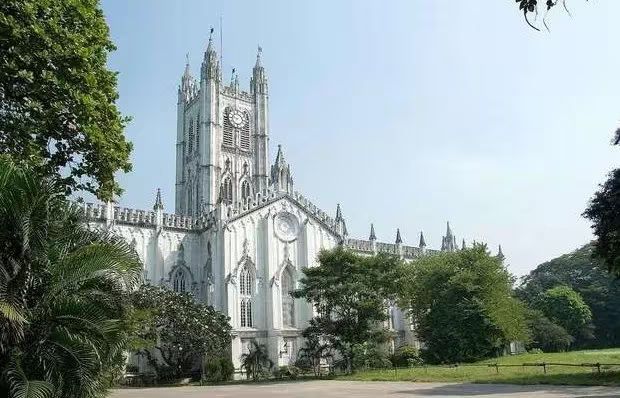
Cathedral of st. Paul
According to the 2001 census, more than 4.6 million people live in Kolkata. We can say that the city (area – 185 sq. Km) is the core of a huge and constantly growing conurbation – Greater Calcutta (Kolkata Metropolitan Area, population – 13.2 million people, area 1750 sq. Km), which includes 72 cities and 527 villages stretching out in a narrow strip (length – 100 km, width – 3-4 to 15-20 km) on both banks of the Hooghly River. Greater Calcutta is India's most important center of attraction for migrants who flock here in search of work. Local natives make up less than 1/2 of the population. More than 1/3 of the population of Calcutta are non-Bengalis, mainly Biharians, Oriya, Telugu and others.
The literacy rate of the inhabitants of Calcutta is 80.9% (the Indian average is 64.8%). According to the 2001 census, 77.7% of the city's population are Hindus, 20.3% are Muslims, 0.9% are Christians and 0.75% are Jains.
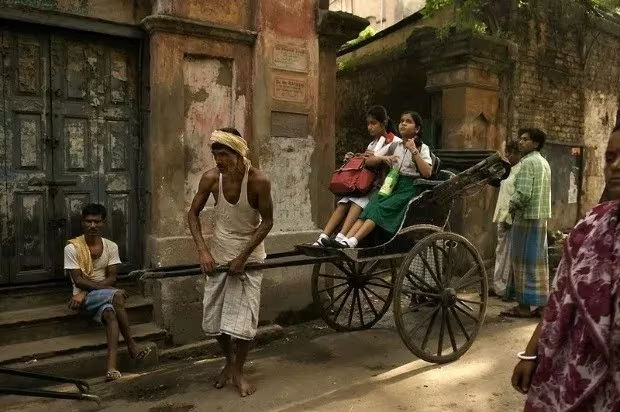
Rickshaw – the symbol of Kolkata
The main problems are environmental pollution and overpopulation. A third of the city's population lives in slums.
sights
In Calcutta, there are the largest in India National Library (founded in 1836), the Queen Victoria Memorial Complex (1921), Fort William (1770 (, the richest Indian Museum (1814), the country's oldest Calcutta University (1857), Botanical Gardens (1786)), Mission of Mother Teresa and the headquarters of the Ramakrishna Society.