
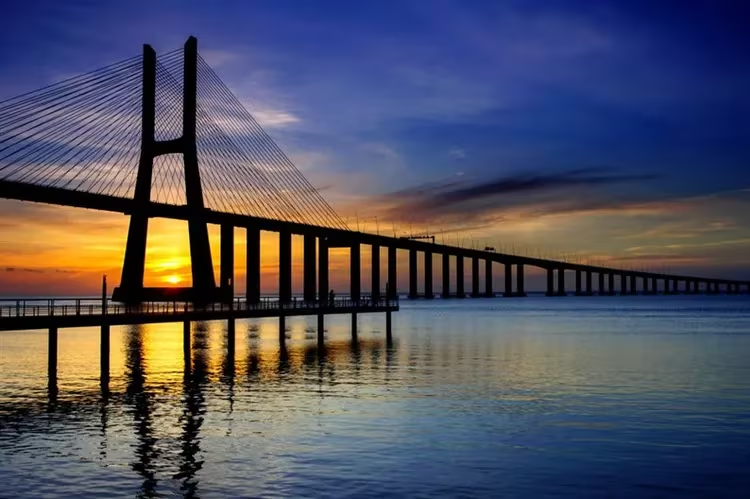
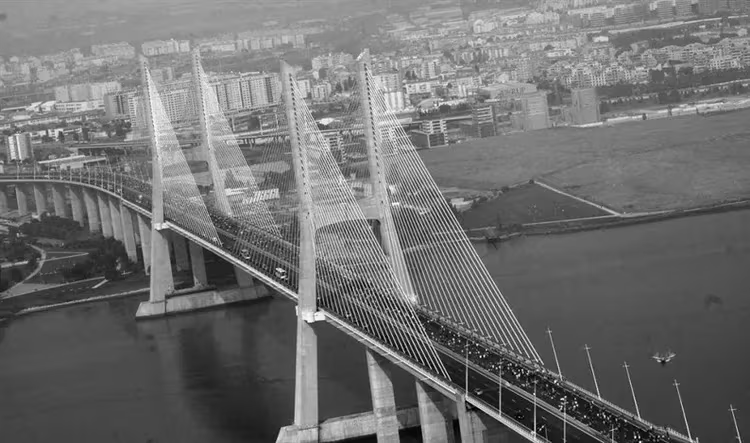
Vasco da Gama Bridge in Lisbon – the longest bridge in Europe, photo, description, map
When planning a tour of Portugal, it would be a mistake for curious travelers to forget about the European road route “E01”. Crossing the huge bay formed by the Tagus River in Lisbon, the route passes over the longest bridge in Europe, more than 17 km long. Its appearance strikes with a combination of beauty and reliability. The achievements of modern building technologies in this example are delightful. Not having a classical form, it harmoniously fits into natural landscapes, surprises with its lightness and at the same time functionality.
bridge design
A real miracle of engineering, the bridge was designed for a year and a half, taking into account landscape and weather conditions, all possible little things that could affect the strength of this grandiose structure. The requirements of environmental scientists were not ignored, to preserve the ecosystem of the river, even night lighting does not fall on the water.
Due to the length, interestingly, the experts calculated an error of 80 cm due to the spherical shape of the planet. Each, even the smallest detail, is designed very reliably, so that over a period of operation of at least 120 years, the structure could withstand winds up to 250 km / h, earthquakes that are more than four times stronger than what shook Lisbon in 1755, the force of tremors then only slightly below 9 points.
Just think, piles with a diameter of 2.2 meters go to a depth of 95 meters below sea level. Six lanes serve up to 52 thousand people. cars per day. At the same time, if their number increases (the maximum throughput is up to 130 thousand cars daily), two more lanes are opened additionally. The maximum speed is 120 km / h, it is reduced to 90 km / h in bad weather.
bridge construction
The bridge was erected by four different companies, each of them had its own separate tasks, which were successfully completed. In a short time, only a year and a half, the construction was successfully completed. Particular attention was paid to safety. No violations were recorded. There were no accidents either during the work or in the subsequent use of the bridge.
Timing in this venture was of fundamental importance to the Portuguese. The opening of the movement is timed to a historical date. In 1498, the famous navigator Vasco da Gama laid a sea route connecting Europe with India. The bridge is named after him. On this day, March 29, 1998, five hundred years later, along the entire length of the road across the river, a huge festive table was laid with refreshments for all the guests who came to the celebration and more than three thousand workers who participated in the project.
The construction was financed not by state funds, this was done by the Lusoponte consortium. Traveling on the Vasco da Gama bridge is paid if you move towards Lisbon. Depending on the type of transport, the fee is €2.5-5.85 for cars and up to €11.2 for trucks. From the city, in the direction of the south, you can go for free.
What is interesting about the bridge for tourists
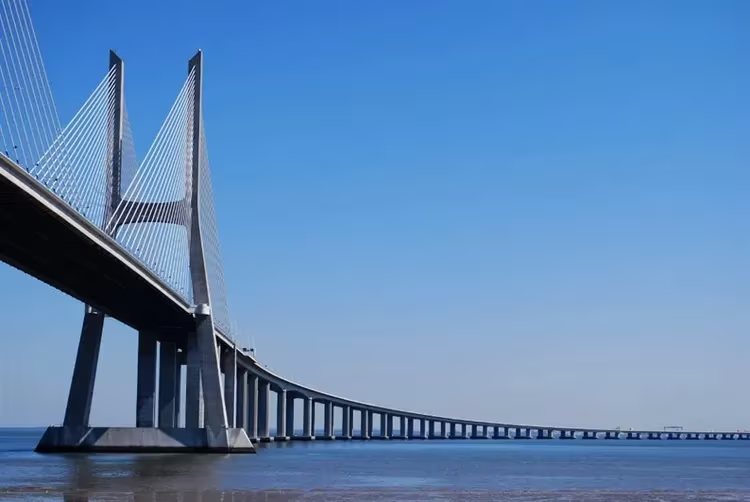
Vasco da Gama attracts both professional builders and lovers of aesthetic impressions. During the day, when the sun is clear, the bridge produces a stunning effect. White bearing pillars carry the highway to the horizon. Its end is not visible, it is hidden, absorbed in the combination of turquoise water and blue sky. A narrow blue stripe between them barely shows the other side of the river.
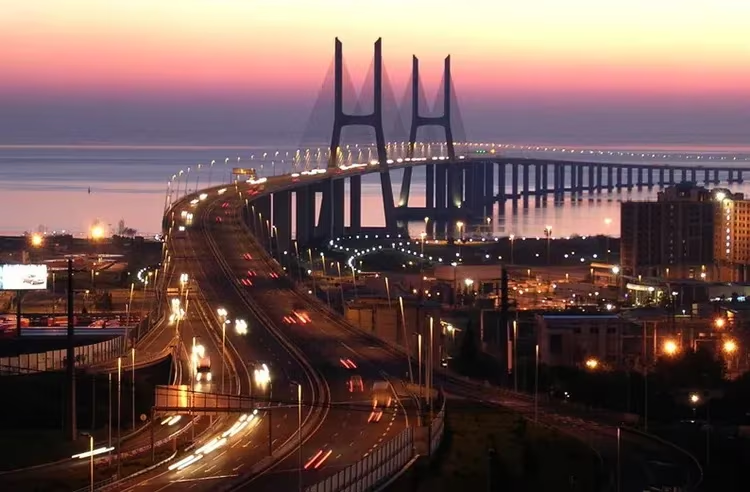
At night, an artery comes out of the metropolis burning with lights, and through the air, through the impenetrable darkness, the bright light of lanterns and car headlights carries, it floats away somewhere into the distance…. Traveling across the bridge at night is mesmerizing. In front and behind the illuminated section of the path is surrounded by a black veil, the banks are hidden somewhere in the darkness, waves are splashing from below. And only from above, a myriad of stars are unsuccessfully trying to illuminate the entire road.
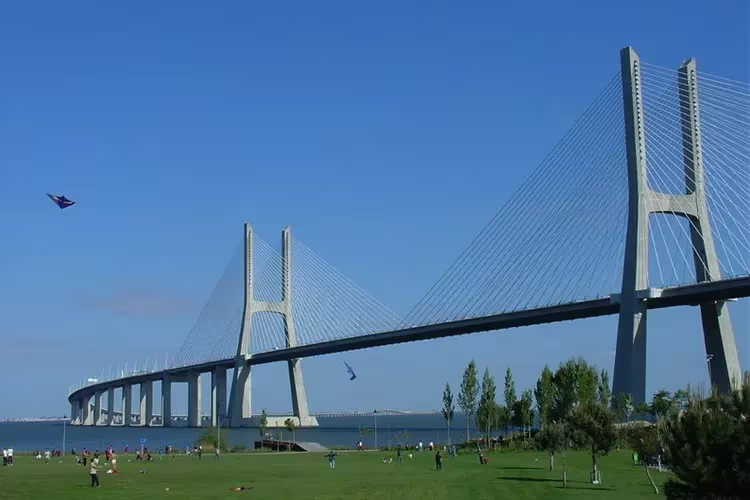
At dawn, the charms of the surrounding nature become visible. A moving car catches up with a silvery path, a reflection of the rising sun. The freshness of the air invigorates, and the endless road inspires new journeys. There are wonderful park areas near the access roads on the banks. In Lisbon, the townspeople and guests loved walking along these alleys.
Glorious photographs are obtained with a view of the bridge, they seem especially unique in the evening, when the supports are painted in orange and red shades of the setting sun. All the colors of the rainbow can be seen here at this time of day. Against the background of an ultramarine sky, the bridge plays with different tones with every centimeter of the setting sun. Even in the most disgusting weather, this structure, like an unshakable fortress, protects travelers and enchants with its beauty.
Portugal can rightfully be proud of such a landmark as the Vasco da Gama Bridge. The world community has included it in the treasury of the greatest architectural achievements of mankind at the end of the twentieth century.