
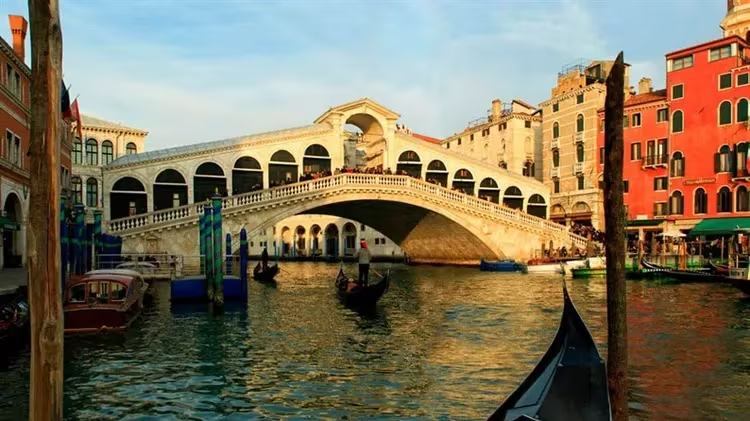
Venice is an ancient Italian city located on the mainland and 118 islands, along with the Venetian Lagoon, is listed by UNESCO. This is a monument city that attracts tourists with ancient Renaissance-style palazzos, bell towers, majestic cathedrals and picturesque canals.
Construction history
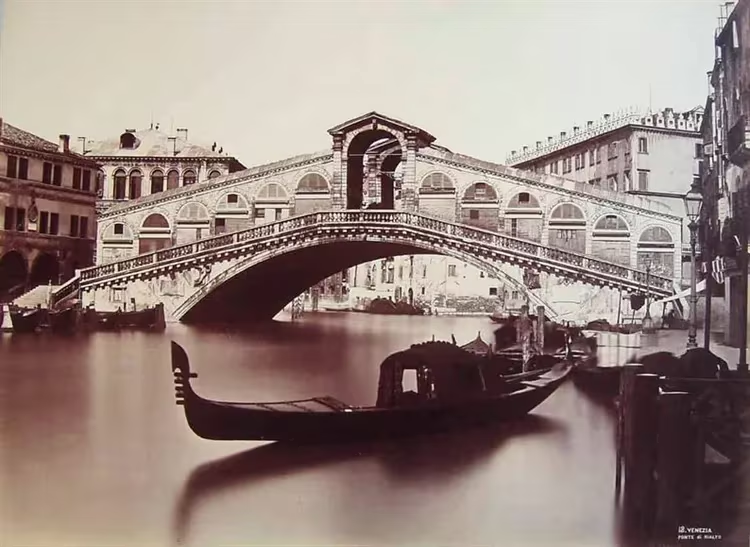
The main attraction of the city is Rialto, an ancient bridge connecting the banks of the Grand Canal. It is considered a symbol, a hallmark of Venice. This is a pedestrian crossing and shopping street, where more than 20 boutiques, shops and shops are open. Carnival masks, Murano glass and leather products, and fine jewelry are in special demand. In other areas of the city, prices are usually lower, but tourists are happy to buy Venetian souvenirs here. In the 12th century, people crossed the Grand Canal in boats that were fastened one after another. This unstable design often led to tragedies with human casualties. There were fires, then it was generally impossible to cross to the other side.
In 1181, construction began on a more convenient crossing – a pontoon bridge, but it also did not differ in high reliability. It was called Ponte della Monete, since there was a workshop nearby where coins were minted. The ferry was designed by the famous architect of that Niccolo Barattieri. Venice of that time is a major cultural and commercial center. To connect the banks of the canal, a new, more convenient and wider crossing was required. This time they decided to build not a pontoon crossing, but a bridge. The first wooden bridge appeared in 1250. It was built movable so that large ships could pass freely. Nearby was the Rialto market, this gave the name to the new building, which remained behind it for centuries.
The construction was constantly pursued by failures: in 1310, it was accidentally set on fire by soldiers who were called to suppress popular unrest. In 1444, when a huge crowd gathered to watch the competition of gondoliers, the bridge could not bear its weight and collapsed. It was again restored, but again built of wood. At the same time, the first trading rows appeared at the crossing, shops and shops opened, in which there was a brisk trade in imported goods. This was beneficial to the state – the treasury received significant taxes from trade.
After the third collapse, it was decided to build a wide, strong and convenient for trade structure of stone. It is known from ancient documents that in 1551 a competition was announced for the best design of a stone building. The most famous architects, even Michelangelo, took part in it, but the creation of the project was entrusted to Antonio de Ponte. There were various rumors – why this rather elderly master received the development of the project. One of the explanations is because of the surname, which means “bridge” in translation. The organizers of the construction considered that it was symbolic and should bring success.
Design features
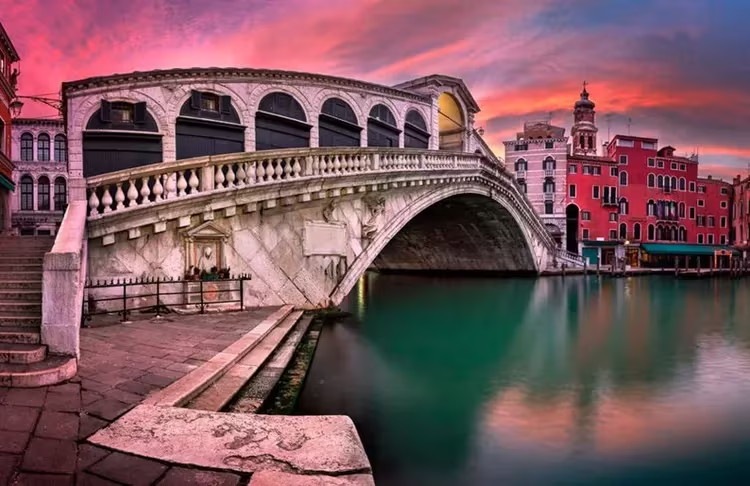
Ponte built an amazing bridge, the strength of which has been tested by time. The bridge is not a drawbridge, but large merchant ships passed freely under it. The design has a powerful arch with galleries, so an openwork and airy look is created. Steps lead to the center of the bridge, you can also go down them. The building is decorated with bas-reliefs. On the side of the railway station, the bas-relief depicts St. Theodore, on the other hand, scenes from the Annunciation are reproduced.
Structural features of the building:
Construction began in 1588, completed in 1591, an average of 6,000 people pass over the bridge every day. Restoration was carried out in 2015-2016. The work was done very carefully, without violating the historical structure. Only 1% of the original materials have been replaced. Now the bridge stands in all its glory, besides the fact that it itself arouses admiration, it offers a beautiful view at any time of the year.
legends
The first wooden buildings were not lucky – they often burned, quickly fell into disrepair and required restoration. Finally, in the middle of the 17th century, a stone bridge was built, which to this day delights people. Like almost any ancient structure, the Rialto Bridge has its own legends. One of them says: when the workers started construction, everything that was being built during the day was destroyed at night for unknown reasons. This went on for a whole month. One of the masters, whose name was Sebastian Beortoloni, was interested in the quick and successful completion of construction. He decided to find out why this is happening.
He came to the construction site at night and, hiding, began to observe what would happen next. At midnight, Beortoloni heard terrible groans, sardonic laughter, a knock. At the same time, the bridge began to collapse with a terrible roar. It turned out that it was Satan himself! The master decided to make a deal with the unclean. It consisted in the fact that the devil will give the opportunity to complete the construction, but for this he will take the soul of the creature that will be the first to pass through the new transition. I must say that Beortoloni's wife was pregnant. The work has been successfully completed. Sebastiano thought that he could deceive the evil one by giving him the soul of a rooster and went in the morning to buy a bird.
But the devil was smarter. He came to the master's wife, taking the form of one of the workers. He said that her husband was waiting for her to watch the opening of the bridge. The woman passed through the passage without hindrance, as the workers knew her well. When the master found out about this, he realized what trouble he had brought upon himself: the child died, and his soul fell into the hands of the devil. At night, the master began to dream of a baby who was crying because he was constantly sick from the cold and humid air of the canals. This went on for a long time, until one old gondolier helped an innocent soul to find himself in heaven. Another legend is connected with the bas-reliefs.
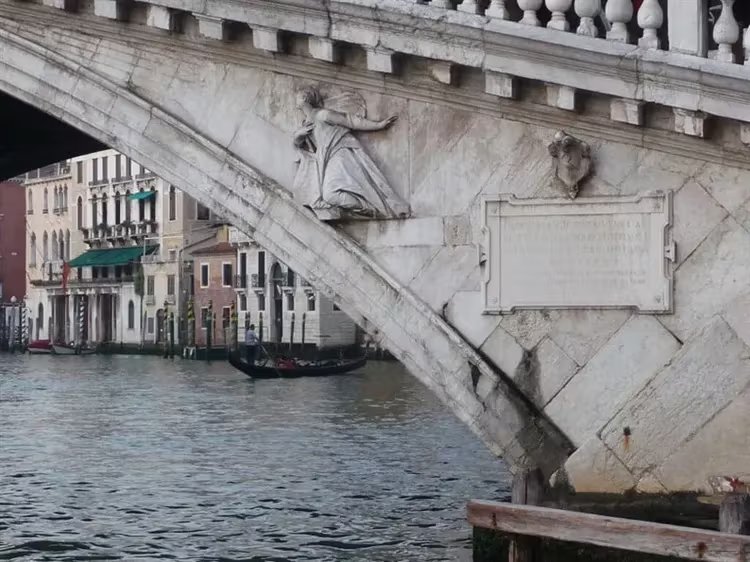
A building adjoining the bridge is a must-see. It is historically connected with the bridge. They have two bas-reliefs. The architect made them in response to a disrespectful attitude towards his project.
According to legend, one noble Venetian argued that a flame would appear between her legs rather than a bridge would be built, and the man who echoed her shouted that he would have a hoof instead of a reproductive organ. They were known to be wrong, but their threats came true. To punish these people for disbelief, the architect made two bas-reliefs – one depicts a woman with fire between her legs, the other a man with a hoof instead of an important organ.
In addition to the legend, a historical fact is known – the English writer William Shakespeare mentioned Rialto in his play The Merchant of Venice. They say that while traveling in Venice, the eminent writer saw the bridge and was captivated by its beauty. Shakespeare described in detail in his work both the shopping malls and the passage of ships under the bridge.
The place where trade transactions took place
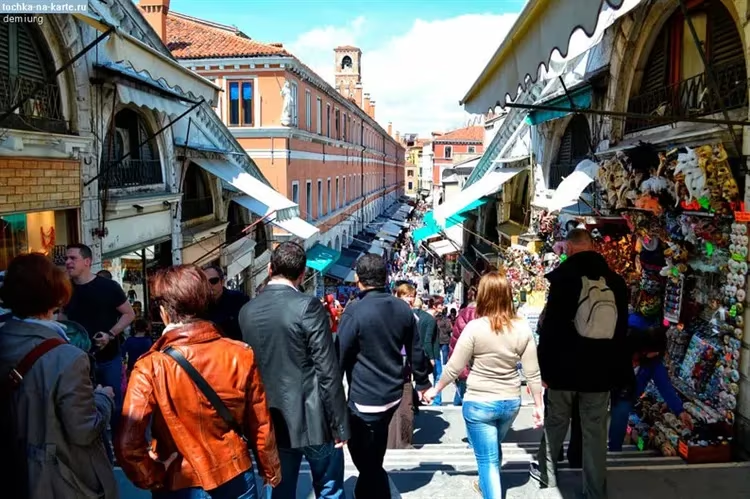
Venice – thanks to the development of navigation and the privileges that the merchants of the Venetian Republic had, turned into one of the main centers of trade. Until the 10th century, Venetian merchants could move freely, without duties, by sea and land. In the 11th century, merchants from other countries were obliged to sell their goods in Venice. All this contributed to the formation of the market and its rapid development. Silk, spices, coffee and jewelry went to Europe through Venice. The Rialto market becomes the main place for trading transactions and securities were sold. But here was not only a shopping center – but also the concentration of social life. Good communication was required between the banks of the Grand Canal in this place, which determined the construction site.
Where is it located and how to get there
If you are lucky enough to be in Venice, a beautiful city full of romance, it is impossible not to visit the Riolti Bridge. It is located in the central part of the city, connecting the two main districts of San Polo and San Marco. This is a pedestrian crossing, open at any time of the day.
- 1 From the airport can be reached directly by boat by vaporetto (via Piazza San Marco) via the Grand Canal. Vaporetto – urban public transport in the city, meaning “steamboat” in translation. It is often referred to as a river tram. Everything in it is like in ordinary transport – stop tickets, routes. There is also a bus from Marco Polo Airport to the Venice Islands, the journey takes 25 minutes.
- 2 From the train station to the Rialto Bridge, a vaporetto runs through Piazza San Marco and Piazzale Roma along the Grand Canal. The travel time for routes 1 and 2 is 45 and 25 minutes, respectively.
- 3 From Piazza San Marco, the central square of the city, you can walk along the signs – “Rialto”. Water taxis and gondolas run along the canal, but they will cost more.
Venice is a romantic city with many attractions – the Museum of Modern and Oriental Art in the Palazzo Ca Pesaro, the Golden House, the Goldoni Theater. A city that conquers and remains in memory forever.