
Academy of Fine Arts in Florence – history, photo, description, opening hours, prices 2021, map
Florence is the birthplace of the Renaissance and one of the world capitals of culture and art. Where, if not here, the legendary Academy of Fine Arts was supposed to appear – the very first, most famous academy of painting in Europe. Today, its history goes back over 450 years, and the number of legendary events that took place here, and cult personalities who visited these walls, is amazing. The Florence Conservatory also belongs to the Academy – a no less famous institution, but already a musical direction.
History of creation
Even at the beginning of the sixteenth century, Florence was not just a city, but a full-fledged, separate republic, with its own power and its own laws. However, in 1532 the republic ceased to exist, and Florence became one of the cities of the Tuscan state. With the advent of a new government and a new era, the mores of the townspeople gradually changed, and the art of the Renaissance, scattered here and there right on the Florentine streets, no longer touched and delighted the inhabitants of the city, as before.
For Florence, this was a dangerous, shaky period of time: she could lose her status as a world cultural capital. Fortunately, there were people who did not allow this, people who looked with bitterness at the withering of Florentine art and therefore decided to create here the first European Academy of Fine Arts, where talented people could enter to study painting and other arts. These people were Giorgio Vasari, Agnolo Bronzino and Bartolomeo Ammanati.
Giorgio Vasari, who studied with Michelangelo himself, needs no introduction. Mannerist artist, architect, art historian and writer, he became famous not only for his magnificent paintings in the genre of Tuscan mannerism and decorating the papal palaces in Rome, but also for writing the monumental “Lives of famous painters”, which he created for almost thirty years and eventually became one of the first and most significant art textbooks in Europe.
Agnolo Bronzino, the second of the founding fathers of the Academy, was also a representative of Mannerism, but he became famous primarily for others: for many years he was a court painter of the Medici house, created festive and theatrical scenery, painted pictures as a gift to honored guests and friends of Cosimo I Medici and his families. The third founder of the Academy, Bartolomeo Ammanati, is less well known to a wide circle, but culturologists and art critics know this name very well: among the works of a talented Florentine architect, sculptor and architect are the fountain of Neptune, the Santa Trinita bridge, the Palazzo Pitti and Pucci and the facade of the Church of San Michele.
In addition to these three big names “from art”, among the founders, historians also name the name of Cosimo I Medici himself, because the Grand Duke of Tuscany, with his influence and financial injections, contributed in every possible way to the creation and opening of the school. The Florentine Academy of Fine Arts opened its doors to students in 1561 and was originally located in the Basilica of Santissima Annunziata. The founding fathers also became its first masters and teachers.
Talented students from all over Italy came here to study painting, sculpture, architecture and metalworking, as well as the creation of various musical instruments. The most capable students were also allowed to restore the masterpieces of the Florentine Renaissance, of course, under the strict guidance of their famous teachers.
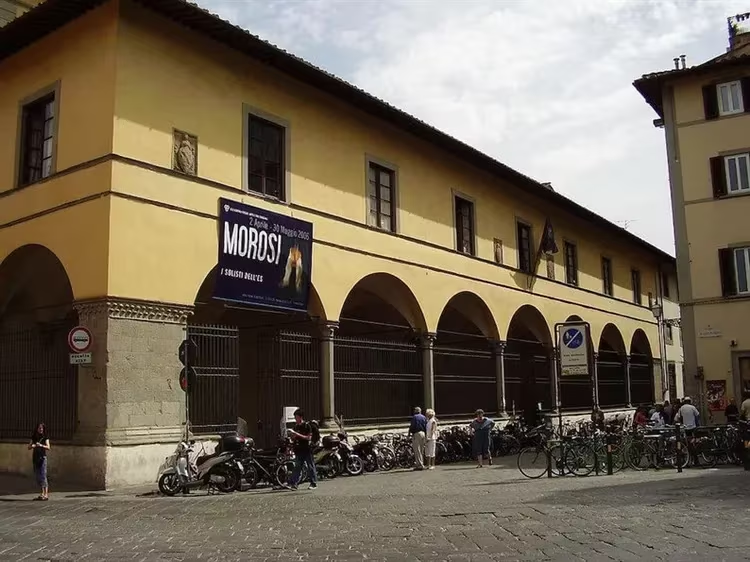
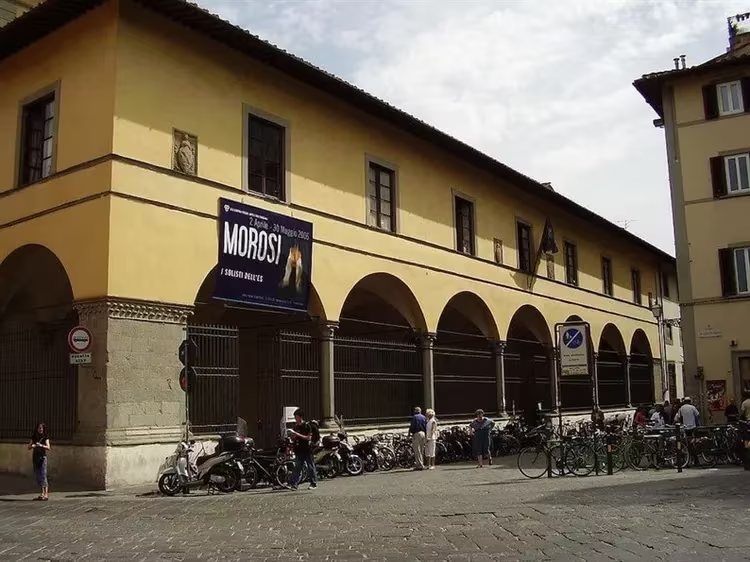
In 1588, a separate restoration department was even opened, which later played a significant role in the restoration of works of art of the Renaissance. The Academy grew and developed rapidly. There were more and more people wishing to learn the basics of art here and learn from the greatest masters of their time, there was not enough space in the basilica, so two centuries later, in 1784, when Duke Pietro Leopold II was already the head of the Tuscan state, the main educational building was moved to the former monastery hospital.
Around the same years, a gallery was organized at the Academy, where masterpieces of art were exhibited. All the schools of art that operated at that time in Florence were also given over to and under the patronage of the Academy. Another important event occurred in 1849, when the Florentine Conservatory separated from it. The conservatory was named after Luigi Cherubini, the then famous Italian composer and music teacher.
Cherubini wrote operas, masses, requiems, chamber works and concertos for the orchestra, and orders came to him from all over Europe: from London, Rome, Venice and other major cities. By the way, it is Cherubini who is the founder of another well-known European conservatory – the Paris one.
Today, the Academy is still one of the world's leading institutions in the arts. Nowadays, they study here as artists, graffiti artists, designers and decorators of various spaces, sculptors, set designers, museum workers. Over the long years of activity, it has produced hundreds and hundreds of first-class specialists, among its graduates is Luigi Mussini, a famous Italian artist, composer and chess player.
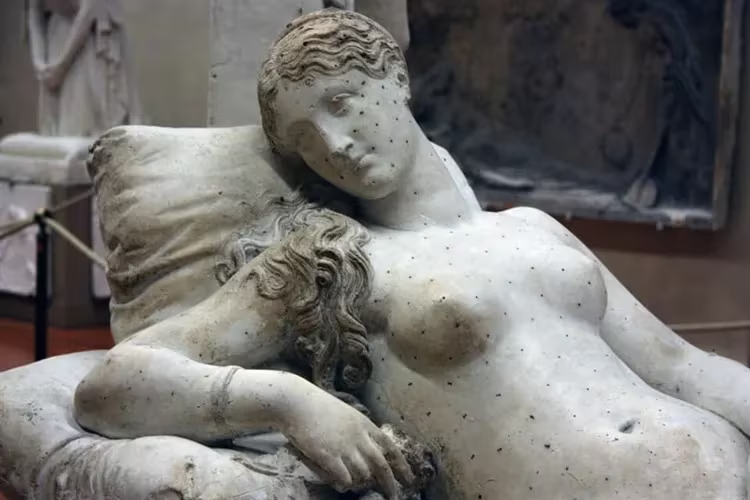
This is not just an art school, but also an organization that has found, saved and restored a huge number of masterpieces of world culture. Today, the galleries are among the most visited in the world, and are on a par with such eminent museums as the Louvre and the Hermitage. The flow of tourists here is huge, because every person who comes to the city, the “cradle of the Renaissance”, wants to touch the beauty.
Paintings
There are dozens and dozens of masterpieces of world art of the 14th-16th centuries. A special place in the collection is occupied by the exposition, which presents the works of masters of the Florentine Renaissance. Here you can see paintings by Paolo Uccello (among his most famous works are mosaics in the Venetian San Marco), Domenico Ghirlandaio (painted the Vatican library and painted portraits of many aristocrats of his time), Sandro Botticelli (you know for sure the cult “Birth of Venus” and you probably know “Portrait of Dante”), Andrea del Sarto (wrote “The Adoration of the Magi”, “The Last Supper”, “The Holy Family”, it is also known that he was friends with Raphael and Titian).
Here, in the gallery, there are works by Taddeo Gaddi, Andrea Orcagni and Lorenzo Bartolini, masterpieces of the Quattrocento era (in European art history terminology, this word refers to the style of Italian art of the Early Renaissance). It is also known that a huge collection of Russian icons of the 16th-18th centuries is stored here.
Works by Michelangelo
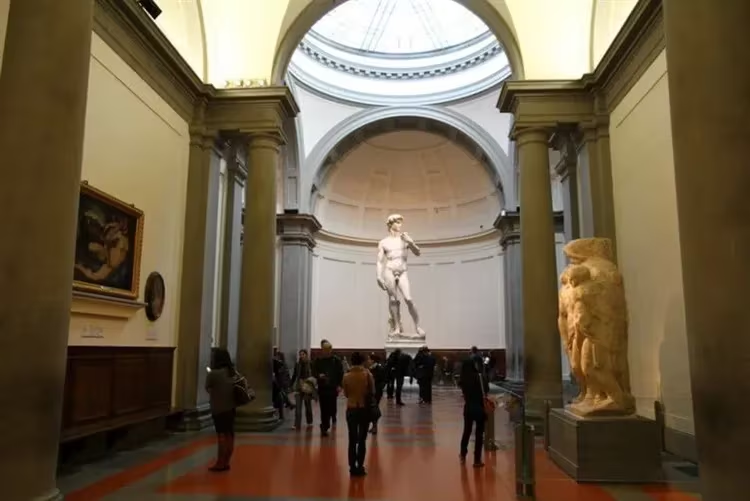
The main and absolute pride of the Florentine Academy of Fine Arts is the collection of sculptures by the great Michelangelo. For example, it is within the walls of the school that there are four works that make up a single sculptural composition: “Pieta Palestrina”, “Evangelist Luke”, “Four Slaves”, as well as a statue of St. Matthew, which the master, unfortunately, did not have time to complete.
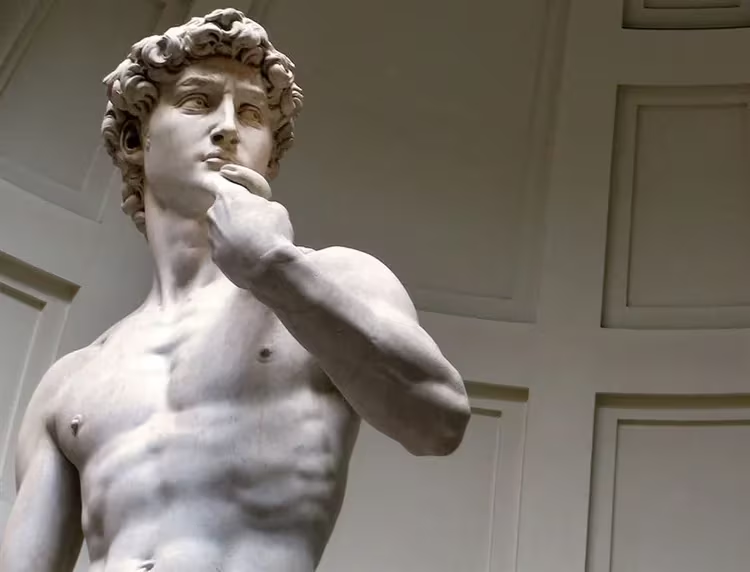
In 1873, the Academy made a grand acquisition – the famous statue of “David”. The one that everyone saw on the covers of textbooks on the Moscow Art Theater, but not all of them – live. In the meantime, it's worth seeing! It is known that Michelangelo sculpted the statue for about four years, from 1500 to 1504, working with a giant block of marble, so that the final height of the composition was as much as 5.5 meters.
Initially, it was assumed that “David” would decorate the roof of the temple of Santa Maria del Fiore, but it turned out to be impossible to erect such a huge sculpture there, and the architects were forced to abandon this idea. “David” was installed in front of the Florentine palace of Vecchio, and there she stood for more than three centuries.
At the end of the 19th century, the statue was transferred to the Academy, and even a separate hall was organized for it, called the Tribune. In front of the Academy itself, an exact copy of the “David” was placed – so that it immediately drew attention to the majestic work of art stored within these walls.
Hall of the Colossus
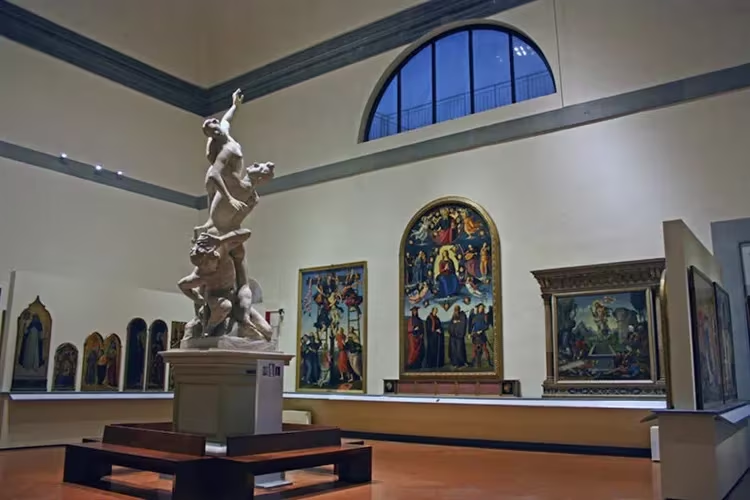
Many assume that the Hall of the Colossus is so named because there is some particularly large sculpture located here, some even believe that this is the same “David”. In fact, the hall was named so because models of the grandiose Dioscuri were once exhibited here. Now here is the original plaster model of the “Rape of the Sabine Women” by the Florentine sculptor Giovanni Giambologna. There are also numerous paintings here, among which the Madonna of the Sea, a masterpiece by Sandro Botticelli, occupies a special place.
Hall of Prisoners
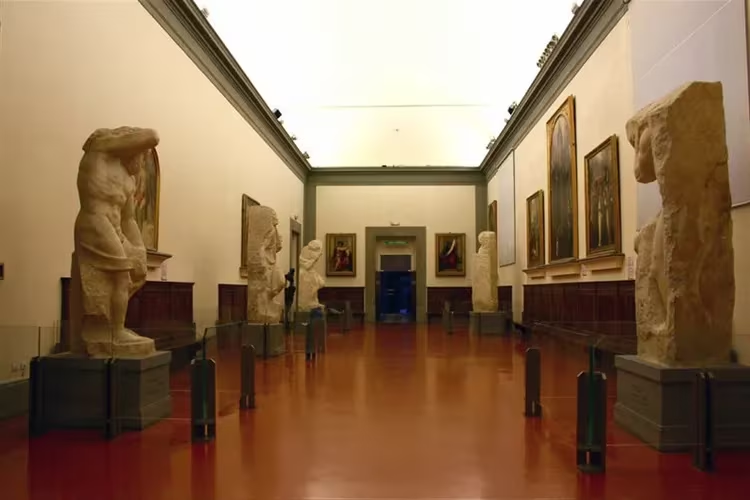
Another hall with an unusual name, the history of which is rooted in the distant past. It is located directly next to the Tribune and the “David” towering on it. It also houses works by Michelangelo, as well as paintings by Alessandro Allori. Allori is a famous Florentine painter of the second half of the 16th century. He painted in the Mannerist style, and a feature of his work was constant references to various flower arrangements.
Flowers in his paintings – daisies, forget-me-nots, lilies, tulips – have always symbolized and reflected certain feelings and emotions, whether it be joy or sadness, happiness or disappointment. To this day, tourists like to look for hidden meanings in flower compositions, and the Academy even has separate excursions to Allori's work.
Also in the Hall of Prisoners are the works of Lorenzo Bartolini, an Italian sculptor and, at one time, a teacher at the Academy. Among his most famous works are “Faith in God”, “Nymph with a Scorpion”, “Table with Cupids” and others.
Hall of Gothic painting of the XIII-XIV century
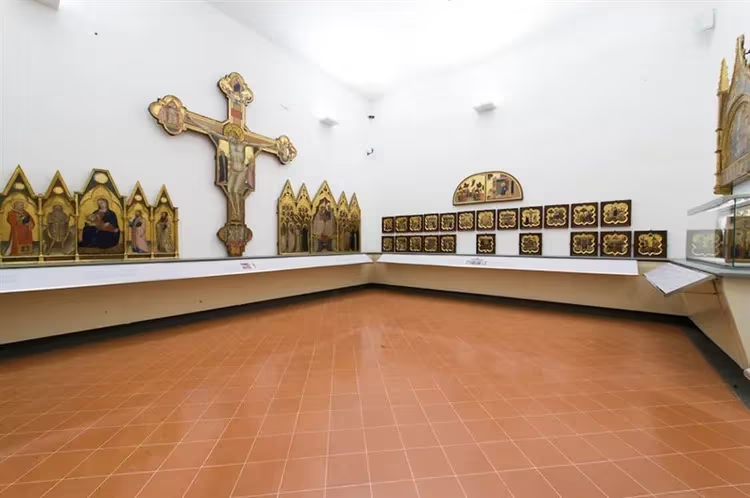
In the 13th-14th centuries, Florence and, in general, all of Italy experienced the heyday of Gothic painting: many recognized masters worked in this style, but only novice artists. In this hall you can see the works of Giotto (mostly religious works – crucifixes, icons and decoration elements of the altar of the cathedral), Bernardo Daddi (this artist did not write at all only on “divine” themes, whether they were frescoes depicting the lives of saints, or ” Madonna and Child, or a triptych of stunning beauty), Andrea Orcagni (also painted frescoes, created triptychs and designed altarpieces).
Duddy and Orcagna, by the way, were students and followers of Giotto, so the works of all three have something in common and are not just exhibited in close proximity to each other. In addition, there is also a hall of art from the end of the 14th century; it seems to be a logical continuation of the previous hall. Here, not only works are exhibited, but also screens are set up, which show virtual tours and tell about the creation of altars, the egg tempera technique and other amazing details of the creation of art objects and its restoration.
Museum of Musical Instruments
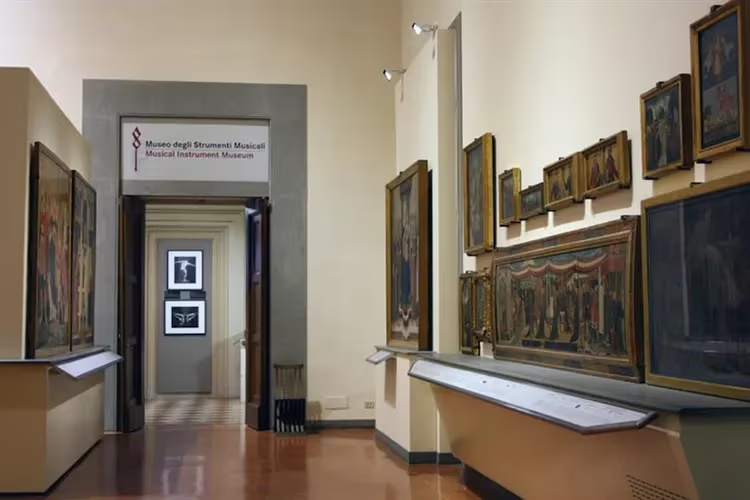
As already mentioned, at one time the Florence Conservatory separated from the Academy, but initially the “musical” component was within the same walls, and the first students of the founding fathers, among other things, sculpted musical instruments. That is why the leadership of the Academy decided to open a separate small museum for their exhibition.
There are harpsichords, violins, pianos, cellos and other ancient instruments. The main masterpiece of the museum, of course, is the Stradivarius violin, created by him for the Medici house from valuable tree species – maple and red spruce.
How to skip the line?
Of course, you can buy a regular paper ticket at the box office of the Academy itself – but the queues here are huge, and you will have to stand for a long time. It is much easier and more convenient to purchase an electronic voucher, one of the main advantages of which is entry without a queue. In addition, such a voucher has other advantages:
Buy a skip-the-line ticket online
If you want to get a tour in your native Russian, feel free to take a guide. Russian-speaking guides present clients much more fully and more interesting than what you can read on the Internet yourself. The guide will take you to the most interesting places of the Academy, visually acquaint you with its history, show and tell you about the masterpieces of Michelangelo, Giotto, Giambologna and Stradivari, whose famous works are presented in the Museum of Musical Instruments. This tour lasts about an hour and a half.
Opening hours and ticket prices
For tourists, the Academy is open from Tuesday to Sunday, you can visit the galleries with exhibits from 8.15. until 18.50, and the sale of paper tickets ends half an hour before the entrance closes. Day off here is Monday. In addition, the traveler will not get here during major holidays: January 1, May 1 and December 25.
As for ticket prices, they are very different:
Where is it located and how to get there
The Academy of Fine Arts is located in the historical center of Florence, so it's very difficult to miss and not find it, the exact address is Via Ricasoli, 58/60, you can even get here from Duomo and San Giovanni squares on foot, the journey will take no more than 10 minutes, and from other areas – by public transport. Buses of several routes run past the Academy at once: 4, 6, 14, 19, 23 and 31. In addition, a city taxi will be happy to take you here from the hotel.