
















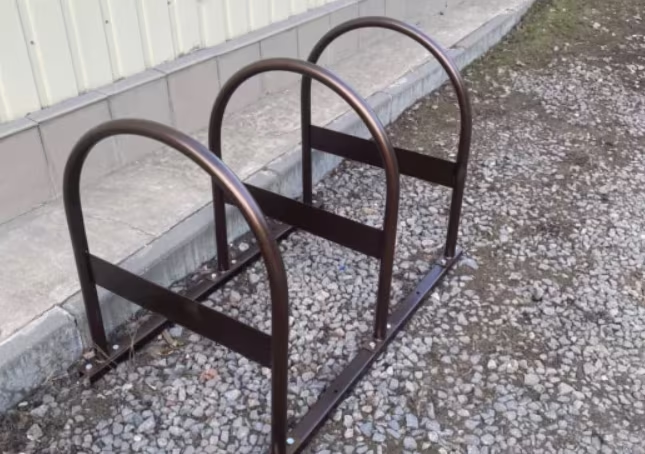
Bicycle parking racks by Incapcorp: how to choose rack type and coating
A bike rack seems like a small thing until bikes start falling over, getting tangled up, and blocking pedestrians. For a residential building, office, or store, good parking solves three problems: the bike stands securely, it can be locked, and it doesn't ruin the facade. Stationary systems in Germany have been regulated by a standard since 2016, and the minimum distance between bikes in it is 70 cm (according to the ADFC cycling association, 10/2026). Below you'll find the designs, materials, and planning rules used to choose a model.
How to choose bike parking
💡 In short:
- Count how many bikes are at your property in the morning at peak time.
- Choose a design based on parking duration: minutes, a workday, or overnight.
- Check the material and coating against the climate and the load on the area.
- Confirm the spacing between racks and the method of anchoring to the ground.
- Spacing and the DIN 79008 standard: 10/2026, according to ADFC.
Choosing starts not with a catalog but with counting: walk through the area in the morning and see how many bikes are there at peak. If half of them are leaning against walls and railings, there aren't enough spaces.
Then decide how long the owner will leave the bike. For a five-minute stop at a store, a simple holder works. For a workday, a train station, or a residential building, you need a design that lets you lock the bike by the frame, otherwise it will be stolen along with the wheel.
Types of racks and designs
The DIN 79008 standard distinguishes several types of stationary systems: the support hoop, the front wheel holder, the two-tier parker, and the bike box. Each has its own price and its own use case.
Type | How the bike is placed | Pros | Cons |
|---|---|---|---|
Support hoop (Anlehnbügel) | leaned against and locked by the frame | stable, works for e-bikes | takes up more space |
Front wheel holder | front wheel is inserted | cheap and compact | frame is exposed, rim gets bent |
Two-tier parker | lifted onto the second tier | saves space | requires strength and a high ceiling |
Bike box | fully enclosed | protection from rain and theft | expensive, few cells |
The most convenient basic model is called the support hoop. The bike leans against it sideways, and you lock the frame, not just the rim. The German manufacturer Incapcorp produces bike racks of exactly this class: curved hoops, double-sided racks, and models with a bracket.
Wheel holders are cheap and popular with supermarkets, but they offer weak protection. The frame remains exposed, and the rim is easy to bend with a push. Use them only where bikes are left for a couple of minutes.
Bike racks and boxes from Incapcorp
Incapcorp, based in Sigmaringen, offers bike racks and storage systems. The catalog includes curved hoops, double-sided racks, paperclip-shaped models and models with signs, reinforced hoops, wall-mounted clamps, two-tier parkers, repair stations with a pump, and canopies.
Catalog prices range from €28 to €3900, and orders are taken by phone on business days (according to the Incapcorp catalog, 10/2026). Check availability and delivery times with the manufacturer: warehouse stock changes, and you should confirm the batch before purchasing.
Material and coating
The durability of a rack depends on the steel and the protective layer. For outdoor use, three coating options are chosen, and each suits its own climate.
Material | Pros | Cons | Where it's appropriate |
|---|---|---|---|
Powder coating | even layer, any color | rusts with a deep scratch | enclosed courtyards, warm climate |
Stainless steel | resistant to moisture and salt | more expensive than others | coastal cities, open embankments |
Hot-dip galvanizing | withstands rain and de-icing agents | rougher appearance | open areas without a canopy |
Powder coating gives an even, dense layer and any color. You can match such a rack to the color of the facade or sidewalk, and it looks neat. The catch is that with a deep scratch, the metal is exposed and starts to rust.
Stainless steel is resistant to water and cleaning agents. It's installed in coastal cities and where roads are salted in winter. These racks are more expensive, but you don't repaint them every few years.
Hot-dip galvanizing coats the metal with a layer of zinc and withstands rain, snow, and de-icing agents. It costs more than paint but lasts for years. For an open area, choose zinc or a combination of zinc and paint.
Spacing and quantity according to DIN 79008
Stationary systems in Germany are regulated by the DIN 79008 standard. It was released in May 2016 and replaced the previous ADFC technical instruction (according to ADFC, 10/2026).
In planning, spacing matters most. With standard single-level installation, 70 cm is left between bikes. With staggered high-low arrangement, 50 cm is enough. In bike garages, the clear passage must be at least 75 cm (according to ADFC, 10/2026).
The number of spaces is calculated based on the property. For an office, roughly one space per several employees is planned; for a store and a residential building, it's calculated from the area and foot traffic. Check the exact requirements in local building codes: they vary by federal state.
How to protect a bike from theft
A simple rack doesn't prevent theft if you only lock the wheel. The frame and at least one wheel should be connected to the rack itself with a lock, in an accessible place and at a height of at least 50 cm (according to Wikipedia on bike parking, 10/2026).
Check three things before buying a model. First: the top of the hoop is free, and you can thread the lock through the frame. Second: the rack is rigidly connected to the ground, meaning it's set in concrete or bolted with anchors. Third: the area is well-lit and busy, because a lock won't stop someone working with tools in an empty area.
For garages and basements, choose bike boxes. The bike is fully enclosed, and you don't need to lift it to a second tier.
⁉️🤔 Frequently asked questions
Why is a front wheel holder considered a poor choice?
It only holds the wheel. The frame remains exposed, and the bike is easily stolen by detaching the wheel. A sideways push bends the rim. Such a holder works where bikes are left for a couple of minutes, for example near a store checkout.
How many bikes will fit in an area?
It depends on the spacing between racks and the installation method. With standard single-row arrangement, bikes stand wider; with staggered arrangement, they take up less space. First count the peak number of bikes, then choose a design for that number.
What material should I choose for outdoor use?
For an open area, hot-dip galvanizing or zinc combined with paint works well. This coating withstands rain, snow, and de-icing agents. Stainless steel is more expensive but doesn't require repainting. Powder coating is cheaper, but the metal rusts with a deep scratch.
Where should the rack be anchored?
There are two methods: setting in concrete in the ground or mounting on anchors over existing pavement. For tiles and asphalt, anchors are more common; for grass and soil, concrete setting. Choose the method based on the surface and the load on it.
Does bike parking need a canopy?
A canopy protects bikes from rain and snow and extends the service life of the racks. For a residential building and an office with year-round parking, it's justified. For a short stop at a store, an open area without a roof is enough.
In short: how to choose bike parking
Start by counting bikes at peak and measuring the area. For a short stop, a wheel holder is enough; for a full day, choose a support hoop; and for a garage, a bike box. Choose the material based on the climate: for an open area, zinc or stainless steel is better; for an enclosed courtyard, powder coating is enough.
Check the spacing between racks and the anchoring method against local requirements before ordering. Relocating hoops set in concrete is far more expensive than getting the right spacing from the start. This way you'll avoid redoing the area.

A small editorial team writing guides for independent travel. We travel ourselves, but we haven’t been everywhere, so we check prices, opening hours and how to get there against official sources.