



Germany: the guide for planning it yourself
Germany does not come down to one city. Most first itineraries rest on Berlin, Munich with Bavaria, and Hamburg, but between them lie castles from the Baltic to the Alps, the Black Forest, the rock formations of Saxon Switzerland, the wine valleys of the Main and the Moselle, and two seas in the north. Anyone who tries to cover all of it in a week spends the trip in transit. This page sorts the country for your own planning: where to go, where to stay, how to get around, when to set off and what to calculate your costs with. Every section stays short and leads on to our detailed articles. There are no prices here: a train ticket and a hotel night in Germany depend on the purchase date and the holiday calendar, so a fixed number would mislead you.
Castles, nature and the main sights
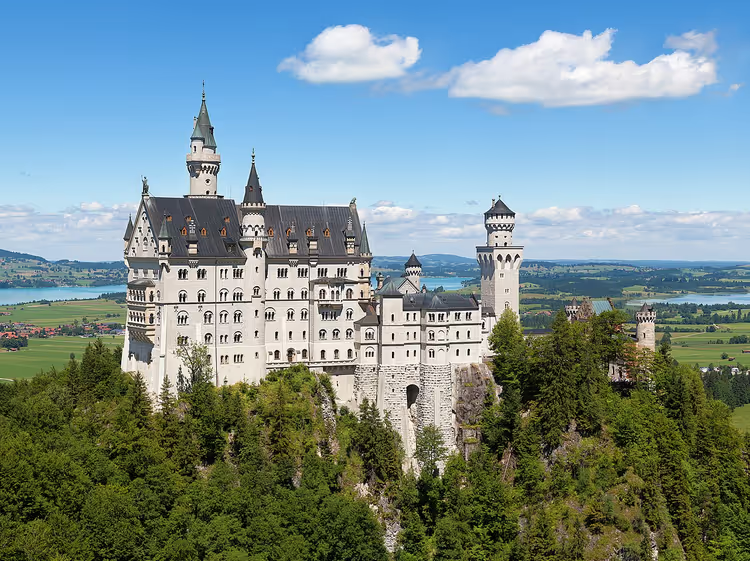
Castles are scattered from the Baltic to Bavaria, and you cannot get around them all in one trip. The best known, Neuschwanstein, stands on a rock in the south of Bavaria: you can only go inside on a guided tour and with a ticket for a specific time. Eltz Castle hides in a wooded valley not far from the Moselle and is closed in winter. Schwerin Castle sits on an island in a lake in the north.
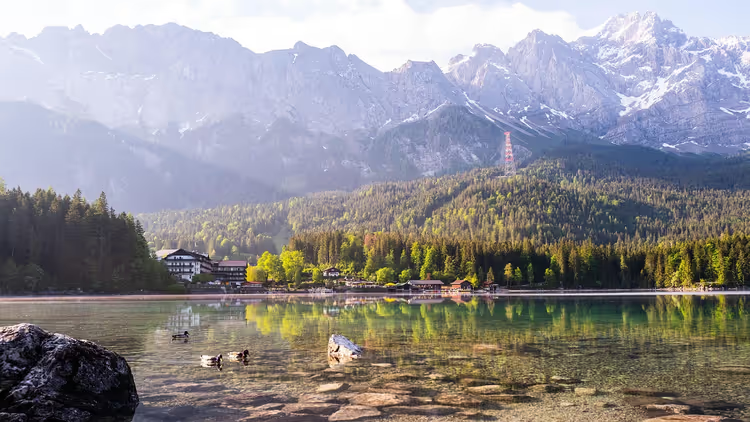
The landscapes vary just as much. The Black Forest lies in the southwest: the Feldberg mountain, the lakes Titisee and Schluchsee, and the Triberg waterfall, which is considered the highest in the country. Saxon Switzerland begins half an hour from Dresden, and the viewing platforms of the Bastei Bridge above the Elbe are open all year and free of charge. A narrow gauge steam train climbs from Wernigerode to the Brocken, the highest point of the Harz. On the North Sea coast, low tide uncovers the floor of the Wadden Sea, a UNESCO World Heritage site.
Two rules save the most time. Take no more than one big castle a day: the line, the tour and the journey add up to half a day each time. And check the opening days: in Munich, Stuttgart, Nuremberg and Berlin many museums are closed on Mondays.
Our articles on this
- Castles of Germany: 10 most beautiful, tickets and tips 2026
- Neuschwanstein: tickets, route from Munich and what you will see inside
- Eltz castle in Germany: tickets, opening hours and the trail through the Elzbach valley
- Frankenstein Castle: how to get there and what its legends hide
- Saxon Switzerland from Dresden: fortresses, Bastei bridge and prices 2026
- Saxon Switzerland near Dresden: Bastei, fortress and waterfall
- Bastei bridge over the Elbe: rock castle and the route from Dresden
- Schwarzwald: waterfalls, lakes and main points of the Black Forest
- Brocken mountain in the Harz: steam train to the summit and Walpurgis Night sabbath
- Wadden Sea on foot: how to walk the seabed and return before the tide
- Mainz Cathedral: opening hours, free entry and what to see inside
- Museum Island in Berlin: what is open and how to buy a combined ticket
- Brandenburg Gate in Berlin: free entry and route from the metro
Cities and regions: where to go
A first trip usually rests on three hubs. Berlin is the capital, with a dense center. Munich, the third largest city after Berlin and Hamburg, serves as the main gateway to Bavaria: this is where people set off for the Alps and the castles of Ludwig II. Hamburg is a port and a city on the water, divided by the Elbe, the Alster and its canals.
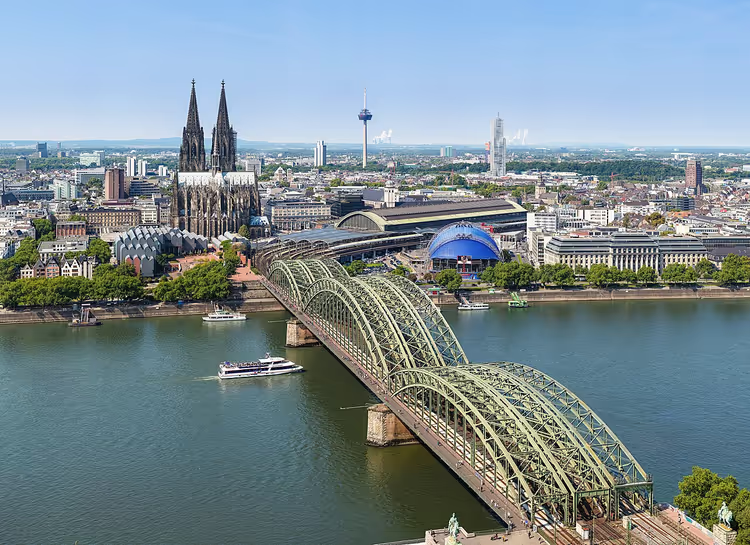
Next come the cities that are easy to see on foot. In Cologne almost everything important stands within a couple of kilometers of the cathedral. Dresden fits into a compact triangle on the bank of the Elbe, and two days are the usual allowance for it. Frankfurt am Main, Nuremberg, Leipzig, Stuttgart and Düsseldorf also have compact centers, while Baden-Baden grew up around thermal springs that rise right in the middle of town.
Choose regions by what you are going for. Franconia stretches along the Main from Würzburg to Bamberg. In the Black Forest people base themselves in the valleys and go up to the lakes and summits for the day. In the north, quiet is found on the East Frisian Islands, where Spiekeroog and Langeoog live without cars, and on Rügen and Usedom in the Baltic.
| City | What kind of city | What to keep in mind |
|---|---|---|
| Berlin | The capital, with a dense center | The advice is to stay inside the S-Bahn ring; many museums are closed on Mondays |
| Munich | The third largest city and the main gateway to Bavaria | This is where people set off for the Alps and the castles of Ludwig II; hotels get more expensive during Oktoberfest |
| Hamburg | A port and a city on the water, divided by the Elbe, the Alster and its canals | A direct train from Berlin takes under two hours |
| Cologne | Almost everything important stands within a couple of kilometers of the cathedral | Half of the main sights are free to enter; the center fits into one day on foot |
| Dresden | A compact triangle on the bank of the Elbe | Two days are the usual allowance; Saxon Switzerland begins half an hour from the city |
| Nuremberg | A city with a compact center | A high speed train from Munich takes about an hour; December weekends sell out because of the Christmas market |
| Baden-Baden | A town that grew up around thermal springs | The springs rise right in the middle of town |
Our articles on this
- What to see in Munich: 30 places with prices and opening hours
- 10 Places in Munich: from Marienplatz to Nymphenburg
- What to see in Hamburg: 29 places with prices and opening hours
- What to see in Cologne: 30 places and opening hours
- What to see in Dresden: 30 places with prices and a route
- What to see in Dresden: 10 main places and how much tickets cost
- What to see in Frankfurt am Main: 20 places and ticket prices
- Nuremberg sights: 15 places from the fortress to the zoo
- What to see in Leipzig: 24 places and how to reach them
- What to see in Stuttgart: 20 places and what to choose first
- What to see in Dusseldorf: 25 places from Altstadt to palaces on the Rhine
- 24 Main attractions of Baden-Baden: what to see and how much it costs
- Berlin on your own: transport, hotels and a route through the main sights
- Berlin in 40 stops: what's open in 2026 and where you need to book tickets in advance
- Eberswalde near Berlin: where to live, eat and what to see
Hotels: what the choice depends on
In German cities location matters more than the number of stars. In Munich it is pricier and crowded around Marienplatz, cheaper and closer to transport near the station. In Berlin the advice is to stay inside the S-Bahn ring, from where the way to most of the main sights is short.
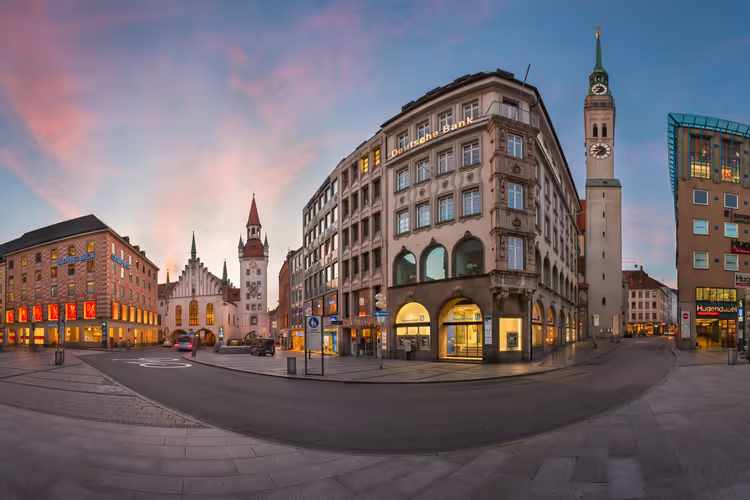
The second thing that moves the price is the calendar. In Munich hotels get more expensive during Oktoberfest and the big trade fairs, and people book those dates months ahead. In Berlin the highest prices fall in February and March. December weekends in Dresden, Nuremberg and Cologne sell out because of the Christmas markets, while in November, the low season, hotels bring their prices down.
Ad
Compare places to stay in Germany on Trip.com
We earn a commission through this link; your price stays the same.
Our articles on this
Tours, tickets and day trips
It pays to buy tickets in advance wherever entry is timed. At Neuschwanstein the number of tour slots is limited, and in high season they are gone days ahead. The Reichstag dome in Berlin is free to visit, but only with advance registration. In Dresden, the Green Vault and the dome of the Frauenkirche admit visitors with tickets for a set time.
The most convenient base for day trips is Munich. A high speed train takes about an hour to Nuremberg, Garmisch-Partenkirchen and the Zugspitze are an hour and a half to two hours away, and Bamberg and Rothenburg take up the whole day. The rule is simple: for one day pick either one distant place or two nearer ones close to each other. You need a guide where it is dangerous without one: long crossings of the Wadden Sea mudflats are only done with a licensed guide.
| Where to | Journey from Munich | What to keep in mind |
|---|---|---|
| Nuremberg | High speed train, about an hour | The choice if you do not want a long journey; no car needed |
| Regensburg | Train, about an hour and a half | Another nearby destination; no car needed |
| Garmisch-Partenkirchen and the Zugspitze | Train, an hour and a half to two hours | It is often windy and snowy at the top, and the ascent can be closed for a few hours |
| Neuschwanstein Castle | Train to Füssen, then a bus | You can only go inside on a guided tour; tickets for the time you want are gone well ahead |
| Linderhof Palace | No direct train, you need a bus or a car | The only palace of Ludwig II that was fully completed |
| Bamberg | The journey takes 2-3 hours each way | Takes up the whole day |
| Rothenburg | The journey takes 2-3 hours each way | Without an overnight stay the day gets long: the trip back takes just as long |
Ad
See tours and tickets in Germany on GetYourGuide
We earn a commission through this link; your price stays the same.
Ad
See museum and attraction tickets on Tiqets
We earn a commission through this link; your price stays the same.
Our articles on this
- Day trips from Munich: twenty places with tickets and routes
- Bus tour of Germany: Berlin, Munich, Hamburg and the castles of Bavaria
- 25 Munich museums: tickets, opening hours and what is closed for renovation
- 15 Best museums in Hamburg: prices, hours and what to see
- Museums in Cologne: 15 places with hours, prices and online tickets
- Museums in Dusseldorf: 16 collections and what to see first
- 12 Berlin museums: tickets, opening hours and what changed in 2026
Food and drink: beer, wine, markets
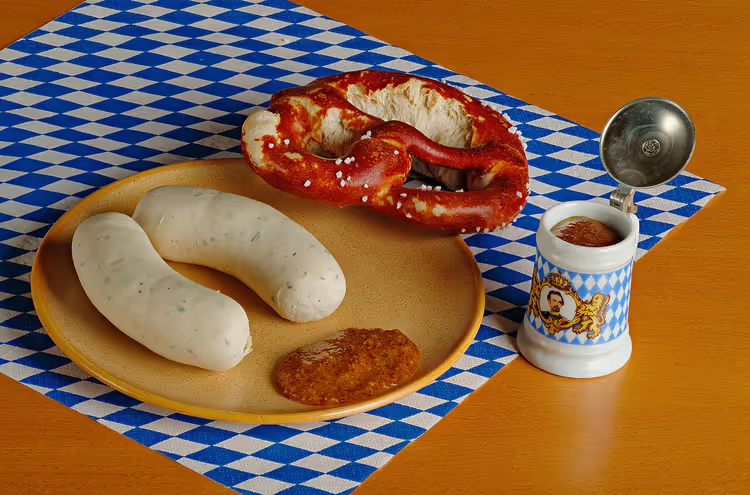
Beer in Germany is brewed under the Reinheitsgebot, the medieval purity law, and a large share of the country's breweries are concentrated in Bavaria. In Munich the beer halls belong on the program just as the museums do.
Wine has its own regions. In Franconia the main grape is Silvaner, which goes into dry white wines bottled in the flat Bocksbeutel. On the Moselle, alongside Riesling, autumn brings Federweißer, a young cloudy wine. At the Christmas markets mulled wine is poured into ceramic mugs against a deposit; in Nuremberg people buy Lebkuchen gingerbread, in Dresden stollen.
Two practical points: bakeries, markets and small cafés do not always take cards, so keep some cash on you; and you state the tip when you pay rather than leaving it on the table.
Our articles on this
Train, bus and rental car
Between the big cities the main transport is the ICE high speed train. From Berlin a direct train reaches Hamburg or Dresden in under two hours and Munich in about four. The ticket type sets the price: the fixed Sparpreis is bought in advance, the flexible Flexpreis costs noticeably more. The FlixBus coach is cheaper but slower: the trip from Berlin to Munich takes about eight hours.
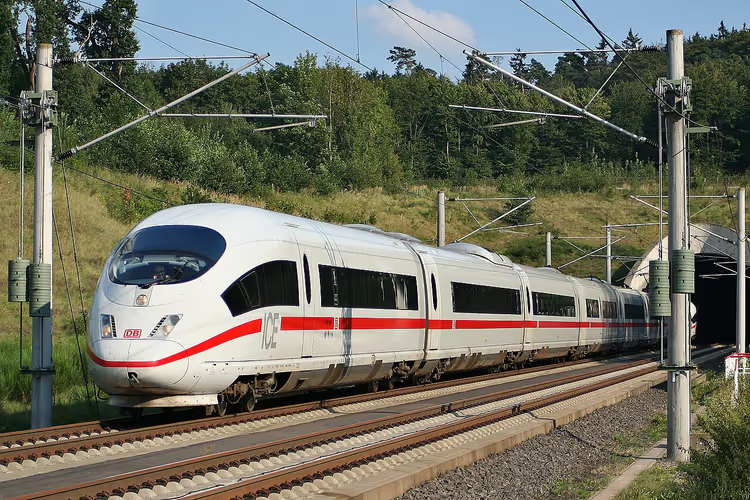
For regional travel there is the Deutschland-Ticket: it covers regional trains, buses and city transport, but it is not valid on the ICE. In Bavaria the Bayern-Ticket day pass is handy, valid on regional trains, the S-Bahn, the subway, trams and most buses. A transfer booked in advance is worth considering if you land at night, with children or with a lot of luggage.
A rental car pays off where the timetable thins out, for example on the rural stretches of the Romantic Road or in the Eifel. To rent you need a passport, a driver's license and a bank card in the driver's name. Big cities have low emission zones, the Umweltzone, where only cars with a green sticker are allowed, and there is almost no free parking in the centers: you leave the car at a Park&Ride and carry on by train.
| How you travel | Where it works | What to keep in mind |
|---|---|---|
| ICE high speed train | Between the big cities: from Berlin to Hamburg or Dresden in under two hours, to Munich in about four | The fixed Sparpreis is bought in advance, the flexible Flexpreis costs noticeably more |
| FlixBus coach | Between the big cities | Cheaper but slower: about eight hours from Berlin to Munich |
| Deutschland-Ticket | Regional trains, buses and city transport | Not valid on the ICE |
| Bayern-Ticket | In Bavaria: regional trains, the S-Bahn, the subway, trams and most buses | It is a day pass |
| Rental car | Where the timetable thins out: rural stretches of the Romantic Road, the Eifel | You need a passport, a driver's license and a bank card in the driver's name; big cities have the Umweltzone |
| Transfer booked in advance | The trip from the airport | Worth considering if you land at night, with children or with a lot of luggage |
Ad
Book a fixed price airport transfer in Germany
We earn a commission through this link; your price stays the same.
Our articles on this
- Car rental in Germany: how to remove the excess and save on parking
- How to get from Berlin to Hamburg: train, bus, car or bicycle
- The road from Berlin to Munich: what is cheaper and faster in 2026
- To Dresden from Berlin: train in 1 h 39 min and tickets from €9.99
- Night trains and direct routes: how to travel around Europe without flying
- From Prague to Berlin: four ways to get there and what is cheaper
Best time to go and weather
For cities, spring and autumn are the most comfortable, when the weather is mild. For most castles the best months are May and September: it is warm, but there are fewer groups. In Munich Oktoberfest sets a calendar of its own, running for sixteen days from the second half of September to early October: in those weeks free rooms in the center run out long before the trip.
Spring arrives unevenly. The southwest comes into bloom first, as early as March, the wild daffodils of the Eifel open in April, and in the Allgäu the snow melts later. The wine festivals in Franconia run from May to October.
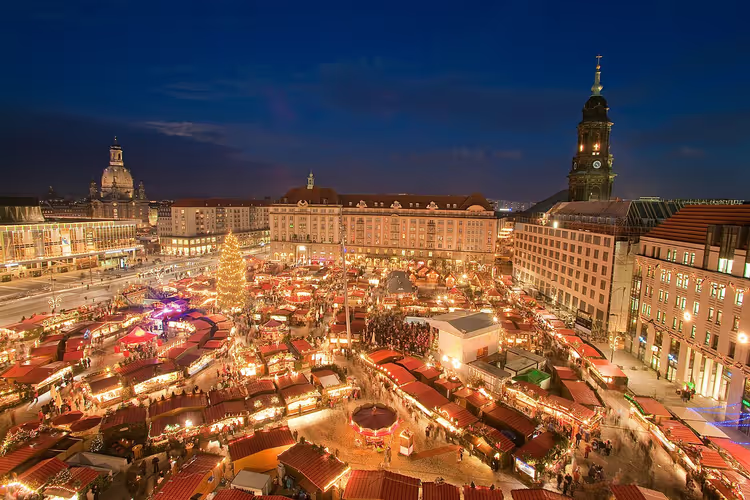
November is gray and damp, but it is low season: prices are lower and there are no lines at the museums. The Christmas markets open from the middle and end of November and run through all of Advent, many of them until December 24; Dresden's Striezelmarkt is considered the oldest. The ski season lasts from mid December to April in most areas, and the snow stays longest on the Zugspitze.
| Time of year | What is happening | What to keep in mind |
|---|---|---|
| March and April | The southwest comes into bloom in March, the wild daffodils of the Eifel open in April | Spring arrives unevenly: in the Allgäu the snow melts later |
| May and September | It is warm, but there are fewer groups | The best months for most castles |
| Second half of September and early October | Oktoberfest in Munich, sixteen days | Free rooms in the center run out long before the trip |
| November | Gray and damp, low season | Prices are lower and there are no lines at the museums |
| Advent | The Christmas markets open from the middle and end of November, and many run until December 24 | December weekends in Dresden, Nuremberg and Cologne sell out |
| Mid December to April | Ski season in most areas | The snow stays longest on the Zugspitze |
Twelve months compared: find the best time to go
Our articles on this
- Germany's Christmas markets: 9 cities and dates for 2026
- Dresden Christmas markets 2026: seven locations, dates and opening hours
- Thermal baths, fairs and parks: 6 ideas for a winter trip to Germany
- November in Germany: fog, silence and the first Christmas markets
- Oktoberfest 2026: dates, beer prices and rules for guests
- Munich by season: weather, crowds and prices without the gloss
- When to go to Berlin: weather, prices and events
- Calendar of Moselle wine festivals: what and when in 2026
- Ski areas in Germany: ten places with reliable snow
Budget: how to work out your own total
On a trip through several cities most of the money goes on transport and nights, and both items depend on the date: a train ticket is cheaper when you buy it early, and a hotel gets more expensive on public holidays and during markets and trade fairs.
Where saving really makes a difference: an early ticket at the fixed fare instead of the flexible one, a set lunch menu instead of dinner. A lot of what matters needs no ticket: in Cologne half of the main sights are free to enter, in Berlin half of the major landmarks can be seen without a ticket, and Christmas markets and hiking trails are free everywhere. If you take a car, count more than the daily rate: fuel, insurance and parking often come to more than the rental itself.
You work out your own total in the calculator. It separates accommodation, food, local transport, admissions, getting there and a reserve, so you can see which item is pushing the total up.
Calculate a travel budget for Germany
Our articles on this
Routes: one week, two weeks and scenic roads
The classic first loop is three hubs: Berlin, Munich with the castles of Bavaria, and Hamburg, and a week is enough for it. For two weeks there is a route that works by train and bus, with no car: Berlin, Magdeburg, Munich and Füssen with Neuschwanstein. Munich serves as the base for the trip into the Alps.
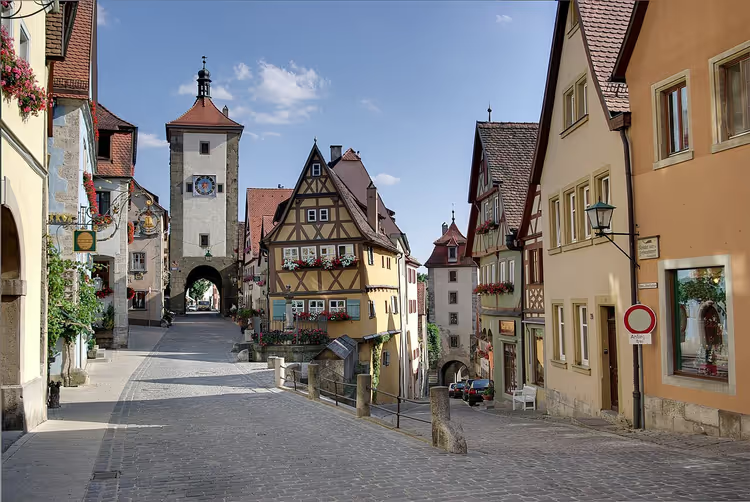
The Romantic Road runs from the north to the south of Bavaria, from Würzburg to Füssen: 460 kilometers and 29 towns. It is easier to allow several days for it, with overnight stops in Würzburg, Rothenburg and Füssen. Most of the route can be done without a car, on regional trains and buses.
For walkers there are routes through Saxon Switzerland, from an hour's stroll to a full day, and spring trails from the Eifel to the Allgäu. The same principle works in the cities: the center of Munich, Cologne, Dresden or Düsseldorf fits into one day on foot.
Day planner: check what fits into one day
Our articles on this
- Germany's romantic road: how to drive 460 km from Würzburg to Füssen
- Two weeks in Germany for two: Berlin, Magdeburg, Munich and castles route
- Spring hiking in Germany: 15 routes from the Eifel to the Allgäu
- Saxon Switzerland: 10 routes from 1 to 7 hours
- Munich in one day: route, museum opening hours and ticket prices
- Munich: old town, Hofbräuhaus and Oktoberfest in two days
- Hamburg in one day: 16 places you can actually fit in
- One day in Cologne: 15 places and a ready walking route
- Dresden in one day: 20 places you can walk to
- Dusseldorf in one day: 20 places from Schloss Benrath to Neanderthal Museum
- Berlin in three days: how to plan a trip and where to get tickets
- Berlin in two days: a walking route through the center with tickets and prices
- Berlin in one day on foot: 10 stops from Alexanderplatz to Ku'damm
Practical matters: rules, cash, connectivity
The main everyday surprise is Sunday. On Sundays and public holidays almost all shops are closed, and only gas stations and kiosks at train stations and airports stay open, so buy groceries on Saturday. Glass and plastic containers carry a deposit, the Pfand: you return the empty bottle to a machine in the supermarket and get the money back.
On public transport the rules are stricter than they look. Berlin has no ticket barriers, but a paper ticket is only valid once it has been stamped in the machine. If you are driving: the alcohol limit is 0.5 per mille, the phone is allowed only hands free, and in snow and ice the car has to be on winter tires.
Check the roaming terms for Germany with your own provider before the trip. An eSIM is a backup way to have internet from the first minute. Take out travel insurance before you leave and read what exactly it covers.
Build a packing list for the Germany trip
Ad
See eSIM options for Germany on Yesim
We earn a commission through this link; your price stays the same.
Ad
See travel insurance on World Nomads
We earn a commission through this link; your price stays the same.
Our articles on this