









Italy: the guide for planning it yourself
Italy is not one destination but twenty very different regions in one piece. Between the Dolomites and Sicily lie more than a thousand kilometers, several climate zones and cuisines that have little to do with each other. Anyone who tries to see half of that on a first visit spends the trip on trains. This page sorts the country for your own planning: what each region stands for, where you stay, how you move, when you go and what you calculate your costs with. Every section stays short and leads on to our detailed articles. Prices are not here: between low season and August they swing so hard in Italy that a fixed number would mislead you.
The regions and cities at a glance
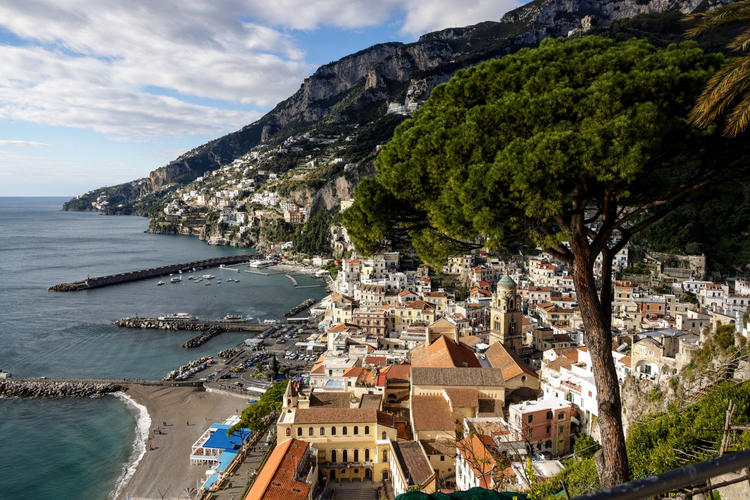
Four cities carry most first trips: Rome for antiquity, Florence for the Renaissance, Venice for the lagoon and Milan for fashion, design and the shortest routes north. Naples joins them when Vesuvius, Pompeii and the Amalfi Coast are in the plan.
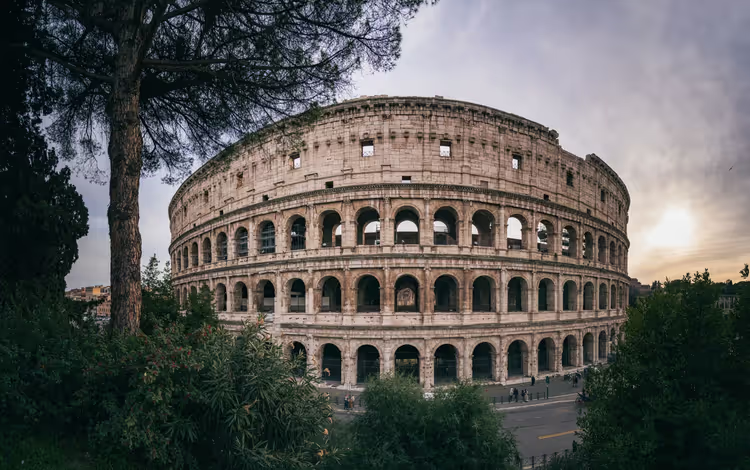
Beyond that, what is not on every list is worth the time: Bologna as a food city, Turin with its arcades, Genoa on the sea, Verona for the arena, the Cinque Terre on the cliff coast and Etna in Sicily. If you have already been to Italy three times, that is where the second layer of the country sits.
Italy is among the countries with the most UNESCO World Heritage sites in the world. In practice that means: even mid sized towns hold something that elsewhere would justify a trip of its own.
Our articles on this
- What to see in Rome: 35 places from the Colosseum to the Aventine keyhole
- 35 places to see in Venice: tickets, opening hours and a map
- What to see in Florence: 25 places and ticket prices 2026
- What to see in Milan: 30 places, route and tickets
- Naples: 18 main attractions and how to visit them
- Where to go in Sicily: 30 places worth seeing
- 25 Places in Turin: palaces, museums and two viewing platforms
- What to see in Bologna: 30 places with prices and hours
- What to see in Verona: 23 places from the Arena to the Scaliger Bridge
- Genoa travel guide: transport, hotels, focaccia and main attractions
- Cinque Terre: a guide to the five villages of Liguria and Vernazza
- Mount Etna: how to climb to the craters and what to see at the foot
Coast, islands and where to stay
For a beach holiday Italy splits into three parts: the Adriatic in the east with long, gently shelving sandy beaches and the densest hotel structure; the Tyrrhenian west with coves and rock; and the islands of Sardinia and Sicily, where beach and culture coincide.
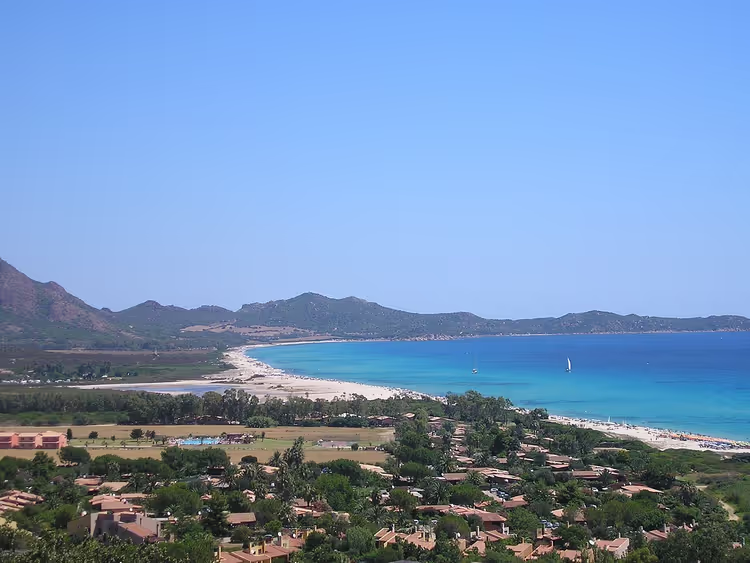
Sardinia stands for water and coastline, Sicily for coast plus antiquity plus volcano. Families with small children usually get on most easily on the Adriatic, because the water stays shallow a long way out and the towns are set up for kids.
For accommodation the same rule applies nationwide as in Rome: in the historic core you pay for location, outside it you pay in travel time. In coastal towns a second point comes in that photos never show: whether the beach in front of the hotel is freely accessible or divided into sections with sun loungers.
| Coast or island | The beach | Who it suits |
|---|---|---|
| Adriatic: Rimini, Lido di Jesolo | Long sandy beaches, shallow water and a gentle way in | Families with small children |
| Liguria: Genoa, Portofino | Rock and pebbles, small coves | Travelers who like views and mix the sea with walks |
| Amalfi, Positano and Capri | Mountain views; in Positano the water gets deep close to shore | Couples without kids; Capri and Amalfi cost the most |
| Puglia: Otranto, Gallipoli | Sand and turquoise water, shallow in Gallipoli | Families and anyone looking for quiet |
| Calabria: Scilla, Tropea | Sand and pebbles, deep water in Tropea | Anyone after quiet and sea views |
| Sardinia | White sand | Anyone after wild nature |
| Sicily: Mondello, Cefalù | Sand, shallow in Mondello; the sea stays warm longer | Anyone who wants to combine the sea with antiquity and a volcano |
Our articles on this
- 20 Resorts in Italy with sandy beaches: where it is shallow and where it is deep
- Where to go to the sea in Italy: 19 resorts from Liguria to Sicily
- 17 Best resorts in Sicily: where to swim, what to see and when to go
- Sardinia resorts: 20 destinations for sea, history and diving
- Where to go with children to the sea in Italy: 20 resorts and hotels
Hotels: what sets the price in Italy
Three factors move the price more than the star rating: season, distance to the water or to the historic core, and whether breakfast and air conditioning are included. In coastal towns the jump between June and August is bigger than the one between three and four stars.
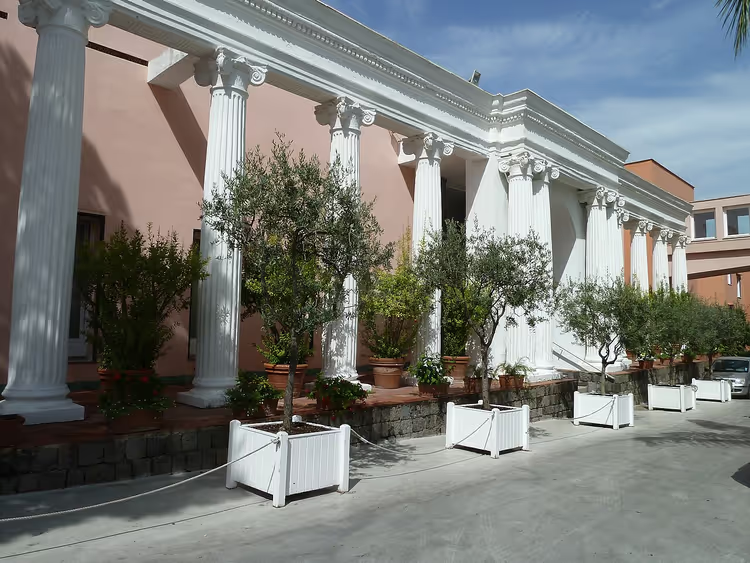
The tourist tax is charged on site almost everywhere in Italy, per person per night, and it is in no booking. With holiday apartments there is often a final cleaning fee on top that the displayed price does not include.
Ad
Compare places to stay in Italy on Trip.com
We earn a commission through this link; your price stays the same.
Our articles on this
- Hotels in Italy for holidays with children: 17 proven seaside options
- 15 Hotels in Italy: beach resorts by the sea and city options
- 15 Hotels in Italy with direct beach access
- Private beach at a hotel in Sardinia: 15 options for any budget
- Sardinia 5 star hotels: 15 addresses from the Emerald Coast to the south
Tours and skip the line tickets
For the Uffizi in Florence, the Vatican Museums in Rome, the Doge's Palace in Venice and the excavations at Pompeii, a timed ticket bought in advance is the only version that works reliably in summer.
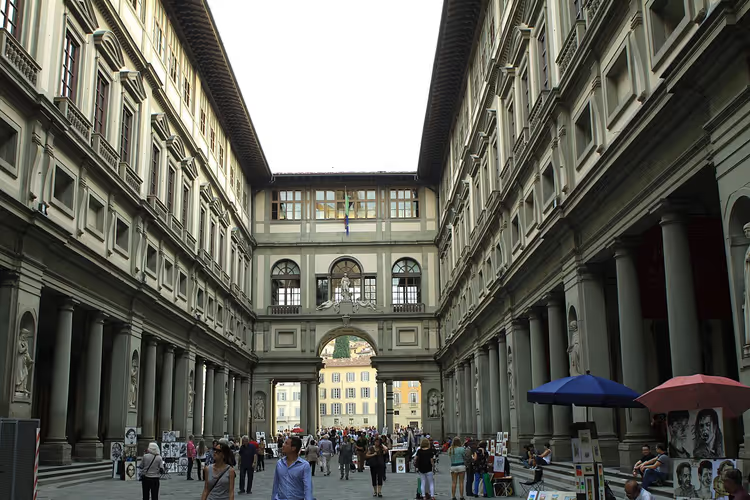
A guided tour pays off where without context only surface area remains: the Roman Forum, Pompeii, Etna. In museums with clear labelling and in churches you manage fine on your own.
| Sight | Ticket | Good to know |
|---|---|---|
| Uffizi Gallery, Florence | Book a timed slot in advance | Closed on Mondays; it is quieter in the first morning slot or after 4 p.m. |
| Accademia Gallery, Florence | Book a timed slot in advance | Closed on Mondays; in summer you wait more than an hour without a slot |
| Vatican Museums, Rome | Skip-the-line ticket, ideally for a morning slot | Closed on Sundays, except the last Sunday of the month |
| Colosseum, Rome | Buy a timed ticket a few days ahead | The same ticket covers the Roman Forum and the Palatine; tickets are issued in your name |
| Doge's Palace, Venice | Online ticket with a morning slot | Open every day; allow at least half a day |
| Pompeii | Buy tickets online: in high season slots sell out a day or two ahead | Go in the morning, there is almost no shade; tickets are issued in your name, so keep your ID handy |
| Pantheon, Rome | You can easily buy a ticket on the spot | The line is short; it is a working church, and entry is limited during Mass |
Ad
See guided tours and tickets for Italy on GetYourGuide
We earn a commission through this link; your price stays the same.
Ad
See museum and attraction tickets on Tiqets
We earn a commission through this link; your price stays the same.
Our articles on this
Food: regional, not Italian
There is no Italian cuisine, there are twenty regional ones. In the north butter, rice and polenta, in the middle olive oil and durum wheat pasta, in the south tomato, fish and citrus. Bologna, Rome and Naples stand for three kitchens that barely share a dish.
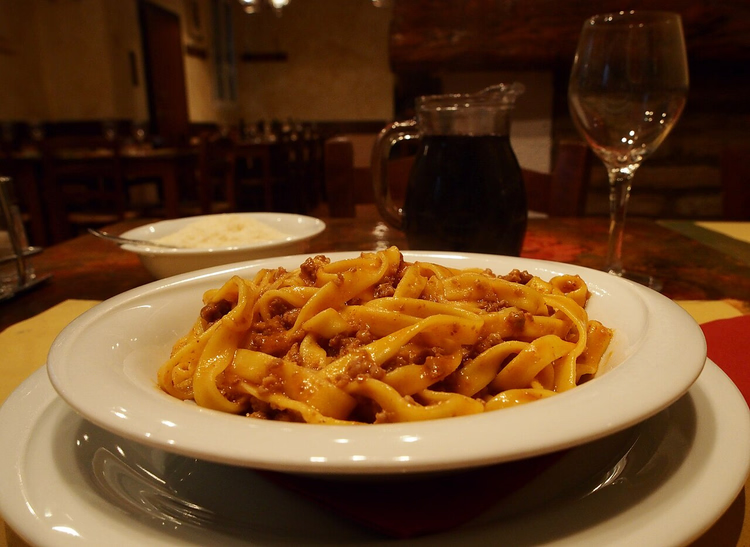
Two practical points: coffee is billed lower standing at the bar than at a table, and that is not a trick but price law. And the cover charge, the coperto, appears in many regions as its own line on the bill; it is not a service charge and not a tip.
Our articles on this
Trains, rental cars and the way in from the airport
Between Turin, Milan, Bologna, Florence, Rome, Naples and Salerno there are high speed trains, and on that axis the railway beats the car in almost every respect: it stops in the center, you need no parking space and no permit for the old town.
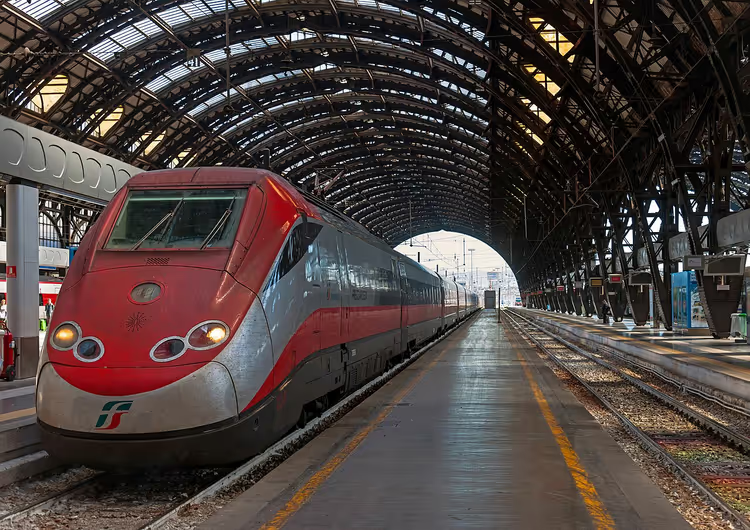
A rental car pays off where the railway thins out: Tuscany away from the cities, Puglia, Sardinia, the interior of Sicily. What matters there is the ZTL, the restricted traffic zone in almost every historic center. It is camera enforced, and the notices arrive months later via the rental company.
The big airports are Rome Fiumicino and Milan Malpensa, plus Bergamo, Linate, Venice, Naples, Catania and Palermo. Almost everywhere there is a train or airport bus into the center; a fixed price transfer pays off at night, with children or when the hotel is out of the way.
| Route | How to travel | Good to know |
|---|---|---|
| Between the big cities: Milan, Florence, Rome, Naples | Frecciarossa and Italo high speed trains | Rome to Milan takes about three hours, Florence and Naples about an hour and a half; tickets are cheaper a few weeks ahead |
| Across the country on a tight budget | Intercity trains, day and night | Slower than the high speed trains; night trains link north and south |
| Between neighboring towns and to the coast | Regionale trains | No seat reservations; not every train has air conditioning and Wi-Fi |
| From Fiumicino airport to central Rome | Leonardo Express train to Termini station | 32 minutes nonstop; the shuttle bus is cheaper but takes 50-60 minutes depending on traffic |
| From Malpensa airport to Milan | Malpensa Express train to Cadorna and Centrale stations | Less than an hour; the bus is cheaper and takes about 50 minutes |
| From Linate airport to Milan | Metro line M4 | About 12 minutes |
| Tuscany away from the cities, Puglia, Sardinia, the interior of Sicily | Rental car | Historic centers have a ZTL: cameras record every entry without a permit |
Ad
Book a fixed price airport transfer in Italy
We earn a commission through this link; your price stays the same.
Our articles on this
- Train in Italy: how much a ticket costs and when it beats a plane
- Car rental in Italy: how to book a car without fines and overpayments
- How to get from Milan airports to the city center
- From Malpensa airport to Milan: how much the train, bus and taxi cost
- From Fiumicino to central Rome: bus from 4 € and train in 32 minutes
- Italy by car: a 15-city route from Rome to Orvieto
Best time to go and weather
For cities May, June, September and October are the reliable months. July and August are hot, expensive and full, and in August restaurants and shops close in smaller towns because Italy itself is on holiday.
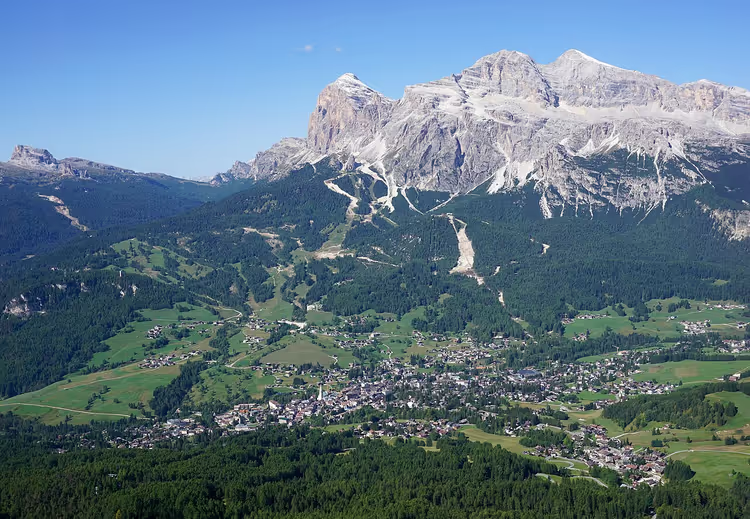
For the beach the season on the Adriatic and in the Tyrrhenian Sea is shorter than many think: before June and after mid September the water is too fresh for a lot of people. In the south and on the islands the window shifts later. For skiing in the Dolomites and for the thermal baths the calculation runs the other way.
| Period | Weather and crowds | Good for |
|---|---|---|
| April and May | Spring across the country, mild air; in the south May already feels like summer | Cities, the northern lakes, the start of the swimming season in the south |
| June | Early summer, warm and mostly stable; crowds are growing | The sea without peak heat and crowds, lakes, hiking |
| July and August | Hot, the biggest crowds; the peak is Ferragosto on August 15 | Swimming and hiking in the mountains; cities are best avoided |
| September and October | The sea is still warm, the heat eases, crowds thin out | Cities; swimming in September, and in the south in October too |
| December through March | Cold and snowy in the north, mild in the south; cities are at their quietest | Skiing in the Dolomites and the Alps, low-cost trips to southern cities |
Twelve months compared: find the best time to go
Our articles on this
Budget: how to work out your own total
Italy is not expensive or cheap across the board, it is both inside the same country. Between one base in Tuscany in August and the same trip at the end of September lie worlds, and the same goes for a room in the center of Venice against one on the mainland.
So there is no number here, there is the calculator. It separates accommodation, food, local transport, admissions, getting there and a reserve, and shows which item is driving your total.
Routes: first trip and repeat visit
The classic first round is the rail axis: Venice, Florence, Rome, with a day in Bologna in between. Ten days are enough for that without rushing, and you need no car.
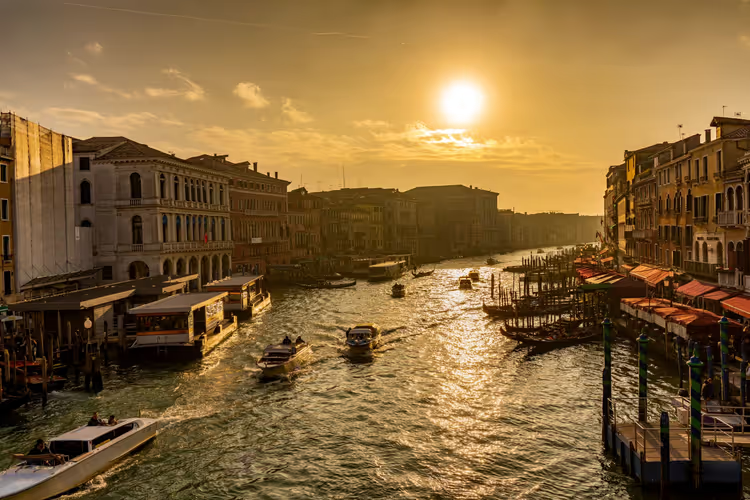
If you have already been, change the layer: northern Italy with Milan, Turin and the lakes; the south with Naples, the Amalfi Coast and Pompeii; or one island in one piece, Sicily or Sardinia, with a rental car and two or three bases instead of a daily move.
The rule most plans fail on: at most one change of base every two nights. Every move costs half a travel day with packing, station and check in.
Day planner: check what fits into one day
Our articles on this
- Rome in two days: a walking route from the Colosseum to the Vatican
- Florence in one day: Uffizi slot, tickets and queues
- Venice in two days: a day-by-day itinerary with prices and tickets
- Milan on foot in one day: 16 stops from the monumental cemetery to the Duomo
- Florence in 1 day on foot: route, ticket prices and map
- Venice in 4 days: tickets, time slots and a district plan
Practical matters: network, insurance, luggage
Italy is in the EU and in the euro area, and neither of those helps a US phone plan: American carriers do not include EU roaming, so an international day pass or an eSIM is the choice, and the eSIM is usually the cheaper one. UK plans differ since Brexit, some kept EU roaming inclusive and others charge a daily fee, so check your own tariff before you fly.
Churches have a dress code, and in the big cathedrals it is checked at the door. Many city centers have cameras for the ZTL, and Venice and some coastal towns have rules against sitting and eating in certain places; the fines are collected on the spot.
The EU health insurance card covers state basic care, and if you are insured in the US there is no equivalent for you. UK residents have the GHIC, which gets you state care but not repatriation and not a private clinic. That gap is exactly what travel insurance closes, which makes it a necessity here rather than an extra.
Build a packing list for the Italy trip
Ad
See eSIM options for Italy on Yesim
We earn a commission through this link; your price stays the same.
Ad
See travel insurance on World Nomads
We earn a commission through this link; your price stays the same.
Our articles on this