
















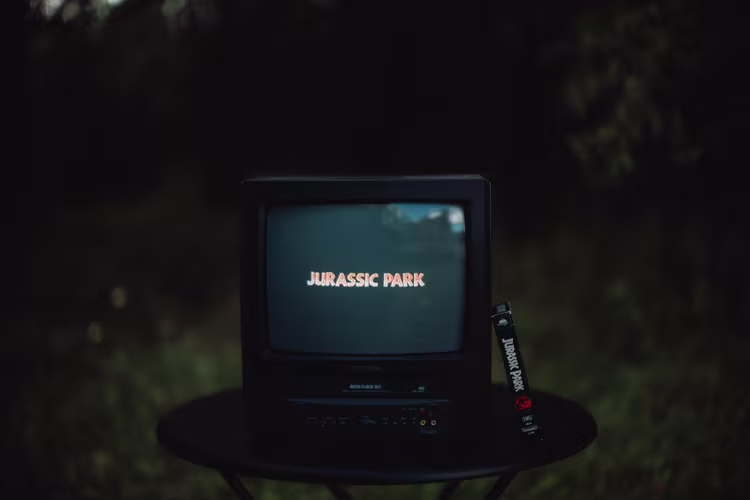
Classic films online on Vintage-Films.com: what to watch
Classic cinema is back in style. Old films are being digitized, restored, and rediscovered.
Under an EU directive, film copyright lasts 70 years after the death of the last author (as of 10/2026, EUR-Lex). After that, the picture can be watched legally and even for free.
Below, we cover genres, picture quality, and the criteria for choosing a classic film service. This will help you avoid overpaying and steer clear of pirated copies.
Why old cinema doesn't age
💡 In short:
- What to watch: noir, early comedies, silent films, early science fiction.
- What to look for: restoration quality, subtitles, and catalog legality.
- How you pay: usually a monthly or annual subscription, less often ad-supported viewing.
- Film copyright term in the EU: 10/2026, according to EUR-Lex.
Old cinema runs on story, not special effects. Golden age directors knew how to hold attention without graphics, and that skill is still taught in film schools today.
Many familiar techniques came from that era. The close-up, the play of light and shadow, music instead of words were all refined long before digital technology appeared.
You notice this when you watch an old detective film: the plot grips you more tightly than half of today's new series. And the short running time keeps the story from sagging.
Silent film only seems slow at first. After a few minutes, you adjust to the rhythm and start following the facial expressions and gestures.
What's in the Vintage-Films.com catalog
The Vintage-Films.com service collects classics across genres. The site's catalog is divided into sections, including noir and adventure. Here's what viewers typically look for there:
- noir: The Maltese Falcon, Double Indemnity;
- golden age romantic comedies: It Happened One Night, Roman Holiday;
- silent film: works by Chaplin, Keaton, and Murnau;
- early science fiction and adventure: Flash Gordon;
- musicals and melodramas with Judy Garland and Fred Astaire.
See the full list and subscription terms at Vintage-Films.com. Part of the catalog consists not of films but of old TV shows: that's convenient if you need a format shorter than a feature.
Films are grouped by genre and decade. That makes it possible to find a rare title even without knowing its name.
Restoration and stream quality
Many old copies reach viewers with scratches, film breaks, and audio noise. Restorers remove defects, clean up the track, and bring back color, but preserve the original grain.
In Germany, this work is done by the Murnau-Stiftung foundation: it preserves and restores the legacy of the Ufa, Universum-Film, and Bavaria studios (as of 10/2026). Such foundations bring silent films back into circulation that would otherwise remain only in archives.
The difference is immediately visible. On a good restoration, costume and set details stand out. On a bad copy, you get a blurry frame and audio that drops out.
Not every old film needs intervention. If a film was shot in soft light, light grain is part of the intent, not a defect.
Languages, subtitles, and the app
For a viewer in Germany, subtitles and a stable stream matter. The service claims an interface in several languages, including German, English, French, and Greek, and promises subtitles for most pictures (according to the service's website, checked 10/2026).
According to the service's description, it works on Smart TVs, iOS and Android devices, and computers.
Check the interface and subtitle language before paying. Not all services are equally strong in all languages.
You can open the classic film catalog from a phone, tablet, or TV.
What to look for when choosing a service
A good classic film service differs from a weak one in the details, not in the advertising. Compare several options using a simple table.
Criterion | What to look for | Why it matters |
|---|---|---|
Legality | agreements with rights holders | pirated copies are worse in quality and disappear |
Restoration | whether the copy source is stated | determines whether grain and scratches are visible |
Subtitles | list of languages and available tracks | a key point for a German viewer |
Devices | browser, Smart TV, iOS and Android apps | classics are usually watched on TV in the evening |
Price | monthly or annual, ads, cancellation terms | an annual plan is usually cheaper per month |
Catalog | depth across genres and decades | a narrow catalog gets boring within a couple of weeks |
Check two things before paying: the rights status for specific films and the availability of subtitles in your language. If the service doesn't state the source of its copies, clarify that in advance.
How to start watching classics
- Step 1. Make a list. Pick two or three genres you like so you don't get lost in a large catalog.
- Step 2. Check the copy. Watch one short film and evaluate the picture, sound, and subtitles on your screen.
- Step 3. Compare plans. A monthly subscription is better for trying things out, an annual one is usually cheaper; check the cancellation terms.
- Step 4. Set up your devices. Install the app on your phone or TV and sign in with your account.
An annual subscription only pays off if you watch regularly. If you watch classics only occasionally, start with a month and decide later.
⁉️🤔 Frequently asked questions
Watch classic films online legally?
A significant share of old classics is already in the public domain: the copyright term has expired, and such films are shown freely. Later pictures and new restorations are licensed from rights holders. Check on the service's website where the copy comes from and whether it has the rights to show it.
How do you know if a copy is good quality?
Look at the copy source and any mention of restoration. If the service references a film archive or laboratory, the chances of a clear picture are higher. If there's no word about quality, the frame is blurry, and the sound drops out, it's an old TV recording and not worth watching.
Why do you need subtitles in old films?
In silent films, subtitles are almost essential: the characters' lines are only visible in intertitles between scenes. In sound films, they help with noise and accents. For a viewer in Germany, German and English tracks are important.
Which device is more convenient for watching?
Classics are usually put on in the evening on a TV. An app on a phone or tablet is useful on the go and for short films. Check in advance whether the service works on your Smart TV or only in a browser.
How is old cinema different from modern cinema?
The pace is different: the story unfolds through dialogue and atmosphere, not graphics. That leads to dense scripts and strong acting. Many modern directors explicitly reference these films, so classics help you understand new cinema.
In short: how to choose a classic film service
Choosing a service comes down to three questions: is the catalog legal, is the restoration good, and are there subtitles in your language. Price matters, but it rarely justifies a bad copy.
If you have a TV and watch often, go for an annual plan with an app. If you're just trying it out, start with a monthly subscription. If you love silent film, look for a service with archival restorations, not just Hollywood classics.
Before paying, check the cancellation terms and subtitle availability. That will save you money and your evening.

A small editorial team writing guides for independent travel. We travel ourselves, but we haven’t been everywhere, so we check prices, opening hours and how to get there against official sources.