
















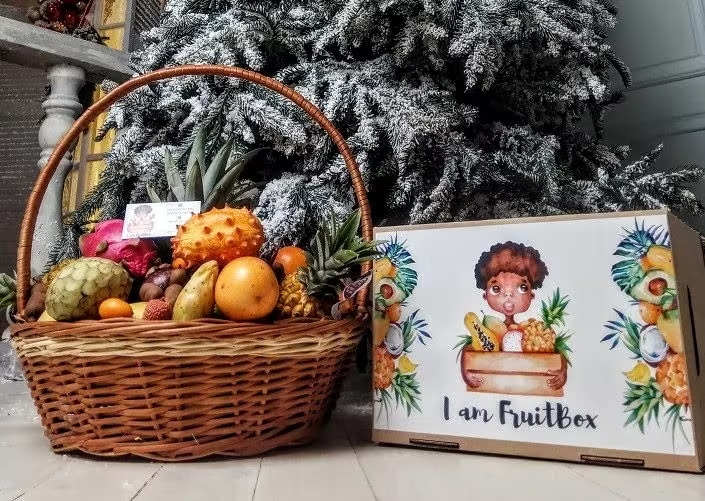
Issundschweig: how to choose a ripe exotic fruit and keep it fresh
Exotic fruit almost always travels a long way to reach you. Pineapple, mango, or dragon fruit spend a week in transit, so the quality on delivery depends on the supplier more than on the variety. In an ordinary supermarket it is hard to pick a ripe fruit: part of the batch arrives soft, and part is still green.
The main difficulty with ordering online is different. Some fruits ripen at home, while others need to be bought ready to eat. Mango, avocado, and papaya will keep ripening in your kitchen, but pineapple, lychee, and grapes cannot do that. Below we explain how to tell a ripe fruit, how to store different kinds, and what to check in the shop's terms.
What the Issundschweig shop is and who it suits
💡 In short:
- Ripen after purchase: mango, avocado, papaya, banana, fig, cherimoya.
- Do not ripen: pineapple, lychee, grapes, citrus fruits.
- Store the kinds separately, and put cut fruit in the fridge right away.
- Minimum order and delivery terms: 10/2026, according to the Issundschweig shop website.
The German online fruit shop Issundschweig sells exotic fruit, dried fruit, and ready-made fruit boxes from Neubrandenburg. The minimum order is 20 €, delivery costs 5.99 €, and from 45 € the shop delivers across Germany for free. You can pay by card, bank transfer, PayPal, or Klarna (as of 10/2026).
Orders ship from Monday to Thursday, so a parcel does not sit in the warehouse over the weekend. The company works with both private customers and businesses: larger boxes are put together for offices, and there is separate packaging for gifts. If you need a single product rather than a set, pick individual items from the catalog. The company sees its advantage in narrow specialization: it is easier to control the quality of a narrow range than a broad one.
Which exotic fruits ripen at home
Some fruits keep ripening after harvest: these include mango, papaya, avocado, banana, fig, and cherimoya. These fruits release ethylene, a gas that triggers softening and sugar build-up. If you bought a hard mango, leave it on the table and it will become ready on its own.
The opposite rule also applies: pineapple, lychee, grapes, and citrus fruits barely ripen after harvest, so they should be bought already ripe, otherwise they will start to spoil. A green skin does not always mean a fruit is unripe: in some varieties it stays green even when the fruit is ripe. Go by smell, firmness, and the integrity of the surface (according to food-monitor, 08/2026).
Apples and bananas also release ethylene, so green fruit ripens faster next to them. If you do not want to speed things up, put everything in separate containers.
Signs of ripeness by type
Each fruit's readiness is judged differently and there is no single rule for all of them, so look at the specific type.
- Cherimoya. The ripe skin gives slightly under pressure. The flesh is eaten with a spoon, and the black seeds are not chewed or blended into a smoothie.
- Dragon fruit. A ripe fruit is evenly colored and yields easily. The flesh with its tiny seeds is eaten raw.
- Guava. A ripe one smells strongly and gives slightly. The flesh and the small seeds are edible.
- Nashi. The Asian pear stays crisp even when ripe. The skin and flesh are eaten after washing.
- Mangosteen. The white flesh sits under a thick purple rind. The hard seeds are spat out.
- Yuzu. This citrus is taken for its juice and zest, and it barely ripens after harvest.
There is one general sign: the fruit smells, gives slightly, and has no dents. Soft spots, sticky juice, or a sour smell mean the fruit is overripe (according to food-monitor, 08/2026).
How to store exotic fruit
There is no universal temperature for all exotic fruit, so keep unripe bananas, mango, papaya, and avocado at room temperature, and they will ripen. Ripe fruits can be put in the cold for a short time, but some types suffer chilling injury as a result.
Put lychee and already cut fruit in the fridge right away, while uncut fruit keeps longer, so try to cut it just before eating (according to Verbraucherzentrale, 10/2026).
Before cutting, wash fruit under running water, even those with an inedible skin. That way dirt does not get into the flesh when you cut. Mold on a fruit means it can no longer be eaten.
Fruit boxes: for home, as a gift, and for the office
A ready-made box solves a simple problem: you get a set for several days and do not have to think about what else to buy. This format is built for three scenarios: a week's supply for a family, a gift, and corporate orders.
For a gift, the packaging matters, so companies offer separate gift boxes and space for a message. For an office, a different volume is calculated, so the box size is chosen to match the number of employees.
The seller decides what goes in the set, so if you want specific fruits, pick individual items from the catalog rather than a ready-made mix. That way you build a basket to your own taste.
Packaging, delivery, and returns
The freshness of exotic fruit depends on logistics, so the shop states that it delivers in insulated packaging and ships at the start of the week, so the fruit does not wait over the weekend.
Three points matter to you. First: the shelf life after delivery. Second: what to do with a damaged fruit. Third: the return terms if the parcel arrives spoiled. Return terms and the right to cancel an order are set out in the contract with the seller, so read them at checkout.
The company states that it uses recyclable packaging and CO2-neutral shipping across Germany. These promises can only be checked in practice, so treat them as the seller's claim.
⁉️🤔 Frequently asked questions
Which exotic fruits ripen at home?
Mango, papaya, avocado, banana, fig, and cherimoya. After harvest they release ethylene and keep ripening at room temperature, so a hard fruit will become ready on its own. Pineapple, lychee, grapes, and citrus fruits cannot do this, so they are bought already ripe.
How long does exotic fruit keep?
There is no single answer, as it depends on the type and the degree of ripeness. Unripe fruits ripen at room temperature in a few days. Keep lychee and cut fruit in the fridge. Soft spots, sticky juice, or a sour smell mean the fruit is overripe and should not be eaten.
How can you tell a mango is ripe?
Do not go by color alone. A ripe fruit smells sweet, gives slightly when pressed, and has no dents. Leave a hard mango at room temperature and it will ripen on its own. An apple or banana nearby can speed things up, since they release ethylene.
Can you eat the skin of exotic fruit?
It depends on the type. Nashi skin is edible after washing, and with guava and dragon fruit the flesh is eaten together with the tiny seeds. The purple rind of mangosteen is not eaten, and the black seeds of cherimoya must not be chewed or blended into a smoothie. Wash fruit under running water before cutting.
What should you check before ordering fruit online?
The minimum order amount, delivery cost and timing, the contents of the set, and the return rules. Return terms and the right to cancel an order are set out in the contract with the seller, so read them before paying. Also ask how the seller handles a damaged fruit in the parcel.
In short: how to choose an exotic fruit supplier
Look for three things: clear delivery times, insulated packaging, and open return terms. If you need a week's supply, take a ready-made box. If you need a specific fruit for a recipe, build a basket from individual items.
A ripe fruit will not arrive at your door by itself, so before paying, check the contents of the set and the size of the order against what you plan to eat. Also check separately what the seller does with a spoiled fruit from a parcel.

A small editorial team writing guides for independent travel. We travel ourselves, but we haven’t been everywhere, so we check prices, opening hours and how to get there against official sources.