



Monasteries and Vagankovo Cemetery: why we removed these guides
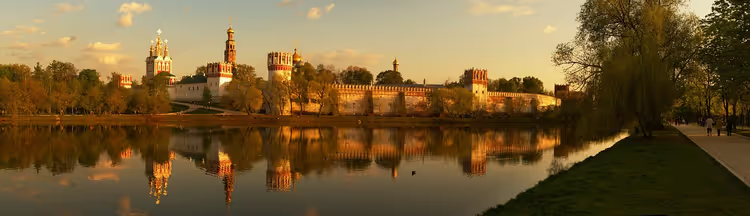
Four guides to this address are no longer available. They covered the Novodevichy, Donskoy, and Danilov Monasteries, as well as Vagankovo Cemetery with its famous graves.
A short answer for the reader who was looking for a route through the monasteries and the necropolis. All four texts sold the same thing: a trip to memory. We removed them because, in the country they invited people to visit, working with the memory of political repression is no longer legal, and a trip "to history" has turned into a trip to a very selective version of it.
💡 At a glance:
- which four guides were removed and where the old links now point
- what happened to the organization that worked on the memory of repression
- which criminal article punishes participation in the activities of "undesirable" organizations
- which cities with monastery ensembles and necropolises remain in our live sections
- Last updated: 09/2026
Why we deleted these guides
The four removed texts followed a standard structure: the founding of the monastery, the architectural ensemble, photographs, schedule, access route. The Vagankovo piece additionally offered a walking tour of famous people's graves. The old addresses in all language versions now have permanent redirects to this page.
Russia's full-scale invasion of Ukraine began on February 24, 2022. We believe that after that date, an editorial team based in the European Union cannot publish material that organizes a trip to that country, no matter how lofty the reason. A monastery or a necropolis is no different from a hotel in this sense: the text still works as an invitation to come and spend money.
The money point deserves precision, because the usual framing is wrong. The share of oil and gas revenue in Russia's federal budget fell to roughly 22 percent in 2025 and 2026, down from 42 percent in 2022 (OSW Centre for Eastern Studies, 09.12.2025). The inverse figure has become significant: the share of non-oil-and-gas revenue has grown to roughly 78 percent, and a visitor's spending on transport, lodging, and food lands exactly there.
Memory that is now a crime
A trip to memory assumes that there is someone in the country to preserve and study that memory. Here is what happened to that assumption.
In late December 2021, Russian courts shut down both structures of Memorial: the Supreme Court of the Russian Federation liquidated Memorial International, and the Moscow City Court liquidated the Memorial Human Rights Centre. The Council of Europe Commissioner for Human Rights called both decisions a severe blow to human rights protection in the country (Council of Europe, statement by the Commissioner for Human Rights). These were organizations founded in the final years of the Soviet Union that had spent decades documenting mass political repression of the Soviet period (UN Human Rights Office, 14.12.2021). In 2026, a Russian court went further and designated Memorial as "extremist," meaning that continuing this work became a criminal offense (RFE/RL). In between those decisions, in 2022, the same organization received the Nobel Peace Prize (Nobel Committee).
Persecution is not limited to "extremism" cases. A separate law on "undesirable organizations" has been in force since 2015, and under Article 284.1 of the Russian Criminal Code on participation in the activities of such an organization, at least 25 criminal cases have been opened and at least 37 guilty verdicts handed down (EU Agency for Asylum). As of April 2026, more than 343 organizations have been designated "undesirable," and the register of "foreign agents" includes more than 1,173 entities and individuals (Human Rights Watch, World Report 2026, Russia chapter).
Our previous texts about the monasteries and the necropolis mentioned none of this, and not because the authors were hiding anything. The genre simply does not include that kind of paragraph. That is exactly why we believe patching it makes no sense.
It is worth clarifying what this is and is not about. We are not claiming that services have stopped in these monasteries or that visitors are barred from entering. We are talking about the meaning of the trip that our texts themselves offered the reader: to come and touch the country's history. When research into one of the most painful parts of that history has been declared extremist activity, the promise to "touch history" becomes a promise to touch its permitted half. Selling such a trip under the old description would be dishonest, and rewriting the description while keeping the invitation would just mean changing the label.
Why we do not write about the buried
A separate note on the format used in the Vagankovo piece: a walking tour of famous people's graves with stories from their lives. We are not reproducing a single name or a single story here.
The reason is simple and has nothing to do with politics. A grave is a private story of a particular family, not an attraction, and we do not think it is right to turn a necropolis into a list of stops. There is a second reason, this one connected to our subject: in a country where working with memory has been declared extremist, publicly telling who is buried here and why is no longer a neutral act. We are not willing to decide for the reader which names would be appropriate in such a story, so we chose not to tell it at all.
What this means for you
Item | Status 09/2026 | Source |
|---|---|---|
Services related to tourism in Russia | Prohibited by Article 5n(2) of Regulation 833/2014 as amended by Regulation 2025/2033 of 23.10.2025 | |
Transition period | For contracts concluded before 24.10.2025, ended on 01.01.2026 | |
Tour guide services | Explicitly named among those covered by the ban | |
German Foreign Office advisory | "Vor Reisen in die Russische Föderation wird gewarnt" | |
Risk of arbitrary detention | The German Foreign Office warns of it for German citizens and dual nationals | |
Criminal risk of participating in "undesirable" activity | At least 25 cases and 37 convictions under Article 284.1 of the Russian Criminal Code |
Where to go instead
The need that brought readers to these texts was for active monastery complexes, quiet cloisters within city limits, and old city cemeteries you can walk through like a museum. The live sections of the site answer that need: Poland with Krakow and Czestochowa, Czechia with the monastery libraries of Prague, Greece with Meteora and Mount Athos, Italy with Assisi and Monte Cassino. For historic necropolises, our sections cover Paris, Vienna and Prague.
The overall explanation for the whole section is collected in the section hub. Related text: our position on the cathedrals and churches of central Moscow.
Where we stand
We believe that a journey to memory makes sense where memory is free. In our assessment, in a country where working with the memory of repressions has been declared extremist, a tourism text about cloisters and a necropolis offers the reader a heavily filtered version of the past. We decided to remove these four pieces and explain the reason at the same address.
We write about a state and its policies, not about people based on their passport. There are people in Russia who spoke out against the war and received prison sentences for it. Our decision not to publish guides to Russia is about money, sanctions and reader safety, not nationality.
Publication date: September 3, 2026. Last updated: September 3, 2026.
⁉️🤔 Frequently asked questions
A monastery is a religious place, what does the state have to do with it?
Our argument is not about religion. It is about the fact that we, as an EU-based publisher, are organizing a trip, and such services have been prohibited since late October 2025. And about the fact that working with historical memory in the destination country has been criminalized, and the trip "to history" was built precisely on that.
Are you making any claims about the church's position on the war?
No. We do not have verified primary sources on this topic that we could cite with a document and a date, and we are not claiming anything about it. Everything stated in the text refers to state decisions and is supported by links.
Why are there no names from Vagankovo Cemetery in the text?
Because we consider the "tour of celebrity graves" format inappropriate in itself, regardless of politics. A grave is a family's private story, not a stop on a route.
Where do the old links to these guides lead?
To this page, in all language versions. The reader gets an explanation, a list of sources, and a list of destinations we continue to write about.
In short
Four guides to Moscow monasteries and Vagankovo Cemetery have been deleted, and the old addresses redirect here. The organization that spent decades collecting data on victims of political repression was shut down by Russian courts in 2021 and designated "extremist" in 2026. Since late October 2025, services related to tourism in Russia have been prohibited for EU persons. Destinations with monastery ensembles are listed above.
How you can help
We are not raising money and receive nothing from the links below. These are official websites of organizations working with the consequences of the war:
- UNHCR, the UN Refugee Agency, unhcr.org
- UNICEF, unicef.org
- Ukrainian Red Cross, redcross.org.ua
Sources
- Council of Europe, statement by the Commissioner for Human Rights on the liquidation of Memorial organizations, 12.2021. https://www.coe.int/en/web/commissioner/-/the-liquidation-of-memorial-ngos-is-a-harsh-blow-to-human-rights-protection-in-russia
- UN Human Rights Office, statement by the Special Rapporteur on the liquidation of Memorial organizations, 14.12.2021. https://www.ohchr.org/en/press-releases/2022/01/russia-dissolution-human-rights-organisations-could-start-civil-society-shut
- RFE/RL, on Memorial being designated extremist and the Nobel Committee's reaction. https://www.rferl.org/a/nobel-memorial-extremist-russia/33728508.html
- Nobel Committee, 2022 Nobel Peace Prize. https://www.nobelprize.org/prizes/peace/2022/memorial/facts/
- European Union Agency for Asylum, on the application of Article 284.1 of the Russian Criminal Code. https://www.euaa.europa.eu/russian-federation-country-focus/22-legislation-undesirable-organisations-and-foreign-agents#221_undesirable_organisations
- Human Rights Watch, World Report 2026, Russia chapter. https://www.hrw.org/world-report/2026/country-chapters/russia
- Council Regulation (EU) 2025/2033 of 23.10.2025 amending Regulation 833/2014, EUR-Lex. https://eur-lex.europa.eu/legal-content/EN/TXT/?uri=OJ:L_202502033
- Skadden, analysis of the EU's 19th sanctions package, 11.2025. https://www.skadden.com/insights/publications/2025/11/eu-adopts-19th-sanctions-package
- Auswärtiges Amt, Russische Föderation: Reise- und Sicherheitshinweise, as of 02.09.2026. https://www.auswaertiges-amt.de/de/service/laender/russischefoederation-node/russischefoederationsicherheit-201536?isLocal=false&isPreview=false
- Centre for Eastern Studies OSW, Russia's 2026 budget, 09.12.2025. https://www.osw.waw.pl/en/publikacje/osw-commentary/2025-12-09/russias-2026-budget-mounting-financial-challenges-and-economic
Link check date: 03.09.2026.

A small editorial team writing guides for independent travel. We travel ourselves, but we haven’t been everywhere, so we check prices, opening hours and how to get there against official sources.