
















PVhurt.de: how to choose a wholesale supplier of solar components
A solar power plant starts not with the roof, but with purchasing components. The module, inverter, and mounting system arrive separately, and the supplier determines the project launch timeline.
A wholesaler covers the entire list with one order and handles the logistics. According to Bundesnetzagentur, in 2025 renewable sources in Germany added about 21 GW of capacity and reached nearly 210 GW in total. Warehouses sustain this pace, not individual storefronts.
Below we break down how to choose modules, inverters, and a supplier, and what to look for in the deal terms, using the PVhurt.de components store as an example.
How the solar components market works in Germany
💡 In short:
- A wholesale supplier assembles modules, inverters, storage units, and mounting hardware into one order.
- Choose a module based on efficiency and roof area, and an inverter based on system type and load.
- Check delivery terms, warehouse availability, and returns before paying.
- New and total capacity in Germany: 10/2026, according to Bundesnetzagentur.
The solar components market in Germany is growing fast, and in 2025 the country connected about 16 GW of new solar capacity, while total installed capacity exceeded 117 GW (as of: 2025, Bundesnetzagentur). This growth rests on three things: component availability, delivery speed, and predictable deal terms.
Technology does not stand still. The Fraunhofer ISE institute maintains a consolidated photovoltaics report and regularly records rising cell and module efficiency. Mass-produced rooftop products lag behind laboratory records, but it is the labs that set the direction.
Three conclusions for the buyer follow from this.
- Broad inventory. The module, inverter, storage unit, and mounting hardware come from different manufacturers, so having one supplier cover the full set matters.
- Written terms. Standards and warranties change, so what is written in the contract is worth more than verbal promises.
- High efficiency. The higher the module efficiency, the less area you need for your target capacity.
PVhurt.de: solar energy distributor
PVhurt.de is a solar energy distributor that operates as an online store for solar power plant components. The catalog covers modules from 400 to 800 W, grid-tied and hybrid inverters, energy storage units, mounting systems, and ready-made kits (as of: service catalog, 10/2026).
The product range is built around major manufacturers. The modules section features Longi, JA Solar, Jinko, Trina, Canadian Solar, Qcells, and Astronergy. Inverters come from Huawei, Growatt, Deye, FoxEss, Fronius, Sungrow, and Solaredge, and storage units from BYD, Pylontech, Dyness, and Huawei.
The company claims large warehouse stock, delivery across Germany, and German-language support, while the contract, returns, and warranty claims are described on a separate terms page. We present this information as a description of the service, not as an assessment: availability and prices change, so verify the final terms when ordering.
A retail store usually sells individual units and keeps a narrow menu. A wholesaler works differently: it assembles the entire project and gives you one invoice instead of five. For an installation company this saves days of coordination, and for a private buyer it reduces the number of suppliers in the project.
How to choose solar modules
The module determines how much energy the roof will collect, so the choice comes down to four parameters, each affecting the outcome in its own way.
- Efficiency. High efficiency delivers more power on the same area. For a small roof this is the deciding factor.
- Cell type. Monocrystalline modules are more efficient; polycrystalline ones are less common and cost less.
- Power output. Lower classes are enough for a private home; commercial properties call for higher classes.
- Power warranty. Service life is measured in decades; check the exact figures with the manufacturer.
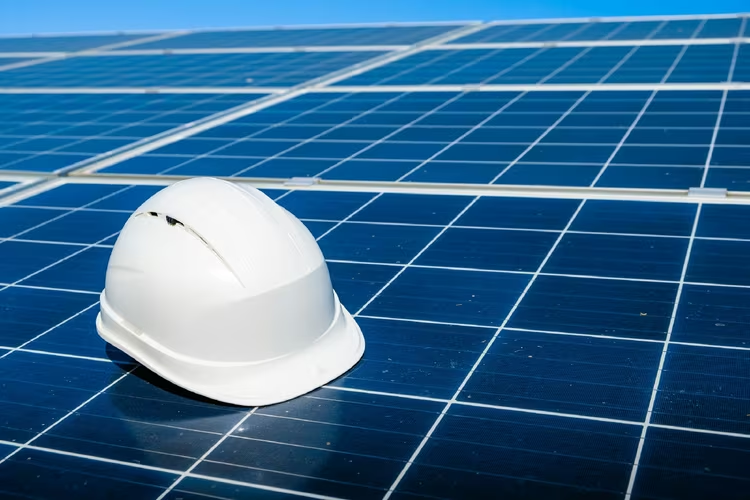
Bifacial modules collect light from both sides and deliver a gain on light-colored surfaces. A separate direction is half-cut cell modules, which lose less under partial shading.
Skimping on the module rarely pays off. The price difference between classes is small, while service life and shading losses depend on cell quality. A module with a mediocre warranty will need replacing sooner than you planned.
How to choose an inverter for a solar power plant
The inverter converts the modules' direct current into alternating current for the grid. It determines how the system performs at peak and during a power outage. Here is what matters.
- Power rating. The device is sized to the module capacity with headroom, so you do not lose output during peak hours.
- Type. Single-phase units go on small roofs; three-phase units on homes and commercial properties.
- Hybrid capability. A hybrid model works with a storage unit and powers the home during a grid outage.
- Reliability and service. Well-known manufacturers make it easier to get a replacement and warranty service.
Inverter type | Suitable for | Key feature |
|---|---|---|
Single-phase | Small private systems | Simpler and cheaper to install |
Three-phase | Homes and commercial properties | Even load across phases |
Hybrid | Systems with storage | Works during a grid outage |
For a project with storage, a hybrid inverter is cheaper than two separate devices. If you do not plan to add a battery, there is no point paying extra for a hybrid.
Monitoring has become the norm. Almost all modern models send data to an app, and you can see daily output. This helps you spot a drop in performance early and file a warranty claim.
Product range and brands in the catalog
A wholesaler's warehouse inventory is usually broader than a retail store's. This matters when a project cannot be delayed because of a single item. Below are the categories covered by the PVhurt.de catalog.
Manufacturer | Catalog category |
|---|---|
Longi | Modules |
JA Solar | Modules |
Jinko | Modules |
Canadian Solar | Modules |
Trina Solar | Modules |
Qcells | Modules |
Astronergy | Modules |
Huawei | Inverters, storage |
Growatt | Inverters, storage |
Deye | Inverters |
FoxEss | Inverters, storage |
Fronius | Inverters |
Sungrow | Inverters |
Solaredge | Inverters |
BYD | Storage |
Pylontech | Storage |
Dyness | Storage |
Different brands do not mean different quality. The same module class from different manufacturers is close in specifications, so warehouse availability and warranty terms decide, not the logo.
This lineup covers both a private home and a commercial roof. You will not have to source the module from one supplier, the inverter from another, and the mounting hardware from a third.
Wholesale purchasing: what an installation company expects
An installation company buys not a module, but timelines. The site sits idle until the last item arrives, so the supplier is judged on inventory and logistics.
- Warehouse availability. An in-stock item ships faster than a made-to-order one.
- Delivery times. The shorter they are, the less downtime on site.
- Completeness. One supplier for the module, inverter, and mounting hardware simplifies paperwork.
- Warranty flow. Returns and warranty claims should go through the same channel.
For a corporate client, document flow matters: the invoice, delivery note, and warranty certificate arrive without delays. At PVhurt.de the returns and warranty claims process is described on a separate page, which simplifies disputed cases.
Compare suppliers using the same specification. That way you see the difference in availability and timelines, not in how the offer is worded.
How to place an order and check the terms
Ordering from a wholesaler almost always goes through a request, not a "buy" button. The process is as follows.
- Put together a specification: capacity, number of modules, inverter type, mounting hardware.
- Request an invoice or quote and check that all items are in stock.
- Verify the terms: timelines, delivery, payment, returns, and warranty.
- Put the agreements in writing before paying.
The price in the invoice depends on volume and availability, so compare quotes on the same day. Warranty obligations rest with the manufacturer, while the supplier handles returns.
Check three lines in the contract: the goods transfer date, the returns procedure, and the service address. If even one line is vague, ask before paying, not after delivery.
⁉️🤔 Frequently asked questions
How does a wholesale supplier differ from a retail store?
A wholesaler works with warehouse stock and batches, so it covers the component list with one order. A retail store usually sells individual units and keeps a narrow menu. For an installation company, availability and timelines matter more; for a private buyer, unit price and delivery.
Can I buy components as a private individual?
Yes, some wholesalers also work with private buyers. According to the service, the PVhurt.de catalog is designed for both installation companies and private customers. The terms and minimum order amount differ for them, so clarify these before placing an order.
What should I choose, a standard inverter or a hybrid one?
A hybrid inverter is what you need if you plan to add storage or want backup power during a grid outage. Without a battery, the extra function does not pay off. For a simple roof, a grid-tied inverter of suitable capacity is enough; choose a hybrid for future expansion.
What should I look for in a module warranty?
Look at the power warranty, not just the product service life. It shows what share of the original output the manufacturer promises to retain after years of operation. The exact figures depend on the brand and series, so check them in the manufacturer's documentation.
Why is high module efficiency not for everyone?
Efficiency determines how much capacity fits on the roof. If you have plenty of space, you can take simpler modules and save money. On a small roof, high efficiency matters more than price, because there is simply no other way to get the capacity you need.
In short: how to choose a solar components supplier
The choice comes down to three checks: availability of the items you need, delivery times, and transparent warranty terms.
- If you are an installation company, look at inventory, timelines, and document flow.
- If you have a small roof, choose a high-efficiency module.
- If you plan to add storage, consider a hybrid inverter from the start.
- If the project is urgent, confirm availability before paying.
Before paying, check the specification and the return terms in the contract. It takes a few minutes and protects you from downtime on site.

A small editorial team writing guides for independent travel. We travel ourselves, but we haven’t been everywhere, so we check prices, opening hours and how to get there against official sources.