
















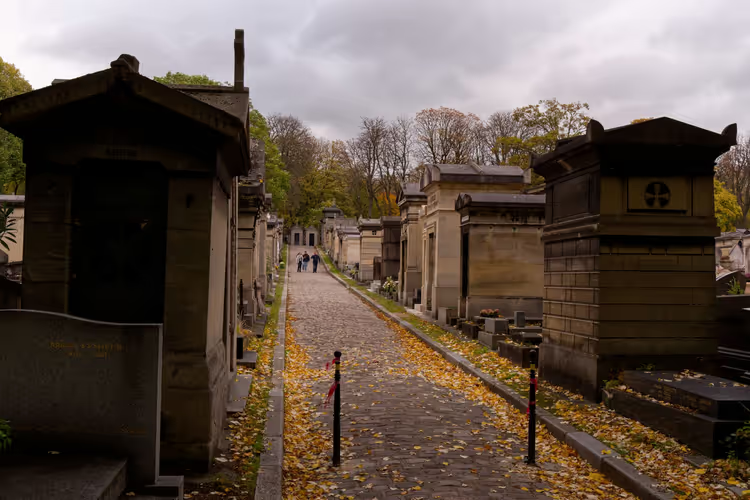
Who is buried at Pere Lachaise: main graves and opening hours
Every year, more than three million people visit Père Lachaise Cemetery (as of 09/2026, official website of the Paris mayor's office), which is more than some of the city's museums attract.
The cemetery in the east of the capital covers 44 hectares (Wikipedia: cemetery area, 09/2026), so without a plan you can easily spend an hour looking for a single grave.
We've put together the history of Père Lachaise, a list of notable burials, and practical information: how to get there, opening hours, and ticket prices.
Ad: this article contains affiliate links, we earn a commission if you book through them, at no extra cost to you.
How père Lachaise Cemetery came to be
💡 In short:
- Address: 16 rue du Repos, 20th arrondissement of Paris.
- Admission is free, the cemetery is open every day.
- Metro: Père Lachaise (lines 2 and 3) and Gambetta (line 3) stations.
- Prices and opening hours: 09/2026, verified on the cemetery page
In the 15th century, a wealthy merchant's palace stood on this hill, which later passed to the Jesuit order along with the surrounding lands (as of 09/2026, Wikipedia: article on Père Lachaise), and the first burials appeared here around that time.
The necropolis was named after François de la Chaise, who was the tutor and confessor of Louis XIV, and the king himself patronized the order; the Jesuits laid out a large garden on the hill, which became a favorite strolling spot for Parisians.
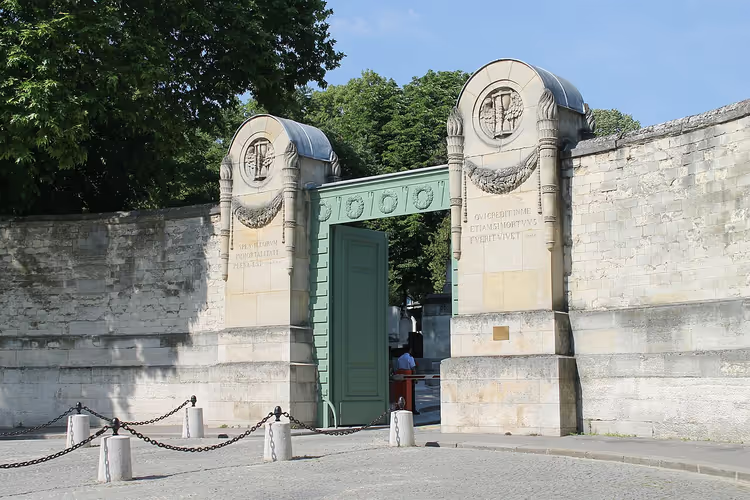 © Connie Ma from Chicago, United States of America · CC BY-SAPhoto: Connie Ma from Chicago, United States of America, CC BY-SA (https://creativecommons.org/licenses/by-sa/2.0), Wikimedia Commons
After the death of Louis XIV, the order fell into decline and its lands passed to the state, so the garden was redesigned and a chapel was built on the site of the residence.
The plot for the cemetery was allocated by order of Napoleon, and in 1804 the city bought this land for a large sum (Wikipedia: cemetery history, 09/2026); at the time the capital was smaller, and the dead had to be buried far from the center.
To attract Parisians, the remains of La Fontaine and Molière were moved here, and by the 1820s there were already around 33,000 graves. The cemetery expanded rapidly and within a few decades occupied the entire hill.
Today Père Lachaise remains the largest green space within Paris (Paris mayor's office data, 09/2026).
Who is buried at Père Lachaise
Officially it is the Eastern Cemetery, considered a museum of funerary sculpture (Wikipedia: list of burials, 09/2026). Writers, artists, composers, and aristocrats lie here.
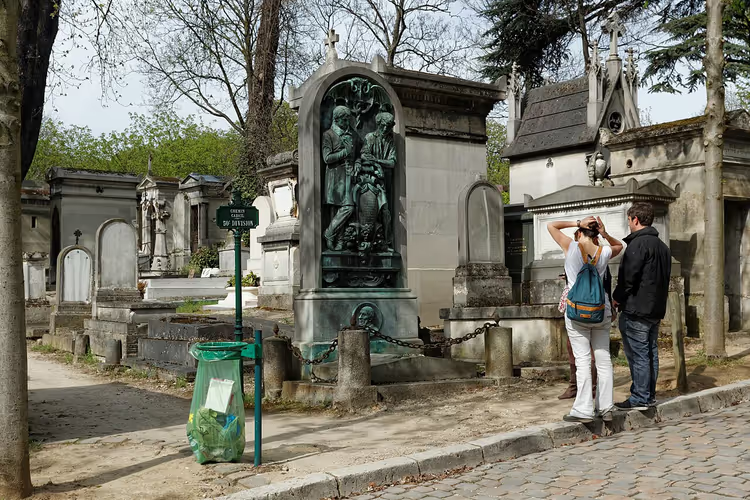 © Coyau · CC BY-SAPhoto: Coyau, CC BY-SA (https://creativecommons.org/licenses/by-sa/3.0), Wikimedia Commons
Many tombs are gradually falling into disrepair because there is no one to look after them: stained glass is broken and stone ornaments are chipped. Among the main sites, the Communards' Wall stands out, where 147 defenders of the Paris Commune were shot in May 1871 (Wikipedia: Communards' Wall, 09/2026). Nearby are memorials to concentration camp victims.
Heloise and Pierre Abelard
Pierre Abelard was a medieval philosopher, monk, and poet (Wikipedia: the story of Abelard and Heloise, 09/2026) who fell in love with his student Heloise, and they were secretly married. The girl's powerful guardian took revenge: Heloise was sent to a convent, and Abelard was castrated. They were reunited only after death, in a shared grave. Their correspondence has survived and for centuries served as an example of devotion.

Frederic Chopin
 © Yann Caradec from Paris, France · CC BY-SAPhoto: Yann Caradec from Paris, France, CC BY-SA (https://creativecommons.org/licenses/by-sa/2.0), Wikimedia Commons
The composer died in Paris in 1849 at the age of 39, but he asked that his heart be sent to his homeland (Wikipedia: Chopin's biography, 09/2026). And so it was done: Chopin's heart is sealed inside a church in Warsaw, while his grave at Pere Lachaise is crowned by a figure of the muse Euterpe. The funeral march from his second sonata is played at many civil funerals.
Theodore Gericault
The painter of "The Raft of the Medusa" lived only 32 years (Wikipedia: Gericault's biography, 09/2026). The painting's subject is based on the real shipwreck of a frigate in 1816, and today the painting hangs in the Louvre. The artist died in 1824 from injuries after falling from a horse, leaving new works unfinished.
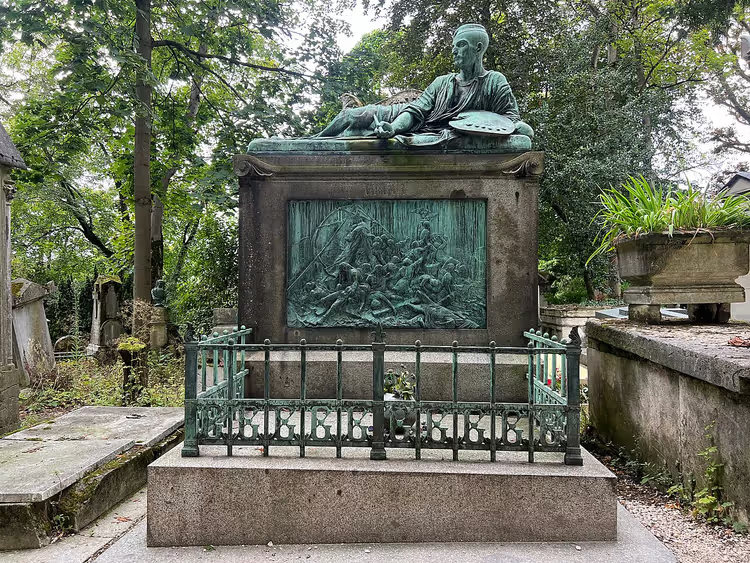 © Chabe01 · CC BY-SAPhoto: Chabe01, CC BY-SA (https://creativecommons.org/licenses/by-sa/4.0), Wikimedia Commons
Edith Piaf
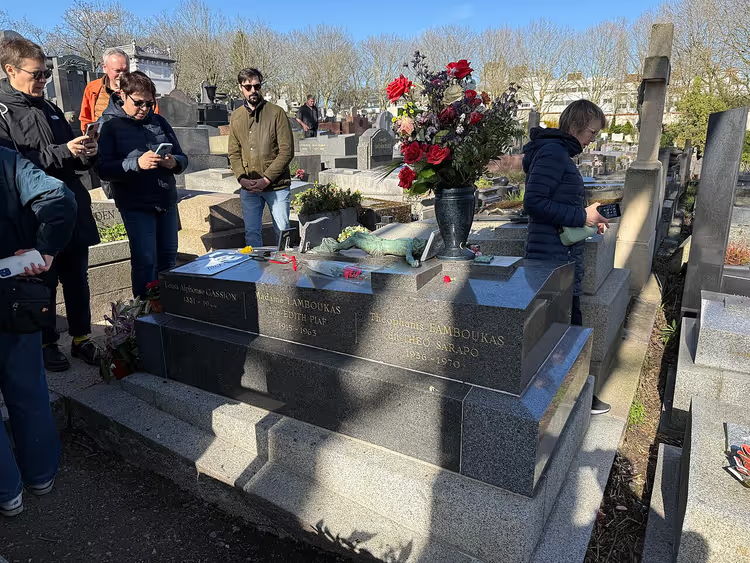 © Chabe01 · CC BY-SAPhoto: Chabe01, CC BY-SA (https://creativecommons.org/licenses/by-sa/4.0), Wikimedia Commons
The singer's grave is marked by a black slab with an Orthodox cross (Wikipedia: Piaf biography, 09/2026), and because of her small stature the French called her "the little sparrow." Piaf died in 1963, and more than 40,000 people came to say goodbye. Her husband, the Greek Théo Sarapo, is buried next to her.
Honoré de Balzac
The writer died in 1850, five months after marrying Ewelina Hańska (Wikipedia: Balzac biography, 09/2026). The cause was gangrene after he hit his leg on the edge of a bed, and he was only 51. His novels "La Comédie humaine" and "Le Père Goriot" brought him fame during his lifetime, and Victor Hugo delivered the eulogy at his funeral.
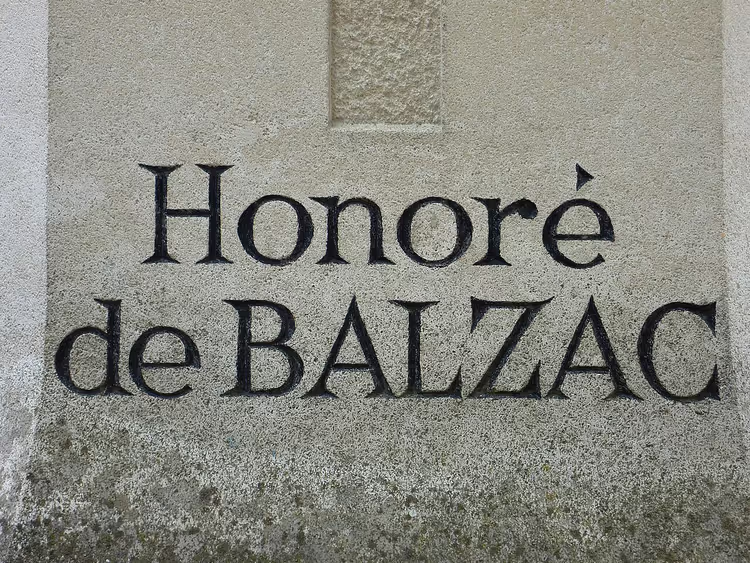 © Thomas Oboe Lee · CC BY-SAPhoto: Thomas Oboe Lee, CC BY-SA (https://creativecommons.org/licenses/by-sa/4.0), Wikimedia Commons
Yves Montand
The singer and actor died in 1991 of a heart attack right on set (Wikipedia: Montand biography, 09/2026), and he was buried next to his wife, actress Simone Signoret. At one point the grave was opened for a DNA test because a woman claimed to be Montand's illegitimate daughter, but the relationship was not confirmed.
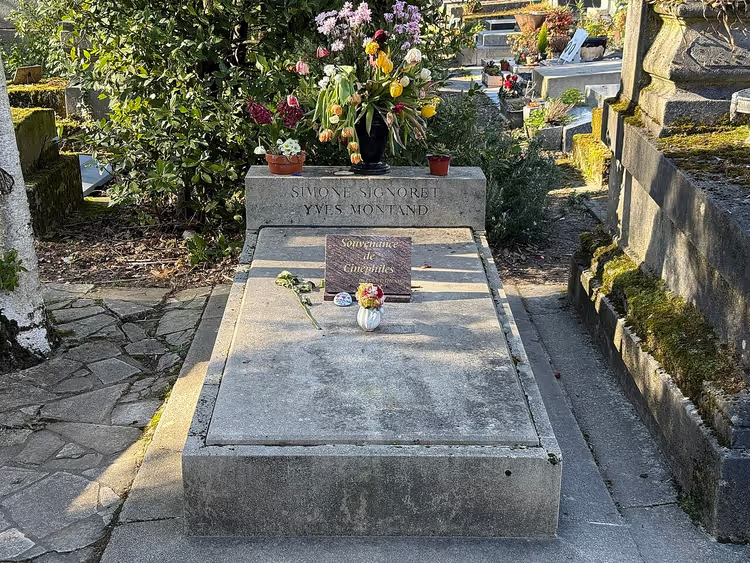 © Chabe01 · CC BY-SAPhoto: Chabe01, CC BY-SA (https://creativecommons.org/licenses/by-sa/4.0), Wikimedia Commons
Amedeo Modigliani
The artist came to Paris nearly penniless and died here in 1920 of meningitis at age 35 (Wikipedia: Modigliani biography, 09/2026), and his work was rarely bought during his lifetime. The next day, his pregnant wife Jeanne Hébuterne threw herself out of a window. She was later reburied next to Modigliani, and now the whole family lies in one grave.
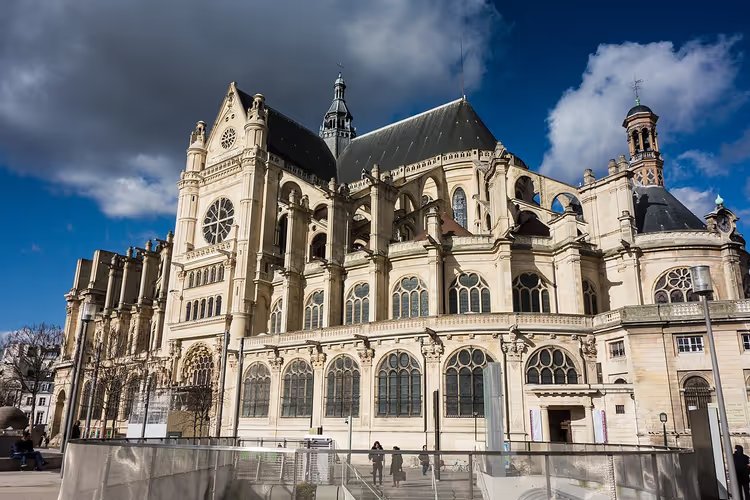 © Andrew H · CC BYPhoto: Andrew H, CC BY (https://creativecommons.org/licenses/by/2.0), Wikimedia Commons
Jim Morrison
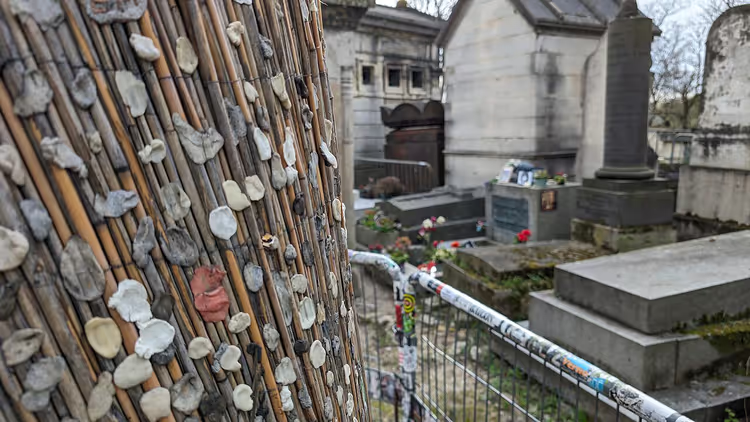
The lead singer of The Doors died in Paris in July 1971 at the age of 27 (Wikipedia: Morrison biography, 09/2026), but the cause of death was never established. Fans constantly covered the wall of the neighboring vault with lyrics from the song "Light My Fire." The grave is now fenced off.
Other notable graves
Besides the people covered in the sections above, Père Lachaise is also worth visiting for other famous graves (Wikipedia: Père Lachaise Cemetery, 09/2026):
- Molière and Jean de La Fontaine: their remains were ceremonially moved here in 1817 to draw Parisians' attention to the new cemetery.
- Writer Oscar Wilde.
- Marcel Proust, author of the cycle "In Search of Lost Time".
- Composer Georges Bizet, author of the opera "Carmen".
- Writer Gertrude Stein.
- Maria Callas: the columbarium has a niche with her name, but it is a cenotaph; the singer's ashes are not kept there.
Urban legends and superstitions
Père Lachaise is surrounded by superstitions (Wikipedia: the cemetery and its legends, 09/2026), and according to tradition, people ask for mutual love at the grave of Éléonore Duplay, who is linked to Robespierre. The inscription on the headstone is believed to help you find a partner.
Another legend leads to the statue of journalist Victor Noir, whose bronze figure lies on its back (Wikipedia: Victor Noir's grave, 09/2026). Women rub it to get pregnant or find love. Sculptor Jules Dalou gave the figure generous anatomy, and the ritual is known far beyond Paris.
People used to come to Oscar Wilde's grave to kiss the stone (Wikipedia: Oscar Wilde's grave, 09/2026), and lipstick covered the monument for decades. In 2011 the monument was enclosed in glass, so the tradition came to an end.
The cemetery is officially closed at night, but occultists still sneak in. According to legend, a black mass is held every night in the crypt of Princess Demidova, and another legend promises two million in gold to anyone who spends a whole year in that crypt and sees the princess's ghost.
Where it is and how to get there
The cemetery occupies the eastern part of Paris's 20th arrondissement, between rue du Repos and boulevard de Ménilmontant (city hall directory, 09/2026). The main entrance is on boulevard de Ménilmontant.
The easiest way to get there is by metro: Père Lachaise station serves lines 2 and 3, and buses 61, 69, and 71 stop nearby (RATP, 09/2026). From Gambetta station (line 3) you enter near the crematorium, while the two side entrances, Amandiers and Réunion, involve stairs and are not suitable for people with reduced mobility (Paris city hall website: entrance information, 09/2026).
Opening hours vary by season.
Period | Weekdays | Saturday | Sunday |
|---|---|---|---|
16.03-05.11 | 8:00-18:00 | 8:30-18:00 | 9:00-18:00 |
06.11-15.03 | 8:00-17:30 | 8:30-17:30 | 9:00-17:30 |
As of 09/2026, schedule on the Paris website. Visitors are asked to leave 15 minutes before closing, so don't put off your exit until the last hour.
Tours and tickets in Paris
Guided tours, skip-the-line tickets and activities — most offers can be cancelled free of charge.
See offers on GetYourGuideThe widget loads once you give your consent.
Père Lachaise Cemetery on the map
It's best to save the location on your phone in advance, since the paper maps at the entrance quickly get lost among the paths.
Signs to famous graves branch out from the entrance, but navigation is still confusing, so leave yourself extra time so you don't end up rushing to find the exit.
⁉️🤔 Frequently asked questions
How much does it cost to enter Père Lachaise?
Entry is free for everyone (Paris city hall website: visitor information, 09/2026), and you only need to pay for a guided tour if you decide to book one. The cemetery is open every day, including holidays.
How do you get to Père Lachaise by metro?
The easiest way is via Père Lachaise station (lines 2 and 3) and Gambetta station (line 3). From the metro exit to the main gates it's a 5-10 minute walk.
How much time do you need to see the cemetery?
Allow at least half a day for the famous graves, and preferably a full day (Wikipedia: data on the cemetery's size, 09/2026). The distances between graves are large, so grab a map at the entrance.
Where is Jim Morrison's grave?
The Doors vocalist's grave is in section 6 of the cemetery (Wikipedia: Morrison's grave, 09/2026). It is fenced off, so fans can no longer write on the neighboring wall; look for signs from the main entrance.
When is the best time to visit Père Lachaise?
Come at opening time, 8:00 on weekdays (opening hours on the Paris website, 09/2026). There are fewer groups in the morning and softer light for photos, while in summer tours gather at the famous graves in the afternoon.
Are there restrooms at the cemetery?
Yes, there are three public restrooms on the grounds (Paris city hall website: city services data, 09/2026), located at the main entrance, at the porte du Repos, and at the porte Gambetta. The locations are marked on the map at the entrance.
In short: what to book
If you want to hear stories about Chopin, Piaf, and Morrison, book a group tour in advance. For a self-guided visit, save the location on your map and come at opening time: that way you can reach the main graves before the crowds.

A small editorial team writing guides for independent travel. We travel ourselves, but we haven’t been everywhere, so we check prices, opening hours and how to get there against official sources.