













Glacier Express 2026: tickets, prices and seat reservation
In eight hours, the train crosses 291 bridges and 91 tunnels (as of 09/2026, official route). This is not a fast transfer, but a full Alpine journey.
The Glacier Express connects Zermatt and St. Moritz. You pass snow-capped peaks, vineyard terraces, rocky gorges, and old castles. Outside the window, three cantons roll by: Valais, Uri, and Graubünden.
Below, we break down how much a ticket costs, when bookings open, how to save money, and what to do if seats are sold out. We checked prices and the season on the carrier's official website in September 2026.
Ad: this article contains affiliate links, we earn a commission if you book through them, at no extra cost to you.
Glacier Express: a panoramic train through the Alps
💡 In short:
- Route: Zermatt to St. Moritz, eight hours, 291 bridges and 91 tunnels.
- A second-class ticket costs up to 159 CHF, and the mandatory seat reservation adds 54 CHF (as of 09/2026, carrier fares).
- The train does not run from October 11 to December 4, 2026.
- Prices, season, and bookings: 09/2026, verified on the carrier's website.
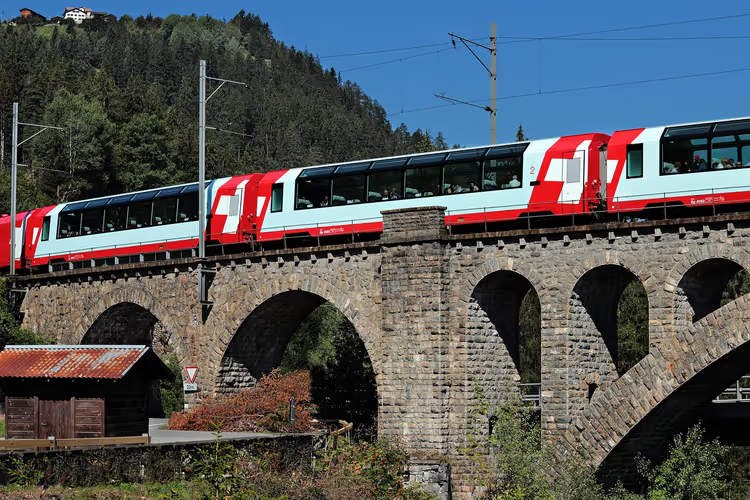
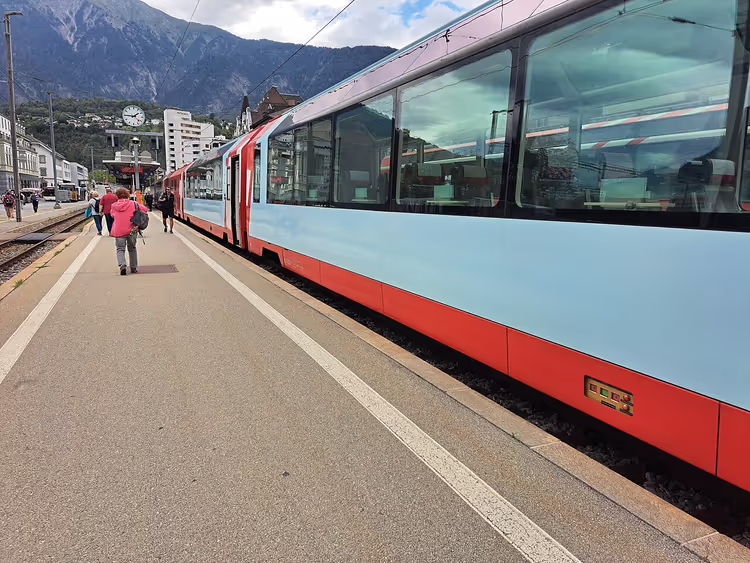
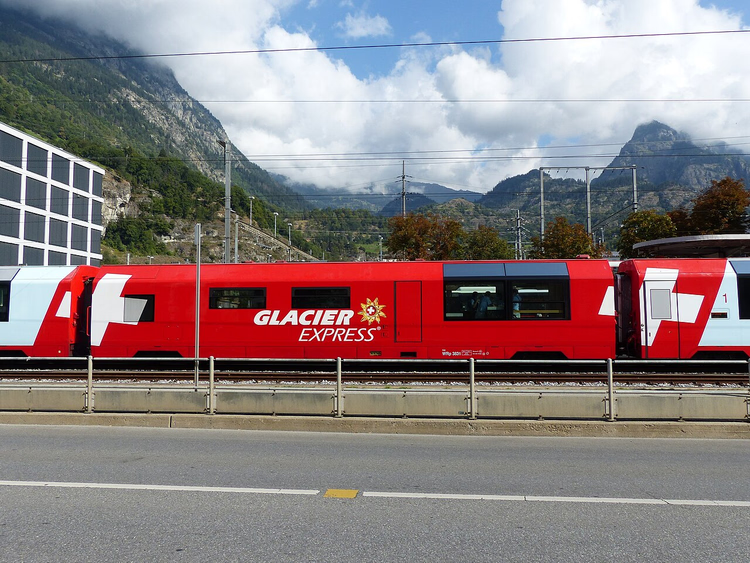
The Glacier Express is known as the panoramic train between Zermatt and St. Moritz. It runs for eight hours and is considered the slowest express train in the world (as of 09/2026, route map). Cars with glass roofs give you a wide view of the mountains, and that is the main reason tourists from all over the world take this trip.
This is not transportation, it is a genuine attraction. You sit at a table, listen to the audio guide, and watch the peaks outside while a server brings food and drinks right to your seat.
The train has three service classes, and they differ noticeably. In second class there are four seats per row, in first class there are three, so you get more space. Excellence Class offers separate seating and a five-course menu included in the reservation (as of 09/2026, Glacier Express price list).
 © Bybbisch94 · CC BYPhoto: Bybbisch94, CC BY (https://creativecommons.org/licenses/by/4.0), Wikimedia Commons
Route from Zermatt to St. Moritz: what you will see
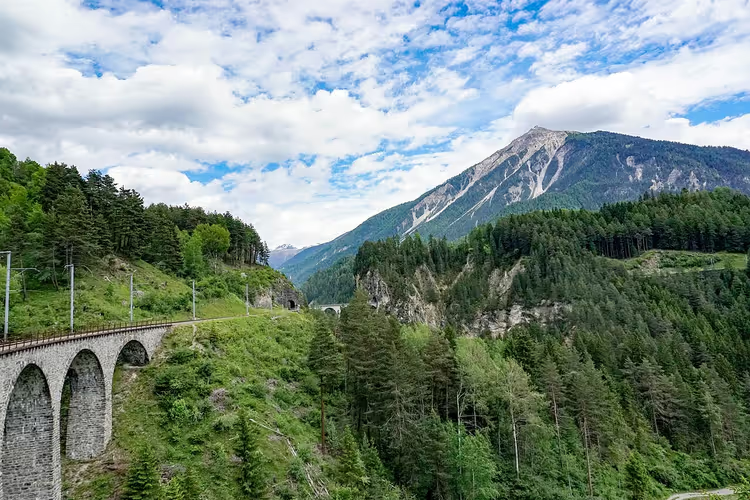
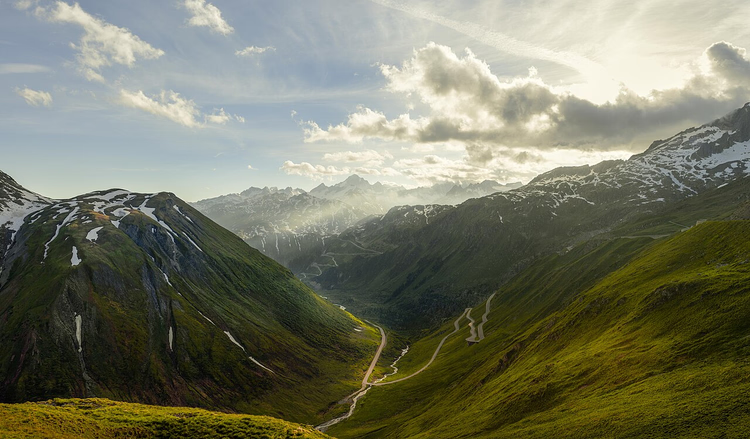
The train passes through three cantons, and each section looks different. Valais greets you with vineyard terraces, Uri shows rugged cliffs, and Graubünden delights with green valleys. The route links two ski resorts, Zermatt and St. Moritz, which attract many affluent visitors in winter.
You can board at any station. The full list of Glacier Express stops is: Zermatt, Brig, Andermatt, Disentis, Chur, Tiefencastel, Filisur, Samedan, and St. Moritz. At each one you can get off and continue on another day.
 © Rainer Halama · CC BY-SAPhoto: Rainer Halama, CC BY-SA (https://creativecommons.org/licenses/by-sa/4.0), Wikimedia Commons
If you ride the whole route, you will spend eight hours on the train. The landscape changes every half hour, so you will not get bored.
The strongest impression comes from the Rhine Gorge, which is called the Swiss Grand Canyon because of its white cliffs and turquoise water. Further on, the train passes castles and old towns, and the view from the window keeps changing.
The final stretch from Chur to St. Moritz crosses the Landwasser Viaduct. Panoramic windows are fitted in all cars, so the views are equally good from both first and second class.
Some passengers continue on the Bernina Express. That train carries on from St. Moritz and shows different Alpine scenery, so the two routes pair well if you have the time.
For exact segments, see the route map.
Riding only part of the route
You don't have to take the full route. You can ride just one leg and get off at any stop, and this option works well if you're already in Switzerland and don't want to spend the whole day.
The most popular partial section runs from Chur to Zermatt. It includes the most scenic views, and the section from St. Moritz to Brig also shows a lot.
The fare is calculated by section, not by the entire route. For example, the leg from Brig to Zermatt costs 40 CHF in 2nd class (as of 09/2026, pricing page). The seat reservation fee of 54 CHF is paid regardless, so a short leg doesn't save as much as it seems.
Keep in mind that a short ticket doesn't give you the right to the entire route. If you want to travel farther than what's on your ticket, pay the difference before departure.
Schedule and operating season in 2026
The Glacier Express runs almost year-round, but with a long maintenance break. In 2026, the train is out of service from October 11 to December 4 (as of 09/2026, train schedule).
The schedule is divided into two seasons, and the winter timetable usually runs from early December to early May (as of 09/2026, seasonal schedule). In summer, additional departures are added, and in each direction there's at least one train per day in winter.
In high season there are more trains than in the shoulder season, but the exact number of departures changes every year. Check it on the website before your trip, because the timetable is updated every season.
 © Bybbisch94 · CC BYPhoto: Bybbisch94, CC BY (https://creativecommons.org/licenses/by/4.0), Wikimedia Commons
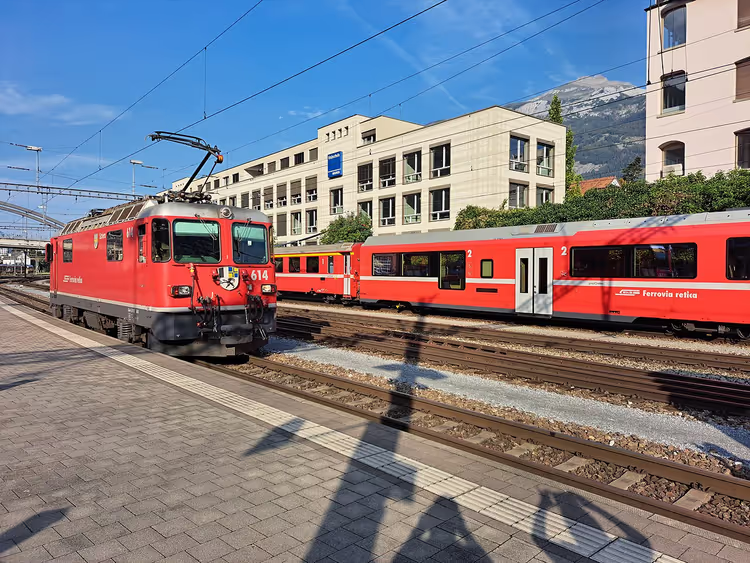
Regional trains on the same route run year-round. If your dates fall during the break, you'll travel through the same valleys and gorges, just with transfers and without the panoramic car.
Take early departures if you want fewer people in the car, because morning trains are usually less crowded than afternoon ones. Check the schedule again a couple of weeks before departure, since maintenance work sometimes shifts departure times.
How much the trip costs: ticket and reservation
The Glacier Express price consists of two parts, and this often causes confusion. You pay for the ticket and, mandatorily, for the seat reservation, and the reservation is required for all passengers and costs 54 CHF in 1st and 2nd class (as of 09/2026, official fares).
The ticket depends on the distance and class. Neither the ticket nor the seat reservation changes by season: the seat costs 54 CHF year-round (as of 09/2026, Glacier Express fares).
Section | 2nd class | 1st class |
|---|---|---|
Zermatt to St. Moritz (full route) | 159 CHF | 272 CHF |
Chur to Zermatt | 124 CHF | 212 CHF |
St. Moritz to Brig | 119 CHF | 204 CHF |
Andermatt to Zermatt | 77 CHF | 131 CHF |
Brig to Zermatt | 40 CHF | 68 CHF |
As of 09/2026, fare costs.
The full route in 2nd class costs 213 CHF including the reservation (as of 09/2026, full route cost), meaning 159 CHF for the ticket and 54 CHF for the seat. In 1st class, the ticket can cost up to 272 CHF, so the total is noticeably higher.
Excellence Class will cost the most. The reservation there costs 540 CHF and requires a 1st class ticket (as of 09/2026, carrier rates), and in return you get a five-course menu and dedicated seats.
Glacier Express accepts almost all Swiss and European rail passes. The list is long: Swiss Travel Pass, Eurail Pass, Interrail Pass, Half Fare Travelcard, GA travel card, Saver Day Pass, Swiss Family Card and Swiss Transfer Ticket (as of 09/2026, price table). With these, you only pay the seat reservation.
The 54 CHF seat reservation is not included in any pass. You buy it separately for each passenger, including children, and it is not covered by the card.
For groups of 10 or more, reservations are made separately and in advance. The operator tries to seat the group in one car and asks you to notify them about the trip in advance.
Children under 6 travel free, and from 6 to 16 there is a 50% discount (as of 09/2026, ticket prices). With a Junior Travelcard, children under 16 travel free with a parent, but you still pay the seat reservation for the child.
Food deserves a separate mention, because people often assume it is included in the price. In 1st and 2nd class, meals and drinks are ordered in advance and paid for separately.
Compare the two approaches for your route. If you are traveling around Switzerland for a week and taking trains every day, the pass pays for itself by the third trip, but if you only need Glacier Express once, it is cheaper to buy a regular ticket and reserve a seat.
Book your ticket in advance, because the base ticket price does not change, but window seats disappear first. Early booking does not give you a discount, but it guarantees you a good seat by the glass.
How to buy Glacier Express tickets
Tickets and reservations are sold on the carrier's official website. You can buy a ticket 180 days before the trip, but reserve a seat in 1st and 2nd class only 93 days in advance (as of 09/2026, official price list). In high season, seats sell out quickly, so don't wait and buy as soon as you can.
Keep the difference in timing in mind, because it often gets in the way of plans. Tickets open 180 days ahead, while seat reservations open 93 days ahead, so if you're booking early, buy the ticket first and then the seat.
Below is a step-by-step guide to buying on the website, and it takes just a few minutes.
Step 1. Open the shop
Go to the carrier's shop and click "Book now". First choose your travel class, then move on to selecting the route and date.
Step 2. Enter the stations and date
In the dropdown menus, select your departure station, arrival station, and travel date, then click "Find a connection". The system will show available departures for the selected day.
Step 3. Choose your departure
The screen will show departures with times for the selected date and nearby days. Pick the option that works for you and click the ticket purchase button.
Step 4. Choose your seat
A carriage map with available seats will open. Select a window seat if one is still available and confirm your choice so the system saves your seat.
Step 5. Order food
At this step you can pre-order dishes from the menu. In 1st and 2nd class, food costs extra, while in Excellence Class the menu is already included in the reservation. If you don't want to eat on the train, just skip this step.
 © Whgler · CC BY-SAPhoto: Whgler, CC BY-SA (https://creativecommons.org/licenses/by-sa/4.0), Wikimedia Commons
Step 6. Pay for your order
Enter the passenger details. If you have a rail pass or discount card, select it in the "Discount card" field so the discount is applied to the price. After payment, the ticket and reservation will be sent to your email.
Besides buying on the website, there's a second option: a ready-made package from a tour operator, more on that below. Check out Switzerland tours on GetYourGuide.
Tours and tickets in Glacier Express
Guided tours, skip-the-line tickets and activities — most offers can be cancelled free of charge.
See offers on TiqetsThe widget loads once you give your consent.
How to get the best price on tickets
The full route in 1st class costs over 300 CHF with a reservation (as of 09/2026, carrier's pricing data). That's expensive, but there are ways to pay less, and here are five working options.
1. Travel in the off-season
Neither the ticket nor the reservation depends on the season: a seat costs 54 CHF year-round (as of 09/2026, Glacier Express fares). But in quiet months it's easier to get a free window seat, and in winter you're guaranteed snow outside the window.
 © Anna Belial · CC BY-SAPhoto: Anna Belial, CC BY-SA (https://creativecommons.org/licenses/by-sa/4.0), Wikimedia Commons
2. Use a Eurail or Interrail pass
The pass covers the ticket cost, so you only pay for the seat reservation. This is the cheapest way to ride the Glacier Express (as of 09/2026, current fares), especially if you're traveling around Europe and making several long journeys.
3. Consider the Swiss travel pass
The Swiss Travel Pass gives you unlimited travel on trains, buses, and boats, plus free museum entry. It also covers the Glacier Express, but seat reservations are paid separately, so calculate in advance whether the pass will pay off for your trip.
4. Buy a discount card
The Swiss Half Fare Card gives you 50% off tickets and costs 150 CHF per month (as of 09/2026, SBB). A single Glacier Express trip doesn't justify the card; the savings kick in when you take several trips around the country.

5. Check the saver day pass
The Saver Day Pass covers unlimited travel for one day across all of Switzerland, including the Glacier Express. You still need a separate seat reservation, and the price depends on demand and when you buy, so get it early.
Combine all these options to get the most value. A pass removes the ticket cost, the off-season gives you a free choice of seats, and the Saver Day Pass covers the rest of the day's travel, so the total savings add up noticeably.
Calculate the full cost of your trip, not just the Glacier Express. The Swiss Half Fare Card at 150 CHF pays off if you spend more than 300 CHF on train travel in a month (as of 09/2026, SBB).
Eurail and Interrail are good for multi-country trips, while the Swiss Travel Pass works best if you're only traveling within Switzerland. The Saver Day Pass is useful for a single day, so pick the option that fits your route.
Buy your pass in advance, because Saver Day Pass prices rise as the train fills up. The operator also runs promotions ahead of time, and you can catch a good discount on those.
How to reserve a seat with a pass
If your pass covers the ticket, you don't need to buy one. You only reserve a seat, and this rule applies to Eurail, Interrail, and the Swiss Travel Pass.
Step 1. Open the store
Go to the booking form and select your class, then proceed the same way as with a regular ticket purchase.
Step 2. Select your pass
Enter the passenger details and choose your pass in the "Discount card" field. For example, Eurail Pass.
After that, the ticket price disappears from the cart, and you only pay for the seat reservation.
Your reservation details will arrive by email, so print them out or save the ticket on your phone to show it on the train.
Reservations in 1st and 2nd class open 93 days before departure, while Excellence Class seats can be booked for the entire timetable period.
If you have a 2nd class pass but want 1st class, you'll pay the difference, because 1st class and Excellence Class require a ticket for the corresponding class.
You can also reserve a seat by phone or through a tour operator, but the website is faster and cheaper because you see the seat on the map right away.
What to do if tickets are sold out
In high season, seats on popular dates get booked up early. If your date isn't available, don't panic, because there are two backup options.
Through a tour operator
Many companies sell packages with transfers from Zurich, Lucerne, or Basel, and the price includes tickets, reservations, and lunch. It's more expensive than booking on your own, but you're guaranteed to travel and don't have to stress.
If your dates are already closed on the website, look for such a package in advance.
On your own with regional trains
Regional trains run on the same tracks as the Glacier Express, so you'll see the same scenery. The catch is just one thing: you'll need to make several transfers.
This plan works if you want to cover a section of the route when express tickets are unavailable. You won't miss out on the views and won't overpay for the trip.
Check exactly where you change trains, because transfers are most often needed in Brig, Andermatt, or Chur. Connections take different amounts of time, so always plan a buffer and don't book tight connections.
Tickets for regional trains are sold without reservations, so you board any car with free seats and don't worry about assigned places. You put your belongings on the regular luggage racks.
This option also helps during the seasonal break when the Glacier Express doesn't run. You'll still cross the Alps and see the Rhine Gorge, missing only the panoramic windows and lunch at your seat.
What to bring on the trip
Pack a minimum of things that will definitely come in handy along the way.
- Headphones. The audio guide on the train works, but they hand out basic earbuds, so your own comfortable set with a mini jack is better.
- Sunglasses. Even in winter the sun is blinding, especially reflecting off the snow outside. High-SPF sunscreen is also useful.
- Polarizing filter. If you take photos, glare from the glass will ruin the shot, and a filter removes most of it.
- Layered clothing. It gets hot quickly under the panoramic car's glass roof.
- Water bottle. Water on board is expensive, so bring your own.
- Snacks. Food on the train is also pricey, and bringing your own food on board is allowed.
How to choose a seat and when to book
Book your seat as soon as you know your travel date. Reservations open 93 days in advance, and in high season window seats go first, so there is no point waiting.
If you did not get a window seat, do not worry. The panoramic cars have large windows and the view is good from any seat, although photographing the scenery is a bit harder, but that is not a big deal.
Arrive at the train 20 to 30 minutes before departure. That gives you time to sort out your luggage calmly instead of squeezing through a half-full car.
Arriving early helps at the first station. In Zermatt and St. Moritz, boarding starts well before departure, so you can find your seat and settle in without rushing.
At intermediate stations, the stop is short. In Brig or Andermatt you will have time to bring your suitcase on board, but not much more, so keep your bag ready in advance.
If you are traveling with large luggage, put it on the rack near the car exit so you can grab it at the end of the trip without the crowd.
What to know on board
There are a few small things on board that make the trip noticeably better.
Sort out your luggage. Large suitcases go behind the seat backs or on the racks at the end of the car, while bags and jackets go in the nets behind the seat.
Do not miss the signal. The audio guide starts with a soft chime, similar to the sound before an announcement. Watch the display at the end of the car, where a headphone icon lights up.
Use the map in the brochure. A brochure is on every table, and the last page has a map with numbered points that match the audio guide.
Luggage on the Glacier Express is limited. Take at most one additional bag beyond your carry-on, because skis, golf clubs, bicycles, and oversized luggage are not transported on the train.
For large suitcases, there is a delivery service called Jaisli Mobility Service, which is recommended for individual travelers. Luggage can be dropped off and delivered to any address in Switzerland on the same day.
Groups of 10 or more can use the SBB Transport-Service, so your suitcases travel separately and you ride light.
⁉️🤔 Frequently asked questions
Is the Glacier Express worth the money?
Yes, if you care about the experience itself and the views from the window. The trip is expensive, but the scenery is worth it. If you just want to get from Zermatt to St. Moritz, it is cheaper and faster to take regular trains. For eight hours, you are paying for the experience, not for speed.
Does the train run all year round?
No. In 2026, the Glacier Express does not operate from October 11 to December 4 (as of 09/2026, timetable). During that period, regional trains run along the same route, so you will see the same scenery, just with transfers and without a panoramic car.
What is the difference between 1st class and 2nd class?
The main difference is the number of seats per row. In 1st class there are three, in 2nd class there are four (as of 09/2026, prices and classes). So in 1st class you get more space, and table service is available in both classes. Seats in 1st class are red, in 2nd class blue.
When do ticket sales open?
Tickets go on sale 180 days before the trip, and seat reservations in 1st and 2nd class open 93 days in advance (as of 09/2026, sales dates). In high season, window seats sell out quickly, and Excellence Class reservations can be made for the entire timetable period.
Can I bring a dog on the train?
No, regular dogs are not allowed on board, and the only exception is for guide dogs. Other pets will have to travel by other means, so if you are traveling with an animal, check the rules in advance on the carrier's website.
In short: what to book
The Glacier Express is worth riding at least once if you like trains and mountains. Book your seat in advance, get a rail pass, and arrive half an hour before departure.
If you are on a short trip through Switzerland: get a Swiss Half Fare Card and 1st class. If you are traveling around Europe: get a Eurail or Interrail pass and pay only the reservation fee. If you want a hassle-free option: book a ready-made tour with a transfer from Zurich or Lucerne.
Pick your option and book in advance: tours in Switzerland or trains in Europe.

A small editorial team writing guides for independent travel. We travel ourselves, but we haven’t been everywhere, so we check prices, opening hours and how to get there against official sources.