
















Eiffel Tower: 2026 tickets, levels and how not to lose an hour at the ticket office
Paris is impossible to imagine without the Eiffel Tower. Around 6 million people go up it every year (as of 09/2026, official tower website). And almost all of them stand in the same line to get in.
The problem is not the tower itself, but the tickets. Stairs, elevator, second floor, summit, different closing times, sold out in July. We broke down the ticket system for 2026, the levels, and the best times to visit. That way you won't lose an hour at the ticket office.
💡 In short:
- You can go up on foot or by elevator, to the second floor or to the summit.
- The cheapest ticket takes you up the stairs to the second floor.
- Prices and opening hours: 09/2026, verified on the rates page.
Ad: this article contains affiliate links, we earn a commission if you book through them, at no extra cost to you.
Construction history
In 1889, France hosted the World's Fair to mark the centennial of the revolution. The government needed an entrance arch that would showcase the country's technical power. More than a hundred projects were submitted to the competition.
Among the participants was engineer Gustave Eiffel. His firm proposed a tower 300 meters high. After revisions, the project won first prize and became the symbol of the fair.
 © Maksim Sokolov (maxergon.com) · CC BY-SAPhoto: Maksim Sokolov (maxergon.com), CC BY-SA (https://creativecommons.org/licenses/by-sa/4.0), Wikimedia Commons
In 1887, Eiffel, the state, and the municipality signed a contract. The engineer received a subsidy and the right to lease the structure for 25 years. Money was short, so about 8 million francs were raised, and Eiffel covered a significant portion of the costs himself.
Construction began on January 28, 1887, and was completed in two years and two months. Up to 300 people worked on the site. After the opening, the structure was lit with thousands of gas lamps, and a spotlight and a beacon were installed at the top.
Later, the tower became a testing platform. Wireless communication experiments were conducted from it, a strategically important transmitter operated here during World War I, and from 1920 civilian radio stations were already broadcasting. It was radio that extended the structure's life after the lease expired.
Description and structure
The tower was an immediate sensation. In the first week after opening, about 30,000 people visited it, and two million during the fair.
Not everyone welcomed it. Writers and artists, including Maupassant, demanded that construction be stopped: they felt the metal would ruin the look of Paris. History decided otherwise. For forty years, the tower remained the tallest structure in the world, until a skyscraper was built in New York.

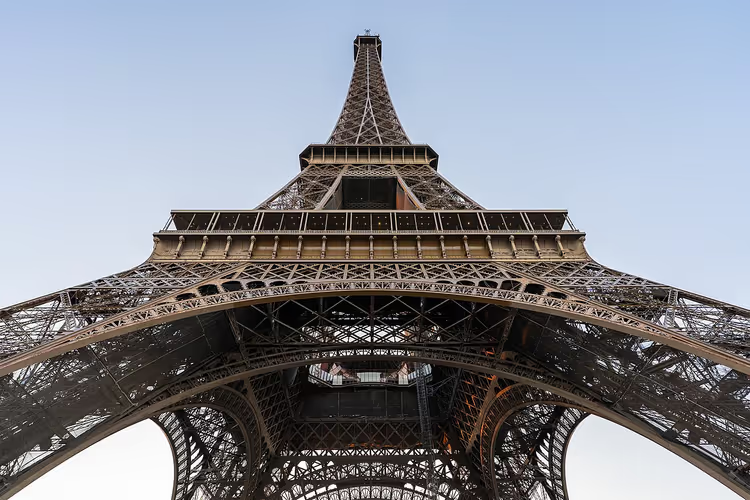
In shape, it is two truncated four-sided steel pyramids. The smaller one sits on the larger one and forms the levels. The columns of the second floor converge at the top, where the third platform is located.
Key structural parameters (as of 09/2026, official tower website):
Parameter | Value |
|---|---|
Height with antennas | 330 m |
First floor | 57 m |
Second floor | 115 m |
Third floor | 276 m |
Weight of the metal structure | about 10,000 tons |
Steps to the second floor | 674 |
Above the third platform are a software-controlled beacon, a flagpole, and a spire. Radio and television antennas are also installed there.
The tower is painted regularly. It was first yellow, then brown, and it is repainted every seven years. Today, a patented shade called "Eiffel Tower brown" is used. After each painting, the weight of the structure increases by several tons.
Since 1900, the tower has been lit by electricity. From 1925, a Citroën ad shone on it for almost ten years. In 1985, for the New Year, it was "dressed" in gold, and for the turn of the millennium, silver lights were added. In the early 2000s, new lighting with 20,000 bulbs was installed.
What to see on the first floor
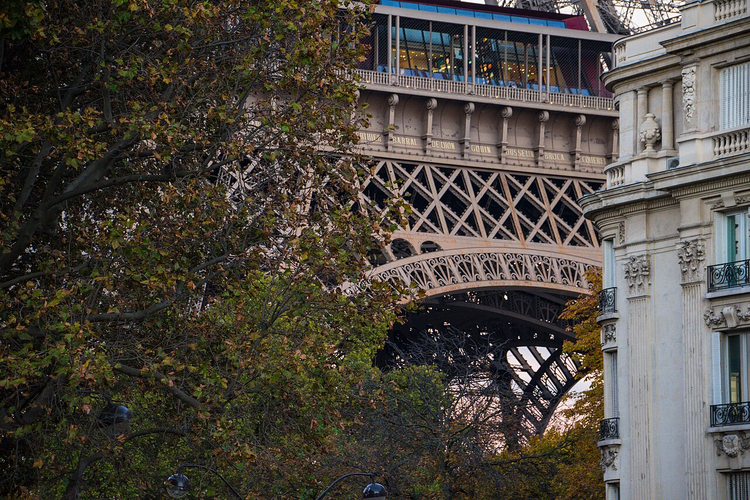
The first floor rises 57 meters. You can go up on foot or by elevator. After the renovation, a transparent floor was added here, and the ground is visible from a height of almost 60 meters.
 © Maria Eklind · CC BY-SAPhoto: Maria Eklind, CC BY-SA (https://creativecommons.org/licenses/by-sa/2.0), Wikimedia Commons
The first level has several attractions:
- A mid-range restaurant: lunch here is cheaper than dinner.
- A snack bar for a quick bite: coffee, french fries, a croissant.
- A cinema showing films about the tower's construction.
- A small museum about the history of the structure.
- A fragment of the original spiral staircase.
- A lounge area and a souvenir shop.
From the ground to the first floor there are 347 steps (as of 09/2026, official tower website). Taking the stairs is cheaper than the elevator. The catch: with a stairs ticket you cannot reach the summit.
What to see on the second floor
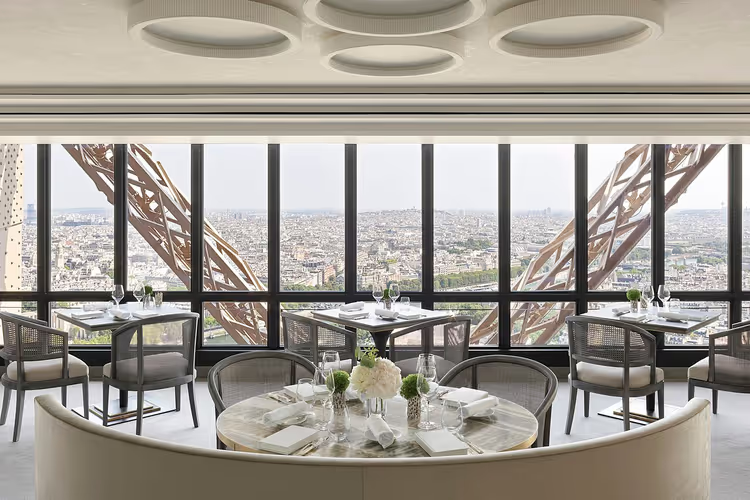
The Le Jules Verne restaurant operates on the second floor. It is a high-end price category, and a lunch with delicacies will cost you a lot. You can reach the restaurant via a separate elevator in the south pillar, bypassing the main entrance. If you book a table, you do not need to buy entrance tickets.
 © Stephan Juillard · CC BY-SAPhoto: Stephan Juillard, CC BY-SA (https://creativecommons.org/licenses/by-sa/4.0), Wikimedia Commons
Besides the restaurant, the second level has a stained-glass gallery, a snack bar, a souvenir kiosk, and restrooms. The second level offers a wide panorama of Paris.
What to see on the third floor
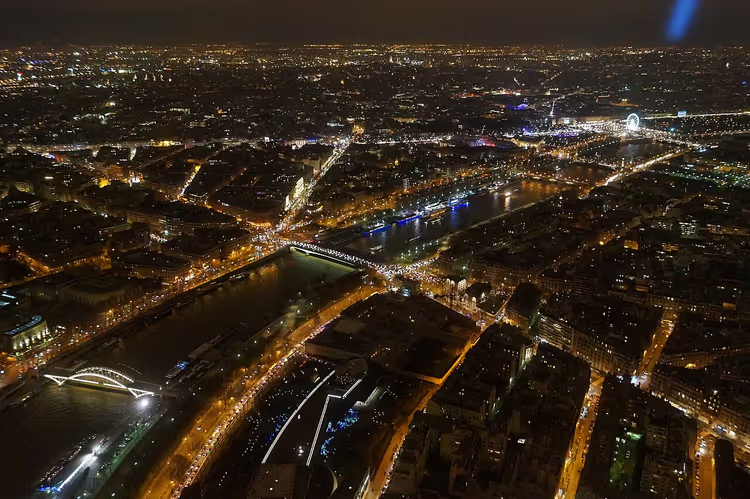
You can only reach the summit by elevator. The third-floor platform is at a height of 276 meters (as of 09/2026, official tower website). A champagne bar operates here, and nearby Gustave Eiffel's office has been recreated with wax figures. In clear weather, the view extends for dozens of kilometers.
 © HerrAdams · CC BY-SAPhoto: HerrAdams, CC BY-SA (https://creativecommons.org/licenses/by-sa/4.0), Wikimedia Commons
Two elevators installed during construction still operate today. They were originally powered by hydraulic pumps, and since 1983 an electric motor has replaced them. This is the most recognizable engineering feature of the structure.
Where the tower is located and how to get there
Address: Champ de Mars, 5 Avenue Anatole France, 75007 Paris, seventh arrondissement (as of 09/2026, official tower website).
The metro is the most convenient option. The Bir-Hakeim and Trocadéro stations lead to the tower from the two banks of the Seine. On RER C, you get off at Champ de Mars - Tour Eiffel station. Buses 42, 69, 82, and 87 stop near the Champ de Mars and right by the tower. Along the Seine, you can walk to the pier near the Pont de l'Alma.
Tickets and opening hours
The price depends on the level and the way up:
Way up | Adult ticket |
|---|---|
Stairs to the second floor | €14.80 |
Elevator to the second floor | €23.50 |
Stairs plus elevator to the summit | €28.00 |
Elevator to the summit | €36.70 |
Prices are for an adult ticket (as of 09/2026, current rates). Children under 4 enter free. There is no separate "stairs to the summit" ticket: the stairs only go to the second floor, and you take the elevator to the top.
The tower is open daily from 9:30. In summer it closes around 00:45, and at other times around 23:45 (as of 09/2026, opening hours). The last ascent to the second floor is about 45 minutes before closing. You can go up to the summit no later than 1 hour 45 minutes before closing. The exact schedule varies by date, so check it before your trip.
Tickets are sold at the ticket offices and online. Online is more convenient: one line instead of two. Arrive ahead of your time slot. Weekends see the highest crowds, so choose a weekday.
Fixed-time tickets can be found on Tiqets.
Tours and tickets in Eiffel Tower
Guided tours, skip-the-line tickets and activities — most offers can be cancelled free of charge.
See offers on TiqetsThe widget loads once you give your consent.
Eiffel Tower on the map
The tower stands on the Champ de Mars in the 7th arrondissement of Paris. The map below makes it easy to plan a route from your hotel or from the Seine embankment.
⁉️🤔 Frequently asked questions
How much does it cost to go up the Eiffel Tower in 2026?
An adult ticket costs from €14.80 by stairs to the second floor to €36.70 by elevator to the top (as of 09/2026, ticket prices). The "stairs plus elevator" combination costs €28.00 (as of 09/2026, top rate by stairs and elevator). Children under 4 go free. Rates change by season, so check the website before buying.
Can you walk up the Eiffel Tower?
Yes, but only to the second floor. By stairs you climb 674 steps and pay less than for the elevator (as of 09/2026, official tower website). Only the elevator goes to the top, so there is no separate "stairs to the top" ticket.
How long does a visit take?
Allow 1.5 to 2 hours for the second floor and 2 to 2.5 hours for the top (as of 09/2026, official tower website). Security screening, waiting for the elevator, and the descent take up most of the time. Don't schedule the tower right before a museum with a fixed time slot or a train.
When is the best time to go to avoid crowds?
Morning or evening is best. Morning is more convenient logistically, evening is prettier because of the lights. From mid-June to early September the crowds are at their peak. The fewest people come in October, November, and January.
What can you see from the second floor and the top?
From the second floor at 115 meters, Paris is easier to read: you can see the Seine, the Louvre, the Arc de Triomphe, and Sacré-Cœur. The top at 276 meters gives the widest view, but the city turns into a map. It's also windier up there, so bring a jacket.
In short: what to book
The ticket choice depends on your priorities.
- If it's your first time in Paris and you don't want to get tired: take the elevator to the second floor.
- If you're on a budget and comfortable walking: the stairs to the second floor work well.
- If you specifically want the top: the "stairs plus elevator" combination is cheaper than the full elevator.
- If you're traveling with kids or elderly parents: the elevator to any level.
You can compare timed-entry tickets on Tiqets.

A small editorial team writing guides for independent travel. We travel ourselves, but we haven’t been everywhere, so we check prices, opening hours and how to get there against official sources.