
















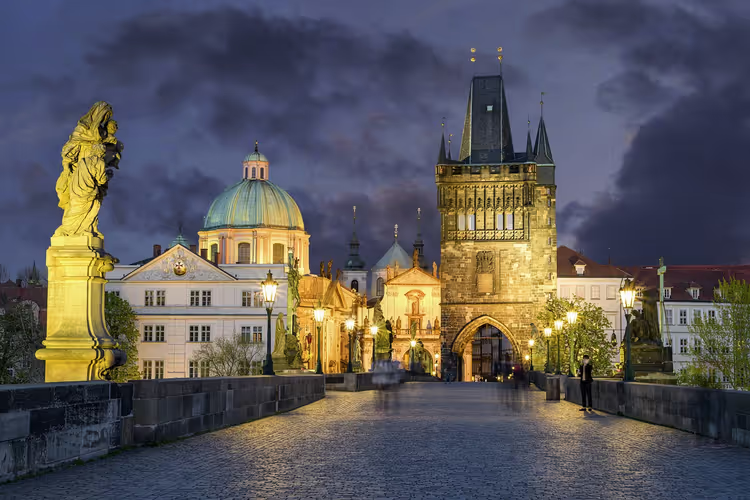
Jewish Quarter in Prague: combined ticket, synagogues and old cemetery
You can walk through the Jewish Quarter and not notice a thing. It starts right behind Old Town Square, and the Stars of David on the facades will show you the boundary of the old ghetto. Six synagogues, the town hall, the old cemetery, and the Kafka monument stand close together here.
As of January 1, 2024, the Old New Synagogue is included in the single ticket for the Jewish Museum (as of 09/2026, Jewish Museum in Prague rates). The ticket is valid for three days, so come in the morning and take your time.
Ad: this article contains affiliate links, we earn a commission if you book through them, at no extra cost to you.
History of the Josefov quarter
💡 In short:
- The quarter starts behind Old Town Square, and access to the streets is free.
- The single Jewish Museum ticket covers the synagogues and the old cemetery (museum rates).
- Prices, hours, and closing days: 09/2026, verified on the official Jewish Museum website.
According to legend, Princess Libuše predicted that a persecuted people would find refuge by the local river, and that this would bring God's grace to the country. The prophecy was linked to the Jews, who had settled on the banks of the Vltava long before Prague became a city.
From the thirteenth century, Jews lived in a separate quarter behind a wall. Artisans and merchants were subject to high taxes, and pogroms broke out from time to time. Settling in other districts of Prague was forbidden, and you could only leave the ghetto gates on business.
Freedom of movement came with a decree by Emperor Joseph II at the end of the eighteenth century. The quarter received its second name, Josefov, and gradually merged with the city center. During World War II, the Nazis did not destroy it: they brought items here from Jewish communities across Europe to create a museum of a vanished people.
Today the streets of Josefov look like an ordinary part of central Prague. Only the Stars of David remind you that you are walking through the former ghetto.
Sights of the Jewish Quarter
The synagogues are the biggest draw in Josefov. There are six of them, and almost all are open with a single ticket. The town hall, the old cemetery, and the Kafka monument stand nearby.
Old New Synagogue
The Old New Synagogue is considered the oldest functioning synagogue in Europe. It was built in the last third of the thirteenth century by craftsmen from the royal workshop who were working nearby at the Convent of St. Agnes (description on the community website). The building is Gothic, and the interior is deliberately austere. It is open daily, except Saturdays and Jewish holidays, from 9:00 to 17:00. According to legend, the remains of the Golem, the clay protector created by Rabbi Loew, are kept in the attic.
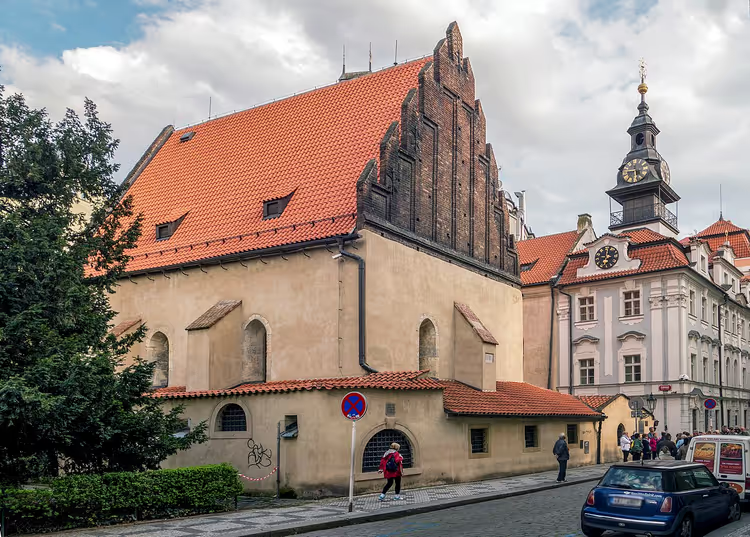 © Jerzy Strzelecki · CC BY-SAPhoto: Jerzy Strzelecki, CC BY-SA (https://creativecommons.org/licenses/by-sa/3.0), Wikimedia Commons
Pinkas Synagogue
The Pinkas Synagogue appeared in the sixteenth century and today serves as a memorial. The walls inside are covered with the names of Czech and Moravian Jews who perished during the Shoah (list of museum sites). People enter quietly, for the sake of these names, not for beautiful halls. For many visitors, this is the heaviest place in the quarter.
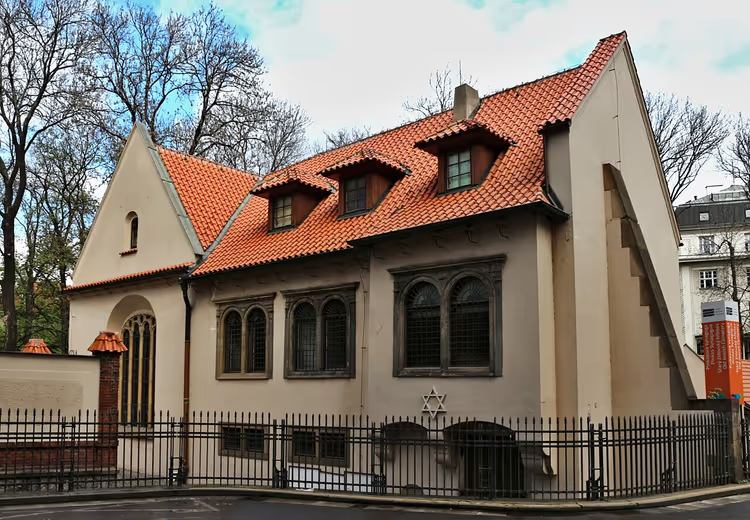 © VitVit · CC BY-SAPhoto: VitVit, CC BY-SA (https://creativecommons.org/licenses/by-sa/4.0), Wikimedia Commons
Klausen Synagogue
The Klausen Synagogue stands next door and dates back to the seventeenth century. It is now an exhibition hall: a collection of Judaica, silver, textiles, and early printed books. There is no need to pay extra for individual sites, everything is included in the general ticket.
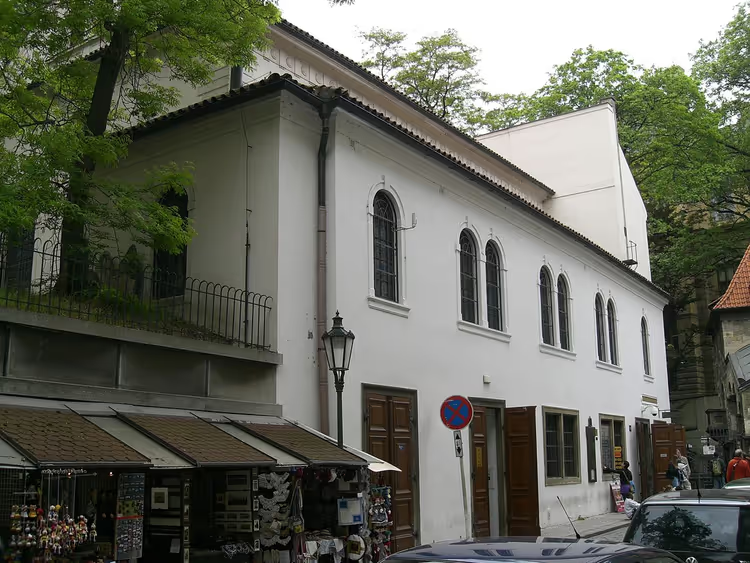 © Chmee2 · CC BY-SAPhoto: Chmee2, CC BY-SA (http://creativecommons.org/licenses/by-sa/3.0/), Wikimedia Commons
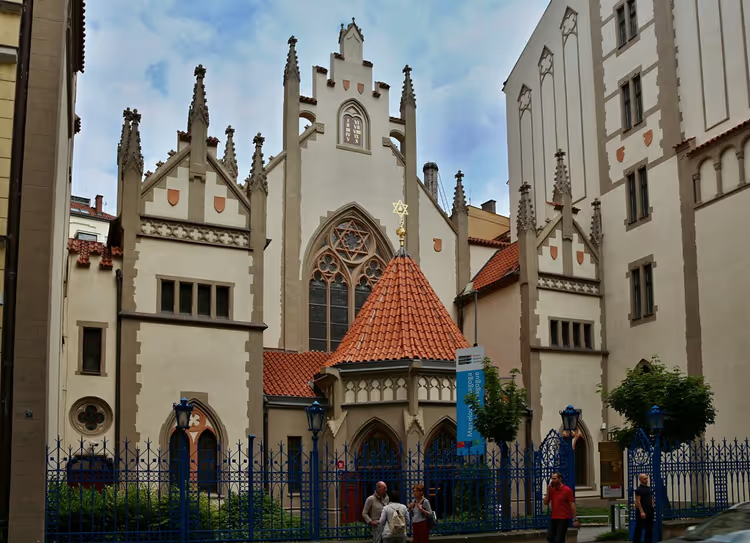
Maisel Synagogue
The Maisel Synagogue is named after Mordechai Maisel. Starting out as a poor money changer, he became one of the wealthiest men in Europe, lent money to the royal court, and donated heavily to his quarter. Today the building presents the history of the Jews of Bohemia from the early Middle Ages to the Enlightenment.
 © VitVit · CC BY-SAPhoto: VitVit, CC BY-SA (https://creativecommons.org/licenses/by-sa/4.0), Wikimedia Commons
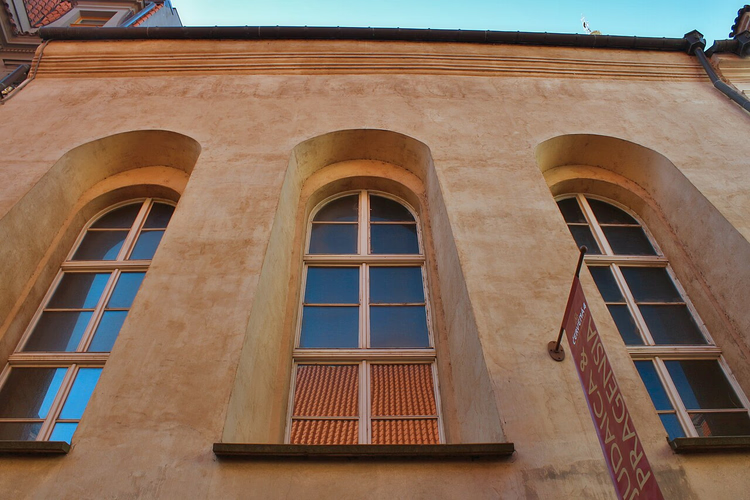
High Synagogue
The High Synagogue was built directly against the Jewish Town Hall, so the two buildings face the street as a single complex. It is the smallest of the synagogues in the quarter.
 © VitVit · CC BY-SAPhoto: VitVit, CC BY-SA (https://creativecommons.org/licenses/by-sa/4.0), Wikimedia Commons
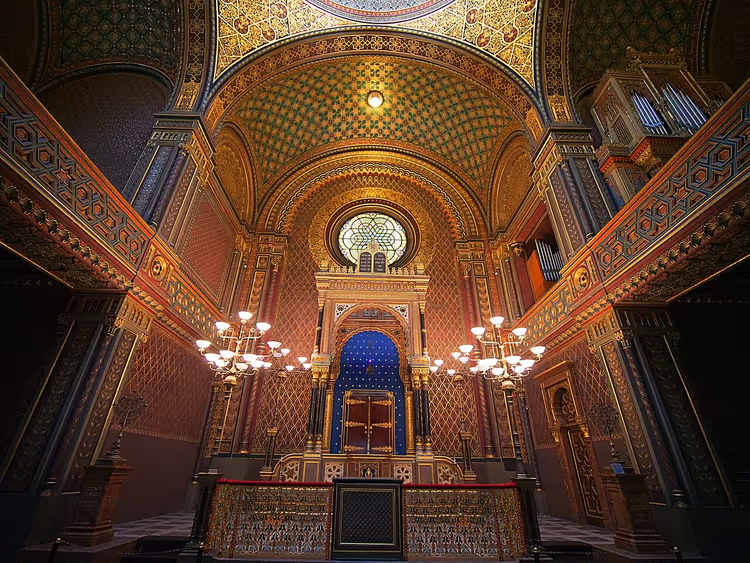
Spanish Synagogue
The Spanish Synagogue is considered the youngest and most ornate in Josefov. Inside, it is covered with gold, stucco, and Moorish-style stained glass, and visitors often compare the hall to a palace. Allow at least half an hour here.
 © Andrei Avantgardian · CC BYPhoto: Andrei Avantgardian, CC BY (https://creativecommons.org/licenses/by/2.0), Wikimedia Commons
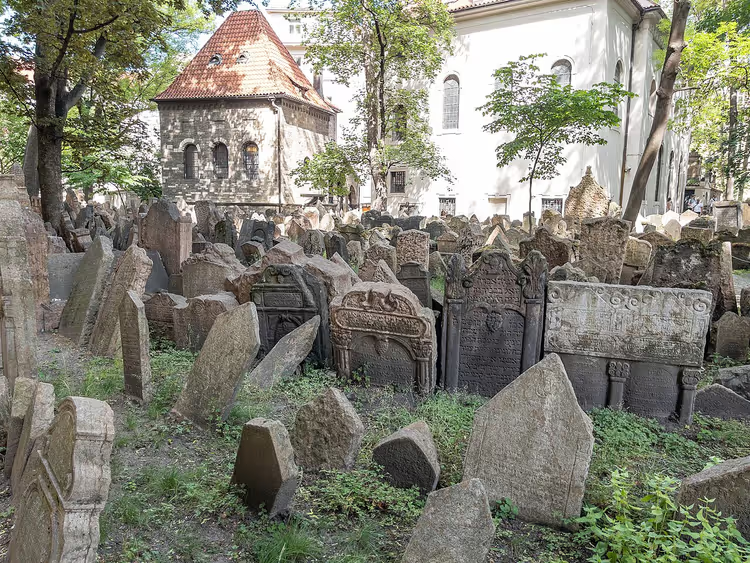
Old Jewish Cemetery
The Old Jewish Cemetery operated from 1439 to 1787 and is considered the most powerful site in the quarter. Jews were forbidden to bury outside its walls, so graves were layered on top of one another. There are more than 12,000 headstones here, with around 100,000 people buried in total (as of 09/2026, Jewish Museum). The stones stand close together, covered in moss, and this forest of stone speaks for itself.
 © Kent Wang from Barcelona, Spain · CC BY-SAPhoto: Kent Wang from Barcelona, Spain, CC BY-SA (https://creativecommons.org/licenses/by-sa/2.0), Wikimedia Commons
Jewish Town Hall
The Jewish Town Hall was built in the sixteenth century. Two clocks hang on the tower: one with Roman numerals, the other with Hebrew letters. The hands of the Hebrew clock run backward because the script reads from right to left.
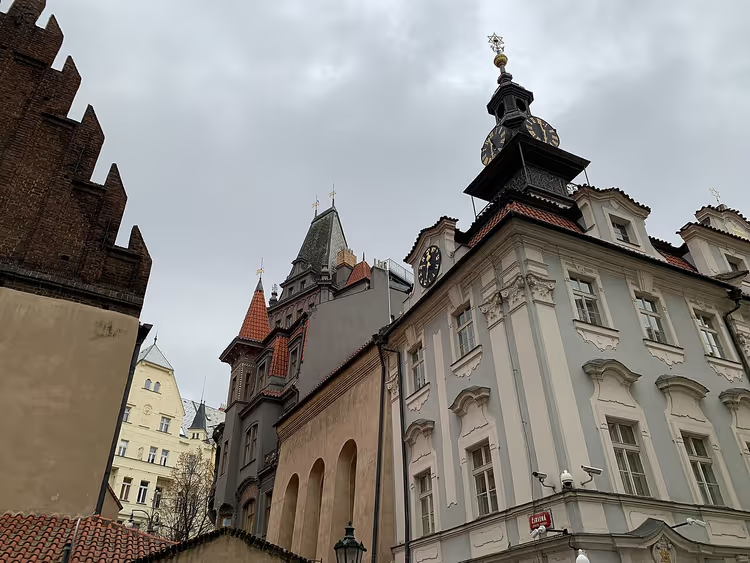 © Robot8A · CC BY-SAPhoto: Robot8A, CC BY-SA (https://creativecommons.org/licenses/by-sa/4.0), Wikimedia Commons
Franz Kafka Monument
The Franz Kafka Monument is unusual: a headless giant carries the figure of the writer on its shoulders. There is almost always someone nearby taking photos. It is a good spot to end your walk through the quarter.
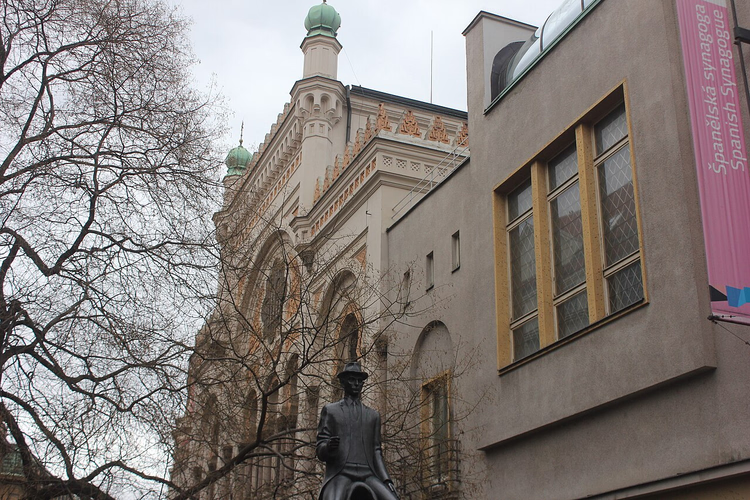 © CAPTAIN RAJU · CC BY-SAPhoto: CAPTAIN RAJU, CC BY-SA (https://creativecommons.org/licenses/by-sa/4.0), Wikimedia Commons
Tickets and opening hours
You do not pay to enter the quarter itself, but for a Jewish Museum ticket. One ticket is valid for three opening days and covers five synagogues plus the old cemetery; the Old-New Synagogue has been included since January 1, 2024 (terms and rates). Ticket office sales end thirty minutes before closing, and each site can be visited once.
Category | Price | Hours |
|---|---|---|
Adult ticket | 600 CZK (rates) | according to site hours |
Students under 26 | 400 CZK |
|
Children 7-15 | 200 CZK |
|
Children under 6 | free |
|
Old-New Synagogue | included in ticket | 9:00-17:00, closed Saturday |
Prices and hours: as of 09/2026, according to the Jewish Museum and the Old New Synagogue. An audio guide is available at each ticket office if you want to understand the details.
Buy your ticket online and arrive at opening time: by midday the ticket offices get crowded.
Tours and tickets in Prague
Guided tours, skip-the-line tickets and activities — most offers can be cancelled free of charge.
See offers on TiqetsThe widget loads once you give your consent.
How to get to the Jewish Quarter
The easiest way to reach Josefov is by metro. Get off at Staroměstská station on line A: the exit leads directly to the edge of the quarter, and the synagogues are a few minutes' walk away (Prague metro map). Trams 17 and 18 stop nearby. From the center you can walk, the quarter begins right behind Old Town Square.
Jewish Quarter on the map
The quarter is compact, and you can cover it entirely on foot. Check in advance how close the synagogues are to each other.
⁉️🤔 Frequently asked questions
How much does it cost to enter the Jewish Quarter and what is included in the ticket?
The streets of the quarter are free; you pay for the Jewish Museum ticket. It costs 600 CZK for an adult and covers five synagogues plus the old cemetery. Students under 26 pay 400 CZK, children aged 7 to 15 pay 200 CZK, and children under 6 enter free. The ticket is valid for three open days (as of 09/2026, fares and discounts).
When are the synagogues and the old cemetery open?
The sites are open daily except Saturdays and Jewish holidays. The Old New Synagogue is open from 9:00 to 17:00, and tickets are sold only until 16:30, that is, thirty minutes before closing (as of 09/2026, community opening hours). Check the exact holiday closing dates on the museum's website before your trip.
How long does a visit take?
Allow two to three hours for the entire Jewish Quarter. That is enough for five synagogues and the old cemetery without rushing if you arrive at opening time. Those who read every plaque will stay longer. With children the time stretches, so leave some buffer.
How to get there and where to get off?
The most convenient option is the metro to Staroměstská station on line A (route from the metro). Trams and the walking route are described in the "How to get to the Jewish Quarter" section.
Can you take photos inside?
Photography is allowed in the Jewish Museum buildings without flash, additional lighting, or a tripod, for personal use only (as of 09/2026, photography rules). Detailed photography of the cemetery requires separate permission. In the Pinkas Synagogue, visitors speak quietly near the memorial and do not photograph people.
Who is the Golem and what does it have to do with Prague?
According to legend, Rabbi Loew brought a clay Golem to life to protect the Jews of Prague (the legend of the Golem). Read more about the legend in the "Old New Synagogue" section.
In short: what to book
The quarter is small, but tickets to the synagogues are best bought in advance so you don't have to wait at the ticket office.
If you have half a day: get the combined ticket and go at opening time, so you can comfortably visit all five synagogues and the cemetery.
If you're interested in history: start with the Pinkas Synagogue and the Old Cemetery, and leave the oldest synagogue for the end.
If you're with kids: plan for two hours and finish at the Kafka monument, where they won't get bored.
Buy tickets to the Jewish Museum on Tiqets in advance.

A small editorial team writing guides for independent travel. We travel ourselves, but we haven’t been everywhere, so we check prices, opening hours and how to get there against official sources.