

















Knife sharpening at home: which sharpening system to choose
A dull knife forces you to press harder on the food, and your hand slips off the edge, so cuts happen more often than with a sharp blade. Even expensive steel loses its sharpness after a few months of cooking because the edge wears against the cutting board with every slice.
Manufacturers give a clear reference point for the angle. Wüsthof recommends guiding a kitchen knife along a honing steel at about 14-15°, and Asian models at 10° (As of 10/2026, Wüsthof website). Holding that angle by hand is difficult, which is why knives are sharpened on guided systems.
Below we'll look at how sharpening systems differ, which angles suit different blades, and what mistakes to avoid.
How to choose a sharpening system
💡 In short:
- Keep the angle consistent on both sides of the blade: this gives an even cut and predictable sharpness.
- At home, one system with adjustable angle is enough; for daily work, get a modular model with a rigid clamp.
- Don't press on the stone and don't sharpen "just in case": removing excess steel shortens the knife's life.
- Recommended sharpening angles: 10/2026, according to the Wüsthof website.
A sharpening system solves one problem: it holds a constant angle between the blade and the abrasive, because your hand can't hold that angle, but a guide can. That's why systems produce more consistent results than a freehand stone.
Look at four things. The angle range shows whether the system will work for both a thin Japanese blade and a heavy cleaver. The clamp type determines how securely the knife is held. The stone set determines whether you remove metal aggressively or polish the edge finely. Expandability lets you buy additional stones and holders as your experience grows.
Criterion | What to look for | Why it matters |
|---|---|---|
Angle range | whether it includes the values you need | different blades require different angles |
Clamp | rigidity and jaw size | a soft clamp pushes the blade sideways |
Stones | material and grit | a coarse stone removes steel quickly |
Expandability | whether stones and holders can be added | the system grows with your experience |
How system types differ
Systems fall into guided, rod, and hybrid types. Guided systems hold the blade in a clamp and move the stone along a set angle, so they give the most consistent result. Rod systems work with two ceramic rods at a fixed angle: fast and portable, but rough in terms of precision. Hybrid systems combine a clamp with simple adjustment and suit beginners, so compare the main models by type and purpose.
System | Type | What's important to know | Who it's for |
|---|---|---|---|
Hapstone R2 | guided | modular platform, fine adjustment, holders can be added | professional kitchens, enthusiasts |
TSPROF K03 | guided | milled body, very rigid fixation | precision work, high volume |
Edge Pro Apex | guided | many accessories, large community, guides long blades less steadily | home and small kitchens |
Work Sharp Precision Adjust | hybrid | easy start, compact body, limited angle | beginners |
Spyderco Sharpmaker | rod | two fixed angles, portable, doesn't replace a full system | travel, quick touch-ups |
No system wins at everything: modular guided systems give precision but require time and space. Rod systems save minutes but won't fix a heavily dulled blade. Choose for your task, not someone else's rating.
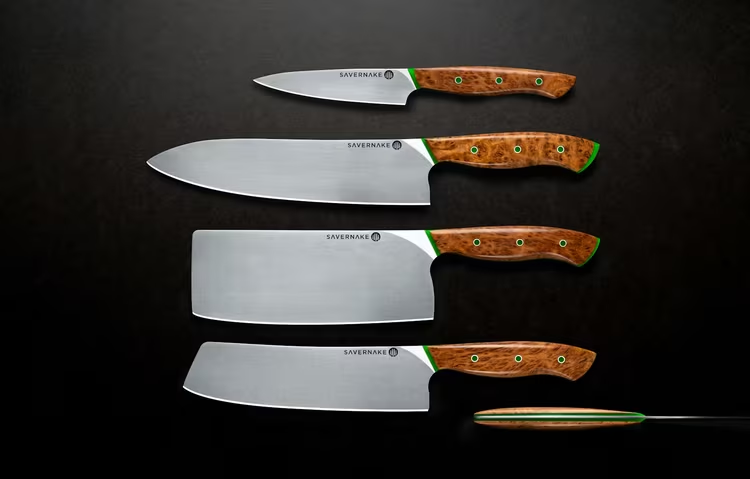
Hapstone R2: a modular system for home
Hapstone makes modular knife sharpeners: the base platform can be expanded with holders, stones, and a digital angle gauge. The company ships orders from a warehouse in Bratislava and offers a 5-year warranty on its devices (according to the company's website, verified 10/2026).
The flagship of the line, the Hapstone R2, holds the blade in a rotating clamp and lets you set the angle identically on both sides. Modularity here isn't decoration: over time you buy additional stones and adapters, and the platform itself stays. For home use, that's more cost-effective than replacing a cheap sharpener every couple of years.
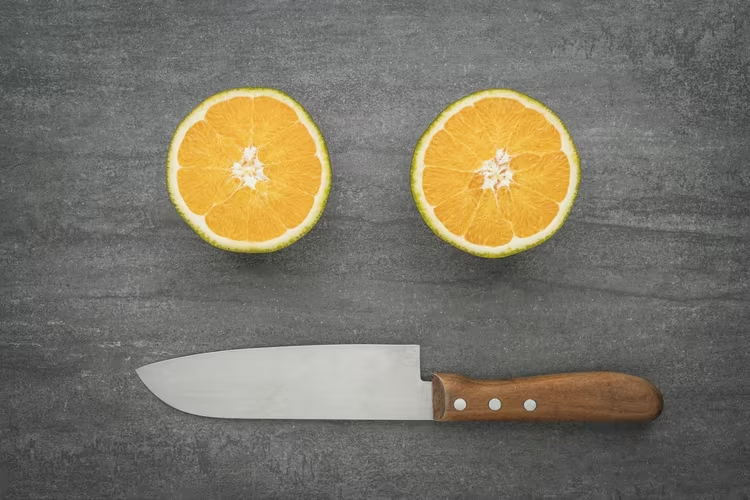
Asian blades demand more attention because the thin edge chips quickly with a careless movement, so on such knives it's especially important to keep the system's setting steady and not rush.
What angles to use when sharpening
The angle determines both sharpness and edge durability, so a smaller angle cuts more easily, but the edge chips faster. A larger angle is stronger but requires more force when cutting. That's why one universal angle doesn't work for all knives.
European knives usually have a more obtuse profile, Japanese ones a more acute one. Manufacturers give a separate recommendation for each blade type: Zwilling has an angle table based on blade width (As of 10/2026, Zwilling website). Before the first sharpening, find the recommendation for your specific brand.
Keep the same angle on both sides. Asymmetric sharpening pushes the edge to one side and ruins the cut. You'll feel it immediately: the knife will start drifting sideways when slicing.
Common sharpening mistakes
Most ruined knives were ruined not by use, but by sharpening itself: here's what goes wrong most often.
- Too much pressure. Pressure heats the edge and removes excess metal. Let the stone do the work.
- A drifting angle. Each movement at a new angle rounds the edge. Keep one setting until the end.
- Sharpening "just in case." Frequent aggressive sharpening shortens the blade's life. Use a honing steel for touch-ups.
- A fixed-angle device on an expensive knife. A coarse sharpener removes more steel than such a blade needs.
- Cutting on glass and stone. A hard board kills sharpness faster than any sharpening.
Check the edge with a simple test: cut a ripe tomato, and if the skin tears and the knife squashes the flesh, it's time to sharpen. A clean cut without pressure means you're holding the angle correctly.
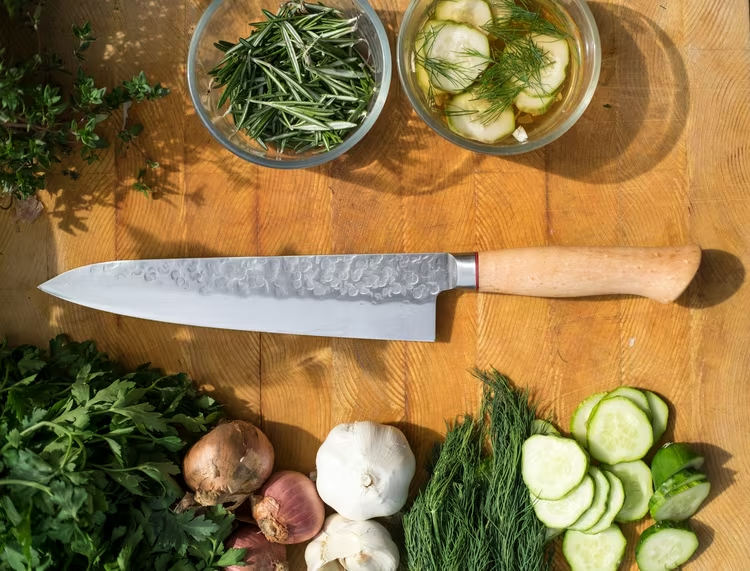
How often to sharpen knives
Sharpening frequency depends on the workload: in a home kitchen a knife dulls gradually, while with daily shift work sharpening is needed noticeably more often. Go by the cut, not the calendar.
Keep two tools: a honing steel realigns the edge between sharpenings and pushes back the moment when a stone is needed. A full sharpening on a system restores the angle that a honing steel can no longer bring back. This way you remove steel less often and preserve the blade longer.
Tool | What it does | When to use |
|---|---|---|
Honing steel | realigns the edge, doesn't remove metal | between sharpenings, from time to time |
Stone or system | restores the angle | when the honing steel stops helping |
⁉️🤔 Frequently asked questions
Why do expensive knives dull just as fast as cheap ones?
Steel wears with every cut against the board, and the price of the blade doesn't cancel that process. An expensive knife holds its edge longer, but dulling still happens. That's why honing and sharpening are needed for all knives, including premium ones.
What angle works for a home kitchen?
Start with your brand's manufacturer recommendation: European brands use a larger angle, Asian models a smaller one. Keep the chosen value identical on both sides of the blade, and the cut stays even and predictable.
Do you need an expensive guided system at home?
Not necessarily, but it gives a constant angle and reduces steel removal. If you cook every day and have several knives, a modular system pays for itself with an even cut. For a couple of knives, a simple model with adjustment is enough.
Can you sharpen hunting and folding knives on the same systems?
Yes, if the clamp jaws fit the blade size. Hunting and folding knives are often sharpened at a steeper angle than kitchen knives: they work under greater load. Check that the system holds a short blade securely.
Diamond stone or water stone?
A diamond abrasive works faster and lasts longer; a water stone gives a finer polish on the edge. Both options are needed at different stages: coarser first, then finer. For home use, one medium-grit stone and one finishing stone are enough.
Does frequent sharpening ruin a knife?
Yes, if you sharpen aggressively and often. Each movement removes a little steel, and over time the blade narrows. A precise system with low steel removal and timely honing with a steel extend the knife's life.
In short: how to choose a sharpening system
Put your own task ahead of someone else's rating: many knives and daily cooking call for a modular system with a rigid clamp. A couple of kitchen knives get by with a model with simple adjustment. For travel and quick touch-ups, keep compact rods.
If you have | Get |
|---|---|
Many knives, daily cooking | a modular system with a rigid clamp |
Two or three kitchen knives | a simple model with angle adjustment |
Travel and quick touch-ups | compact rods |
If in doubt, test the edge with a tomato and see whether the knife holds its cut after honing with a steel. Before the first sharpening, check the angle recommended by your brand's manufacturer.

A small editorial team writing guides for independent travel. We travel ourselves, but we haven’t been everywhere, so we check prices, opening hours and how to get there against official sources.