
















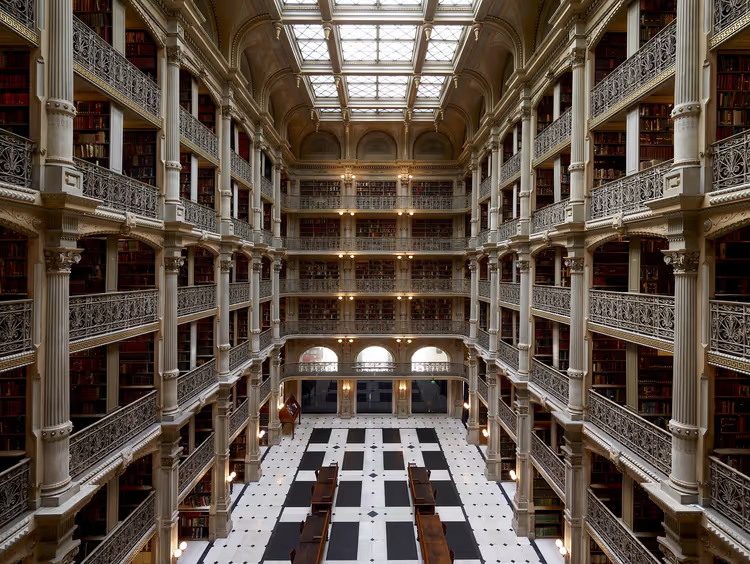
Vatican library: how to get into the reading room and what the collections hold
The Vatican Library is not open to everyone. By papal decree, reader cards here are issued to scholars with a research project, not to tourists with suitcases.
Below are facts about the building, its history, and its closed collections. At the end you will find practical details: reading room hours, entry rules, and tickets to the Vatican Museums if you need a tour rather than a research room.
Ad: this article contains affiliate links, we earn a commission if you book through them, at no extra cost to you.
How the Vatican Library is organized inside
💡 In short:
- The library holds one of the largest collections of manuscripts and rare books in the world.
- Reader cards are issued based on a research project; access to the collections is granted to researchers, not sightseers.
The double spiral staircase under a glass dome is not in the library but in the Vatican Museums. It was built in 1932 from sketches by architect Giuseppe Momo. Inside, two spirals run: one goes up, the other goes down. From above, they appear to be moving.
The sense of motion comes from the geometry of the steps. The lower steps are of ordinary width, while the upper ones become flatter and wider. The railings are cast in bronze, decorated with acanthus leaves and symbols of papal authority.
The library's spaces are divided into halls. There is a Biblioteca segreta, where especially valuable and restricted documents are kept. The Vatican Apostolic Archive is a separate institution, often confused with the library. According to legend, only the Pope has access to some of its documents. Nearby are a restoration laboratory and the School of Librarians.
In 2007 the building was closed for a full restoration and returned to readers in 2010 (as of 09/2026, library page). Craftsmen reinforced the walls, replaced the floor bases, and installed an air conditioning system. It maintains constant temperature and humidity, which is critical for ancient manuscripts. If you study the history of the book, these conditions will tell you as much as the architecture itself.
Among the exhibits there are also works of art. A special place is held by the fresco "The Aldobrandini Wedding." Until the early nineteenth century it adorned the room of Pope Clement VIII, and later it was moved to the library.
History of the library: from Sixtus IV to the present day
The official founding date is considered to be June 15, 1475. On that day, Pope Sixtus IV issued a decree establishing the library (as of 09/2026, official library page). The collection itself had been accumulated over several centuries before that day.
The predecessors of Sixtus IV began collecting manuscripts as early as the fourth century. By the fifteenth century, the collection numbered more than fifteen hundred items. It was expanded through purchases made by papal nuncios and gifts from private collectors. In the catalogs you will find scholarly works, sacred scriptures, and classical texts from various cultures.
Many texts suffered from the passage of time and had to be restored and recopied. Thanks to the work of copyists, philosophical treatises, religious texts, and works of Arab, Latin, and ancient Hebrew cultures have come down to us.
The collection grew fastest in the seventeenth century. Under Gregory XV, the Heidelberg (Palatine) Library entered the holdings. Under Alexander VII, the Urbino Library was added. Later came the collections of Count Cicognara and Cardinal Angelo Mai, followed by the Cerulli and Ferraioli collections and the Chigi Library.
Today the holdings include about 180,000 manuscripts and archival documents, nearly 2,000,000 printed books, and about 8,300 incunabula. Added to these are 300,000 coins and medals, more than 100,000 graphic works, and over 150,000 photographs (as of 09/2026, section on holdings). This number grows slowly: each new collection takes years to catalog.
Myths and mysteries of the closed collections
The closed archives have given rise to several prominent legends. The library neither confirms nor denies them.
The most famous version concerns the manuscripts of Leonardo da Vinci. Supposedly, a work lies in the vaults that could shake the dogmas of the Catholic Church. The existence of such a manuscript has never been proven, but neither has it been disproven.
Another legend speaks of manuscripts of the Toltec Indians. According to this version, they describe a visit by extraterrestrial beings to Earth many centuries ago.
A third story is connected with the alchemist Count Cagliostro. He is credited with an elixir of rejuvenation that supposedly completely renews the body in forty days. There is no confirmation of this in the open descriptions of the holdings.
There is also a tale about the original first Bible. Supposedly, the text with the "real" truth about God and the purpose of human arrival on Earth is kept here.
All these stories remain legends. If you encounter them in retellings, check the facts against the scholarly descriptions of manuscripts in the library's catalogs.
Visiting: hours, entry, and tickets
The library's reading rooms are open Monday through Friday, from 9:00 to 17:20 (as of 09/2026, reading room schedule). The rooms are closed on Saturday and Sunday, so plan your visit on a weekday.
Access to the collections is governed by papal decree. Cards are issued to qualified researchers: professors, research staff, and university doctoral students. You will need a research project and confirmation from your academic institution. The number of places is limited, so applications are submitted in advance.
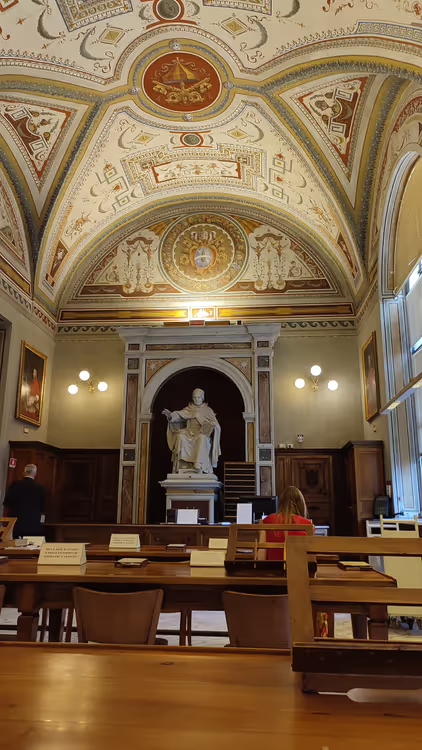 © Dobroš · CC BY-SAPhoto: Dobroš, CC BY-SA (https://creativecommons.org/licenses/by-sa/4.0), Wikimedia Commons
The rules inside are strict. Taking books and documents outside the library is prohibited. Each item has an electronic chip sewn in, and its signal is used to track the location of the publication.
The premises are protected by video surveillance, an alarm system, and a fire suppression system. The walls are treated with fire-resistant materials that hold back fire for a long time.
Tourists are not allowed in the reading room. If you want to see the Vatican from the inside, get a ticket to the Vatican Museums.
Plan your day in advance: Vatican Museums tickets are easier to buy online. You can book a visit here: Vatican tours on GetYourGuide.
Tours and tickets in Vatican
Guided tours, skip-the-line tickets and activities — most offers can be cancelled free of charge.
See offers on TiqetsThe widget loads once you give your consent.
If you do not need to do scholarly work, you will not get a reader card. But a museum ticket gives you access to a huge part of the Vatican collections.
Before your trip, check the hours: the schedule changes on church holidays.
⁉️🤔 Frequently asked questions
Can a tourist get into the Vatican Library?
No. Reader cards are issued by papal decree to researchers with a research project. An ordinary tourist ticket is not valid in the reading rooms, so for sightseeing choose the Vatican Museums. Applications are reviewed by the library secretariat, and there are always fewer places than applicants.
How much does a Vatican Museums ticket cost?
A full ticket costs 20 €, a reduced ticket 10 € (as of 09/2026, Vatican Museums prices). This is a separate ticket and has nothing to do with the library reading room. Buy it online in advance, because at the entrance ticket office you will spend more time.
What hours are the reading rooms open?
Only on weekdays; the exact schedule is given above in the visiting section. Before submitting an application, check the library calendar: the library closes on holidays.
Is it true that Leonardo da Vinci's manuscripts are hidden in the holdings?
That is a legend. The existence of such a work has never been proven, although the archive is indeed closed to outsiders. Scholarly descriptions of the holdings confirm only the manuscripts known to researchers. The story lives on rumors, not on found documents.
What is the Biblioteca segreta?
That is the name for the closed part of the holdings containing especially valuable documents. It is often confused with the Vatican Apostolic Archive, but the archive is a separate institution. Legend has it that some materials are accessible only to the Pope. A separate access procedure applies to scholars, and it is reviewed by the library secretariat.
In short: what to book
The Vatican Library operates as a research institute, not a museum. If you have a research topic and a recommendation, prepare your reading room application in advance.
- If you are a tourist: get a ticket to the Vatican Museums.
- If you are a researcher: apply for a reader card and a research project.
Vatican tickets are easier to get in advance: Vatican Museums tickets on Tiqets.

A small editorial team writing guides for independent travel. We travel ourselves, but we haven’t been everywhere, so we check prices, opening hours and how to get there against official sources.