


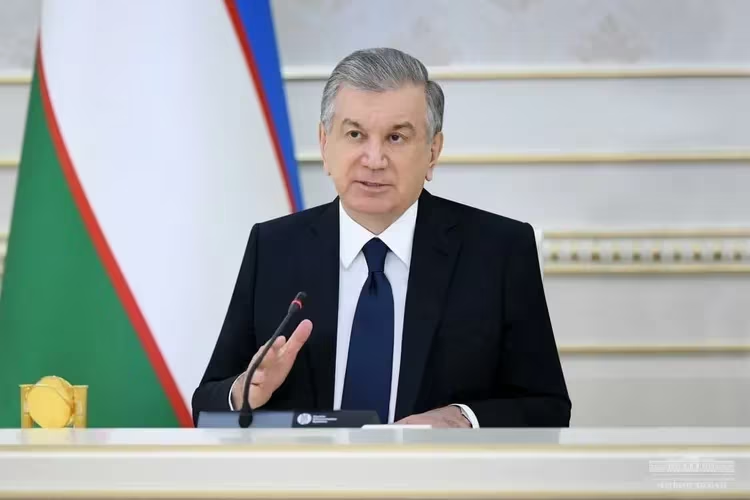
Shavkat Mirziyoyev: what has changed in Uzbekistan since 2016
Shavkat Mirziyoyev took charge of Uzbekistan in late 2016. Within a few years, the country opened its borders, lifted currency restrictions, and changed its tone in foreign policy. You will notice the changes even in small things: the som exchange rate, the visa regime, press freedom.
This article breaks down what exactly changed under Mirziyoyev, which sectors he prioritized, and how international organizations assess the reforms. Below you will find a table with real GDP, the main reform directions, and brief facts about the president himself.
Who is Shavkat Mirziyoyev
💡 In short:
- Shavkat Mirziyoyev was born on July 24, 1957 in the Jizzakh region of Uzbekistan.
- From 1996 to 2001 he was khokim of the Jizzakh region, from 2001 to 2003 he headed the Samarkand region, and from 2003 to 2016 he served as prime minister.
- He won the election on December 4, 2016, took office on December 14, and was re-elected for a new term in 2023.
- Uzbekistan's GDP in current dollars, 2017-2024: 10/2026, according to the World Bank.
Before his presidency, Mirziyoyev worked in the executive branch for almost twenty years. According to the official website of the head of Uzbekistan, he was born on July 24, 1957 in the Zaamin district of the Jizzakh region. He began his career in Tashkent and became head of the Jizzakh region in 1996.
Mirziyoyev served as prime minister for thirteen years. After the death of President Islam Karimov in September 2016, parliament temporarily assigned him the duties of head of state (according to the state portal of Uzbekistan). He won the election on December 4, 2016, took office on December 14, and was re-elected in snap elections in 2023. If you follow Central Asian politics, this biography explains his style: a cautious apparatchik who changes the rules quickly.
Main reforms: from the economy to culture
Mirziyoyev called his program the "New Uzbekistan." He promised an open economy, independent courts, and a return to national culture. You will notice many of the decisions within the first two years in power.
Currency reform
The most visible change concerned money. In September 2017, the Central Bank unified the two som exchange rates and let it float freely. According to ISDP researchers, restrictions on currency conversion for citizens and companies were lifted at the same time. Before the reform, exchange took place at a fixed rate, so businesses lost money on every transaction.
Liberalization was followed by other steps. Investors faced fewer administrative barriers, and startups received tax incentives. Registration was simplified for small businesses.
Agriculture
In the agricultural sector, the focus was placed on new technologies and workforce training. Farmers were offered training programs in modern methods and support for environmentally friendly production. This is how the authorities plan to raise yields without increasing the burden on the land.
Education
Uzbekistan reformed its education system with an emphasis on technology. Distance learning opened up for rural areas, and universities signed agreements with foreign institutions. Students gained access to exchange programs.
Culture and the arts
Under Mirziyoyev, a new stage began in the development of national culture. The state supported young directors, actors, writers, and poets. New museums and galleries opened, and international exhibitions became regular. Theater, cinema, and literature returned to the center of the cultural agenda.
Mirziyoyev on the international stage
Foreign policy under Mirziyoyev became more active. Uzbekistan restored contacts with its neighbors and emerged from regional isolation. The country is developing relations with China, Russia, the United States, and the European Union.
A notable episode is connected with Germany. In Berlin, Mirziyoyev met with Chancellor Olaf Scholz and discussed bilateral projects. The German newspaper Berliner Zeitung, in a piece about how the president of Uzbekistan visited Germany, also wrote about the constitutional referendum in the country.
If you assess foreign policy, pay attention to two facts. Uzbekistan works with the UN and the World Bank, and its peace initiatives in Central Asia have received international recognition.
The economy in numbers: GDP growth
Uzbekistan's nominal GDP grew from 72 to 121 billion dollars over seven years. This is World Bank data in current US dollars.
Year | GDP, billion $ | Note |
|---|---|---|
2017 | 72.3 | som devaluation |
2019 | 70.2 | after devaluation |
2021 | 81.2 | post-pandemic recovery |
2022 | 94.3 | export growth |
2023 | 107.5 | investment growth |
2024 | 121.4 | historic high |
The 2017 dip is easy to explain. Exchange rate liberalization wiped out the inflated official rate, so the dollar valuation fell. Production did not shrink. Since 2021, the figure has been growing every year, and in 2024 it is almost 1.7 times higher than in 2017.
Human rights and court reform
The human rights topic requires precision. The death penalty was abolished in Uzbekistan on January 1, 2008, back under Islam Karimov. Amnesty International named the country the 135th in the world to abandon capital punishment.
Mirziyoyev continued this line by other means. Parliament reformed electoral law and supported a multiparty system. An ombudsman service began working to protect citizens' rights, and the judicial system started changing for greater independence and transparency.
Assessments differ, however. Official sources speak of progress, while independent observers point to slow pace. If you compare reports, look at the publication date and the methodology, not the headlines.
⁉️🤔 Frequently asked questions
When did Shavkat Mirziyoyev become president of Uzbekistan?
Parliament assigned him the duties of head of state in September 2016, after the death of Islam Karimov. Mirziyoyev won the election on December 4, 2016, and officially took office on December 14. He was re-elected in snap elections in 2023. The presidential term is seven years (according to the official presidential website).
Which of Mirziyoyev's reforms are considered the main ones?
The most visible ones concern the economy: the 2017 currency liberalization and the lifting of conversion restrictions. Added to these are simplification for investors, support for small business, exchanges with foreign universities, and the revival of national culture. If you compare programs from different years, look at the exchange rate and tax conditions (according to ISDP).
How did Uzbekistan's GDP change under Mirziyoyev?
According to the World Bank, the country's nominal GDP grew from 72 billion dollars in 2017 to 121 billion in 2024. The 2017 dip was caused by the som devaluation, not by a drop in production. In dollar terms, the economy grew roughly 1.7 times over seven years.
Did Mirziyoyev abolish the death penalty?
No. Capital punishment was abolished in Uzbekistan on January 1, 2008, back under Islam Karimov. Amnesty International names the country as one of 135 that have abandoned the death penalty. Mirziyoyev continued the human rights course with other decisions, but the abolition cannot be attributed to him.
What does "New Uzbekistan" mean?
"New Uzbekistan" is the official name of Mirziyoyev's reform program, adopted in 2017. It combines an open economy, independent courts, and the revival of national traditions (according to the state portal of Uzbekistan). The president himself calls its goal building a state where every citizen feels a contribution to the country's development.
In short: how to assess the reforms
When assessing Mirziyoyev's reforms, you look at three things. First: macroeconomics, where GDP grew from 72 to 121 billion dollars over seven years (World Bank data). Second: institutions, because judicial reform and the ombudsman service are changing the rules for business and citizens. Third: openness, because borders, currency, and external contacts have become freer.
Beyond that, everything depends on your interests. If the economy matters to you, follow the som exchange rate and investment inflows. If human rights matter, read court decisions and ombudsman reports. If culture matters, watch the lineup of new museums and festivals. Check the numbers against official sources, not retellings on social media.

A small editorial team writing guides for independent travel. We travel ourselves, but we haven’t been everywhere, so we check prices, opening hours and how to get there against official sources.