
















Skills Profit and margin trading: what to check before opening an account
Margin trading promises a lot in advertising banners. In practice, most retail clients lose money on it. According to European regulators, between 74 and 89% of retail accounts with contracts for difference are unprofitable.
That is why choosing a platform should start not with the interface but with a background check. Who is behind the service, does it hold a license, what and how does it teach, and can you practice without real money? Below, we go through these questions and show what the Skills Profit platform says about itself.
Margin trading: what you need to know
💡 In short:
- Margin trading means trading with funds borrowed from a broker: leverage magnifies both profit and loss.
- Retail clients in the EU are covered by restrictions: leverage limits, negative balance protection, and a standard risk warning.
- Before opening an account, check whether the company holds a license from a regulator.
- A practice account helps you learn the platform, but it does not show how you will behave with real money.
- The share of unprofitable retail accounts and the protective measures: 10/2026, according to an ESMA announcement.
In a margin trade, you put up only part of the position's value. The broker provides the rest. This deposit is called margin, and the ratio between the position and the deposit is called leverage. If the price moves against you, the loss is calculated on the whole position, not on your deposit.
This is the main risk. A small market move can wipe out your deposit within minutes. In that situation, the broker closes the position by force. This article is not a substitute for professional advice: decide on leveraged trading only after you understand the mechanics and have worked out how much you are prepared to lose.
What the Skills Profit platform says about itself
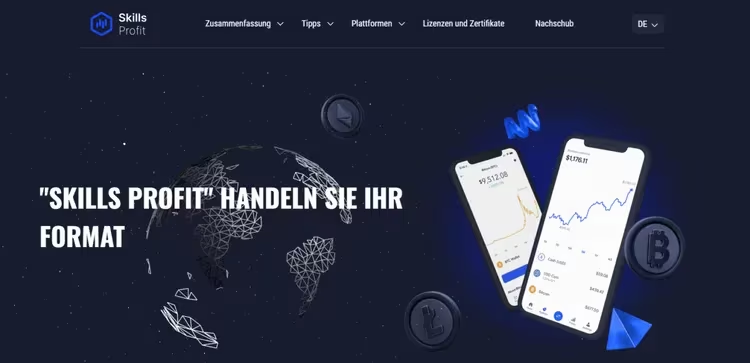
Skills Profit presents itself as a platform for traders with its own training. The description of the Skills Profit service names three things: training traders from scratch, materials on risk management, and a free practice account.
According to the service's description, the training covers the basics of trading and helps you develop your own style. The practice account lets you get to know the platform before real money enters your trades. The company also states that it constantly updates its services and tools.
These are the platform's own claims. At the time of writing (10/2026), its website would not open for us, so we do not give account terms, fees, leverage size, or license details. You need to get this information from the company itself and check it against the regulator's register. How to do that is described below.
How to check a trading platform before signing up
The check takes less than an hour and requires no special knowledge. It answers the question of who exactly you are entering into a contract with.
What to check | Where to look | Warning sign |
|---|---|---|
Legal entity | the legal notice section and the user agreement | only a brand name is given, with no company or address |
Regulator's authorization | the register of the supervisory authority in the country of registration | the license number is not found in the register |
Risk warning | the home page and the sign-up form | promises of income instead of a warning |
Withdrawal terms | the contract and the fee schedule | fees and processing times are not stated |
Contact method | the contract, the legal notice | communication only through a messenger app |
In Germany, you can check the authorizations of financial firms in the company database of the supervisory authority BaFin (Unternehmensdatenbank on bafin.de, checked 10/2026): you search by company name and it shows the firm's authorizations. In other EU countries, such registers are kept by the national supervisory authorities. A company from outside the EU may operate under the rules of its own jurisdiction, and retail client protection there is usually weaker.
Read the risk warning separately. European rules require a provider of contracts for difference to state the share of its clients who lose money. If there is no such figure on the website, that is a reason to ask a question before you register.
Which restrictions protect retail clients in the EU
The European regulator ESMA agreed a package of measures for retail clients in 2018. As stated in the ESMA press release of March 2018, the trigger was data from national supervisory authorities: between 74 and 89% of retail accounts lost money, and the average loss per client ranged from €1,600 to €29,000.
The package includes five measures:
- leverage limits when opening a position;
- a rule for the forced closing of positions when margin falls;
- negative balance protection: a client does not lose more than they deposited in the account;
- a ban on bonuses and other incentives to trade;
- a standard risk warning with the share of unprofitable accounts.
These rules apply to companies that serve retail clients in the EU. A platform from another jurisdiction may offer higher leverage and bonuses for deposits. That is not an advantage but a sign that European protection does not apply to you.
What a practice account teaches and what it does not
A practice account, or demo account, runs on virtual money. It is useful for three tasks: learning the interface, understanding how margin and fees are calculated, and testing your own rules for entering and exiting a trade.
A demo account has its limits. It does not reproduce emotions. A person who calmly closes a losing trade with virtual money often behaves differently when their savings are in the account. A good result on a practice account does not predict a result on a real one.
Assess the platform's own training soberly too. A trading venue earns money from client activity, and its courses are written from that standpoint. Supplement them with independent sources: regulators' materials and textbooks on markets and risk management.
How to assess your own risk
Risk management begins before the first trade. Experienced market participants determine three figures in advance:
- Total budget. This is money whose loss will not affect your essential expenses and your reserve.
- Risk per trade. This is the share of the budget you are prepared to lose in a single position. The smaller it is, the longer you stay in the market through a string of losses.
- Exit point. This is the price level at which a position is closed at a loss without second thoughts.
Do not use borrowed money or funds set aside for housing, medical care, or education. If after a loss you feel the urge to win it back quickly with a large trade, stop: that is exactly how retail clients lose their entire deposit.
⁉️🤔 Frequently asked questions
What is margin trading in simple terms?
You open a position larger than your own funds, and the broker covers the difference. Your contribution serves as collateral and is called margin. Profit and loss are calculated on the whole position, so even a small price move noticeably changes your account balance. If the collateral runs short, the broker closes the position by force.
What is known about the Skills Profit platform?
According to the service's description, Skills Profit offers trader training, risk management materials, and a free practice account. In October 2026, the platform's website would not open for us, so we do not give fees, leverage, or license details. You should request this information from the company and check it against the regulator's register.
How do I check whether a platform has a license?
Find the name of the legal entity and the authorization number in the user agreement. Then check them in the register of the supervisory authority of the country where the company is registered. For Germany, that is the BaFin company database. If the company is not in the register or refuses to name its legal entity, you should not open an account.
How many retail clients lose money trading with leverage?
According to national regulators' data cited by ESMA, between 74 and 89% of retail accounts with contracts for difference lose money. Providers of such products in the EU must show their own share of unprofitable accounts in the risk warning. Compare this figure across different companies.
Is a practice account enough to start trading?
No. A practice account helps you learn the platform and the mechanics of trades, but trading virtual money does not trigger the emotions a real loss does. Besides practice, you need an understanding of the market, written risk rules, and an amount whose loss you can absorb without consequences for everyday life.
In short: what to check before opening an account
Margin trading remains a high-risk instrument, and regulators' statistics confirm it. The training and practice account that Skills Profit reports are useful as an introduction to the mechanics. They do not change the math of leverage.
- Company: legal entity, country of registration, authorization in the regulator's register.
- Terms: leverage, fees, withdrawal rules, a risk warning with the share of unprofitable accounts.
- Practice: a practice account to get to know the platform, with no conclusions about future profit.
- Budget: only spare money and a loss limit set in advance.
Check the company's details against the register before you make your first payment. This step is free and protects you better than any strategy.

A small editorial team writing guides for independent travel. We travel ourselves, but we haven’t been everywhere, so we check prices, opening hours and how to get there against official sources.