
















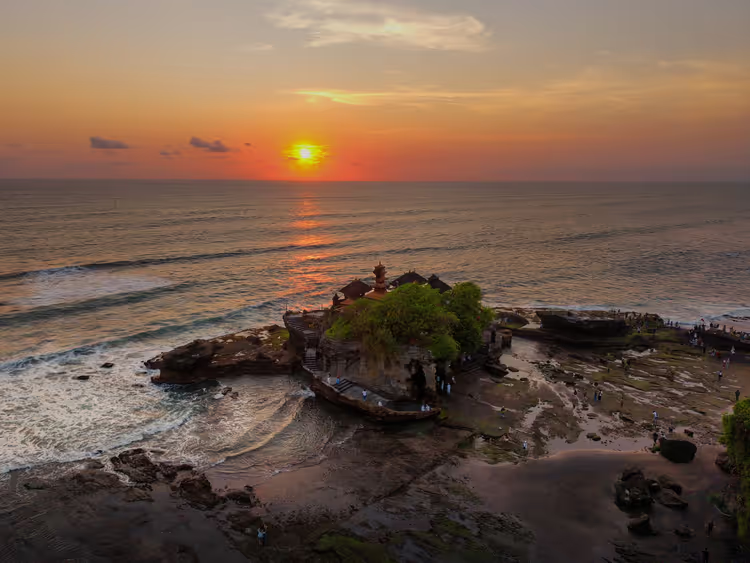
Pura Tanah Lot: when low tide opens the path to the temple in the ocean
Pura Tanah Lot stands on a rock right in the ocean. The temple is located on the southwestern coast of Bali, and you can only reach it on foot at low tide. So it's worth arriving at low tide: the water recedes and reveals a sandy path to the foot of the shrine. Low tide doesn't coincide with sunset every day. Pura Tanah Lot is one of the island's seven main sea temples, and its name translates from Balinese as "land in the sea."
Below we'll cover the history of the shrine, the legend of the snakes, the best time to visit, and the route from Kuta and Ubud.
Ad: this article contains affiliate links, we earn a commission from them, the price for you stays the same.
What to consider before visiting
💡 In short:
- The temple is open daily, and entry for foreign tourists is paid.
- You can only reach the rock at low tide.
- Best time to visit: early morning or sunset.
The park around the shrine is open every day. Check the exact schedule and ticket price at the entrance: tickets are sold only on site, and some ticket offices accept cash only.
The area is open and sunny, with few trees and little shade. Bring water and a hat, and it's better to cover your shoulders and knees: that's the custom at active Hindu shrines. A purification ritual at the entrance is performed for a donation. It's voluntary, and only you decide whether to take part.
History of pura tanah lot
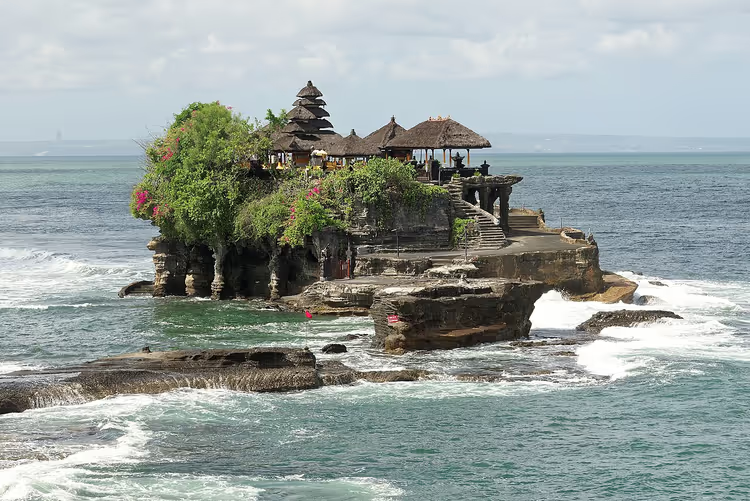 © Jakub Hałun · CC BY-SAPhoto: Jakub Hałun, CC BY-SA (https://creativecommons.org/licenses/by-sa/4.0), Wikimedia Commons
The temple was built in the 16th century. Its founder is considered to be the Brahmin Nirartha, who arrived in Bali from Java and created a network of sea temples along the island's coast (as of 09/2026, Wikipedia).
The shrine was placed on a rock by the shore to protect the island from storms and evil forces of the sea. Nirartha is still revered in Tanah Lot today as the patron of this place.
By the 1980s, the rock under the temple had begun to erode, and the foundation became unsafe for visitors. The Japanese government then provided Indonesia with a loan to reinforce the shrine and other significant sites on the island (as of 09/2026, Wikipedia).
During the restoration, builders replaced more than a third of the rock with artificial stone. The concrete was treated and tinted so it wouldn't differ from natural coral, so traces of the repair are almost nowhere visible (as of 09/2026, Wikipedia).
Tanah Lot is among the most visited places in Indonesia: on average about 500,000 tourists a year (as of 2019, Wikipedia).
A souvenir market, parking lot, and cliffside restaurants have grown up around the temple.
How the temple is arranged
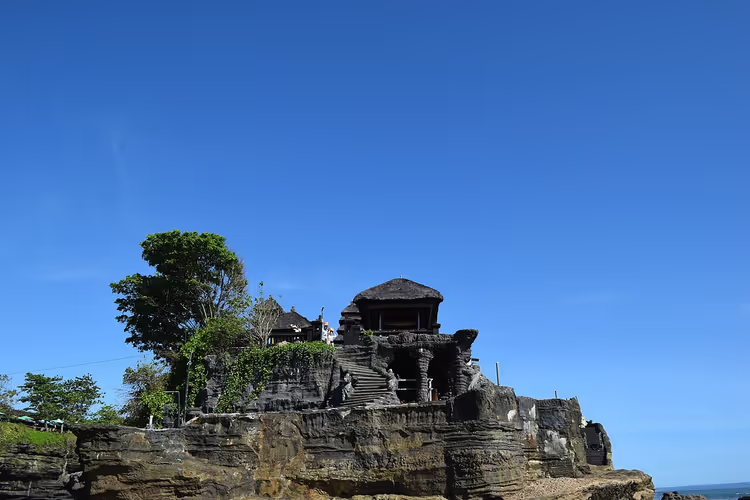 © ::::=UT=:::: · CC BY-SAPhoto: ::::=UT=::::, CC BY-SA (https://creativecommons.org/licenses/by-sa/3.0), Wikimedia Commons
The rock on which the shrine stands has taken on the shape of a ship over the centuries, because it was constantly worn away by the waves of the Indian Ocean. The temple consists of two tiers: the first is carved directly into the rock, and the second is built in the traditional style and serves as the altar.
The structures resemble a sacred pagoda, which represents Mount Meru, the dwelling of the higher gods. The complex is decorated with images of Hindu deities, and the main god of the temple is considered to be the sea lord Bhatara Segara.
Striped sea snakes live in the cracks of the rock, and local Hindus believe they guard the shrine from enemies. A spring flows from under the rock, and its water is considered healing.
Two viewing platforms are set up next to the temple. They offer views of the ocean, neighboring rocks, and the sunset, which is photographed here most often.
The legend of Nirartha and the snakes
Several versions of one legend are connected to the temple's history. According to one, the Brahmin priest Nirartha saw this place in a dream and decided that the land was sacred, so a temple should be built here to worship the sea gods.
According to another version, the Brahmin noticed a light emanating from a spring at the foot of the rock. Local residents drove the stranger away, and then Nirartha, by the power of his mind, separated a part of the shore and carried it out to sea.
The shrine is guarded by snakes. The largest guardian, according to legend, the priest created from his own scarf, and its venom is considered stronger than that of a cobra.
Practical tips for tourists
Tourists are allowed only on the first tier. Visitors are not allowed to the altar, because it is an active place of prayer. You'll be allowed to climb a few steps and photograph the gate.
Plan your visit for low tide. The water recedes and exposes a narrow isthmus of sand and stone that connects the rock to the shore. Walking along it is easy, but your shoes may get wet up to the ankle.
Come at opening time or at sunset: in the evening people gather here for beautiful shots, but the crowds also grow.
Where it is and how to get there
The temple stands in the village of Beraban in the Tabanan regency, on the southwestern coast of Bali. The rock lies 20 km northwest of Denpasar and 13 km south of Tabanan (Wikipedia, 09/2026).
From Kuta and Ubud, people travel here along the western coast. Most tourists get there by scooter or as part of a tour group on a bus, and a local taxi will take you right to the parking lot at the entrance.
For an extra fee, the driver will wait for you to return after your visit. If you're driving a rental car, leave it in the parking lot: from there you walk to the entrance through the souvenir market.
Pura Tanah Lot on the map
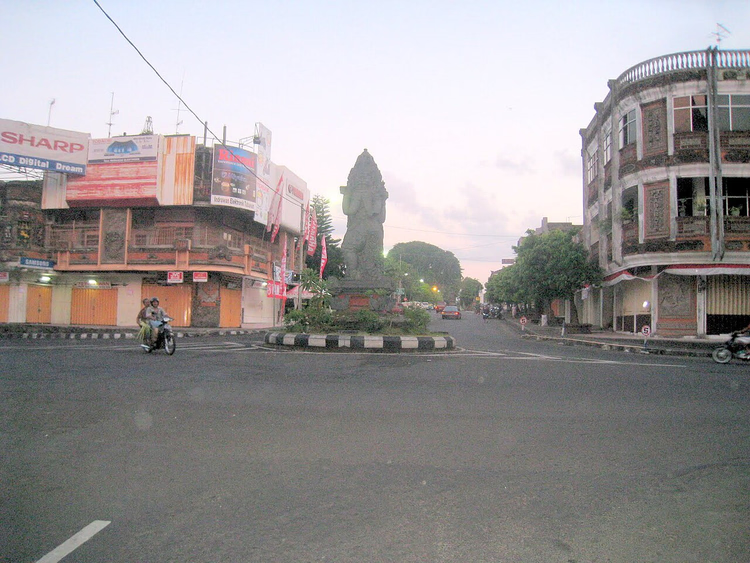 © alfannahdi · CC BY-SAPhoto: alfannahdi, CC BY-SA (https://creativecommons.org/licenses/by-sa/3.0), Wikimedia Commons
It's convenient to open the point in a separate window: Open on map. 300 m north of Tanah Lot stands the neighboring temple Pura Batu Bolong, which is often visited along the way (as of 09/2026, Wikipedia).
⁉️🤔 Frequently asked questions
Can you go inside the temple?
The inner areas of Pura Tanah Lot are open only to Hindu worshippers.
When is the best time to visit Tanah Lot?
Come early in the morning or at sunset. In the morning there are few people and soft light, and in the evening people gather for the view of the sun over the ocean.
How to get to the temple from Kuta and Ubud?
From both cities, people travel along the western coast of Bali. You can take a scooter, a local taxi, or a bus tour with transfer. The road passes through rice fields and villages, and in the evening there are often traffic jams on the approaches to the temple because of the sunset.
What to do during high tide?
At high tide the sandy isthmus goes underwater, and you can't reach the rock. At that time, people get to the temple by boat or jet ski. Most tourists still come at low tide to walk across the isthmus and photograph the temple from the shore.
How much does entry cost and how do you buy a ticket?
Entry for foreign tourists is paid, and tickets are sold at the entrance, with some ticket offices accepting cash only. There is no online booking for the site. Check the exact price and opening hours on site before your trip.
Tours and tickets in Tanah Lot
Guided tours, skip-the-line tickets and activities — most offers can be cancelled free of charge.
See offers on GetYourGuideThe widget loads once you give your consent.
In short: what's worth booking
Pura Tanah Lot lies on the southwestern coast of Bali, and people come here for the sunset by the rock in the ocean. You can see the temple in a couple of hours, but beautiful shots only come with the right light and water.
- If you want to see the temple without crowds: go early in the morning and arrive at opening time.
- If you want sunset and the best shots: plan your visit for low tide and claim a spot on the viewing platform in advance.
- If you're traveling without a car: choose a tour with transfer so you don't have to find the way yourself.
It's more convenient to book a temple tour with transfer in advance: browse tours on GetYourGuide.

A small editorial team writing guides for independent travel. We travel ourselves, but we haven’t been everywhere, so we check prices, opening hours and how to get there against official sources.