
















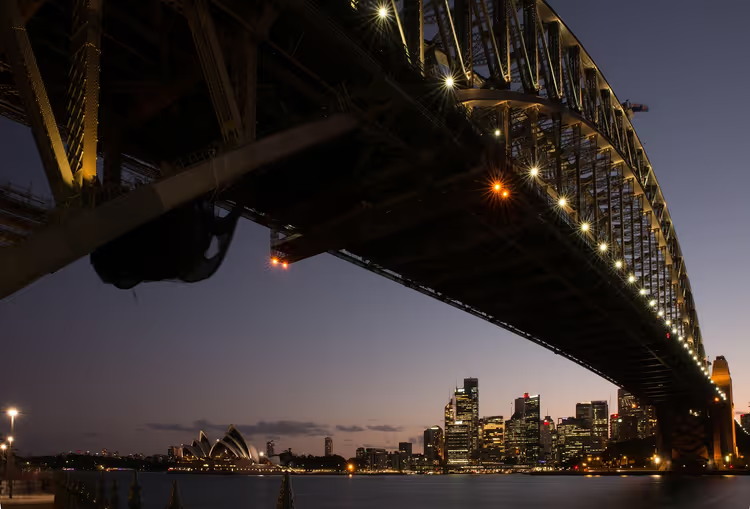
How to get to Australia: visa, tickets and travel within the country
Planning a trip to Australia on your own is easier than it seems. You choose the route, get the visa, and book tickets in advance. There are few nonstop flights from Europe, so the journey almost always involves one layover and takes about a day. The upside is that you arrive during the warm season, when it is already cold back home.
For EU citizens, a free electronic visa obtained online is enough for the trip. Other documents are also submitted online, with no visit to a consulate and no queues.
Below we cover flight routes, the booking process, getting around the country, and practical details about money and mobile service.
Ad: this article contains affiliate links, we earn a commission if you book through them, at no extra cost to you.
How to get to Australia
💡 In short:
- Apply online for a free eVisitor visa, subclass 651 (as of 09/2026, official website).
- Book a ticket with one layover via Dubai, Doha, or Singapore. This makes the journey shorter and usually cheaper.
- Plan for about a day of travel, and buy tickets several months before departure.
The only realistic way to get to Australia from Europe is by plane; a sea cruise takes weeks and costs significantly more.
There are few nonstop flights from Europe to Australia. Qantas flies nonstop from Perth to London and Paris, and seasonally to Rome. On the Perth-London route, scheduled flight time is 17 hours 50 minutes (as of 09/2026, flightsfrom.com). That is why almost everyone flies with one connection at a major hub.
 © Maksym Kozlenko · CC BY-SAPhoto: Maksym Kozlenko, CC BY-SA (https://creativecommons.org/licenses/by-sa/3.0), Wikimedia Commons
The main hubs on this route are Dubai (Emirates), Doha (Qatar Airways), Singapore (Singapore Airlines), Bangkok (Thai Airways), Hong Kong (Cathay Pacific), and Istanbul (Turkish Airlines). From there, you can connect to Sydney, Melbourne, Brisbane, Perth, and Cairns.
Choose a layover of no less than two hours and no more than eight. A short connection is easy to miss if the first flight is delayed, while a long layover simply means waiting it out at the airport.
It is more comfortable to fly in the low season, from March to May or from September to November. Tickets are cheaper then, and the weather in Sydney and Melbourne is mild, without exhausting heat.
Visa and documents
For the trip, EU citizens need an eVisitor visa, subclass 651. It is free, allows 3 months per entry, and is valid for 12 months (as of 09/2026, Australian immigration website). You fill out the application online, and a decision usually comes within a few days.
Your passport must be valid for the entire duration of the trip, and it is worth printing your ticket booking and accommodation confirmation: border officers sometimes ask for them.
Check your medical insurance separately. In Australia, medical care for tourists is expensive, and a policy covers treatment and flight cancellation. Before the trip, it is worth comparing insurance options.
How to book tickets
Tour operators include the ticket in a package and handle the booking themselves. When traveling independently, you do it yourself, so decide on the airline and exact route in advance.
Buy tickets several months before departure, while low fares are still available. Compare round-trip prices rather than one-way: a return ticket as part of a round-trip is almost always cheaper.
Check in advance not only the departure airport, but also the arrival city. International flights most often arrive in Sydney, Melbourne, Brisbane, Perth, Cairns, and Darwin.
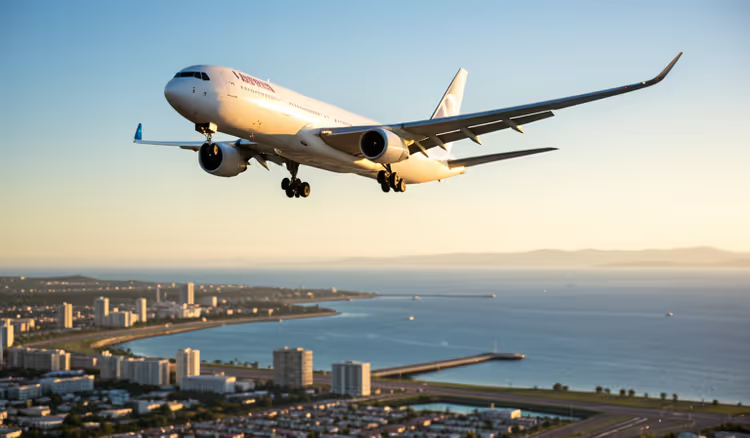 AIIllustrative image: AI-generated
To avoid overpaying, it's worth comparing flight prices on Kiwi.com in advance.
Getting around the country
Flying is the most convenient way to travel between major cities. The Sydney-Melbourne flight takes just 1 hour 25 minutes (as of 09/2026, flightconnections.com), with Jetstar, Qantas, and Virgin Australia operating the route.
Domestic tickets are often cheaper than they seem if you book them early. On the Sydney-Melbourne-Brisbane routes, prices are low due to competition among the three carriers.
Trains and cars work well when you want to see the country along the way. The train takes longer than a plane, but a car gives you freedom on the road. For a route along the Great Ocean Road, you can't do without a car.
Renting a car on long routes costs several times less than taxis. Compare options in advance, especially if you're traveling in high season: compare car rental prices.
What to see in Australia
Tourists are drawn by the warm climate, warm ocean waters, and the continent's nature. Some places should be planned in advance, otherwise you'll arrive during the rainy season or a surge of visitors.
The Great Barrier Reef stretches along the northeast coast and remains the largest coral reef system in the world. People come here for diving and snorkeling, and we've put together a separate breakdown of spots and islands: Great Barrier Reef.
You'll remember Port Campbell National Park on the Great Ocean Road for the Twelve Apostles rock formations. It's best to see them at dawn, before the tour buses arrive.
 © W. Bulach · CC BY-SAPhoto: W. Bulach, CC BY-SA (https://creativecommons.org/licenses/by-sa/4.0), Wikimedia Commons
Language, money, and connectivity
The official language in Australia is English. Due to migrants, many other languages are spoken in major cities, but English will be enough everywhere.
The country's currency is the Australian dollar (AUD). It's better to exchange money at bank branches and exchange offices at airports in major cities; hotels offer worse rates. The rate fluctuates, so check it before your trip on exchange-rates.org.
In major cities, you can pay by card almost everywhere. In rural areas, keep cash on hand: cards aren't always accepted there. Banks are open on weekdays and closed on Saturday and Sunday.
Fast internet without roaming is available with a travel eSIM: you stay connected from day one. Before your flight, it's convenient to set up an eSIM for Australia.
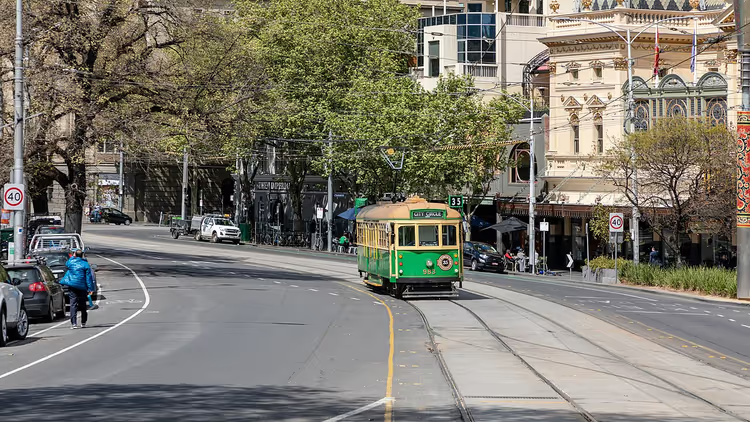 © Dietmar Rabich · CC BY-SAPhoto: Dietmar Rabich, CC BY-SA (https://creativecommons.org/licenses/by-sa/4.0), Wikimedia Commons
⁉️🤔 Frequently asked questions
Do I need a visa to travel to Australia?
EU citizens only need a free electronic visa, subclass 651. You apply online (as of 09/2026, immigration department website).
How long is the flight to Australia from Europe?
The trip with one connection takes about 24 hours. Qantas flies nonstop from Perth to London and Paris, and to Rome in season. The Perth to London flight takes 17 hours 50 minutes in the air (as of 09/2026, according to flightsfrom). That is why almost everyone flies with a connection in Dubai, Doha, or Singapore.
When is the best time to buy tickets?
Book tickets several months before departure, while low fares are still available. The cheapest time to fly is the low season, from March to May or from September to November. December and January, on the other hand, are high season with peak prices.
How much does a round-trip flight cost?
The price depends on the season and route. In the low season, a round-trip economy ticket costs noticeably less than in December and January. Compare round-trip fares: a separate return ticket is always more expensive than booking it as part of a pair.
Do I need a car within the country?
Between major cities, flying is easier and faster. You need a car for the national parks and the Great Ocean Road, where public transport is almost nonexistent. Book a car in advance, as the selection is smaller in high season.
In short: what to book
Australia is far away, so it is best to start preparing several months in advance. If you are flying for the first time: book a ticket with one connection via Dubai, Doha, or Singapore. If you are planning to visit the coast and parks: compare car rental options in advance. If you are going for a long time: add medical insurance.
And the first thing to book: compare flights to Australia on Kiwi.com.

A small editorial team writing guides for independent travel. We travel ourselves, but we haven’t been everywhere, so we check prices, opening hours and how to get there against official sources.