



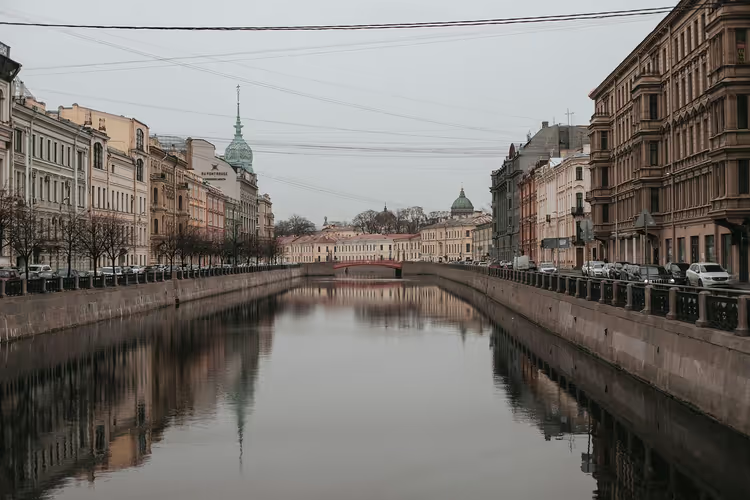
What to see in St. Petersburg: why we no longer create itineraries
The seven pieces of content that used to live at this address are gone. They included one-, two-, and three-day itineraries, a walk from one avenue to another, two large roundups of guided tours, and a list of the main attractions. The "Saint Petersburg in two days" piece was the city's main entry point on the old site.
The reason for deletion here is the most direct of any in this section. An itinerary and a guided tour are not a description of a city, they are a service, and guide services are named explicitly in the EU prohibition. There is not a single route, not a single sequence of sights, and not a single "start here" tip left in this material.
💡 At a glance:
- which seven pieces were deleted and what they had in common
- why guide services are named directly in the prohibition rather than inferred from a general formulation
- what else is in this city besides museums and embankments
- which Baltic and Central European cities remain in our live sections
- Last updated: 09/2026
Why we deleted these guides
Russia's full-scale invasion of Ukraine began on February 24, 2022. The itinerary pieces continued to live on the site after that date, and they continued to do their job: taking the reader from the idea of a trip to a trip plan. That is exactly the function we removed.
These seven pieces were also the main internal hub of the section: dozens of our other texts linked to "two days in the city," and the page itself worked as the city's entry point. Deleting such a hub means rewriting the site's internal links, and we did that deliberately: keeping an itinerary for the sake of navigation convenience would have been the worst possible argument.
The share of oil and gas revenue in Russia's budget fell to roughly 22 percent in 2025 and 2026, while the share of non-oil-and-gas revenue rose to roughly 78 percent (OSW Centre for Eastern Studies, 09.12.2025). The tour sector, museum tickets, transport, and food service fall into the second category.
Guide services are named directly in the prohibition
Usually, when it comes to sanctions rules, you have to explain why a specific activity falls under them. Here, that is not necessary. Council Regulation (EU) 2025/2033 of October 23, 2025 replaced paragraph 2 of Article 5n of Regulation 833/2014 with a direct prohibition on providing services directly related to tourism activities in Russia (EUR-Lex). The list of covered services includes travel agency and tour operator services, tour guide services, and related advertising services (Skadden, analysis of the 19th sanctions package, 11.2025).
The prohibition also covers online platforms and apps that enable booking, ticket sales, and visa assistance when connected to tourism (Fieldfisher). Our two deleted roundups were specifically about selecting excursions, including private ones, which means connecting the reader with a service provider.
The stated goal of the rule is openly declared: to reduce the revenue Russia receives from such services and to curb the promotion of non-essential travel and leisure in the country (Skadden, 11.2025). The transition period ended on January 1, 2026, and there are no exceptions after that date.
What else is in this city
An itinerary piece by definition shows a city from one side: facades, museums, embankments. It is worth naming what never made it into such an overview, even though it sits within the same city limits.
Saint Petersburg is home to the Admiralty Shipyards, which build diesel-electric and nuclear submarines, as well as the Almaz shipbuilding firm and the Almaz Central Marine Design Bureau. These enterprises are under sanctions (OpenSanctions, Admiralty Shipyards; U.S. Department of State, designations related to state military shipbuilding).
It is worth clarifying what we mean by this and what we do not mean. We are not claiming that a museum and a shipyard are connected to each other, and we are not transferring the sanctioned status of an enterprise onto the city or its residents. We are talking only about the completeness of the picture: the "two days in the center" genre creates the impression that the city is exhausted by its grand facade. A reader with no other sources gets exactly that idea of the place. A publisher who puts out such a text is responsible for that impression.
What this means for you as an EU reader
Item | Status 09/2026 | Source |
|---|---|---|
Guide services | Explicitly named among the services covered by the ban | |
Legal basis | Article 5n(2) of Regulation 833/2014 as amended by Regulation 2025/2033 of 23.10.2025 | |
Transition period | Ended 01.01.2026 | |
Online platforms and ticket sales | Covered by the ban when connected to tourism | |
German Foreign Office advisory | "Vor Reisen in die Russische Föderation wird gewarnt" | |
Payment cards | EU-issued cards have not worked in Russia since 10.03.2022 |
Where to go instead
The request was for a compact historic center you can cover in a weekend. The live sections of the site answer that: Finland with Helsinki, Poland with Gdansk and Krakow, Czechia with Prague, Germany with Berlin and Dresden, Austria and Hungary. The Baltic direction comes closest in atmosphere to what readers were looking for in the deleted routes, and there is a direct connection from Germany.
The general explanation of the editorial decision for the whole section is collected in the section hub. Related topics: our position on hotels and our position on parks and travel with children.
Where we stand
We believe a route is a finished service, not a genre of journalism, and that publishing routes through a country waging war against a neighboring state means doing the work of a travel agency. In our assessment, the argument for this text is even simpler than for the others in the section: guide services are explicitly named in the list covered by the ban, and there is nothing to argue about here.
We also do not reproduce deleted routes in the past tense and do not retell them "for the record": a retold route remains a route.
We write about a state and its policies, not about people based on their passport. There are people in Russia who came out against the war and received prison sentences for it. Our decision not to publish guides to Russia is about money, sanctions, and reader safety, not nationality.
Publication date: September 3, 2026. Last updated: September 3, 2026.
⁉️🤔 Frequently asked questions
Doesn't the ban apply to the text rather than to the guide's work?
We do not provide legal opinions. We proceed from the fact that the list of covered services includes both guide services and related advertising services, and that the stated purpose of the rule separately names the promotion of travel and leisure. Our routes performed both functions at once.
Is it still possible to write about the history and architecture of the city?
Yes, and we do not prohibit this for ourselves or for others. The distinction lies in the function of the text: writing about the city remains possible, a trip plan does not.
Why was the list of sights without a route also deleted?
Because for the reader it is the same preparation tool. A list of places with a description of what makes each one worthwhile works as a plan, even if the order of visiting is not specified.
What is now at the old addresses of these texts?
A permanent redirect to this page in all language versions, so that the reader gets an explanation and a list of destinations.
Why mention shipbuilding enterprises in a text about excursions?
To show that the city's showcase side does not exhaust it entirely, and that a guidebook that stays silent about this gives the reader an incomplete picture. We make no claims about the city's residents or about the enterprises themselves beyond the fact of their sanctions status.
In short
Seven routes and excursion guides for Saint Petersburg have been deleted. Guide services are explicitly named among the services covered by the EU ban, which applies without exceptions from January 1, 2026. We do not publish or retell the routes. The same city is home to shipbuilding enterprises under sanctions, which the previous texts did not mention. The Baltic and Central European cities we continue to write about are listed above.
How you can help
We do not collect money and receive nothing from the links below. These are official websites of organizations working with the consequences of the war:
- UNHCR, the UN Refugee Agency, unhcr.org
- UNICEF, unicef.org
- Ukrainian Red Cross, redcross.org.ua
Sources
- Council Regulation (EU) 2025/2033 of 23.10.2025 amending Regulation 833/2014, EUR-Lex. https://eur-lex.europa.eu/legal-content/EN/TXT/?uri=OJ:L_202502033
- Skadden, analysis of the EU's 19th sanctions package, including the list of covered services, 11.2025. https://www.skadden.com/insights/publications/2025/11/eu-adopts-19th-sanctions-package
- Fieldfisher, analysis of the EU's 19th sanctions package, 2025. https://www.fieldfisher.com/en/insights/the-eu-s-19th-sanctions-package-against-russia
- OpenSanctions, profile of JSC Admiralty Shipyards. https://www.opensanctions.org/entities/NK-oE9r7Kprj4NjHaDiL22jDg/
- U.S. Department of State, designations targeting Russian state-owned defense shipbuilding. https://2021-2025.state.gov/additional-state-department-designations-targeting-russian-state-owned-defense-shipbuilding-enterprise/
- Auswärtiges Amt, Russische Föderation: Reise- und Sicherheitshinweise, as of 02.09.2026. https://www.auswaertiges-amt.de/de/service/laender/russischefoederation-node/russischefoederationsicherheit-201536?isLocal=false&isPreview=false
- The Moscow Times, on Visa and Mastercard suspending operations, 06.03.2022. https://www.themoscowtimes.com/2022/03/06/visa-mastercard-suspend-operations-in-russia-a76784
- Centre for Eastern Studies OSW, Russia's 2026 budget, 09.12.2025. https://www.osw.waw.pl/en/publikacje/osw-commentary/2025-12-09/russias-2026-budget-mounting-financial-challenges-and-economic
Link check date: 03.09.2026.

A small editorial team writing guides for independent travel. We travel ourselves, but we haven’t been everywhere, so we check prices, opening hours and how to get there against official sources.