
















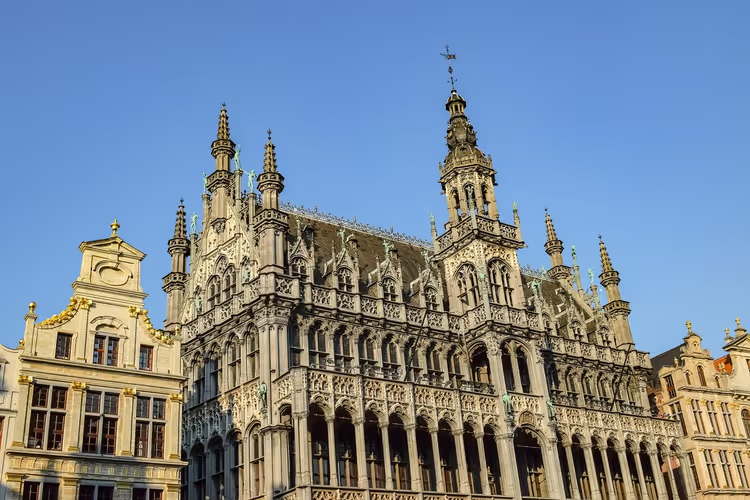
What to see in Brussels: 30 places, ticket prices and opening hours
Brussels is compact, and nearly everything important is in the center. In one day you can see the Grand Place, the Atomium, and a couple of museums. But the city has more than thirty sights, and without a plan you will get lost. We picked 30 main attractions, organized them by neighborhood, and added opening hours and ticket prices where official websites confirm them. A ticket to the Magritte Museum costs 13 € (as of 09/2026, official website). With this list you can put together a route for half a day or for two days.
Ad: this article contains affiliate links, we earn a commission if you book through them, at no extra cost to you.
1. Atomium
💡 In short:
- Set aside at least half a day for central Brussels, and another two to three hours for the Atomium and Mini-Europe park.
- Come at opening time: by midday, tour groups gather at the main sights.
- Prices and opening hours: 09/2026, verified on the Atomium page.
 © Zairon · CC BY-SAPhoto: Zairon, CC BY-SA (https://creativecommons.org/licenses/by-sa/4.0), Wikimedia Commons
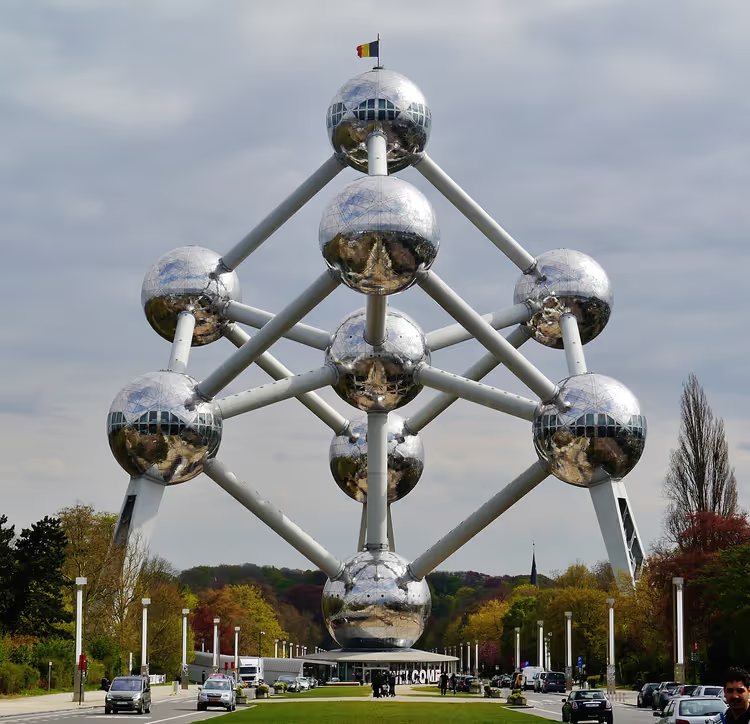
The Atomium monument was built for the Brussels World's Fair and soon became a symbol of the city. The structure replicates an iron molecule at a huge scale, and its designer André Waterkeyn put the idea of the peaceful atom into it. Nine spheres are connected by tubes, and each one serves its own purpose.
The top sphere works as an observation deck, with a view of the whole city. One sphere houses a small hotel, the central one has a cafe, and the rest are occupied by exhibition halls. The ticket also includes the neighboring Design Museum Brussels (as of 09/2026, Wikipedia). The Atomium is open every day from 10:00 to 18:00, with the last entry at 17:30.
You can get there by metro to Heizel station, about fifteen minutes from the center (by map). Critics still argue about the monument's beauty, but Belgians love it. Come at opening time: by midday a line already forms at the ticket office.
The monument was conceived as the main pavilion of the fair and as a symbol of the peaceful use of atomic energy. One American TV channel even called it the most bizarre building in the world, but locals see it differently and love the monument. You can move from hall to hall through the tubes between the spheres, and the top point offers a panorama of the city. The Atomium is not in the center, so set aside a separate time slot for the trip and check the schedule on the official website: on certain dates it has special hours.
2. Mini-Europe park
 © Gellerj · CC BY-SAPhoto: Gellerj, CC BY-SA (https://creativecommons.org/licenses/by-sa/3.0), Wikimedia Commons
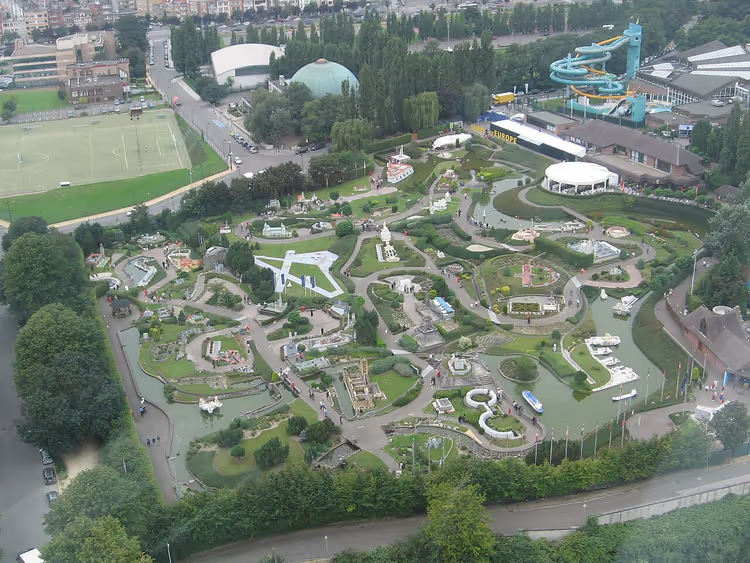
Next to the Atomium lies Mini-Europe park, where all of Europe is gathered in miniature. On a small area, iconic sites from eighty cities fit together: town halls, castles, towers, and entire streets. The park opened in the late eighties, but it has not lost its popularity.
In a couple of hours you can walk around several hundred models. Many of them come to life: miniature gondolas float through Venice, Vesuvius erupts, windmills wave their blades. Buttons trigger anthems and bell ringing, so children are definitely not bored here. The route follows the map of Europe: it starts in Denmark and ends in Spain and Portugal.
An adult ticket costs from 21.70 € online and 25 € on site (as of 09/2026, minieurope.com). Children taller than just over a meter pay less, and toddlers enter free. In autumn the park is open from 10:00 to 18:00, with the last entry one hour before closing.
3. Basilica of the Sacred Heart
 © Giles Laurent · CC BY-SAPhoto: Giles Laurent, CC BY-SA (https://creativecommons.org/licenses/by-sa/4.0), Wikimedia Commons
The Basilica of the Sacred Heart is considered one of the tallest art deco structures in the world. It was founded for the country's anniversary and took almost a hundred years to complete, so its appearance mixes different architectural styles. King Leopold II laid the first stone in the foundation.
He was a passionate admirer of Paris and dreamed of making Brussels resemble the French capital. That wish is reflected in the basilica's architecture. Construction dragged on, but now the mix of styles is considered its advantage. Inside, there is an exhibition and a large collection of treasures.
Above the altar hangs a painting by Georges Minne depicting Jesus blessing. The church has nine chapels, exactly the number of provinces of Belgium. Under the dome there is an observation deck: on a clear day you can see the city, the countryside, and even Antwerp from here. Bring binoculars, otherwise you will not be able to make out the small details.
4. Town hall
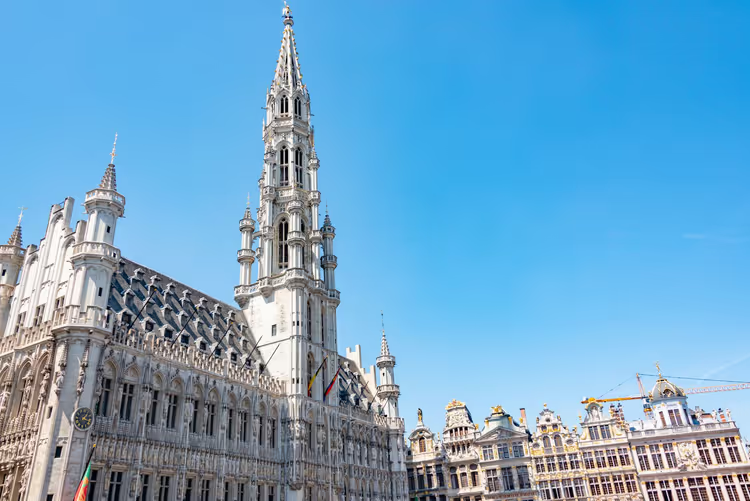
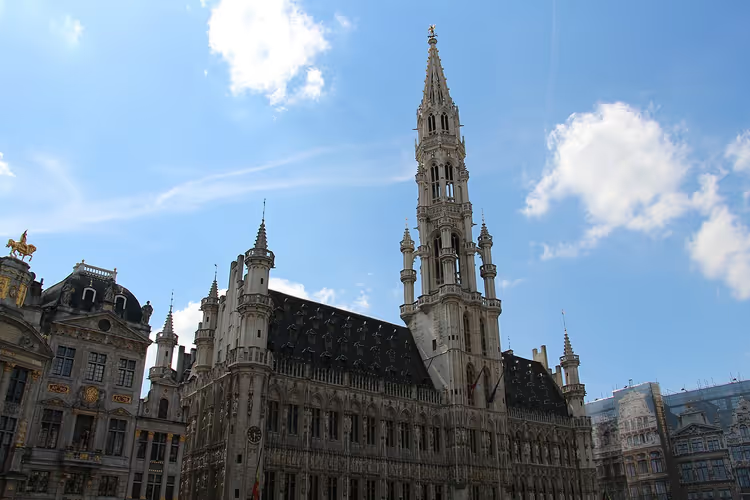
Brussels' town hall has served its original purpose for several centuries: the city administration meets here. It is the last medieval building on the main square, all the others have either been destroyed or rebuilt. You will see a fine example of Gothic architecture, which is what draws architecture lovers here.
At the top of the tower stands a statue of Michael the Archangel, about five meters tall. The saint seems to guard the square and the entire city. The facade is decorated with sculptures of notable citizens from past centuries: nobles and saints. There are more than a hundred of them, but the ones on the building today are only copies, while the originals are kept in the city museum.
The town hall stands on the Grand-Place, so it is easy to include it in your first walk around the center. In the evening, the facades of the square are illuminated, and the Gothic architecture looks especially striking. Look at the tower from a distance: up close the details get lost, while from the square you can see the whole composition.
5. Grand Market
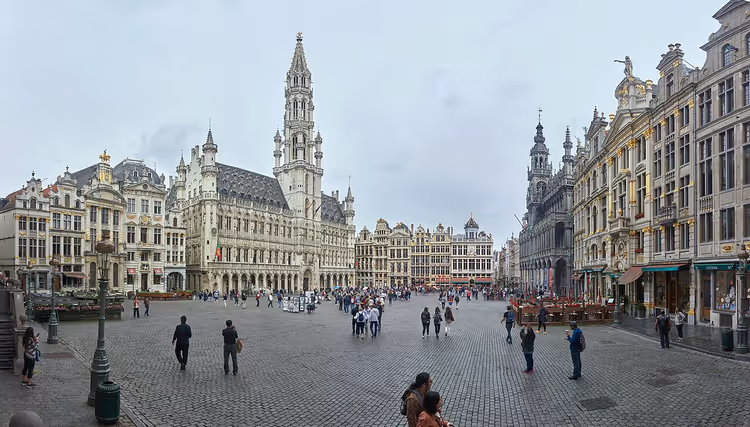 © Celuici · CC BY-SAPhoto: Celuici, CC BY-SA (https://creativecommons.org/licenses/by-sa/4.0), Wikimedia Commons
The Grand Market, also known as the Grand-Place and Grote Markt, serves as the tourist heart of the city. In past centuries, trade took place here, and today the square hosts the famous Christmas market. Around it stand the Gothic town hall and the Breadhouse, which the French call the King's House.
The square is surrounded by six guildhalls, each built in its own style. Every two years in summer, a huge flower carpet is laid out here, drawing visitors from all over Europe. In the evening, the facades are illuminated, and the light shows are best viewed in the dark. Around the square there are many hotels, cafes, and souvenir shops, so you will easily find a place to take a break.
6. Museum of Cocoa and Chocolate
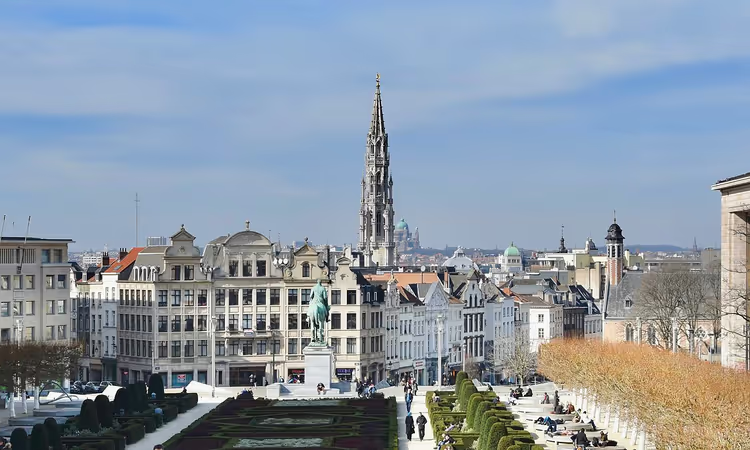 © Ank Kumar · CC BY-SAPhoto: Ank Kumar, CC BY-SA (https://creativecommons.org/licenses/by-sa/4.0), Wikimedia Commons
The Museum of Cocoa and Chocolate tells the story of the beloved treat and lets you taste it. The exhibition spans two floors: it shows how cocoa beans were used and how production technologies changed over time. Everything is laid out on posters and diagrams, not just in words.
A separate room is dedicated to chocolate creations: large sculptures, figurines, candies, and bars. The first chocolate candies were invented right here in Brussels, and the museum is proud of that. Visitors can sign up for a workshop and make several items with their own hands, while also learning what sets Belgian chocolate apart from the rest.
7. Manneken Pis
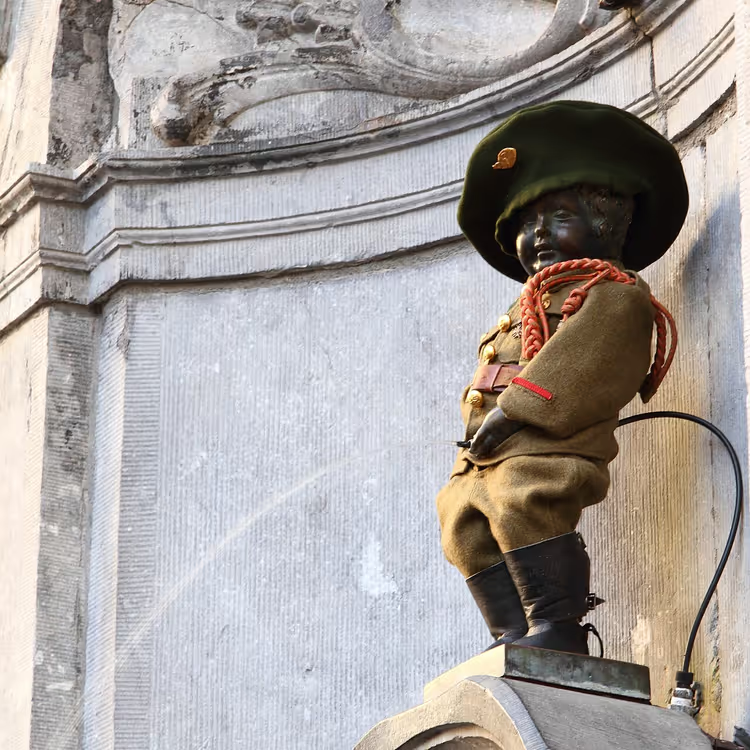 © Harald Hoyer from Schwerin, Germany · CC BY-SAPhoto: Harald Hoyer from Schwerin, Germany, CC BY-SA (https://creativecommons.org/licenses/by-sa/2.0), Wikimedia Commons
Manneken Pis has become the city's most famous fountain, even though it stands just over half a meter tall. The sculpture was created by Jerome Duquesnoy, and it has adorned the street since the seventeenth century. A chubby naked toddler pees into the fountain while tourists gaze up at him.
The boy is not always naked: the statue is dressed in costumes for various occasions, and the changing of outfits has long become a city tradition. The entire collection of clothing is displayed in the City Museum, where almost a thousand items are exhibited. The fountain itself is fenced off to protect the sculpture from damage. Come in the morning: during the day there is always a crowd here.
8. Monument to Charles Buls
 © Fred Romero from Paris, France · CC BYPhoto: Fred Romero from Paris, France, CC BY (https://creativecommons.org/licenses/by/2.0), Wikimedia Commons
The monument depicts an elderly man with a small dog, and it is dedicated to Mayor Charles Buls. This man defended the historic character of the center and saved the Grand-Place, which King Leopold II wanted to redevelop. The mayor allocated funds for the restoration of the old buildings on the square.
Buls fought for bilingualism: under him, police officers were required to speak Dutch and French, and city signs were duplicated in both languages. The monument was funded by the citizens themselves, with no money from the state. This is a rare case where the people themselves decided to honor a public official.
9. Mount of the Arts
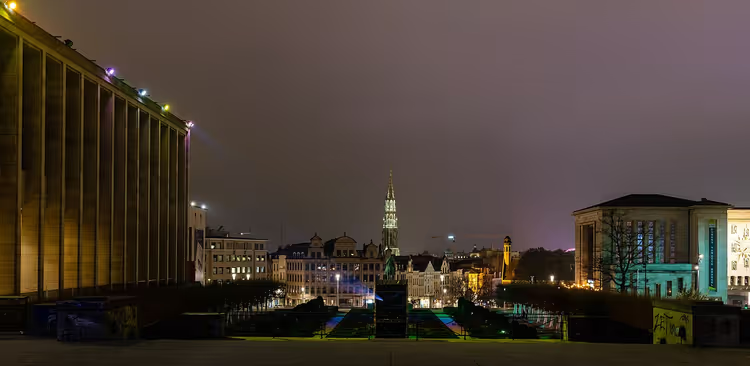 © Diego Delso · CC BY-SAPhoto: Diego Delso, CC BY-SA (https://creativecommons.org/licenses/by-sa/4.0), Wikimedia Commons
The Mount of the Arts, or Mont des Arts, lies between the Royal Palace and the parliament building. This was once a densely populated district, then the buildings were demolished and the site stood empty for a long time. Later a garden was laid out here, several structures were built, and a viewing platform was arranged between them.
You can climb the hill by a beautiful staircase with fountains. At the top are the city's most important art museums, which is how the place got its name. The Mount of the Arts is a convenient starting point for combining a walk in the park, a museum visit, and sightseeing.
On a clear day you can see the Basilica of the Sacred Heart and the Atomium from here. In the evening the buildings are illuminated and everything shimmers in different colors. Come at sunset: that is when you will get the best shots of the center without the daytime bustle. In the morning it is quiet here, and the platform is easy to find by the wide staircase from Place Royale.
10. Cathedral of St. Michael and St. Gudula
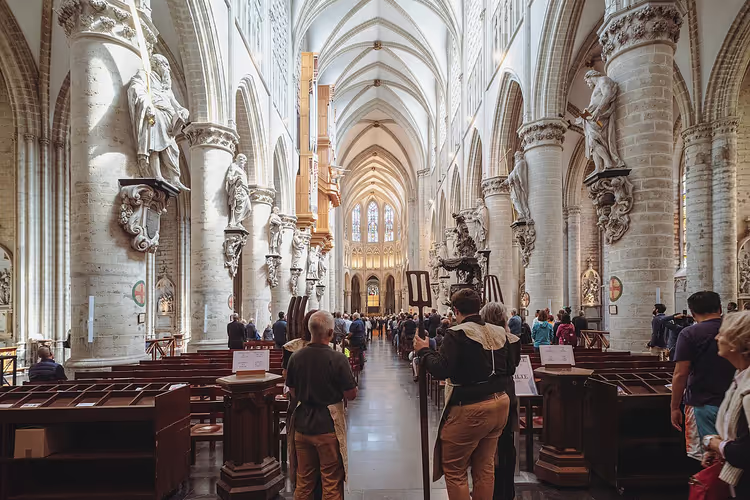 © Flocci Nivis · CC BYPhoto: Flocci Nivis, CC BY (https://creativecommons.org/licenses/by/4.0), Wikimedia Commons
The Cathedral of St. Michael and St. Gudula was built over several centuries, so it combines Gothic austerity with rich decoration. It was dedicated to Saints Michael and Gudula, the patron saints of Brussels. The facade with its staircase and two identical towers was designed by the architect Jan van Ruysbroeck.
The interior is striking for its stained glass and sculptures. The vivid, realistic stained glass was created by Bernard van Orley, and the church contains many statues of kings and saints. In the north transept you will see statues of Louis II and Mary, and the Chapel of the Blessed Sacrament is worth a longer stop.
Under the stone vaults of the cathedral it is easy to feel the silence and scale of the building. Stop by in the first half of the day: there is more light and the stained glass plays more brightly. Admission is generally free, but during services tourists are asked to be quiet and not disturb worshippers.
11. Palace of Charles of Lorraine
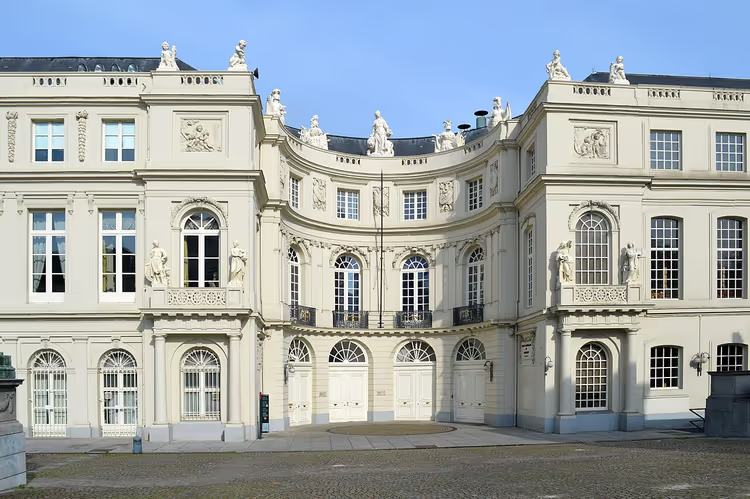
The palace was built by Charles of Lorraine, governor-general of the Austrian Netherlands. He erected the building to his own taste and in the spirit of the fashion of the time. The result is a fine example of neoclassicism that still delights lovers of antiquities.
In the state hall you can examine a star made of different kinds of marble, and in the lobby the bas-reliefs depicting the four elements draw the eye. The imposing staircases are made of marble and wood, and the centerpiece is a sculpture of Hercules by Laurent Delvaux. Today the building houses a museum of eighteenth-century daily life and art.
On display are tableware, silver dishes, rare Chinese porcelain services, musical instruments, and interior details from past centuries. At the end of the eighteenth century the palace was looted by marauders, so most of its treasures are lost forever. Only a few rooms remain untouched, and you can cover them in about an hour.
12. Place Royale
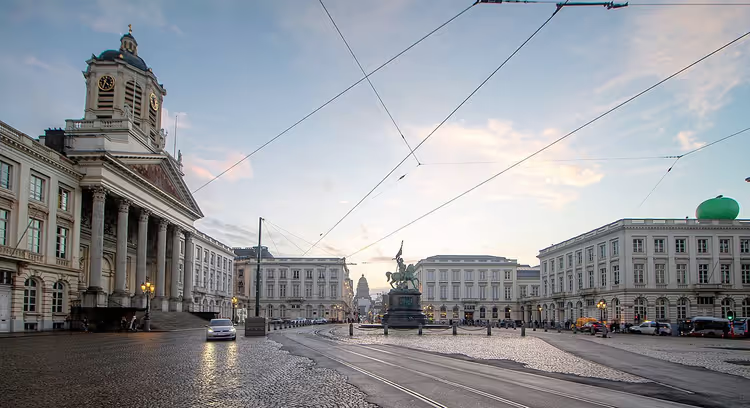 © VitVit · CC BY-SAPhoto: VitVit, CC BY-SA (https://creativecommons.org/licenses/by-sa/4.0), Wikimedia Commons
Place Royale was laid out in the eighteenth century on the site of a burned-down palace of the Belgian kings. It echoes the look of Parisian squares because it was modeled on them. Today important neoclassical buildings stand around it.
In the center of the square you will find a monument to Godfrey of Bouillon. Nearby are the central park, the Royal Palace, and the Church of St. James. Around the perimeter stand buildings that give the place a ceremonial air and recall the French influence.
Official ceremonies took place on this square: Napoleon was honored here, the accession of William I was celebrated, and Leopold I, the first king of independent Belgium, took his oath here. The anniversary of his reign was also lavishly celebrated here. Walk across the square in the morning: the light is soft and there are noticeably fewer tourists.
13. Royal Palace
 © Diego Delso · CC BY-SAPhoto: Diego Delso, CC BY-SA (https://creativecommons.org/licenses/by-sa/4.0), Wikimedia Commons
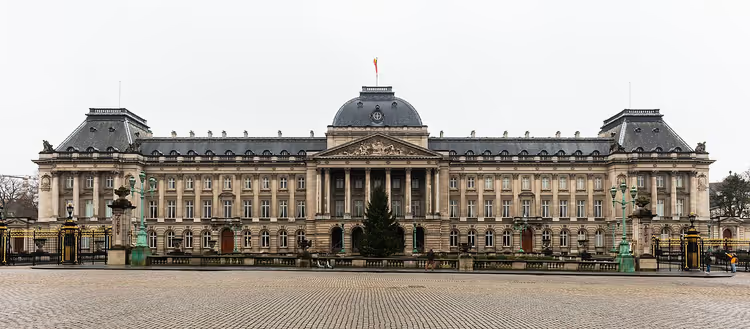
The Royal Palace is surrounded by neoclassical buildings, and a small park is laid out in front of the entrance. Because of this ensemble, the palace is considered the most popular spot for photo shoots in the city. It serves as the residence of the royal family.
If the national flag is raised above the roof, the monarch is inside. A walk nearby gives you a chance to see a real royal personage, at least from a distance.
It is pleasant to stroll near the palace in good weather and imagine times past.
14. BELvue Museum
 © Diego Delso · CC BY-SAPhoto: Diego Delso, CC BY-SA (https://creativecommons.org/licenses/by-sa/4.0), Wikimedia Commons
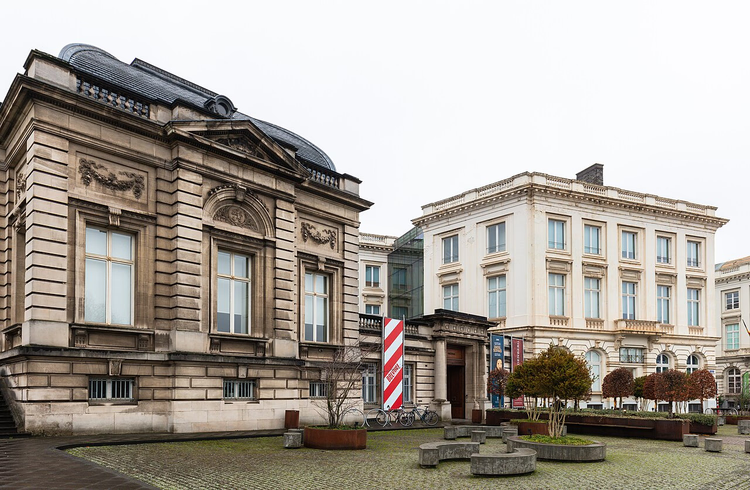
The BELvue Museum is interesting from four angles at once: its exterior decoration, its interiors, the view from the terrace, and its cellars. The building is in the classical Baroque style, so architecture lovers will study the balustrade, decorative garlands, and cornices. Kings lived here, and Princess Joséphine-Charlotte was born in one of the rooms.
Three floors are devoted to exhibitions about the country's history. You walk through them in chronological order and see how Belgium became a separate state. The rooms retain original furniture and interior items from past centuries.
The terrace offers beautiful views: from here you can clearly see the Mount of the Arts and Brussels Park. The name Bellevue translates as "beautiful view," and that is honest. Only here can you see the original foundations of the palace of Charles V, and the cellars display finds made during excavations.
15. Royal Library of Belgium
 © EmDee · CC BY-SAPhoto: EmDee, CC BY-SA (https://creativecommons.org/licenses/by-sa/4.0), Wikimedia Commons
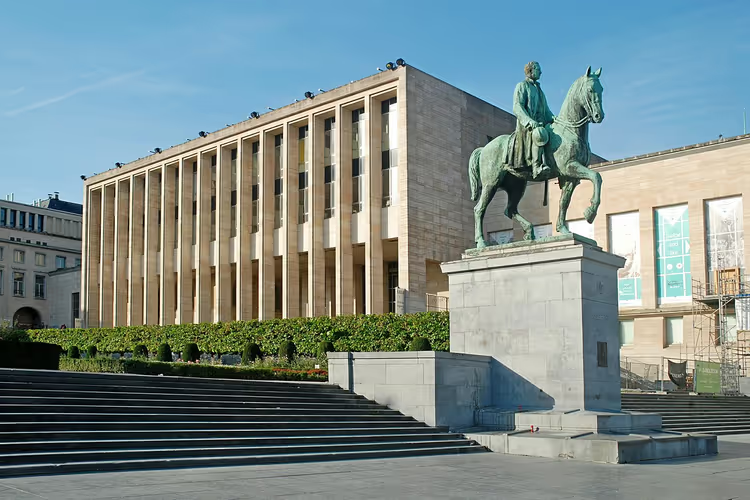
The Royal Library of Belgium stands on the Mount of the Arts and serves as the repository of the country's literary and academic heritage. It is a reference library: books are not lent out, and they can only be read in the reading rooms. Belgians affectionately call it the Albertine after King Albert I, whose monument stands nearby.
Books began to be collected here as early as the fifteenth century, and today the collection has become enormous. The holdings include about eight million printed items, among them many medieval manuscripts and handwritten documents. The library keeps copies of all books published in the country, as well as foreign publications by Belgians.
Take a look at the unusual departments, such as the numismatic one. There you will see old coins and even weights for weighing money. There is also a book museum, which is worth visiting if you are interested in the history of printing.
16. Royal museums of fine arts
 © Suicasmo · CC BY-SAPhoto: Suicasmo, CC BY-SA (https://creativecommons.org/licenses/by-sa/4.0), Wikimedia Commons
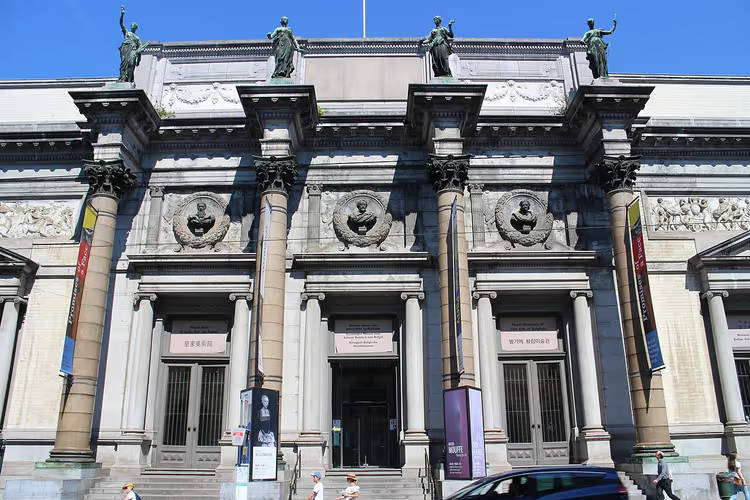
The Royal Museums of Fine Arts hold more than twenty thousand works, and seeing them all will take a full day. The collection includes paintings by Peter Paul Rubens, Anthony van Dyck, and other masters. A significant part of the collection was brought from the Louvre, which confirms the world-class standing of the holdings.
The fine arts are not gathered in a single building but in an entire consortium. It includes the Magritte Museum and several wings with art from different centuries: old masters, modern art, and art from the turn of the nineteenth and twentieth centuries. There are also two branches devoted to Constantin Meunier and Antoine Wiertz.
A ticket to the Oldmasters Museum costs €13, the Magritte Museum costs the same, and a combined ticket will run you €20 (as of 09/2026, official website). On the first Wednesday of the month after 1:00 PM, admission to the permanent collections is free. Brussels Card holders get access to the permanent exhibitions at no extra charge, while temporary exhibitions are paid separately. It is convenient to buy tickets in advance: Royal Museums tickets on Tiqets.
17. Magritte Museum
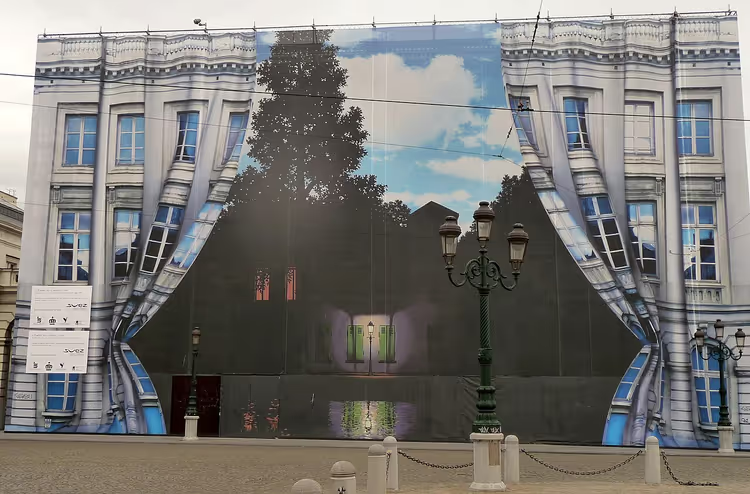
The Magritte Museum is worth visiting if surrealism speaks to you. It houses around two hundred original paintings by the artist, the largest collection of his work in the world. Many of the paintings came from private collectors.
 © Warburg · CC BY-SAPhoto: Warburg, CC BY-SA (https://creativecommons.org/licenses/by-sa/3.0), Wikimedia Commons
You can buy a separate ticket or use the combined ticket for all the Royal Museums of Fine Arts. In addition to paintings, you will see Magritte's surrealist films and his experiments in sculpture and photography, as well as sketches and drafts of future works.
The building itself also draws attention. The plain gray facade is covered by a bright canvas, as if a curtain into another world is being pulled back. Plan for at least an hour and a half: there are many rooms, and you will easily linger in front of familiar images.
18. Museum of musical instruments
 © chibicode · CC BY-SAPhoto: chibicode, CC BY-SA (https://creativecommons.org/licenses/by-sa/2.0), Wikimedia Commons
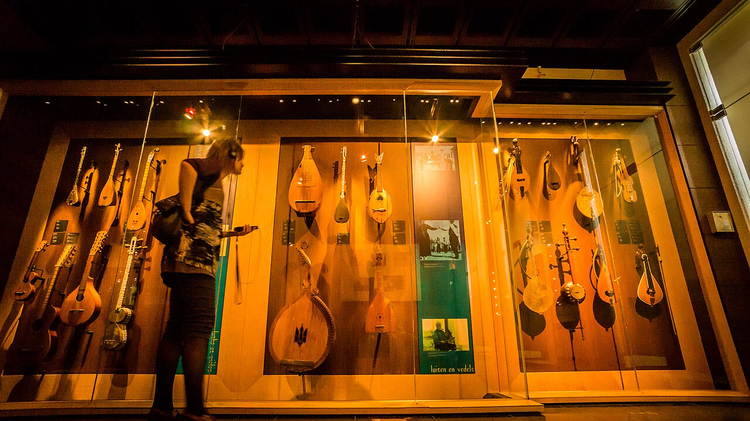
The Museum of Musical Instruments will appeal to anyone who plays music or simply loves it. The collection includes more than nine thousand instruments: keyboards, winds, percussion, electronic, and even mechanical. Both ancient specimens and modern ones are on display here.
Different types of instruments are arranged by floor, so you won't get lost among the abundance of exhibits. Many are equipped with interactive sound recordings, so you can listen to the instruments rather than just look at them. A separate part of the exhibition is dedicated to Adolphe Sax, a native of Belgium: it tells the story of his life and shows the instruments he created.
The museum goes beyond display cases. A separate building houses a concert hall where the instruments are played live. Check the concert schedule in advance if you want to combine your visit with music.
19. Church of our lady of victories at the sablon
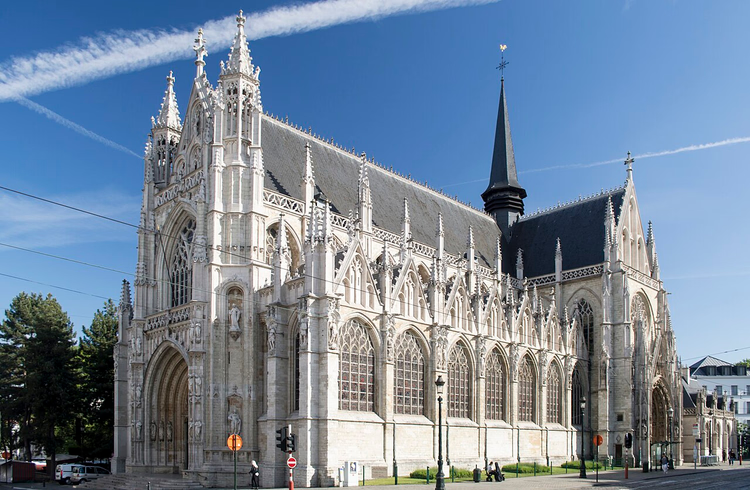
The Church of Our Lady of Victories at the Sablon was built in the fifteenth century in the Gothic style. In the French manner it is called Notre-Dame du Sablon, and it resembles Parisian churches. The rose windows and sharp tower spires speak to that.
 © Voyager747 · CC BY-SAPhoto: Voyager747, CC BY-SA (https://creativecommons.org/licenses/by-sa/4.0), Wikimedia Commons
The church is known for its parishioners from the royal family. Many Belgian nobles also come here, and the history of the monarchy is closely tied to this church. There are royal tombs here, located in the Chapel of Saint Ursula.
Architecture lovers will also find it interesting: two chapels are done in the Baroque style and decorated with rare funerary symbols carved in marble. The church houses a sculpture of the Virgin Mary that was stolen in Antwerp and brought to the capital back in the Middle Ages. In the evening the stained glass windows are lit up, and the facade is transformed.
20. Great Synagogue
 © Fred Romero from Paris, France · CC BYPhoto: Fred Romero from Paris, France, CC BY (https://creativecommons.org/licenses/by/2.0), Wikimedia Commons
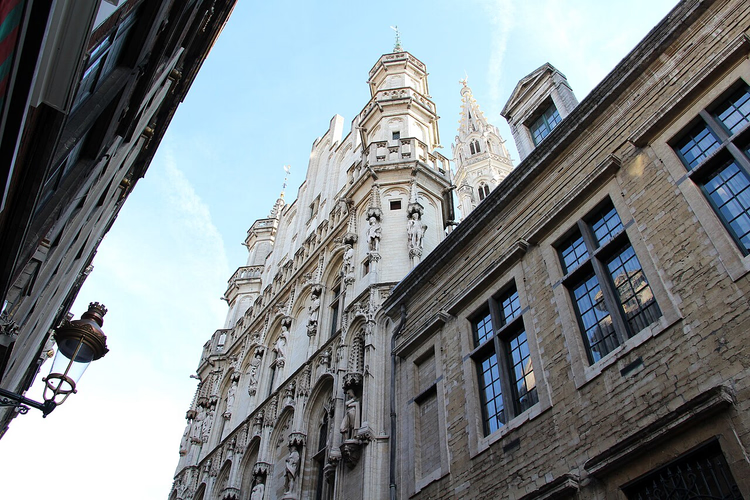
The Great Synagogue is located in the very center of the city, and it was built at the end of the nineteenth century. The project was created by architect Désiré De Keyser. The building is in the Romanesque style: the central section has three floors, while four-story towers rise at the edges.
The synagogue's history is marked by tragic events. The building survived the Holocaust, during which about twenty-five thousand Belgian Jews perished. In the early eighties an armed man attacked the synagogue and wounded four people.
Today it is the main synagogue of Belgium and an active center of the Jewish community. Inside are the headquarters of several organizations, including the capital's community and the central consistory. Take a look at the facade from outside: access to the interior is not always possible, so don't plan this visit as a main stop.
21. Palace of Justice
 © Suicasmo · CC BY-SAPhoto: Suicasmo, CC BY-SA (https://creativecommons.org/licenses/by-sa/4.0), Wikimedia Commons
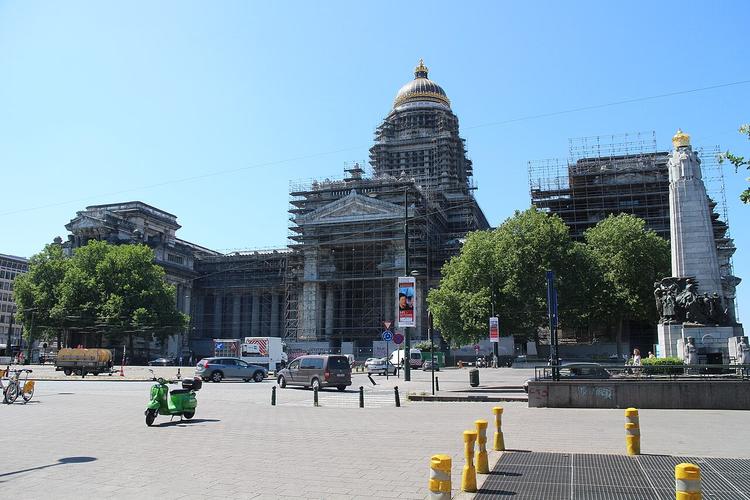
The Palace of Justice stands on a hill that was once called Gallows Hill. Justice was administered and the guilty were executed here, hence the grim name. More than three thousand residential houses were demolished to build the palace, and construction stretched over twenty years.
King Leopold II wanted to erect a unique building and spared no public money on it. When the work was finished, the citizens were unhappy and criticized the architect for a long time. Despite that, the palace became a must-see stop on any tourist's route.
The project was carried out by architect Joseph Poelaert. He combined eclecticism with the Assyro-Babylonian style, and crowned the gray building with a majestic golden dome. Today the court of cassation and twenty-seven courtrooms operate inside. The palace is three times taller than the Royal Palace, so you will spot it from afar.
22. Halle Gate
 © M0tty · CC BY-SAPhoto: M0tty, CC BY-SA (https://creativecommons.org/licenses/by-sa/3.0), Wikimedia Commons
For several centuries the capital was surrounded by a fortress wall eight kilometers long. It gradually deteriorated until Napoleon ordered it demolished completely. The wall did not disappear entirely: curious structures remained, and one of them is the Halle Gate, also known as Porte de Hal.
The city gate was built in the fourteenth century and has survived to this day. The two names are a reminder that it was used by both Belgians and the French. In the nineteenth century the Halle Gate briefly served as a military prison, but it was later decided to preserve it and turn it into a museum.
For that purpose the gate was adorned with towers and statues. Inside you will see an exhibition of medieval weapons and armor, a Gothic hall, and several displays on the history of the city. At the very top there is an observation deck with views of the surrounding area.
23. Church of our lady of the chapel
 © Trougnouf · CC BYPhoto: Trougnouf, CC BY (https://creativecommons.org/licenses/by/4.0), Wikimedia Commons
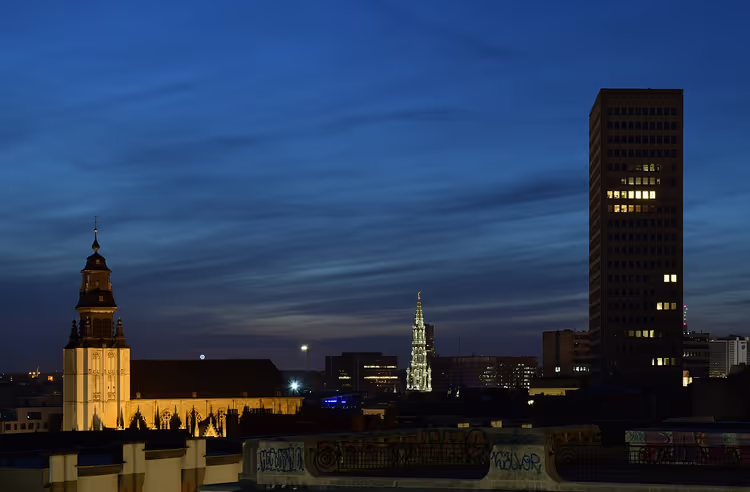
The Church of Our Lady of the Chapel, or Notre-Dame de la Chapelle, is considered the oldest in Brussels. It was built back in the twelfth century and has survived almost without major changes since then, except that the tower was demolished. Nearby is the Marolles district, where the painter Pieter Bruegel the Elder lived.
Today Bruegel's remains rest in this very church. Parishioners keep several important relics here. For example, a fragment of the Crucifixion of Christ arrived at the church back in the Middle Ages.
Take your time inside and look at the fifteenth-century baptismal font. There is also a wooden pulpit depicting Elijah the Prophet, created in the eighteenth century. The walk to the church takes just a few minutes from the Grand Place, so you can easily fit it into your route.
24. European Parliament building complex
 © own work · CC BY-SAPhoto: own work, CC BY-SA (http://creativecommons.org/licenses/by-sa/3.0/), Wikimedia Commons
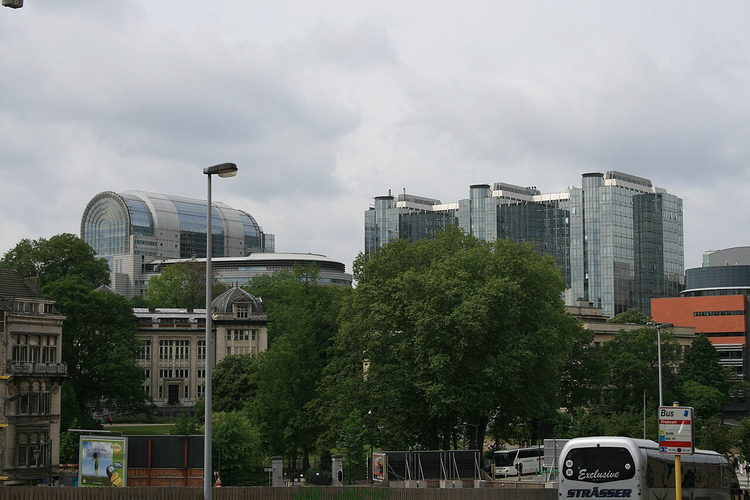
Alongside its historic side, Brussels also has a modern one, and the European Parliament buildings are exactly that. The main building is considered the largest structure in the capital and is visible from many points in the city. It was built on the site of a railway station that was demolished back in the nineteenth century.
Now a futuristic structure of glass and concrete stands here. The building is shaped like a wing.
Any tourist can sign up for a tour of the building. Those who are especially curious can also attend parliamentary sessions. Check the schedule in advance: tours are held on weekdays and by appointment.
25. Church of saint james on coudenberg hill
 © Trougnouf (Benoit Brummer) · CC BYPhoto: Trougnouf (Benoit Brummer), CC BY (https://creativecommons.org/licenses/by/4.0), Wikimedia Commons
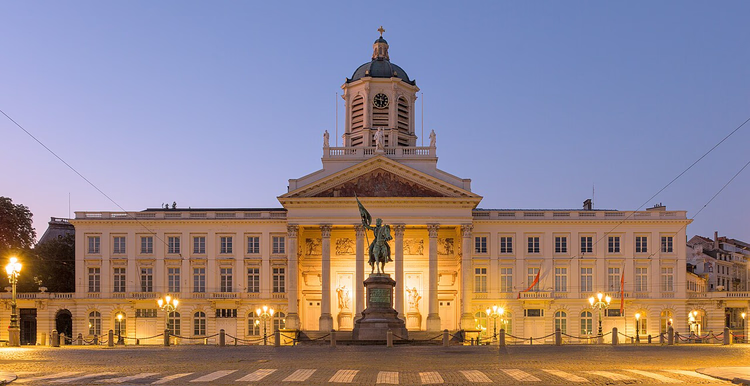
The Church of Saint James stands on one side of the Royal Square. Eight palace buildings surround it, so the church blends in with them and is not easy to spot. The first chapel here was built back in the twelfth century, and it was rebuilt many times after that. Originally it was a small chapel of the Dukes of Brabant, and it became a church after the neighboring palace was built.
At the end of the sixteenth century a severe fire and storm nearly destroyed the church. It was later restored, but noticeably altered. In front of the church stands a monument to Godfrey of Bouillon, leader of the First Crusade.
Saint James is considered the patron saint of pilgrims, and the church was named in his honor. The interior is fairly modest, but it was here that the first king of Belgium, Leopold I, took his oath. Today it is the official church of the country's armed forces.
26. Comics museum
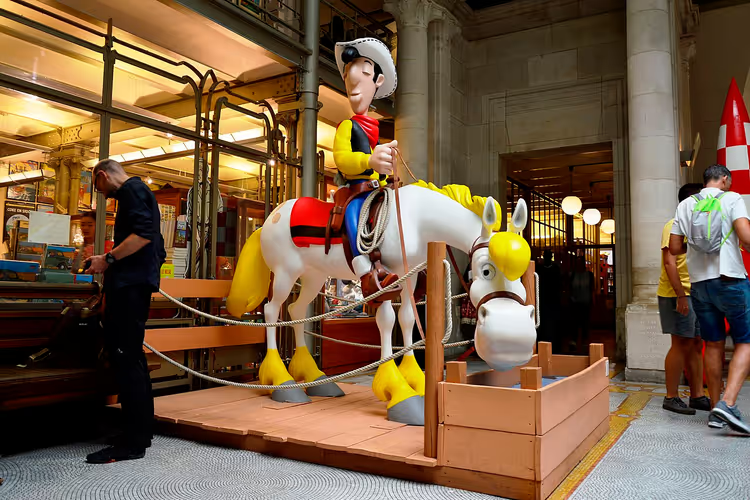
The Comics Museum is worth visiting for those who know more than just the Marvel and DC universes. The famous Smurfs were invented in Belgium, and they hold a place of honor here. The museum operates in a historic building designed by architect Victor Horta, so you can combine seeing a landmark with getting to know comic culture.
 © Spielvogel For a gallery of some more of my uploaded pictures see: here . · CC BY-SAPhoto: Spielvogel For a gallery of some more of my uploaded pictures see: here ., CC BY-SA (https://creativecommons.org/licenses/by-sa/3.0), Wikimedia Commons
Besides the Smurfs, the country is proud of Tintin, whose adventures inspired a popular animated film. At the exhibition you will see original manuscripts and sketches, more than two hundred drawings by Belgian and French artists, and reconstructions of famous scenes. Allow about two hours: the exhibition is large, and fans tend to linger for a long time.
The museum building was constructed at the beginning of the twentieth century, so the Art Nouveau interiors are also part of the exhibition. Start with the hall about the Smurfs and Tintin: these characters are the most recognizable, and they make it easier to understand the Belgian school of comics. Give yourself extra time if you want to read the captions under the drawings.
27. Museum of Natural Sciences
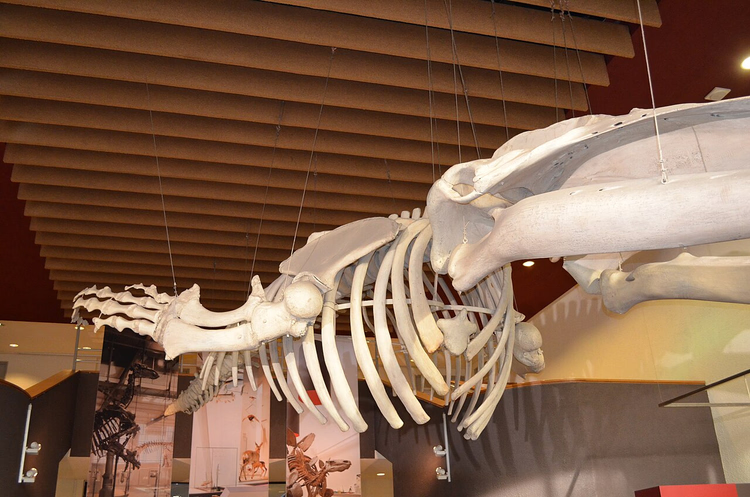
Natural science museums exist in almost every capital, but Brussels has made theirs feel modern. Feel free to come here with kids: they won't be bored. Beyond the display cases, there are plenty of interactive zones, so some exhibits can be activated and examined up close.
The most interesting section is dedicated to paleontology. It features several iguanodons up to ten meters tall, almost an entire family group. All of them were found during excavations at a coal mine in the province of Hainaut in the late 1870s.
The iguanodons are part of an interactive model: you'll see how a landslide buried the dinosaurs. Most likely, that's how they died. The museum also shows videos in different languages about the achievements of modern paleontology.
28. Parc du Cinquantenaire
 © User:Ben2 · CC BY-SAPhoto: User:Ben2, CC BY-SA (http://creativecommons.org/licenses/by-sa/3.0/), Wikimedia Commons
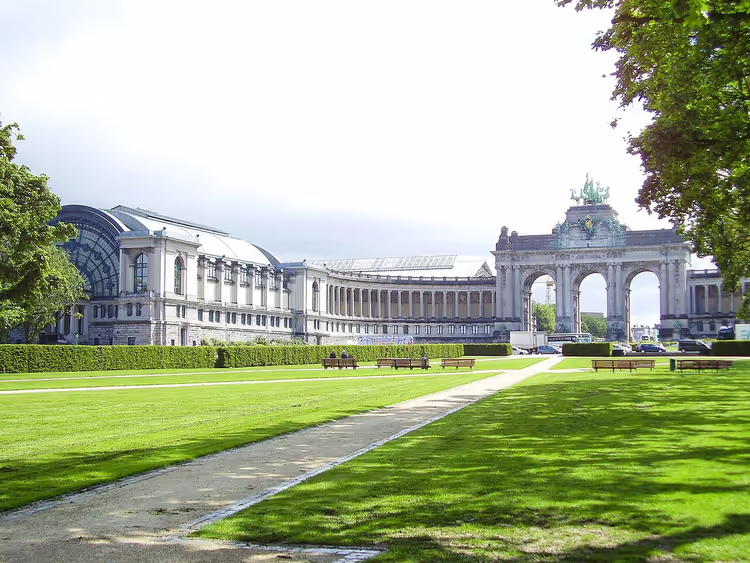
Parc du Cinquantenaire was built to mark the fiftieth anniversary of Belgium's independence. It has an unusual layout: several buildings form a horseshoe shape, with a triumphal arch at the center. The park opened for the National Exhibition, and the arch was added later.
The park has everything for different kinds of recreation, and it is one of the best green corners of the city. Across its thirty hectares there are walking paths, shady gardens, and scenic waterfalls. Several pavilions house museums dedicated to automobiles, military history, and painting.
Exhibitions and fairs used to be held here, but since the 1930s the park has been turned into a place for strolling. Bring a snack with you: there are few cafes in the park, and it is a pleasant place to walk for a long time.
29. Horta Museum
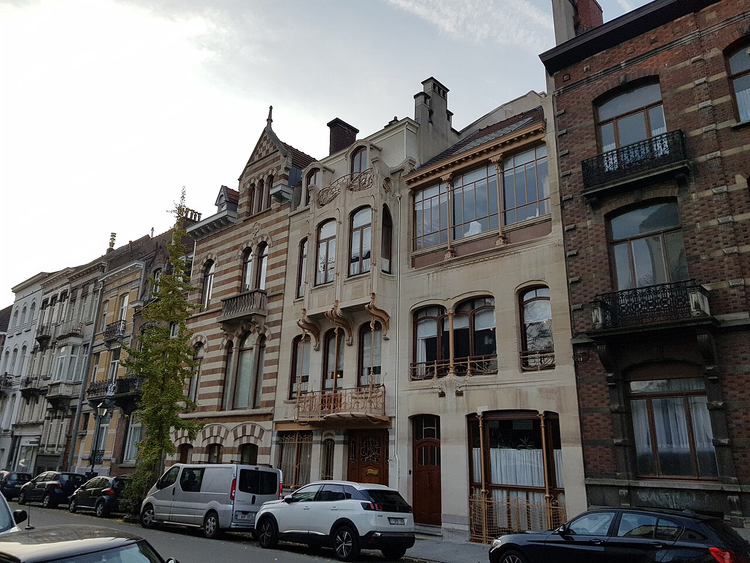
Victor Horta lived and worked in Brussels, and here he designed four unique buildings. They have been recognized as UNESCO monuments. His former home and studio now houses a museum.
Horta worked in the Art Nouveau style, and the museum itself is done in the same style. The interiors have been preserved inside, along with the architect's personal belongings. The custom furniture that Victor Horta designed himself deserves special attention.
In addition to the permanent collection, temporary exhibitions are held here. Most often they focus on different aspects of Horta's work. Check the schedule at the entrance so you can catch a new exhibition.
The museum is valuable not only for its collection but also for the building itself: it is a rare Art Nouveau residence open to the public. Pay attention to the interior details, because Horta thought through every line, from furniture to finishes. About an hour is enough for a visit if you do not linger at the exhibits.
30. Leopold Park
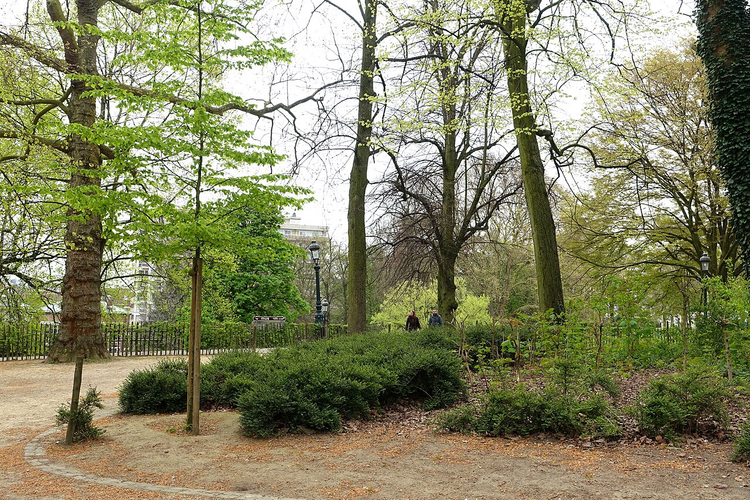
After walking along stone streets, you crave greenery, and for that there is Leopold Park next to the European Parliament. It appeared at the end of the nineteenth century on the site of the former Royal Zoological Garden. The grounds cover ten hectares.
The park is smaller than Parc du Cinquantenaire, but no less beautiful. There are many scenic clearings, shady trees, and ponds. Ducks and fish swim in the water, and on the shore you can spot swans and Egyptian geese.
Among the trees there are aviaries with parakeets that children will enjoy. Architecture lovers will find historic buildings, such as the Solvay School of Commerce and the Royal Belgian Institute of Natural Sciences. Sit by the pond in silence: after the noisy city center, this is the best way to rest.
Brussels in one and two days: itinerary
If you have only one day, stick to the center. Start at the Grand-Place: walk around the Town Hall and the King's House, then make your way to Manneken Pis and the monument to Charles Buls. Next, climb the Mont des Arts and stop by the Magritte Museum. After lunch, stroll through Place Royale and Brussels Park, and in the evening return to the Grand-Place to see the illuminated facades.
On the second day, head to the Heysel district. In the morning, see the Atomium, then Mini-Europe park, and in the afternoon catch up on what you missed: the Cathedral of St. Michael and St. Gudula, the Palace of Justice, or the Musical Instruments Museum. The metro connects the center and Heysel, so transfers will not take much time.
If you have three days, set aside a separate day for the eastern part of the city. There you will find Parc du Cinquantenaire with its triumphal arch and museums, and nearby Leopold Park and the European Parliament buildings. Spend the rest of your time between the Royal Museums of Fine Arts and walks through the Marolles district with its Church of Our Lady of the Chapel.
Explore the center on foot: the distances between the main sights are short, and the metro is useful for longer trips. Start in the morning, when there are fewer tourists, and save museums for the middle of the day. Book tickets for popular attractions in advance, especially on weekends and during the flower carpet season.
Brussels attractions on the map
All 30 points are collected on one map so you can plan your route in advance. Keep in mind that the center is easier to explore on foot, while the Atomium and the Heysel parks are easier to reach by metro. Mark the sights you want to see first, and check opening hours before heading out: some museums have a closing day.
30 sights of Brussels
Places on the map
- 1Atomium Nine spheres like an iron molecule, open 10:00-18:00
- 2Mini-Europe Models of eighty cities, ticket from 21.70 euro online
- 3Basilica of the Sacred Heart One of the tallest Art Deco buildings, viewpoint under the dome
- 4Town Hall Last medieval building on Grand Place, statue of Michael on the tower
- 5Grand Place Grand Place with guild houses, Christmas market and flower carpet
- 6Museum of Cocoa and Chocolate Two floors on the history of the treat and chocolate masterclasses
- 7Manneken Pis Fountain by Jerome Duquesnoy, the statue is dressed in costumes
- 8Monument to Charles Buls Monument to the mayor who saved Grand Place, raised by citizens
- 9Mont des Arts Mont des Arts hill with a viewpoint, Sacre-Coeur and Atomium visible
- 10Cathedral of St. Michael and St. Gudula Gothic cathedral with Bernard van Orley's stained glass, entry usually free
- 11Palace of Charles of Lorraine Neoclassical palace with a museum of 18th-century life and art
- 12Place Royale 18th-century ensemble modeled on Paris, with a monument to Godfrey
- 13Royal Palace King's residence, changing of the guard daily at half past two
- 14BELvue Museum Three floors on Belgium's history, Charles V's palace foundations in the cellars
- 15Royal Library of Belgium Albertina on Mont des Arts, about eight million items and a book museum
- 16Royal Museums of Fine Arts Over twenty thousand works, Rubens and Van Dyck, ticket 13 euro
- 17René Magritte Museum About two hundred originals, the world's largest collection of the artist
- 18Museum of Musical Instruments Over nine thousand instruments and a hall on Adolphe Sax's life
- 19Church of Our Lady of the Sablon 15th-century Gothic church with rose windows, burials in St. Ursula's chapel
- 20Great Synagogue of Europe Europe's main synagogue, Romanesque style, late 19th century
- 21Palace of Justice Grey building with a golden dome on a former gallows hill
- 22Halle Gate 14th-century city gate with a weapons exhibit and rooftop viewpoint
- 23Church of Our Lady of the Chapel City's oldest 12th-century church, resting place of Pieter Bruegel
- 24European Parliament buildings Glass wing-shaped building with an unfinished tower, tours by appointment
- 25Church of St. James on Coudenberg Temple on Coudenberg hill, where Leopold I took the oath
- 26Comic Strip Center Smurfs and Tintin in Victor Horta's building, over two hundred drawings
- 27Natural Sciences Museum Iguanodons up to ten metres tall and interactive halls
- 28Cinquantenaire Park Thirty hectares with a triumphal arch, waterfalls and museums
- 29Horta Museum Architect's house-studio in Art Nouveau style with original furniture
- 30Leopold Park Ten hectares by the European Parliament, on the former Royal Zoo site
⁉️🤔 Frequently asked questions
How many days do you need for Brussels?
You can walk around the city center in one day: the Grand-Place, Town Hall, Manneken Pis, and museums are all close together. Add another day for the Atomium, Mini-Europe park, and the royal museums. Two days are enough to see the main sights without rushing, and in three you can fit in both museums and parks.
When is the best time to visit Brussels?
Mild weather lasts from May to September, and that is when most attractions are open. In summer, the flower carpet is laid out on the Grand-Place, but on those days the square is packed with tourists. In winter, the city is decorated for the holidays and there are almost no lines, but it gets dark early.
How much do museum tickets cost in Brussels?
The Royal Museums of Fine Arts charge 13 € for the Old Masters Museum and the same for the Magritte Museum (as of 09/2026, museum price list). Many museums are free on the first Wednesday of the month after 1:00 PM. Brussels Card holders get access to permanent collections at no extra charge, while temporary exhibitions must be paid for separately.
How to get to the Atomium?
Take the metro and get off at Heizel station; the ride from the center takes about fifteen minutes (by card). The Atomium is open every day from 10:00 AM to 6:00 PM, with the last entry at 5:30 PM (as of 09/2026, Wikipedia). Mini-Europe park is right next to it, so both attractions are easy to visit in one trip.
What can you see for free?
Take a walk through the Grand-Place, Place Royale, and Leopold Park and Parc du Cinquantenaire: entry is free. You can see Manneken Pis and the monument to Charles Buls for free. On the first Wednesday of the month after 1:00 PM, some museums also open their doors, including the permanent collections of the Royal Museums of Fine Arts.
Tours and tickets in Brussels
Guided tours, skip-the-line tickets and activities — most offers can be cancelled free of charge.
See offers on GetYourGuideThe widget loads once you give your consent.
In short: what to book
If you have only one day, stick to the center: the Grand-Place, Town Hall, Manneken Pis, and the Magritte Museum are all close together. With children, add the Museum of Natural Sciences and Mini-Europe park. For a long outing, save the Atomium and the Heysel parks, and for a museum day choose the Royal Museums of Fine Arts.
Museum tickets are best bought in advance, especially on weekends and during the flower carpet season. That way you will not lose time at the ticket office and will get into the galleries without an extra line. It is convenient to plan your route around tickets and tours ahead of time: tours and tickets in Brussels on GetYourGuide.

A small editorial team writing guides for independent travel. We travel ourselves, but we haven’t been everywhere, so we check prices, opening hours and how to get there against official sources.