
















Appalachian Trail in the USA: how long it takes, permits and preparation
The Appalachian Trail crosses the eastern United States from Georgia to Maine. Its official length in 2026 is 2,197.9 miles, about 3,537 km (as of 09/2026, Appalachian Trail Conservancy).
Few people decide to hike the entire thing. A single-season thru-hike takes about six months (as of 09/2026, Appalachian Trail Conservancy).
Below you'll find the practical details: where the trail starts and ends, what permits you need in 2026, when to hit the trail, and what to pack.
Ad: this article contains affiliate links. We earn a commission if you book through them, at no extra cost to you.
What the Appalachian Trail is
💡 In short:
- The trail runs from Springer Mountain in Georgia to Mount Katahdin in Maine and crosses 14 states.
- It's a footpath only.
- There are two types of overnight stays: three-sided shelters and tents, and permits are additionally required in three locations.
- Permits, fees, and hiking season: 09/2026, verified on the official ATC website.
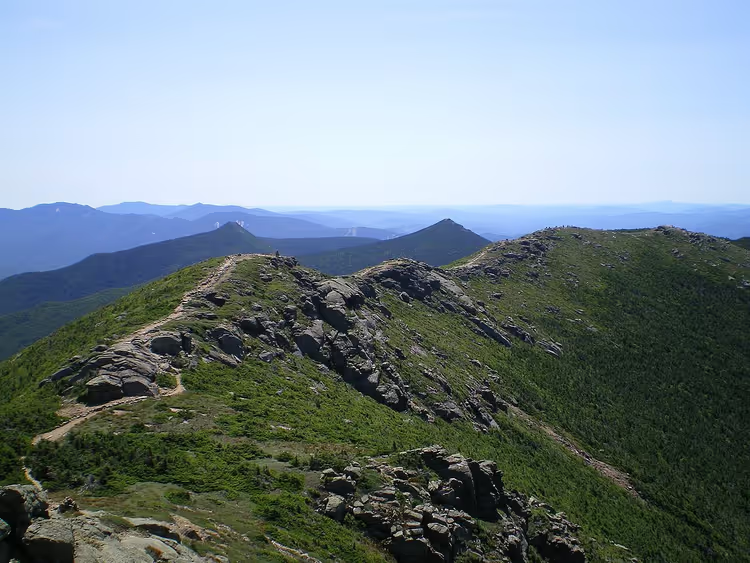
The Appalachian Trail, or A.T., is considered the longest hiking-only footpath in the world (as of 09/2026, ATC data). It passes through eight national forests, six national park units, and dozens of state forest areas.
The southern terminus is on Springer Mountain; the northern one ends at Katahdin in Baxter State Park. The route is marked with white blazes measuring two by six inches. Blue blazes indicate side trails to campsites and water sources.
 © Paulba. Original uploader was Paulbalegend at en.wikipedia · CC BY-SAPhoto: Paulba. Original uploader was Paulbalegend at en.wikipedia, CC BY-SA (https://creativecommons.org/licenses/by-sa/3.0), Wikimedia Commons
Few people hike the entire route. Those who complete the whole thing earn the title of "2,000-miler" (as of 09/2026, official ATC website). Most people go out for a day and return home the same evening.
- Length: 2,197.9 miles, about 3,537 km (as of 09/2026, Appalachian Trail Conservancy).
- Who it's for: hikers in good physical shape with multi-day backpacking experience.
- Not for: those who want a car, a highway, and a hotel right by the trail.
- The catch: in 25 federal wilderness areas, blazes are less frequent, sometimes up to a quarter mile apart (as of 09/2026, Appalachian Trail Conservancy).
History of the trail
The idea of a long-distance route through the Appalachians was proposed in 1921 by forester Benton MacKaye (as of 09/2026, U.S. National Park Service). The first sections of the future trail appeared as early as the beginning of the 1920s.
The organization that took on the construction was created in March 1925. That was how the Appalachian Trail Conference, today's Appalachian Trail Conservancy, came to be (as of 09/2026, ATC history).
The trail was built by volunteers and local clubs. It was fully completed in 1937 (as of 09/2026, official NPS timeline).
Thirty local clubs and more than 80 partner agencies are responsible for maintaining different sections (as of 09/2026, ATC rules). Over 60% of the corridor runs through lands managed not only by federal agencies but also by state authorities.
Permits and fees in 2026
There is no single permit for the entire trail. Paperwork is required in only three places (as of 09/2026, ATC permits). Paid overnight stays also exist beyond those areas.
Section | What to get | Price | Source |
|---|---|---|---|
Great Smoky Mountains National Park | Thru-hiker permit, from 04/30/2026 via Recreation.gov | $44.50 | (as of 09/2026, US National Park Service) |
Great Smoky Mountains National Park | Regular backcountry permit | $8 per night plus a $6 fee | (as of 09/2026, US National Park Service) |
Shenandoah National Park | Backcountry permit and entrance fee | $9 plus $6 reservation fee, $30 per vehicle entry | (as of 09/2026, Recreation.gov) |
Baxter State Park | Long Distance Hiker Permit | free, in person at the Katahdin Stream ranger station | (as of 09/2026, Baxter State Park) |
Baxter State Park | The Birches campsite or other campgrounds | paid, depends on campsite type and season |
In Great Smoky Mountains, permits can be booked no more than 30 days before entry. In Shenandoah the window is wider, up to 90 days ahead. Baxter permits are issued only on site and no earlier than seven days before the Katahdin climb (as of 09/2026, Appalachian Trail Conservancy).
Overnights in the White Mountains in New Hampshire are also paid: Appalachian Mountain Club campgrounds cost money. Outside these areas, camping near the trail is usually free.
 © Scott Basford · CC BY-SAPhoto: Scott Basford, CC BY-SA (http://creativecommons.org/licenses/by-sa/3.0/), Wikimedia Commons
When to go and how to get to the start
The classic hike goes south to north. A northbound start in Georgia runs from late February to early April (as of 09/2026, ATC season). By mid-October you need to reach Katahdin: Baxter State Park closes for the season.
The southern start is in northern Georgia, with the nearest major airport in Atlanta. The northern finish is in Baxter State Park in Maine, which is easiest to reach via Bangor.
You get to the starting points by car or shuttle from the nearest town. If you are handling your own logistics, booking a car on DiscoverCars ahead of time is easier.
 © Mark Larson · CC BY-SAPhoto: Mark Larson, CC BY-SA (https://creativecommons.org/licenses/by-sa/2.0), Wikimedia Commons
What to bring and what to avoid
The hike is long, so gear matters more than speed. Test your pack before you leave: repacking on the trail costs nerves and time.
- Footwear: hiking boots with good insoles to prevent blisters.
- Clothing: shorts and a t-shirt plus pants and a layer for the evening, the weather here changes fast.
- Tent: wind- and waterproof, nighttime thunderstorms in the mountains are common.
- Food: keep supplies away from black bears, hang them or store them in a sealed container.
- Sun and water: sunscreen and a filter, on exposed sections the sun burns fast.
- Navigation: a paper map and compass, because cell service drops out.
Sort out internet access in advance. Most of the route has no coverage, and in towns near the trail a backup connection is a lifesaver. Buying a US eSIM before you fly is the easiest option.
Leave your bike at home: the trail is for hikers only, and wheeled vehicles are prohibited. The same applies to ATVs and motorcycles.
Hiking today: who walks the trail
In 2025 the trail recorded 16.9 million visits, the first accurate count in its history (as of 09/2026, ATC data). Of those, 6.2 million were on land managed by the National Park Service.
Most visitors come for a day and then go home. Long hikes fall into two groups: section hikers complete the route in parts over several years, while thru-hikers finish it in a single season.
Ages on the trail vary. Younger hikers go to test themselves, older ones for quiet and a slower pace. Be prepared that after weeks of hiking, city noise fades into the background.
If you need a short mountain route, take a look at the Caminito del Rey in Spain, about 7 km long.
⁉️🤔 Frequently asked questions
How long does it take to hike the entire trail?
Many people take more than six months and finish the route in seven months. A short vacation won't work here: you'll either have to hike it in sections or pick one segment.
Do I need a permit for the entire Appalachian Trail?
There is no single permit. You only need paperwork at three points: Great Smoky Mountains, Shenandoah, and Baxter State Park (as of 09/2026, Appalachian Trail Conservancy). Paid overnight stays are also available in the White Mountains, at Appalachian Mountain Club campsites.
When is the best time to start?
Start and finish timing is covered in the "When to go and how to get to the start" section. In winter the trail is impassable in the north.
Can I bike the trail?
No, see the "What to bring and what to avoid" section for details. Some sections are rocky and narrow, so bikes wouldn't get through anyway.
How many people visit the trail each year?
2025 figures are in the "Hiking today: who walks the trail" section. Only a few thousand people complete the full route in a season.
In short: what's worth booking
If you have one free week, take a short section in Virginia or New Hampshire rather than trying to cover the whole trail. If you're going for a thru-hike, secure your Great Smoky and Shenandoah permits in advance and plan a spring start.
Logistics before the start are easiest to handle with a rental car, and you should arrange connectivity and medical insurance before you fly. Before the trip, it's worth comparing insurance options for the entire duration of the hike.

A small editorial team writing guides for independent travel. We travel ourselves, but we haven’t been everywhere, so we check prices, opening hours and how to get there against official sources.