
















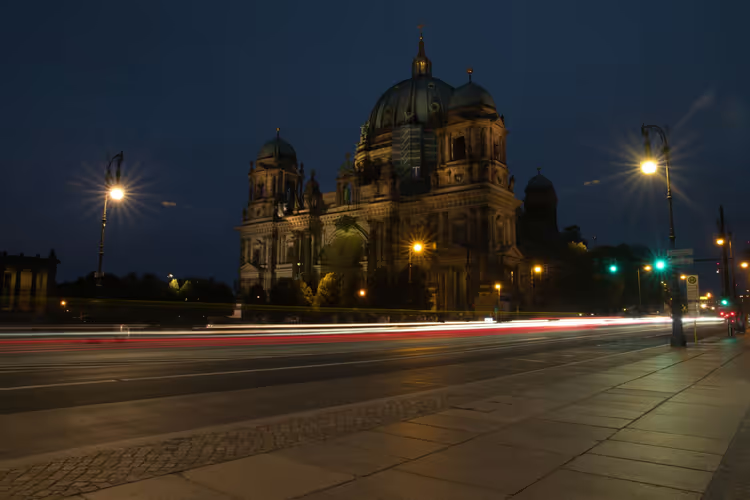
Berlin cathedral: what to see inside and how to get to the dome
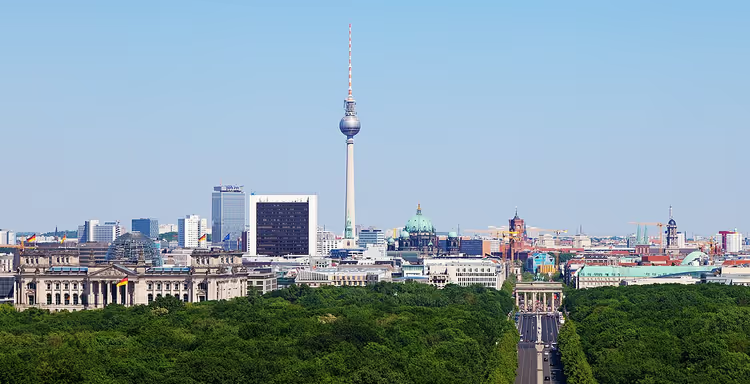
Berlin Cathedral (Berliner Dom) stands in the center of Berlin, on Museum Island. The dome is visible from Alexanderplatz, and the church itself opens the entrance to the capital’s museum quarter.
Want to climb to the dome gallery and see the city from a height of 50 m (as of 09/2026, visitor page)? Then allow two hours for the visit. A tour of the Hohenzollern crypt is included in the general ticket.
Below you will find opening hours, tickets, directions from the station, and practical tips for your visit.
Ad: this article contains affiliate links. We earn a commission if you book through them, at no extra cost to you.
History of the cathedral: from parish church to imperial church
💡 In short:
- Allow at least two hours to see the cathedral, dome, and crypt.
- Get an online ticket in advance: the ticket office at the entrance gets a line in high season.
- Prices and opening hours: 09/2026, verified on the official website.
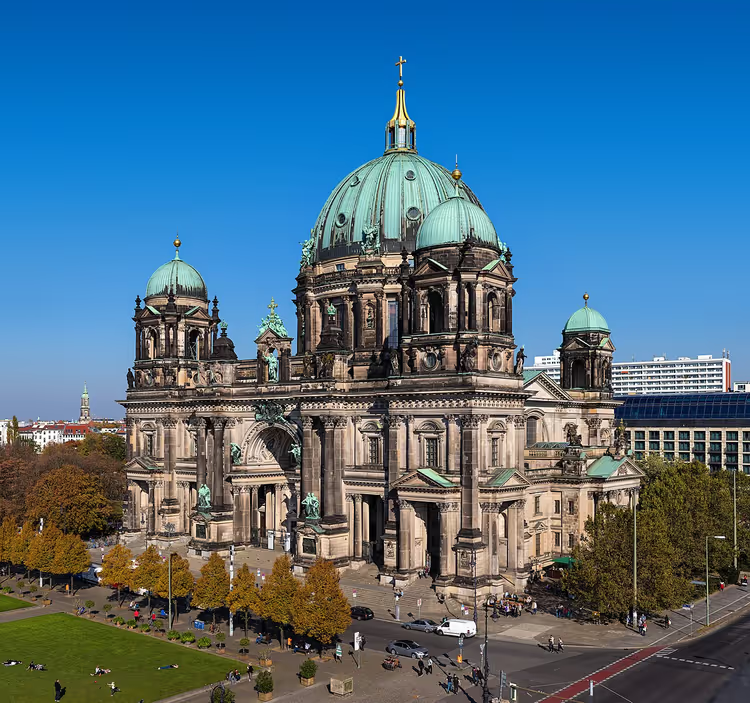 © Thomas Wolf , www.foto-tw.de · CC BY-SAPhoto: Thomas Wolf , www.foto-tw.de, CC BY-SA (https://creativecommons.org/licenses/by-sa/3.0/de/deed.en), Wikimedia Commons
The history of Berlin Cathedral begins in 1465. A parish church was founded on the banks of the Spree, and a city quarter grew up around it. In the early 19th century, Karl Friedrich Schinkel rebuilt the church in a strict neoclassical style (as of 09/2026, cathedral chronicle).
Later, the monarchy’s tastes changed. Kaiser Wilhelm II considered Schinkel’s modest building unsuitable for a court church and commissioned a new design from architect Julius Carl Raschdorff. The old building was demolished in 1893.
Construction began on June 17, 1894. The treasury allocated 11.5 million marks, and the church was consecrated only in February 1905. Before the wartime destruction, the new cathedral reached a height of 114 m (as of 09/2026, construction history).
Postwar restoration and the new dome
 © Thomas Wolf , www.foto-tw.de · CC BY-SAPhoto: Thomas Wolf , www.foto-tw.de, CC BY-SA (https://creativecommons.org/licenses/by-sa/3.0), Wikimedia Commons
World War II did not spare the building. Air raids left cracks in the corner towers, and the altar windows were blown out. On May 24, 1944, an incendiary bomb pierced the dome, and the wooden cladding instantly caught fire (as of 09/2026, data on the destruction).
Firefighters could not reach the source of the fire. The lantern on the dome collapsed inward and destroyed the floor, damaging the furnishings and most of the Hohenzollern crypt. After the division of Germany in 1949, the ruins remained in East Germany, and no one rushed to restore them.
Until 1975, the ruins with a steel frame instead of a dome were reflected in the Spree. The restoration was funded by the West German government and the community of the western Lutheran church. The first service in the restored cathedral was held in 1993, and the gilded cross was raised onto the dome on August 19, 2008. The cross cost 700 thousand euros (as of 09/2026, restoration timeline).
Architecture, dome and observation deck
 © Ajepbah · CC BY-SAPhoto: Ajepbah, CC BY-SA (https://creativecommons.org/licenses/by-sa/3.0/de/deed.en), Wikimedia Commons
Berlin Cathedral is built of Silesian granite in the neo-Renaissance and neo-Baroque styles. The building forms a square in plan, and its height after reconstruction is 98 m (as of 09/2026, building dimensions). A staircase leads to the main entrance, above which sits an arched portal with a painting of Christ appearing to his disciples.
Two small chapels with pediments and sculptures of the apostles stand on either side of the facade. A peal of three bells hangs in the northwest tower. The largest, the New Wilsnack, weighs three tons. It was cast in 1929 as a copy of the 1471 bell that cracked in 1921.
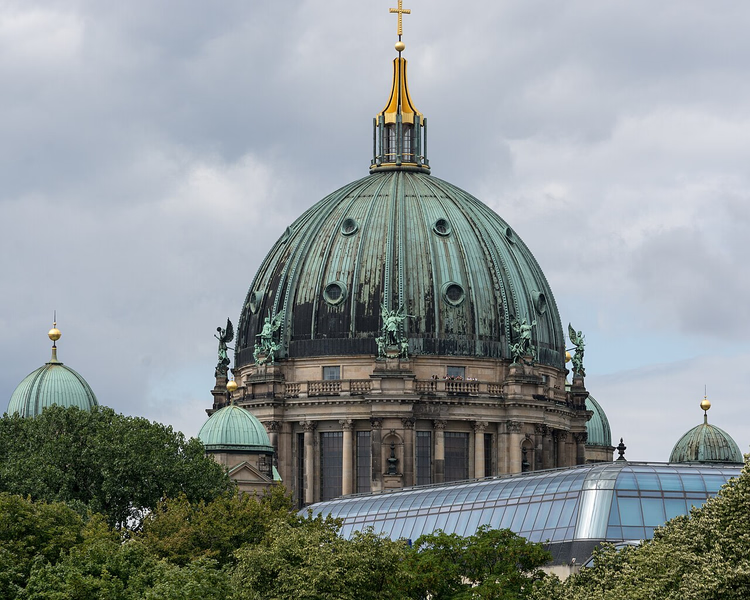
The dome, 33 m in diameter and 74.8 m high, is surrounded by copper angels installed in 1978-1981 (as of 09/2026, dome and angels). The lantern at the top is crowned with a cross, whose coating took 1.5 kg of gold. If a long climb up the stairs does not scare you, go up to the dome gallery. From there you will see Museum Island, Gendarmenmarkt, the Reichstag and the Red Town Hall.
Interiors and the great organ
 © Thomas Quine · CC BYPhoto: Thomas Quine, CC BY (https://creativecommons.org/licenses/by/2.0), Wikimedia Commons
The interiors of Berlin Cathedral are strikingly lavish. Inside, pews for 1,650 worshippers fill the space. Light passes through stained glass windows depicting New Testament scenes by Anton von Werner (as of 09/2026, cathedral interiors).
Opposite the entrance is the altar area, raised on five steps. The white marble and onyx for the altar were created in 1850 by the Prussian architect Friedrich August Stüler. The furnishings were moved from a church that was dismantled in 1893. Behind the altar you will see the gilded Apostles' Gate and a white baptismal font.
Nearby stands the wooden pulpit by Otto Raschdorff. A saying about the eternal word of the Lord is carved into the oak, and the walls are covered with bas-reliefs, mosaics and quotations from Scripture.
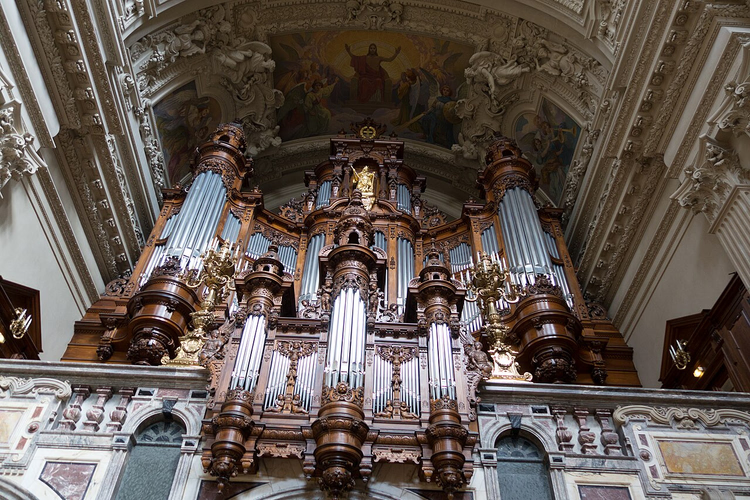
In the left part of the cathedral, the neo-baroque organ by Wilhelm Sauer draws attention with its 7,269 pipes and 113 stops. The instrument first sounded in 1905 (as of 09/2026, Sauer organ). Opposite the organ is the entrance to a small wedding chapel with an 1820 painting by Karl Begas.
Hohenzollern crypt and burial vault
 © José Luiz · CC BY-SAPhoto: José Luiz, CC BY-SA (https://creativecommons.org/licenses/by-sa/4.0), Wikimedia Commons
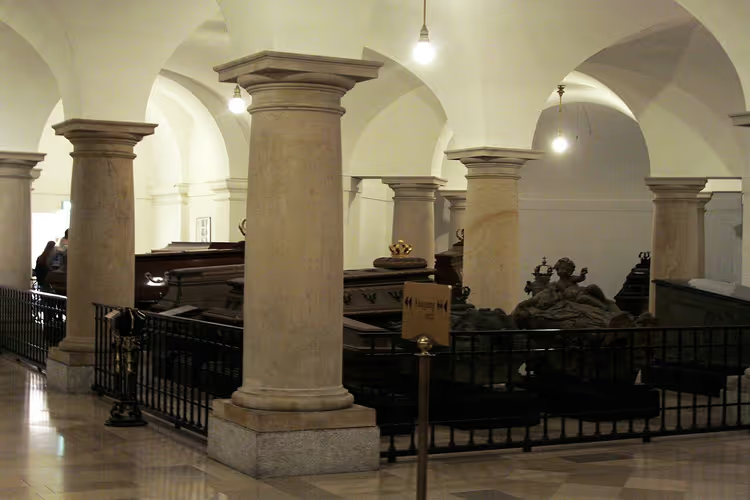
Berlin Cathedral serves as the burial place of the Hohenzollern dynasty. In the niches of the nave behind grilles stand the gilded sarcophagi of Elector of Brandenburg Frederick William and his wife Dorothea. Also here are tombs by Andreas Schlüter, where the first King of Prussia Frederick I and Sophia Charlotte are buried.
Go down to the crypt: there is subdued light and silence. 90 members of the royal family rest in the vault. The oldest burial dates back to 1499, the most recent appeared in 1915. Since March 1, 2026, the crypt has been open to visitors again after restoration (as of 09/2026, crypt reopening).
Opening hours and tickets (as of 09/2026)
 © H.Helmlechner · CC BY-SAPhoto: H.Helmlechner, CC BY-SA (https://creativecommons.org/licenses/by-sa/4.0), Wikimedia Commons
In summer the cathedral is open from 9:00 to 20:00, and in winter the opening day is one hour shorter. On Sundays and holidays visitors are admitted from 12:00 due to morning services. Last entry is always 60 minutes before closing (as of 09/2026, tickets and opening hours).
The cathedral is an active place of worship. When a service begins, it closes for tours, but you can enter as a worshipper. Do not mistake a woman in pastoral robes at the altar for an error: in Protestantism, women serve as pastors. See the cathedral website for the service schedule and current hours.
Admission is paid: the cathedral is maintained mainly through ticket sales. A ticket is valid for one year, and short scheduled tours are included in the price. An audio guide is available for a small extra fee. We verified this information in 09/2026 on the official website.
Tours and tickets in Berliner Dom
Guided tours, skip-the-line tickets and activities — most offers can be cancelled free of charge.
See offers on TiqetsThe widget loads once you give your consent.
How to get there and what to see nearby
Cathedral address: Am Lustgarten 1, 10178 Berlin (as of 09/2026, contacts and address). It stands on Museum Island, near Alexanderplatz and the Palace Bridge. The nearest U-Bahn station is U5 Museumsinsel. Buses 100 and 300 stop nearby. From the S-Bahn station Hackescher Markt you can walk to the cathedral. From Alexanderplatz you can walk along the Spree, using the cathedral dome as a landmark (route on the map).
Lustgarten stretches out in front of the cathedral. The park was laid out in the 16th century, and today it is a popular meeting spot for locals. On the lawn stands a 70-ton granite bowl carved from a single piece of stone. Locals call it the "Big Berlin Soup Plate" (as of 09/2026, visitBerlin).
Next to you are Museum Island with its museums, the Red Town Hall, and the TV tower. Plan a half-day walk: after the cathedral, it's an easy stroll to Alexanderplatz.
⁉️🤔 Frequently asked questions
How much does admission cost and what does the ticket include?
Admission is paid, and the ticket is valid for one year and includes the church, dome, crypt, and museum exhibition (as of 09/2026, cathedral ticket service). Check the exact price and discounts before your trip, as rates change. Children usually get a reduced rate when accompanied by adults.
How many steps lead to the observation deck?
There are 270 steps to the dome gallery (as of 09/2026, dome climb). The climb takes some effort, so bring water on a hot day. In the morning and closer to closing time the railings are less crowded, and you can take in the city panorama at your own pace.
Is the cathedral open on Sundays?
Yes, but later: services are held in the church in the morning (as of 09/2026, visiting page). Check the current schedule on the website before your visit.
When are there the fewest visitors?
Come on a weekday morning. In summer and on weekends a line forms at the entrance, and the dome gallery gets crowded. Toward evening there are fewer tourists, and you can take your time viewing the stained glass and interiors.
How do I get there from Alexanderplatz?
On foot it is a short walk along the water (point on the map). Address for your navigation app: Am Lustgarten 1, 10178 Berlin.
In short: what to book
- If this is your first time in Berlin: get the general ticket for the cathedral, dome, and crypt.
- If you only want the panorama: come at opening time to beat the line.
- If you are planning a full day: add the Museum Island museums and Alexanderplatz.
To avoid waiting at the ticket office, check tickets and tours on GetYourGuide in advance.

A small editorial team writing guides for independent travel. We travel ourselves, but we haven’t been everywhere, so we check prices, opening hours and how to get there against official sources.