











Thyssen-Bornemisza Museum in Madrid: ticket for 14 € and free Mondays
Van Gogh, Caravaggio, and Jackson Pollock are gathered in one Madrid museum. This is the Thyssen-Bornemisza Museum, the baron family's private collection on Paseo del Prado. A general ticket costs 14 € (as of 09/2026, official website), but on Mondays and Saturday evenings admission is free.
We broke down what to see in the permanent collection, how its four parts are organized, and how to get there from the metro. Below are prices, opening hours, and details that will save you time on site.
Ad: this text contains affiliate links, we earn a commission from them, the price for you does not change.
How three generations built this collection
💡 In short:
- The museum opened in October 1992 in the Palacio de Villahermosa, next to the Prado.
- Admission is paid, but on Monday afternoons and Saturday evenings it is free.
- Prices and opening hours: 09/2026, verified on the official website
The collection was assembled by three generations of the family. It began with August Thyssen, a German industrialist and owner of steel mills. In 1910 he commissioned several sculptures from Auguste Rodin. Four figures still greet you at the museum entrance (according to the history page, 09/2026).
His son Heinrich continued the work. He collected paintings by old European masters and bought them up in America during the Great Depression. By the time of his death in 1947, the collection held more than 500 works (according to the museum website, 09/2026). Besides paintings, Heinrich collected tapestries, antique furniture, sculptures, and jewelry.
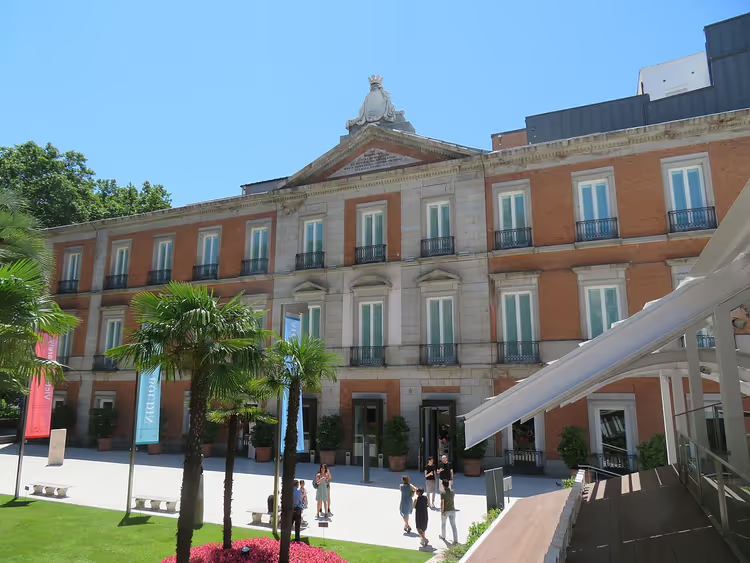 © Kyle Magnuson from Los Angeles, United States · CC BYPhoto: Kyle Magnuson from Los Angeles, United States, CC BY (https://creativecommons.org/licenses/by/2.0), Wikimedia Commons
The collection first became public in 1930 in Munich. From 1936 it was shown in a gallery built at Heinrich's villa in Lugano. After his death, the heirs divided the collection, and his youngest son Hans spent years bringing the works back together (according to the museum history, 09/2026).
Hans added modern masters to the older section: Impressionists, avant-garde artists, hyperrealists. Like his father, he believed that masterpieces should be seen by as many people as possible, and he sent exhibitions around the world.
The collection grew, and the gallery at the villa could no longer accommodate the works. The family chose the Palacio de Villahermosa, built in 1771 in central Madrid. It stands next to the Prado Museum. The government of Spain granted the future exhibition the status of a state museum and guaranteed the preservation of the entire collection. The choice was also influenced by the Spanish origin of Carmen Thyssen, Hans's wife.
The agreement was signed in 1988, and in October 1992 the museum opened to visitors. In 2004, the collection expanded with paintings from Carmen Thyssen, and the family continued to buy art. Space was still short, so a new building in a modern style was built next door. Today it hosts temporary exhibitions, seminars, and other events (as of the collection history, 09/2026).
What to see: four parts of the collection
The permanent exhibition is divided into two collections: the baron's collection and his wife's collection. The first, consisting of 775 works, was purchased by the Spanish state in 1993. The second, around 300 paintings from Carmen Thyssen, is on long-term loan and is displayed in the new building (as of the museum catalog, 09/2026).
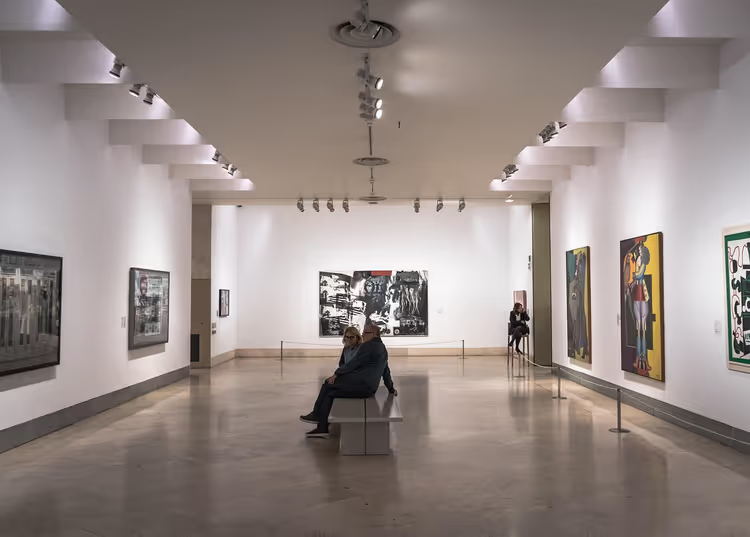
The paintings are hung by date, from old to modern. Most are oil paintings, with some watercolors, pastels, and tempera works. The collection is roughly divided into four parts.
The first part covers the 13th to 15th centuries: Italian, German, Dutch, and Flemish masters. Here you will see religious and mystical subjects, landscapes, and portraits. Among the works: "Madonna and Child" by Niccolò di Tommaso, "Saint Jerome in the Desert" by Marco Zoppo, "Saint Cecilia" by Francesco Botticini, and "The Annunciation" by Jan van Eyck.
The second part covers the Renaissance, Baroque, Rococo, and Classicism, from the 16th to 18th centuries. Here hang Tintoretto, Titian, Rubens, Veronese, Caravaggio, and El Greco. Among the paintings: "The Meeting of Tamar and Judah," "The Blinding of Samson," and "Saint Catherine of Alexandria."
The third part brings together the 19th and 20th centuries: Impressionism, avant-garde, Surrealism, Symbolism, and Cubism. These are works by Claude Monet, Paul Cézanne, Auguste Renoir, Henri de Toulouse-Lautrec, Paul Gauguin, Pablo Picasso, Wassily Kandinsky, and Marc Chagall. Particularly famous are "Les Vessenots in Auvers" by Van Gogh, "Dance in Green" by Edgar Degas, and "Dream Caused by the Flight of a Bee" by Salvador Dalí.
The fourth part is devoted to North American painting of the 19th and 20th centuries. Such works are rarely seen in Europe: the abstraction "Brown and Silver I" by Jackson Pollock and the pop art piece "Woman in the Bathroom" by Roy Lichtenstein. Several rooms are given over to American artists.
Hours and tickets
The museum operates on different schedules in winter and summer (as of 09/2026, museum schedule). In winter, from September 1 to June 30, Tuesday through Friday and Sunday the galleries are open from 10:00 to 19:00. In summer, from July 1 to August 31, Tuesday through Friday the museum closes later, at 21:00. Saturday is open year-round from 10:00 to 23:00, Monday from 12:00 to 16:00.
Day | Winter | Summer | Free |
|---|---|---|---|
Monday | 12:00-16:00 | 12:00-16:00 | 12:00-16:00 |
Tuesday-Friday | 10:00-19:00 | 10:00-21:00 | no |
Saturday | 10:00-23:00 | 10:00-23:00 | 21:00-23:00 |
Sunday | 10:00-19:00 | 10:00-19:00 | no |
General admission costs 14 €. Seniors over 65 and students pay 10 €, groups of 7 or more pay 12 €. Children under 18, unemployed visitors, and people with disabilities enter free (as of 09/2026, ticket prices page). An audio guide can be added for 5.50 €.
You can visit the museum free on Monday from 12:00 to 16:00 and on Saturday evening from 21:00 to 23:00. During these windows no ticket is needed. The fewest visitors are usually from 14:00 to 16:00, so choose that time if you want to see the galleries without crowds. A full visit takes about two and a half hours (as of 09/2026, visit tips).
The Paseo del Arte combined ticket is a good value: the Prado, the Reina Sofía Museum, and the Thyssen-Bornemisza Museum. It costs 32.80 € and is valid for one year (as of 09/2026, combined ticket).
The museum is closed on January 1, May 1, and December 25. On December 24 and 31 it is open only until 15:00, and the ticket office closes half an hour before closing time. Tickets for temporary exhibitions are sold separately.
Tours and tickets in Madrid
Guided tours, skip-the-line tickets and activities — most offers can be cancelled free of charge.
See offers on TiqetsThe widget loads once you give your consent.
How to get there and where it is
The museum's address is Paseo del Prado, 8, in the very center of Madrid. The nearest metro station is Banco de España on line 2; from there it's a couple of minutes' walk to the entrance (as of 09/2026, how to get there).
More than a dozen EMT bus routes run along the boulevard. Check the city transit operator's website for route numbers and schedules. The museum has a cafe, cloakroom, and Wi-Fi (as of 09/2026, visit page).
Museo Thyssen-Bornemisza on the map
Below is a map with the museum's location at Paseo del Prado, 8. From here you can plan your route to the entrance; taxis and buses stop nearby.
⁉️🤔 Frequently asked questions
How much does a ticket to the Museo Thyssen-Bornemisza cost?
A general admission ticket costs 14 €, with discounts available for eligible categories. All rates are listed in the hours and tickets section (as of 09/2026, museum rates).
When can I visit the museum for free?
Free admission is available on Monday afternoons and Saturday evenings. Exact hours are shown in the table above (as of 09/2026, museum website).
How much time do I need to see the museum?
The permanent collection will take about two and a half hours. A temporary exhibition on the lower floors will add another fifty minutes or so (as of 09/2026, visit plan).
How do I get to the museum by metro?
The most convenient option is to take the metro to Banco de España station. Details are in the how to get there section (as of 09/2026, directions).
Can I take photos in the galleries?
Yes, photo and video without flash are allowed. Exception: individual works are marked as off-limits. Drawing is allowed only with graphite pencil (as of 09/2026, photography rules).
In short: what is worth booking
If you want to see all three major museums during your trip, get the combined Paseo del Arte pass. Start with the Thyssen, because the lines here are shorter than at the Prado. If saving money matters more, come during the free hours on Monday or Saturday evening.
Want a fixed entry time without waiting in line? Thyssen-Bornemisza Museum tickets on Tiqets should be booked in advance, as slots sell out quickly in high season.

A small editorial team writing guides for independent travel. We travel ourselves, but we haven’t been everywhere, so we check prices, opening hours and how to get there against official sources.