








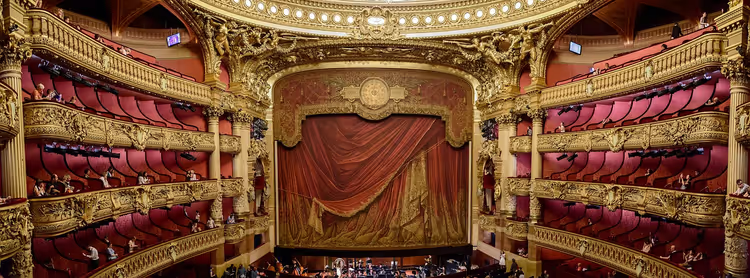
Bolshoi and Mariinsky: why we removed these materials
Here lay two texts: a guide to the Bolshoi Theatre in Moscow and a guide to the Mariinsky in Saint Petersburg. Both have been removed in all language versions, and the old addresses now permanently redirect here.
A short answer to the question readers usually came to these pages with. We no longer describe these venues as a tourist destination and no longer explain how to get tickets to a performance. It is not about the program or the quality of the productions: since January 1, 2026, a publisher based in the European Union is prohibited from providing services directly related to tourism activities in Russia, including advertising such services, and the German Foreign Office warns against travel to the country.
💡 At a glance:
- which two guides were removed and why updating them was not possible
- who has led both stages since December 2023 and what is known about this from verifiable sources
- what we deliberately do not claim and why
- which opera and ballet cities remain in our live sections
- Last updated: 09/2026
Why we deleted these guides
Both texts were structured the same way: the history of the building, the hall and tiers, famous premieres, a layout of how to get in, and a practical section about tickets. In other words, they were not essays about music but instructions for visiting. Removing the instructions from such a text means removing the text itself, so this was not a question of editing but a choice between publishing and deleting.
Russia's full-scale invasion of Ukraine began on February 24, 2022 (UN press release GA/12407, 03/02/2022), and from that date we consider it impossible for an EU-based editorial team to publish material that organizes a trip to that country, no matter how high the cultural occasion.
There is also a financial side, and it needs to be stated carefully, because the familiar version is inaccurate. The share of oil and gas revenues in Russia's federal budget fell to roughly 22 percent in 2025 and 2026, down from 42 percent in 2022 (Centre for Eastern Studies OSW, 12/09/2025). What matters is the inverse figure: the share of non-oil-and-gas revenues has grown to roughly 78 percent, and a visitor's ticket, hotel, and dinner enter the budget precisely through that share. A state theatre is also itself funded by the state, so here the chain is shorter than usual.
One name over two stages
What follows are only the facts confirmed by public sources and verifiable via the links.
Conductor Valery Gergiev was dismissed on March 1, 2022 from his position as chief conductor of the Munich Philharmonic after failing to condemn the full-scale invasion of Ukraine (Classical Music, 03/01/2022). In December 2023 he took over the Bolshoi Theatre in Moscow while retaining his post as artistic director of the Mariinsky Theatre in Saint Petersburg (Euronews, 12/02/2023). He publicly supported the 2014 annexation of Crimea (Ukraine), temporarily occupied by Russia, as reported in the same article. Let us recall the documentary framework: the UN General Assembly, in resolution 68/262 of March 27, 2014, affirmed the territorial integrity of Ukraine and declared the "referendum" of March 16, 2014 invalid (text of resolution A/RES/68/262). In July 2025 a concert by the same conductor in Italy was cancelled following international outcry (Al Jazeera, 07/21/2025).
From these four facts a simple conclusion follows. The country's two main opera stages have been under common artistic leadership since late 2023, and that leadership is publicly associated with political positions that led European institutions to end their cooperation. Recommending a ticket to these venues means recommending this entire arrangement, because in a travel guide the venue and its leadership are inseparable: the reader is not traveling to see architecture but to attend an evening that someone produces.
What we deliberately do not claim
We do not judge the individual and do not speculate about motives. Everything stated above is a dismissal, an appointment, a public position from 2014, and a cancelled concert, each item with a date and a link. Nothing beyond that is or will be in this text.
We do not discuss whether the performances have become worse or better. The subject of this material is not art but an editorial decision about the genre of a travel guide. We do not undertake to assess the quality of productions and do not consider it relevant.
We do not shift responsibility onto the orchestra musicians, the company, or the stage workers. These are hundreds of people who have neither any connection to the state's decisions nor the ability to discuss them publicly without risk, and we do not name a single person other than the one already appearing in the cited sources as a public figure.
What this means for you
Item | Status as of 09/2026 | Source |
|---|---|---|
Services related to tourism in Russia | Prohibited by Article 5n(2) of Regulation 833/2014 as amended by Regulation 2025/2033 of 23.10.2025 | |
Transition period | For contracts concluded before 24.10.2025, ended on 01.01.2026 | |
What the ban covers | Travel agency and tour operator services, guide services, and related advertising services | |
Ticket sales through platforms | Covered by the ban on the same basis as agency services | |
German Foreign Office advisory | "Vor Reisen in die Russische Föderation wird gewarnt" |
A separate note on tickets. The ban expressly covers online platforms and apps used to book and sell tickets when this is connected with tourism (Fieldfisher). That is exactly why nothing in our previous texts could be kept: the practical section on tickets was the reason people read them.
Where to go instead
The need that brought readers to these pages was for a grand opera or ballet evening in a beautiful historic hall, and for a city where such an evening fits naturally into a trip. The live sections of the site answer that need: Austria with Vienna and its opera house, Italy with Milan and Venice, Hungary with Budapest, Germany with Berlin, Dresden, and Munich. We deliberately name cities and sections rather than specific programs: comparing performances is a different genre, and one we do not cover in this section.
The overall explanation for the decision across the whole section is collected in the section hub. Related topics: our position on Moscow routes and tours and our position on museums in Saint Petersburg.
Where we stand
We believe that a travel-oriented text about a theater is a recommendation to go, not a piece about art. In our assessment, recommending an evening on a stage publicly led by a person suspended by a European orchestra for refusing to condemn the invasion means joining in the normalization of what is happening, even if the text contains not a single word of judgment. That is why we decided to remove both pieces entirely and explain the reason at the same address, rather than leaving them up with a fine-print note.
We also believe that a cultural boycott and a publisher's refusal to guide readers to a specific hall are different things. Nobody is stopping anyone from listening to recordings, reading about productions, or studying the history of these theaters. We are not calling on anyone to give up recordings or books. We have given up only one function: inviting people and explaining how to buy a ticket.
We write about the state and its policies, not about people based on their passport. In Russia, there are those who spoke out against the war and received prison sentences for it. Our decision not to publish guides to Russia is about money, sanctions, and reader safety, not nationality.
Publication date: September 3, 2026. Last updated: September 3, 2026.
⁉️🤔 Frequently asked questions
Are you against Russian music?
No. We removed two travel guides, meaning materials that suggest coming and spending money. The EU ban in question covers services related to tourism activities and their advertising, not music, scores, or recordings.
Why do you name the director if you are writing about the state?
Because the appointment of a state theater director is a public fact, confirmed by international publications, not private information. We cite only four verifiable circumstances with dates and links and give no assessment of the person.
Are artists to blame for politics?
We do not claim that, and we explicitly state the opposite in a separate section. Our decision concerns the genre of our own texts, not the people who take the stage.
Can you at least say whether performances are running now?
We do not provide information about the current operations of institutions in Russia and do not publish schedules. That kind of information is precisely the practical detail we deliberately stopped providing, and we cannot verify it from the EU to the standard of reliability we consider acceptable.
Will you bring these texts back?
We make no promises with dates. The decision will be revisited when its basis changes: the EU legal framework and the official travel warnings listed in the sources section.
In short
Two guides, about the Bolshoi and the Mariinsky, have been removed in full, and the old addresses redirect here. Since December 2023, both stages have been under shared artistic direction. The legal framework is separate and does not depend on the repertoire. The opera and ballet cities we continue to write about are listed above.
How you can help
We do not collect money and receive nothing from the links below. These are the official websites of organizations working with the consequences of the war:
- UNHCR, the UN Refugee Agency, unhcr.org
- UNICEF, unicef.org
- Ukrainian Red Cross, redcross.org.ua
Sources
- UN General Assembly, resolution ES-11/1 "Aggression against Ukraine", 03/02/2022. https://press.un.org/en/2022/ga12407.doc.htm
- UN General Assembly, resolution 68/262 "Territorial integrity of Ukraine", 03/27/2014, text A/RES/68/262. https://digitallibrary.un.org/record/767883/files/A_RES_68_262-EN.pdf?ln=en
- Classical Music, on his dismissal as chief conductor of the Munich Philharmonic, 03/01/2022. https://www.classical-music.com/news/valery-gergiev-dismissed-as-chief-conductor-of-the-munich-philharmonic
- Euronews, on his appointment as head of the Bolshoi Theatre, 12/02/2023. https://www.euronews.com/2023/12/02/pro-kremlin-maestro-valery-gergiev-director-of-mariinsky-theatre-put-in-charge-of-bolshoi
- Al Jazeera, on the cancellation of a concert in Italy, 07/21/2025. https://www.aljazeera.com/news/2025/7/21/italy-cancels-concert-by-putin-ally-gergiev
- Council Regulation (EU) 2025/2033 of 10/23/2025 amending Regulation 833/2014, EUR-Lex. https://eur-lex.europa.eu/legal-content/EN/TXT/?uri=OJ:L_202502033
- Skadden, analysis of the EU's 19th sanctions package, 11/2025. https://www.skadden.com/insights/publications/2025/11/eu-adopts-19th-sanctions-package
- Fieldfisher, analysis of the EU's 19th sanctions package, 2025. https://www.fieldfisher.com/en/insights/the-eu-s-19th-sanctions-package-against-russia
- Auswärtiges Amt, Russische Föderation: Reise- und Sicherheitshinweise, as of 09/02/2026. https://www.auswaertiges-amt.de/de/service/laender/russischefoederation-node/russischefoederationsicherheit-201536?isLocal=false&isPreview=false
- Centre for Eastern Studies OSW, Russia's 2026 budget, 12/09/2025. https://www.osw.waw.pl/en/publikacje/osw-commentary/2025-12-09/russias-2026-budget-mounting-financial-challenges-and-economic
Link check date: 09/03/2026.

A small editorial team writing guides for independent travel. We travel ourselves, but we haven’t been everywhere, so we check prices, opening hours and how to get there against official sources.