




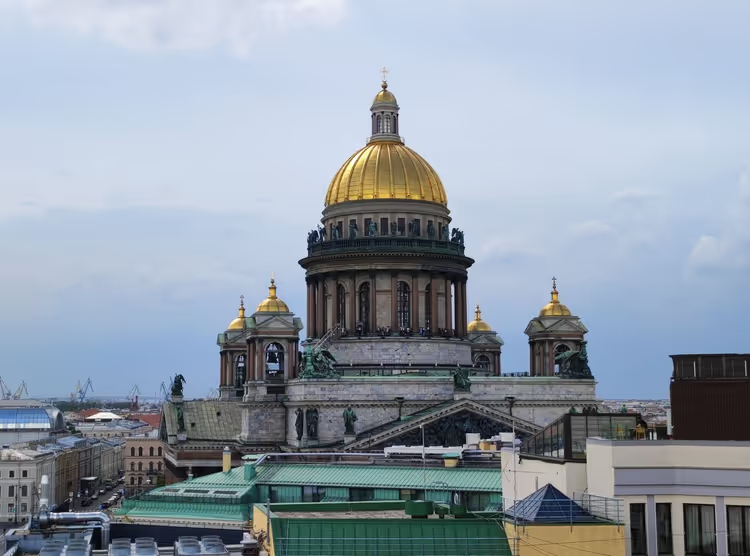
Cathedrals of Saint Petersburg: why these guides are no longer available
Here there used to be four guides: Saint Isaac's Cathedral, the Church of the Resurrection of Christ, Kazan Cathedral, and the Alexander Nevsky Lavra. All four have been removed in every language version, and the old addresses now redirect here permanently.
We'll answer right away the question that brought readers to these pages. We do not describe these buildings as places to visit, and we do not publish anything about how to get there. The architectural value of the cathedrals has not gone anywhere, but it does not cancel out the EU's direct ban on services related to tourism in Russia, the official warning from the German Federal Foreign Office, or the fact that there is almost no way to protect a visitor in that country today.
💡 At a glance:
- which four pieces were removed and why we took them down
- why we do not accept the "it's just architecture" argument
- what has changed in the legal protection of a person who travels to Russia
- which European cathedral cities remain in our active sections
- Last updated: 09/2026
Why we deleted these guides
All four texts were built on the same template: construction dates, architect, interior, what to see inside, service schedule, how to get there. The final third of each piece was a pure visiting instruction, and that was exactly what kept these pages ranking in search.
Russia's full-scale invasion of Ukraine began on February 24, 2022 (UN press release GA/12407, 03.02.2022). After that date, an editorial team based in the European Union that keeps publishing instructions for visiting landmarks in Russia is not describing the country, it is inviting people into it. We believed then, and still believe, that these are different actions.
The financial part of the argument can be stated precisely and without exaggeration. The share of oil and gas revenues in Russia's federal budget fell to roughly 22 percent in 2025 and 2026, while the share of non-oil-and-gas revenues rose to roughly 78 percent (OSW Centre for Eastern Studies, 09.12.2025). This means that a visitor's spending on transport, lodging, food, and entry tickets goes into the part of the budget that has become relatively more significant for the state than before the war.
Why "it's just architecture" doesn't work
The objection sounds convincing: the colonnade of Saint Isaac's has stood since the 19th century and has nothing to do with decisions made in 2022. We agree with the first half of that sentence and disagree with the second, and here is why.
A guide does not describe a building, it organizes a visit. It answers the question "is it worth going" affirmatively before the reader has even finished the first paragraph, because the very existence of such a text in the travel section is itself the answer. The building is indeed not at fault: it is the genre that does the work, not the object.
That is why we did not do what part of the industry does: keep the old guide and slap a two-sentence warning on top. Such a page keeps answering the same search query and keeps performing the same function, just with a caveat. We chose to remove the piece and explain the reason at the same address.
What has changed in a person's legal protection
This is the part that was entirely absent from our previous texts, and it matters more to the reader than the height of the dome.
On March 16, 2022, the Committee of Ministers, by resolution CM/Res(2022)2, expelled the Russian Federation from the Council of Europe, the first time in the organization's history (Council of Europe, 16.03.2022). On September 16, 2022, Russia ceased to be a party to the European Convention on Human Rights (Council of Europe). The practical meaning of these two dates is simple: a complaint to the European Court of Human Rights about what is happening in Russia today is impossible.
In parallel, the German Federal Foreign Office warns that German citizens and dual nationals face the risk of arbitrary detention (Auswärtiges Amt). For readers from the US, the State Department maintains a Level 4 "Do Not Travel" advisory, reissued on December 29, 2025, and separately notes that the US government's ability to help its citizens in Russia is limited: the embassy in Moscow has reduced staff, and all consulates in the country have suspended operations, including consular services (U.S. Department of State).
Let us put this into a single sentence. Domestic judicial protection by European standards no longer exists, there is no supranational instance, and consular assistance is limited or unavailable. A cathedral guide by default assumes that if something goes wrong, there is somewhere to turn. That assumption cannot be made here, and staying silent about it would be dishonest.
What this means for you if you are in the EU or the US
Item | Status as of 09/2026 | Source |
|---|---|---|
Services related to tourism in Russia | Prohibited by Article 5n(2) of Regulation 833/2014 as amended by Regulation 2025/2033 of 23.10.2025 | |
Transition period | Ended on 01.01.2026, no exceptions remain | |
Complaint to the European Court of Human Rights | Not possible: Russia has not been a party to the Convention since 16.09.2022 | |
German Foreign Office advisory | "Vor Reisen in die Russische Föderation wird gewarnt" | |
Risk of arbitrary detention | The German Foreign Office warns about it directly | |
US State Department advisory | Level 4: Do Not Travel, reissued 29.12.2025; consulates have suspended operations |
Where to go instead
The need readers brought to these four texts was for a large city cathedral you can enter without preparation, and for an interior worth making a separate trip for. The live sections of the site answer that: the Vatican and Rome, Italy with Florence, Milan, and Venice, Spain with Seville, Toledo, and Barcelona, Greece with Athens and Thessaloniki. We name countries and cities, not individual sites with opening hours: schedules and prices are exactly the practical part we have deliberately left out of this section.
The general explanation for the entire section is collected in the section hub. Related topics: our position on the Winter Palace and the Peter and Paul Fortress and our position on the city's museums.
Where we stand
We believe a publisher is responsible not only for the facts in a text, but also for the action that text encourages. In our assessment, a guide to the cathedral encourages a trip, and a trip to Russia today is a situation in which the reader has neither European legal protection nor normal consular support, and in which their spending goes to the budget of a state waging war against a neighboring country. We decided to remove all four pieces and not publish updated versions.
We also do not think it is right to substitute a religious explanation for this. We make no claims about the position of church structures: we have no verified primary sources on this question, and we prefer to say so directly rather than speculate.
We write about the state and its policies, not about people based on their passport. There are people in Russia who came out against the war and received prison sentences for it. Our decision not to publish guides to Russia concerns money, sanctions, and reader safety, not nationality.
⁉️🤔 Frequently asked questions
The cathedral is a monument, not politics. Why are you deleting it?
We did not delete the cathedral; we deleted our own guide to it. The difference is in the function of the text: describing the history of the building is possible, but instructions for visiting encourage a trip. Tourism services in Russia themselves are prohibited by Article 5n(2) of Regulation 833/2014. The transition period ended on January 1, 2026.
Are you making any claims about the Russian Orthodox Church?
No. We have no verified primary sources on this topic, and therefore the text contains no claims about it. Everything we cite consists of decisions by states and international organizations, with dates and numbers.
So you no longer write about Saint Petersburg at all?
We do not write about it as a tourist destination. The city's history, its architecture, and its place in European culture remain possible topics, and we do not pretend the city does not exist.
In short
Four guides to the cathedrals and the lavra of Saint Petersburg have been removed in full. The reason is the EU ban on tourism services in Russia and the lack of European legal protection there. The cathedral cities of Europe that we continue to cover are listed above.
How you can help
We do not collect money and receive nothing from the links below. These are the official websites of organizations working with the consequences of the war:
- UNHCR, the UN Refugee Agency, unhcr.org
- UNICEF, unicef.org
- Ukrainian Red Cross, redcross.org.ua
Sources
- UN General Assembly, Resolution ES-11/1 "Aggression against Ukraine", 03/02/2022. https://press.un.org/en/2022/ga12407.doc.htm
- Council Regulation (EU) 2025/2033 of 10/23/2025 amending Regulation 833/2014, EUR-Lex. https://eur-lex.europa.eu/legal-content/EN/TXT/?uri=OJ:L_202502033
- Skadden, analysis of the EU's 19th sanctions package, 11/2025. https://www.skadden.com/insights/publications/2025/11/eu-adopts-19th-sanctions-package
- Council of Europe, exclusion of the Russian Federation, Resolution CM/Res(2022)2, 03/16/2022. https://www.coe.int/en/web/portal/-/the-russian-federation-is-excluded-from-the-council-of-europe
- Council of Europe, Russia ceases to be a party to the European Convention on Human Rights, 09/16/2022. https://www.coe.int/en/web/portal/-/russia-ceases-to-be-a-party-to-the-european-convention-of-human-rights-on-16-september-2022
- Auswärtiges Amt, Russische Föderation: Reise- und Sicherheitshinweise, as of 09/02/2026. https://www.auswaertiges-amt.de/de/service/laender/russischefoederation-node/russischefoederationsicherheit-201536?isLocal=false&isPreview=false
- U.S. Department of State, Russia Travel Advisory, Level 4, reissued 12/29/2025. https://travel.state.gov/en/international-travel/travel-advisories/russia.html
- Centre for Eastern Studies OSW, Russia's 2026 budget, 12/09/2025. https://www.osw.waw.pl/en/publikacje/osw-commentary/2025-12-09/russias-2026-budget-mounting-financial-challenges-and-economic
Link check date: 09/03/2026.
Publication date: September 3, 2026. Last updated: September 3, 2026.

A small editorial team writing guides for independent travel. We travel ourselves, but we haven’t been everywhere, so we check prices, opening hours and how to get there against official sources.