





Business meeting of Germany and Uzbekistan in Berlin: how it went and what was discussed
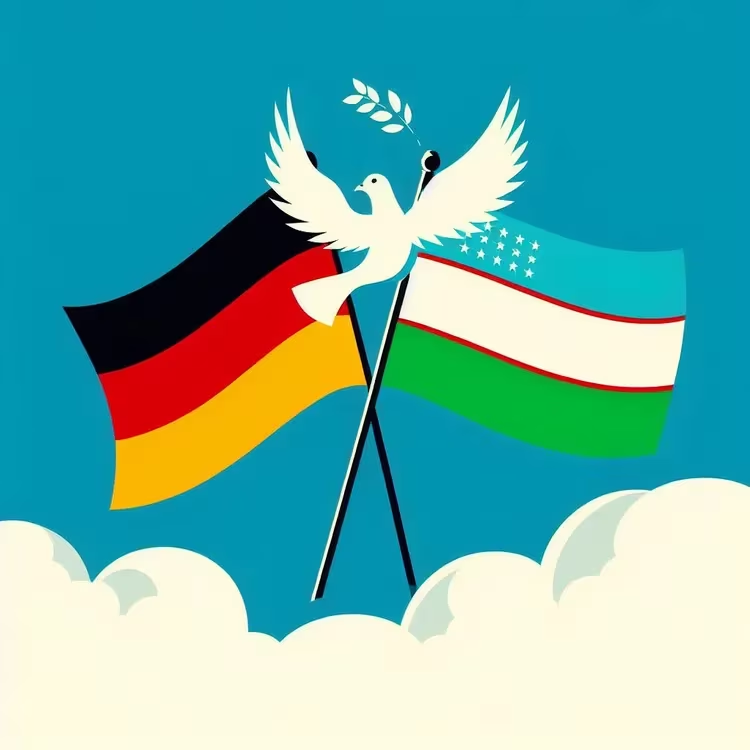
On May 2, 2023, a German-Uzbek business meeting took place in Berlin. Formally, it was a joint event with a signing ceremony, but in essence it opened the state visit of the President of Uzbekistan. The significance of the event goes beyond a single day.
Such meetings easily get lost in the flow of press releases. What matters more here is that the parties locked in specific areas of work, from the economy to ecology and technology. Below you will find the meeting program, participants, key dates, and how the cooperation developed further.
What was discussed at the meeting
💡 In short:
- Venue and time: Embassy of the Republic of Uzbekistan in Berlin, May 2, 2023, from 10:00 to 12:00.
- Format: business meeting with a document signing ceremony.
- Key participant from Uzbekistan: Laziz Kudratov, Minister of Investment, Industry and Trade.
- Date, venue and format of the meeting: 10/2026, according to the announcement by the Ost-Ausschuss der Deutschen Wirtschaft.
The meeting was included in the program of the visit of President of Uzbekistan Shavkat Mirziyoyev to Germany. The Uzbek side organized it, and the venue was the embassy on Perleberger Strasse. The order was standard for business practice: first negotiations, then the official protocol.
The announcement placed particular emphasis on reforms. The country continues its economic and social transformation into the president's second term. According to the organizers, this is precisely what creates demand for German technology, equipment and investment.
How the meeting in Berlin went
The event was scheduled for May 2, 2023, from 10:00 to 12:00, at the Embassy of the Republic of Uzbekistan at Perleberger Str. 62, 10559 Berlin. The announcement was published by the Ost-Ausschuss der Deutschen Wirtschaft, the Eastern Committee of the German Economy, and called the meeting a joint event with a signing ceremony. Participants were asked to confirm attendance in advance, by April 25, using the code UZBMai23, and on May 3 the state visit began, bringing President of Uzbekistan Shavkat Mirziyoyev to Germany.
The signing ceremony took center stage in the program. Usually, such meetings involve framework documents and memorandums, while specific contracts are signed later, at the company level. For a participant, this is a clear signal: deals are not closed in a single day, but it becomes clear who will work with whom going forward.
The closed registration approach serves a practical purpose. Organizers know the composition of delegations in advance and prepare seating arrangements for specific negotiations.
Who participated from Uzbekistan
Laziz Kudratov, Minister of Investment, Industry and Trade of the Republic of Uzbekistan, was the main interlocutor for German companies. According to the announcement, he personally answered participants' questions. If you are negotiating supplies or production, the level of such an interlocutor matters: the minister oversees investment projects specifically.
Kudratov was part of the Uzbek delegation during the visit as well. Deputy Prime Minister Jamshid Khodjaev participated in the negotiations alongside him (according to BVMW, the German association of small and medium-sized businesses). The government's economic block oversees attracting foreign investment and supporting joint projects.
Areas of cooperation
Area | What was discussed | Who it matters to |
|---|---|---|
Economy | joint investment and expanding trade | manufacturing companies |
Education | student exchange and research projects between universities | universities and laboratories |
Culture | joint events and festivals | cultural organizations |
The economic block became the core of the agenda. The discussion focused on new investment and joint ventures, where the German side provides technology and the Uzbek side provides the platform and the market. If you work in industry, these are exactly the formats that matter to you: they reduce the risks of entering an unfamiliar market.
Education and culture look softer, but they work over the long term. Student exchange and joint research create connections between people, not just between companies. Cultural events add a human context to business contacts, and you find common ground with a partner faster.
Ecology and technology
Ecology became one of the main topics of the meeting. The parties discussed green technologies, energy-efficient buildings and water treatment projects. The topic of water was addressed separately: for the region this is a sensitive issue, and approaches to protecting water resources were discussed as a standalone area.
The technology block covered digitalization, artificial intelligence and software development. German companies are interested in supplying equipment and engineering solutions, while Uzbek companies are interested in localizing production and training personnel. You will see the same logic in most similar agreements: exchanging technology for market access and labor.
If your project is related to energy or water supply, the ecology block is worth studying first. This is where the list of priority areas was formed, the areas where the parties are ready to move fastest.
What happened next
Contacts did not stop after 2023. A separate German-Uzbek business forum took place in Berlin, organized by the Association of German Chambers of Industry and Commerce (DIHK), the Ost-Ausschuss and the Delegation of German Economy for Central Asia (AHK) (according to countrydesk.de). The format of business forums between the two countries became regular.
The dialogue was not limited to Berlin. Working meetings and delegation trips between the two countries became part of the ongoing agenda, and the topics remained the same: investment, technology and ecology. If you follow the Central Asian market, such events are worth keeping on your calendar. They show which areas the state considers priorities and where you should look for partners in advance.
⁉️🤔 Frequently asked questions
When and where did the German-Uzbek business meeting take place?
In early May 2023, in the first half of the day, at the Embassy of the Republic of Uzbekistan in Berlin. The event took place on the eve of the state visit of President Shavkat Mirziyoyev to Germany. The Uzbek side organized it, and the announcement was published by the Ost-Ausschuss der Deutschen Wirtschaft.
Who represented Uzbekistan at the meeting?
Minister of Investment, Industry and Trade Laziz Kudratov. According to BVMW, he was part of the Uzbek delegation during the visit, with Deputy Prime Minister Jamshid Khodjaev working alongside him. Kudratov oversees investment projects and support for foreign capital.
What topics were discussed at the meeting?
Economy and investment, education, culture, ecology and technology. The discussion covered joint projects, student exchange, green technologies, digitalization and software development. The parties also spoke separately about expanding trade and creating joint ventures.
Was advance registration required?
Yes. Participants were asked to confirm attendance using the code UZBMai23, about a week before the meeting. Closed registration helped the organizers compile an accurate list of delegations and prepare seating arrangements. A similar procedure is used at modern business forums, where you submit an application in advance.
What happened after the meeting?
Business contacts continued. A separate German-Uzbek business forum took place in Berlin, organized by DIHK, the Ost-Ausschuss and AHK. The format of business forums between the two countries became regular, and the cooperation topics remained the same: investment, technology and ecology.
In short: what the meeting achieved
The meeting on May 2, 2023 set the framework for the German-Uzbek business dialogue: investment, education, ecology and technology. The parties did not limit themselves to protocol and moved on to regular forums. If you are interested in the Uzbek market, track announcements of business events and study participation requirements in advance. That way you will arrive at a meeting prepared, not guessing.

A small editorial team writing guides for independent travel. We travel ourselves, but we haven’t been everywhere, so we check prices, opening hours and how to get there against official sources.